
- Intuitive Surgical (NASDAQ: ISRG) grew third-quarter revenue +21.7% to $3.05 billion and non-GAAP diluted EPS 25% to $3.00, and the shares rose +6.0% in the week of the results. On the same day the company said pricing actions starting in 2027 will lower instrument revenue per da Vinci procedure by roughly 3% to 5% at constant mix, and the third-quarter 10-Q shows a $450 million charge to settle a class action over the service and repair of its instruments. The question is how much procedure growth it takes to keep instrument revenue growing once the company cuts what it collects per surgery.
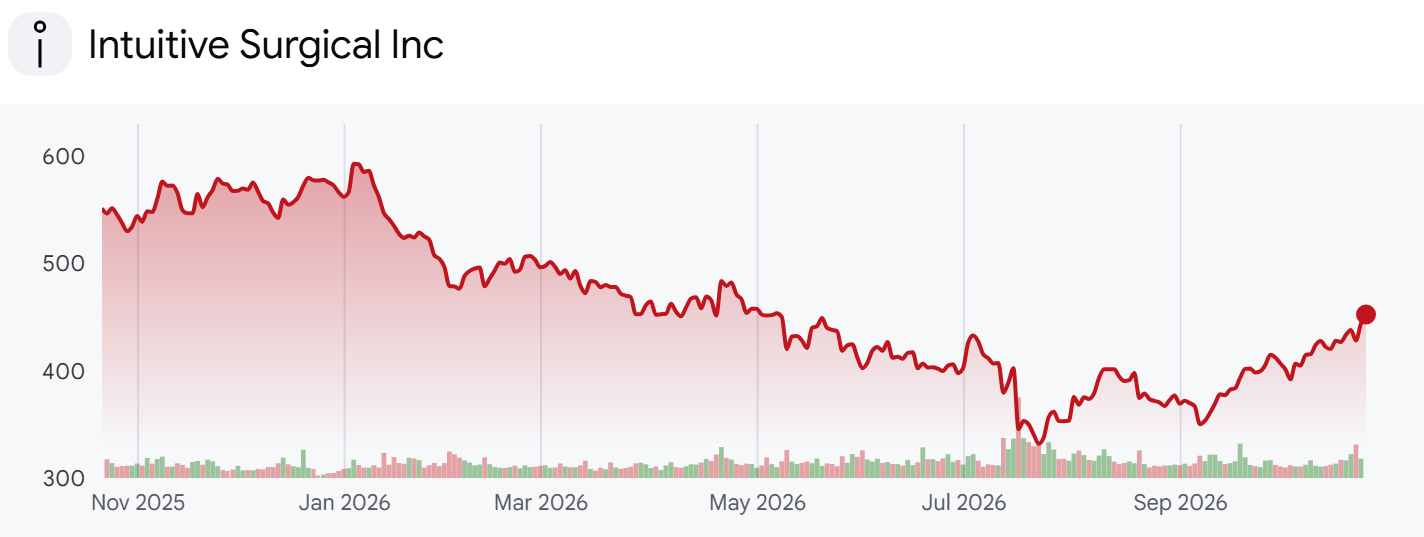
- Intuitive sells or leases da Vinci surgical robots and Ion lung-biopsy robots to hospitals, then earns on the instruments and accessories used in every procedure and on service contracts. At $452.29 a share and 346.64 million shares on the 10-Q cover, the company is worth $156.78 billion, -24.1% below the weekly high of $595.55 set in the week of February 14, 2025. The 3% to 5% figure is a company estimate that holds procedure, product, and regional mix constant and applies to da Vinci instruments only; Intuitive reports quarterly procedure growth rates rather than counts, and its instrument revenue also includes Ion. Non-GAAP figures exclude share-based compensation, litigation charges, and other items, and third-quarter GAAP diluted EPS was $1.49. P/E uses trailing twelve-month (TTM) EPS.
Recurring Revenue and Unit Prices in the Q3 Deck
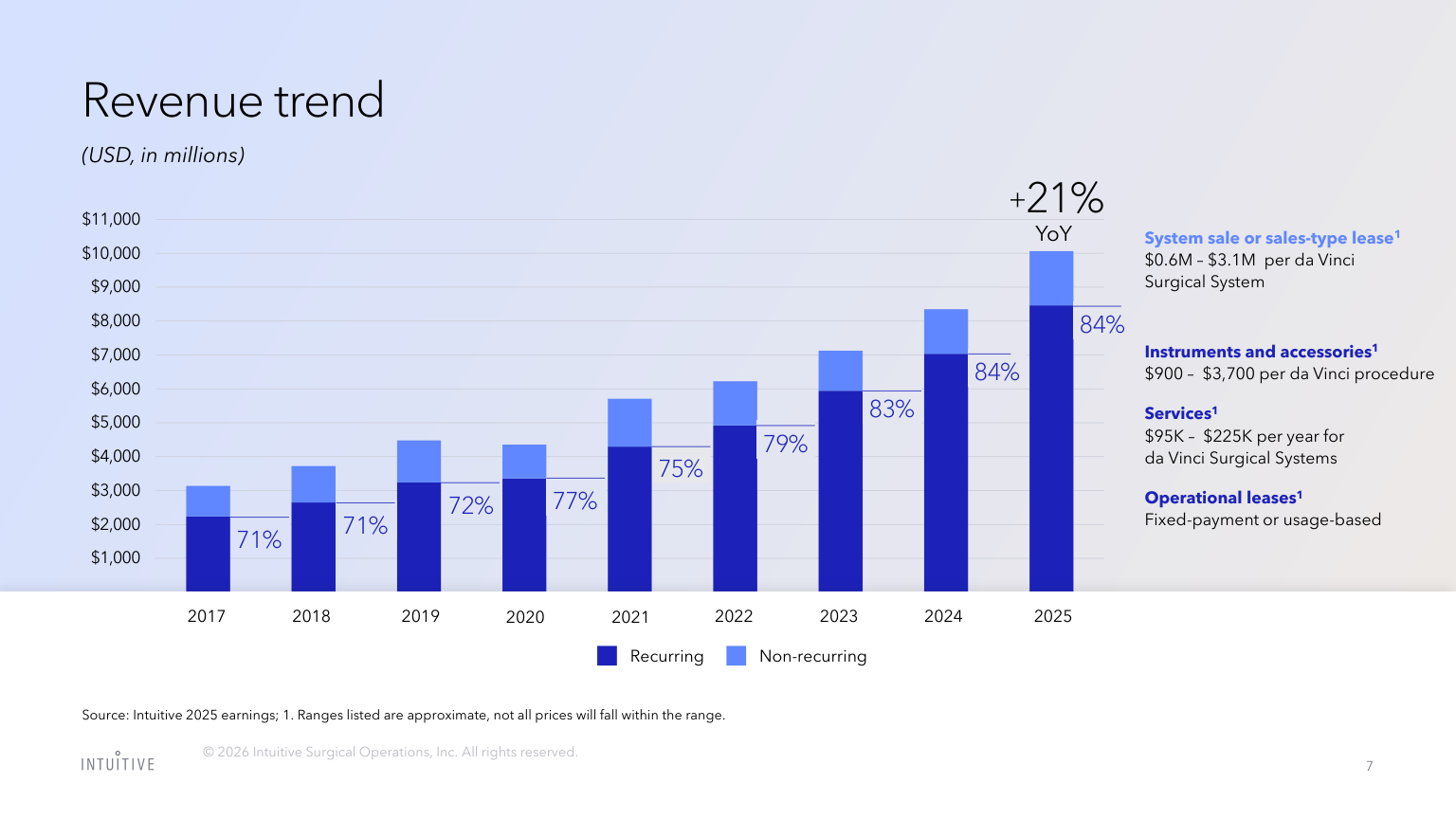
- Page 15 of the third-quarter investor presentation puts da Vinci procedure growth of 14%, installed base growth of 12%, 546 systems placed, $3.05 billion of revenue, a 69.9% non-GAAP gross margin, and $3.00 of non-GAAP EPS on one slide. Page 7 shows recurring revenue rising from 71% of the total in 2017 and 2018 to 84% in 2024 and 2025, and lists the unit economics beside the chart: $0.6 million to $3.1 million per da Vinci system sold or placed on a sales-type lease, $900 to $3,700 of instruments and accessories per da Vinci procedure, $95,000 to $225,000 a year in service per system, and operating leases that are either fixed-payment or usage-based. Chief executive Dave Rosa said in the release that customers performed, on average, "over 10,000 procedures per day throughout the period."
- Company disclosure (Q3 release, 2026 outlook): Worldwide da Vinci procedure growth of approximately 14% to 15%, with the company expecting to be closer to the midpoint; non-GAAP gross margin of 68.7% to 69.3% of revenue, including a tariff impact of about 0.9% of revenue excluding recognized refunds; and non-GAAP operating expense growth of 11% to 13%.
- On the call, chief financial officer Jamie Samath narrowed the July procedure range of 13.5% to 15.5% and lifted the margin range from 68% to 69%. The third-quarter non-GAAP gross margin of 69.9% included a one-time $28 million refund of tariffs paid earlier under IEEPA; without it the margin was 68.9%, up 0.9 points from a year earlier. Non-GAAP operating expenses rose 18% on variable compensation, headcount, and prototype costs, with R&D growing faster than SG&A. He explained revenue growing faster than procedures by a richer mix of da Vinci 5, SP, and Ion, deeper integration with hospital systems, and upgrade volume.
- The same call quantified the pricing. Starting in the first half of 2027 Intuitive will extend the useful life of a subset of core EndoWrist instruments on its fourth- and fifth-generation platforms and introduce volume-based pricing, and in China a billing-code policy change cuts instrument prices from November. Together these lower da Vinci instrument revenue per procedure by about 3% to 5% at constant mix, which management compared with the 7% it estimated when it launched its first extended-use program in 2020.
- Own calculation (size of the cut): Third-quarter instrument and accessory revenue of $1.80 billion was 59.0% of the total. Annualized at $7.19 billion and multiplied by 3% to 5%, the cut is $216 million to $359 million a year, or 1.8% to 2.9% of annualized revenue. Because that base includes Ion instruments, the real effect is smaller.
How Leasing Changes System Placements
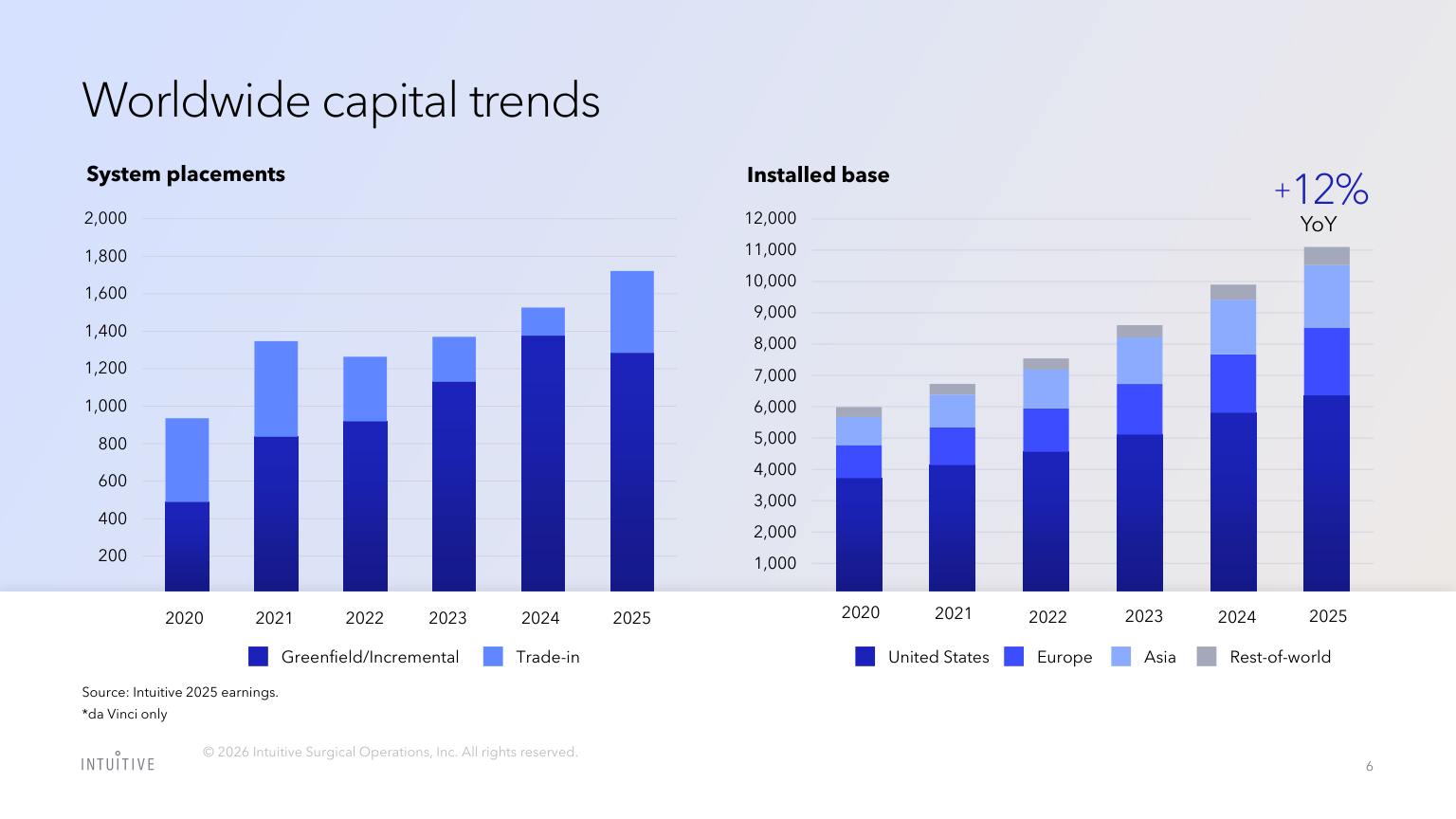
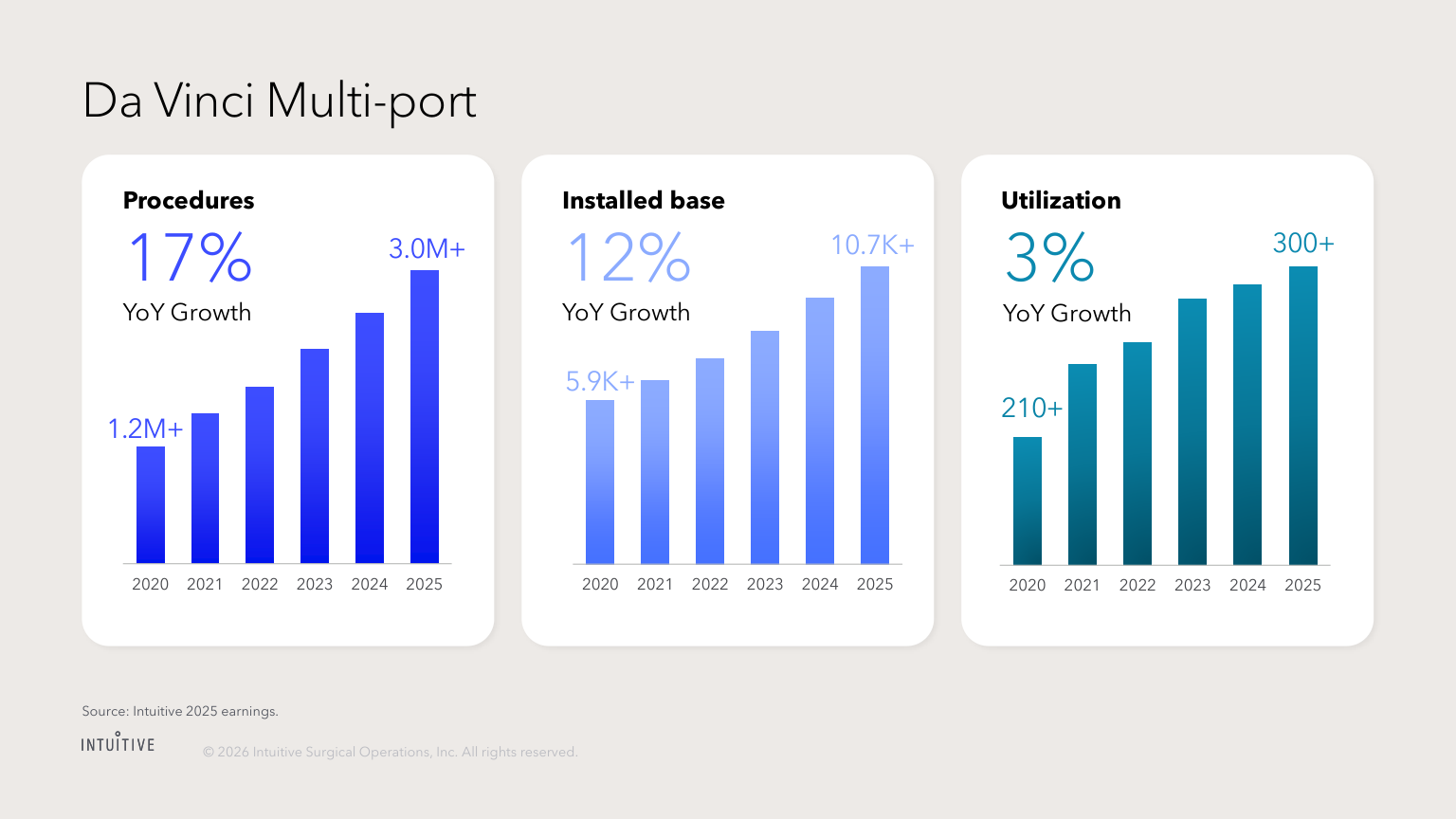
- Page 6 of the deck splits annual system placements from 2020 to 2025 into greenfield or incremental systems and trade-ins, and stacks the installed base by region with 12% growth in 2025. Page 9 shows multi-port da Vinci procedures topping 3.0 million in 2025, up 17%, an installed base above 10,700 systems, up 12%, and utilization per system up 3%. Page 13 adds Ion: more than 140,000 procedures in 2025, up 51%, and more than 990 installed systems, up 24%. In the third quarter Intuitive placed 315 da Vinci 5 systems out of 546, against 240 a year earlier, and 56 Ion systems against 50.
- On the call management said da Vinci placements rose 28%, da Vinci 5 and SP made up 65% of them, and placements of the lower-cost XiR and X more than doubled. The average selling price of purchased systems held at about $1.6 million because the higher da Vinci 5 mix was largely offset by more XiR. Net placements, the ones that grow the installed base rather than replace systems, rose 40%.
- Of the 546 third-quarter placements, 291 were operating leases and 160 of those were usage-based, meaning the hospital pays per procedure. The 10-Q puts nine-month operating lease revenue at $787 million, up 24.5%, and the variable portion tied mostly to usage at $504 million, up 32.6%. The 10-K says plainly, "We are increasingly offering usage-based arrangements as part of our business model," and warns that revenue falls in periods when usage drops and that some leases let customers cancel, return, or upgrade without penalty.
- Leasing also shows up in cash. Systems for leases are built from inventory and then transferred to property and equipment: $422 million in 2023, $615 million in 2024, $809 million in 2025, and $671 million in the first nine months of 2026. The cash goes out through inventory inside operating cash flow, and the transfer is disclosed as a non-cash item, so free cash flow defined as operating cash flow less capital spending does not show it as investment.
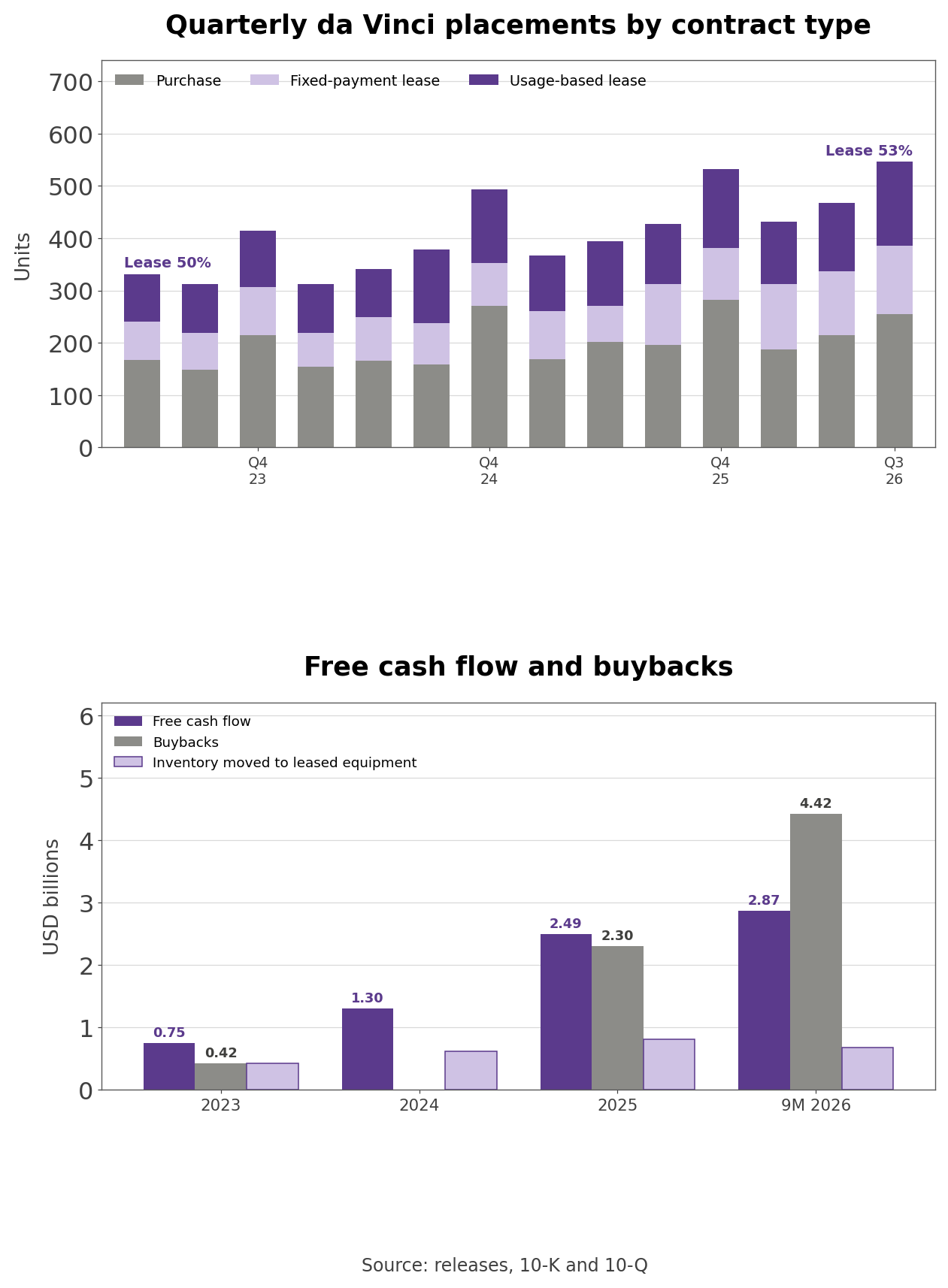
- Own calculation (lease mix): Operating leases rose from 49.5% of quarterly placements in the second quarter of 2023, when Intuitive first split out usage-based leases, to 53.3% in the third quarter of 2026, and usage-based leases from 27.5% to 29.3%. In the first quarter of 2022 operating leases were 34.7%.
The Bull and Bear Case for Intuitive Shares
- The bullish case rests on volume and mix. Total procedures rose 15% in the third quarter, instrument revenue per da Vinci procedure rose from $1,800 to $1,860 on more SP and da Vinci 5, 84% of revenue is recurring, and the stock trades at 41.76 times non-GAAP EPS, the 10th percentile of 83 months.
- The bearish case is about U.S. growth and price. U.S. da Vinci procedures grew 10%, which an analyst on the call called the slowest since Covid; the 2027 pricing and the November China cut take 3% to 5% off instrument revenue per procedure; the antitrust settlement pairs $450 million with injunctive relief; and nine-month buybacks were 154.1% of free cash flow.
- Outside view (sell-side research aggregate, October 2026): Of 57 analysts, 40 rate the stock Buy, 12 Hold, and 5 Sell, with an average price target of $491 and a range of $357 to $651. The day after the results Leerink raised its target from $454 to $503, Baird from $500 to $550, and Barclays from $485 to $500, while RBC lowered its target from $600 to $550.
- The average target sits 8.6% above the share price.
From Extended Use Instruments to an Antitrust Settlement
- On July 21, 2020, alongside second-quarter results, Intuitive introduced an extended-use program for "select Xi/X instruments possessing 12 to 18 uses compared to the current 10 use instruments," and cut prices on other instruments used in lower-acuity procedures. The release said, "These actions will reduce the cost for customers to treat patients, which, in turn, will reduce the Company's revenue per procedure." The numbers bore that out: instrument revenue grew 12.8% in the fourth quarter of 2021 while da Vinci procedures grew 19%, and from the first quarter of 2021 to the third quarter of 2022 instrument growth mostly trailed procedure growth. Results from the third quarter of 2021 onward reflect a three-for-one stock split.
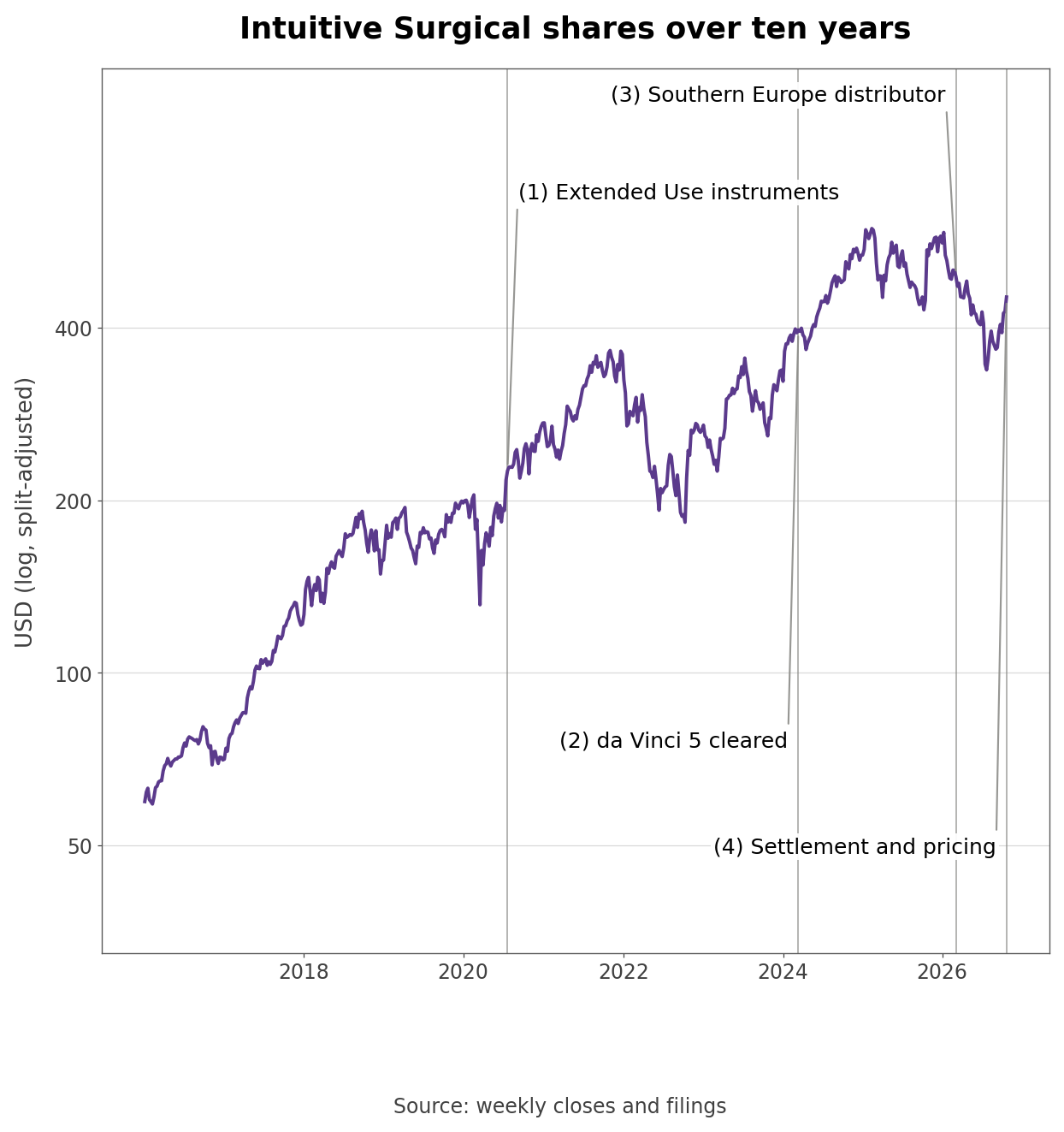
- Between May and July 2021 hospitals filed class actions "alleging antitrust allegations relating to the service and repair of certain instruments manufactured by the Company," consolidated as In re: da Vinci Surgical Robot Antitrust Litigation. In October 2026 Intuitive agreed, without admitting liability, to settle for "a one-time payment of $450 million and mutually agreed injunctive relief," subject to court approval. A separate antitrust suit by the instrument repair company SIS, filed in May 2021, went Intuitive's way at trial in January 2025, but on August 13, 2026 the Ninth Circuit reversed and remanded; Intuitive petitioned for rehearing en banc on September 29, and the 10-Q says it cannot estimate a possible loss.
- In March 2024 the FDA cleared da Vinci 5, and Dave Rosa succeeded Gary Guthart as chief executive, with Guthart becoming executive chair. The shares fell 26.1% in 2022, then gained 27.1% in 2023, +58.5% in 2024, and 8.0% in 2025, and are down -21.7% in 2026.
How Much Procedure Growth Does a 3% to 5% Price Cut Need?
- Instrument revenue per da Vinci procedure was about $1,860 in the third quarter, up 3.3% from $1,800 a year earlier, which management attributed to SP growth and da Vinci 5-specific instruments, partly offset by procedure mix. The 2027 actions target high-volume benign procedures such as cholecystectomy and inguinal hernia repair, especially outside the United States and in outpatient settings, and the extended-use instruments need 510(k) clearance in the U.S., which is under way.
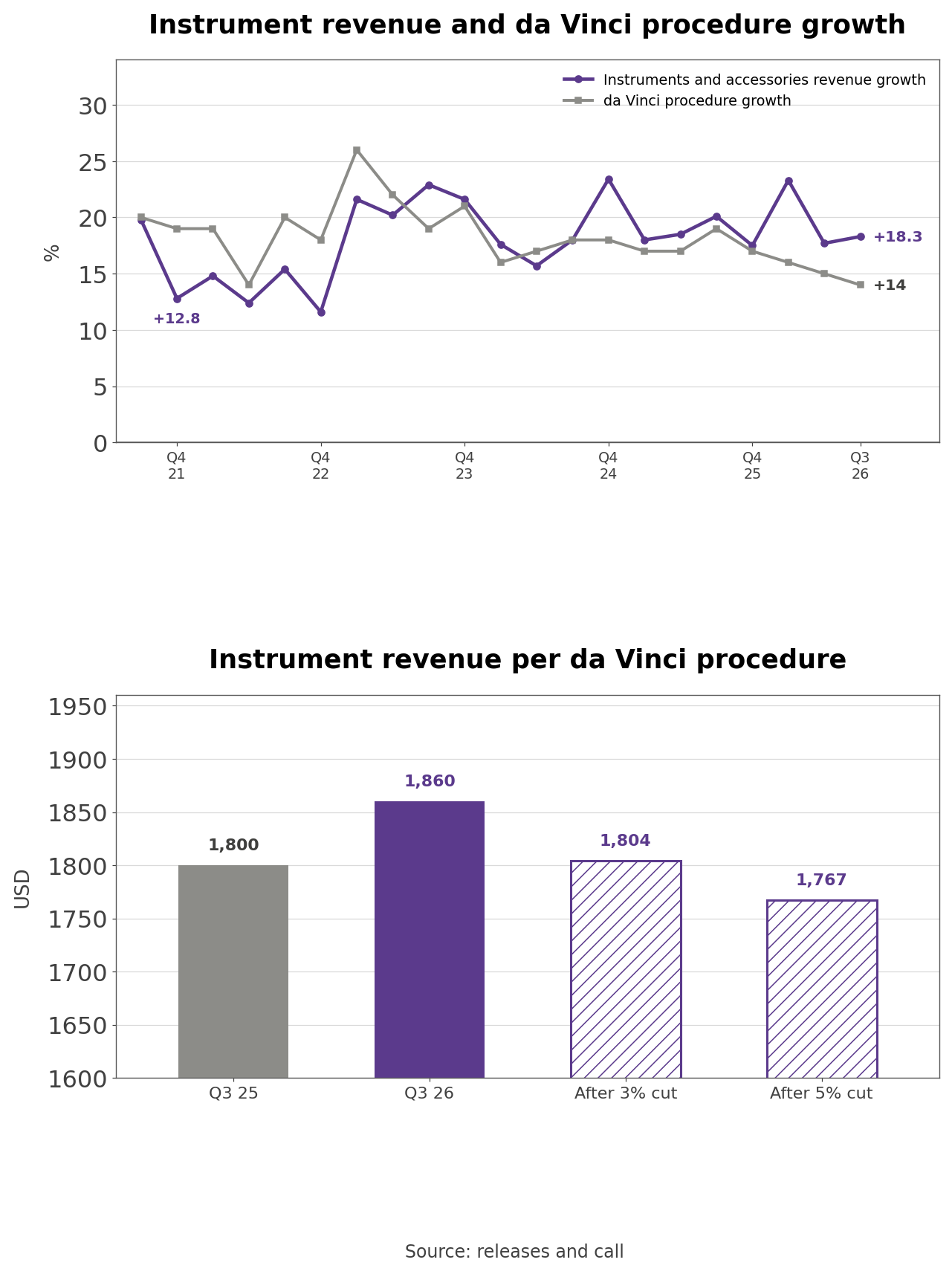
- Own calculation (break-even volume): A 3% cut takes $1,860 to $1,804 and a 5% cut to $1,767. To hold instrument revenue level, procedures would have to grow 3.1% to 5.3% more than they would without the cut, against 2026 guidance of 14% to 15% da Vinci procedure growth.
- Over the last six quarters instrument revenue growth beat da Vinci procedure growth by 0.5 to 7.3 points. The 7.3-point gap in the first quarter of 2026 includes direct sales from the Italian, Spanish, and Portuguese distributors Intuitive bought on March 1, which the 10-Q calls not significant for separate disclosure. Management said the 3% to 5% excludes favorable mix such as Force Feedback instruments and the shift to da Vinci 5 and SP, and that China takes effect in the fourth quarter while extended-use instruments roll out country by country through 2027.
Slower U.S. Procedures and Faster Benign Surgery Abroad
- U.S. da Vinci procedures grew +10% in the third quarter, in line with what management described in July, against a demanding 16% comparison a year earlier. Da Vinci 5 handled more than a quarter of U.S. procedures, up from 13%. Management is watching lower ACA enrollment, Medicaid eligibility changes, and possible changes to the 340B program.
- Outside the U.S., da Vinci procedures grew +20%, with Europe up 20%, Asia 19%, and the rest of the world 22%. Benign procedures outside the U.S. accelerated from 34% growth in the first quarter to 37% in the second and 41% in the third and now exceed a quarter of the volume there. India grew 42% and passed 200,000 cumulative procedures, Japan accelerated after a June reimbursement change, and China grew roughly in line with the company average as capital placements fell in a difficult operating environment.
- SP, the single-port system, grew procedures +55%, including 50% in the U.S. and 40% in Korea, its largest market, with 487 systems in 27 countries. Ion procedures grew 31%, and Korea granted Ion reimbursement in the quarter.
How the Robot-and-Instrument Model Makes Money
- Third-quarter revenue split into $1.80 billion of instruments and accessories (59.0%), $769 million of systems (25.2%), and $482 million of services (15.8%), growing 18.3%, 30.3%, and 21.8%. Once a robot is placed, every procedure consumes instruments and service contracts renew each year, so recurring revenue grows with the installed base.
- By geography, U.S. revenue was $2.06 billion, up 20.1%, and revenue outside the U.S. was $986 million, up 25.2%, leaving the U.S. at 67.7% of the total. U.S. instrument revenue rose 17.5% to $1.25 billion, 7.5 points faster than U.S. da Vinci procedures. SP, da Vinci 5, and Ion, which use more expensive instruments per case, account for that gap, and the 2027 pricing hands part of it back to customers. Remaining performance obligations stood at $3.8 billion, much of it service on system sales and leases.
- The da Vinci installed base reached 12,094 systems: 6,807 in the U.S., 2,436 in Europe, 2,176 in Asia, and 675 elsewhere. More than 2,000 da Vinci 5 systems are installed and over 18,000 surgeons have used them. The 10-K says "Da Vinci 5 has more than 10,000 times the computing power of da Vinci Xi," and the system adds Force Feedback instruments that measure the force applied to tissue plus a My Intuitive+ digital subscription. Intuitive positions da Vinci 5 and Xi for complex surgery, the lower-cost X for price-sensitive customers, and SP for narrow workspaces; SureForm staplers, vessel sealers, and the E-200 generator also sit in instrument revenue. Ion is a catheter-based robot whose first cleared indication is lung biopsy, with 1,152 systems installed, up 21%.
- Most instruments are made in Mexico and most endoscopes in Germany, and a new instrument plant in Penang, Malaysia is expected to open in 2028. Intuitive sells directly in the U.S. and most of Europe and through majority-owned joint ventures with Fosun in China. On March 1, 2026 it paid $533.1 million for the distribution businesses covering Italy, Spain, Portugal, and nearby territories, booking $196.3 million of goodwill. It had about 17,021 employees at the end of 2025.
- Hospitals and health systems are the customers, and they can buy, take a sales-type lease, or take an operating lease, either fixed-payment or usage-based. Leasing lets a hospital add a robot without a large capital budget while Intuitive collects instruments, service, and lease payments over time. Page 5 of the deck says more than 3.2 million procedures were performed on Intuitive systems in 2025, more than 20.4 million to date, and more than 1,900 systems were placed that year. R&D rose 24.0% to $408 million in the third quarter, faster than revenue, and GAAP gross margin was 68.4% against 66.4% a year earlier.
How Intuitive Compares With Four Medtech Peers
- Trailing twelve-month revenue is $37.54 billion at Medtronic, $25.84 billion at Stryker, $21.00 billion at Boston Scientific, $11.58 billion at Intuitive, and $8.51 billion at Zimmer Biomet. Growth runs from Intuitive at +20.5%, Boston Scientific at 13.5%, Medtronic at 9.8%, and Zimmer Biomet at 8.6% to Stryker at 8.5%.
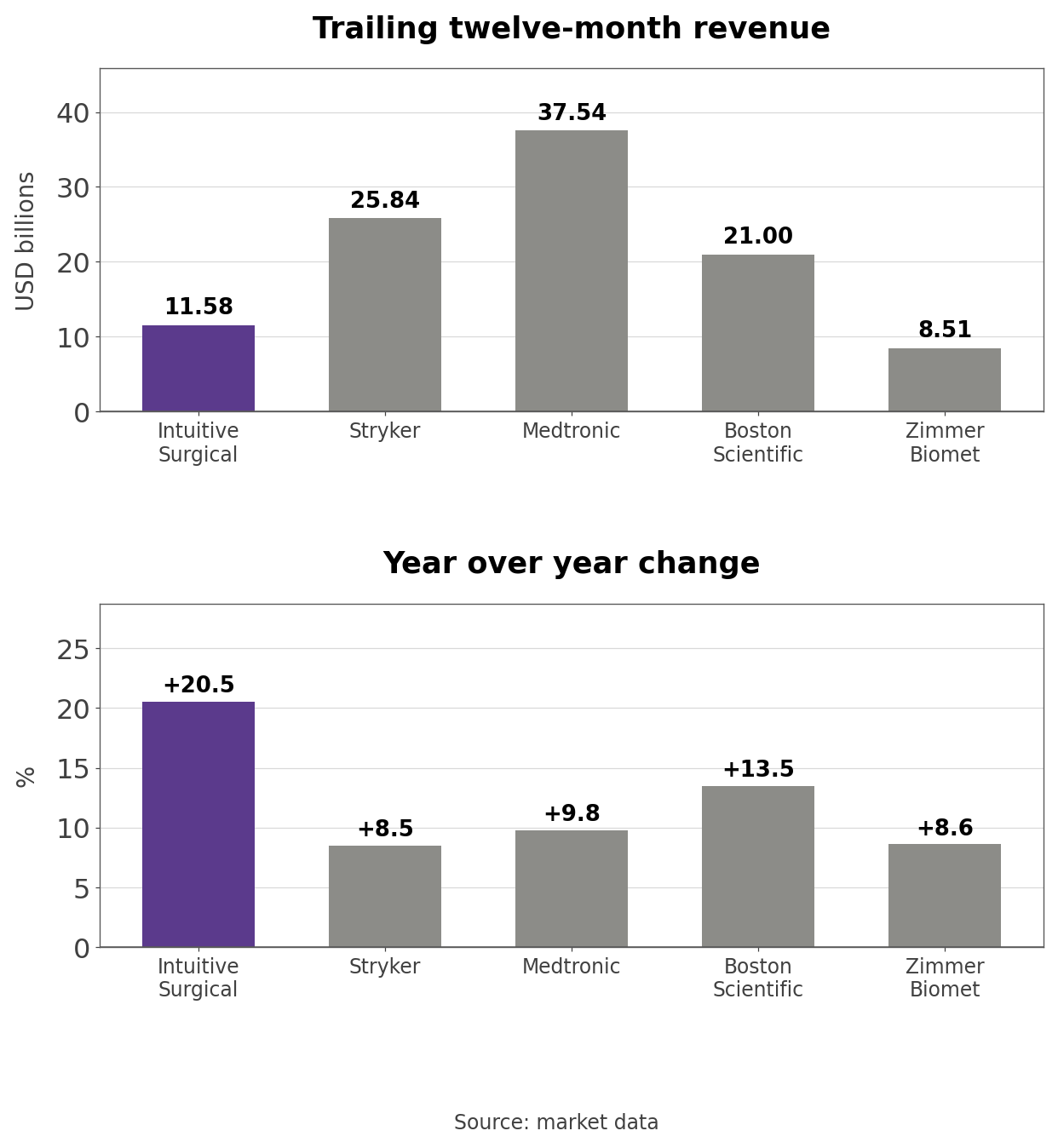
- Stryker sells orthopedic implants and surgical equipment, Medtronic cardiac, neuroscience, and surgical devices, Boston Scientific cardiovascular devices, and Zimmer Biomet joint replacements. Each mixes in some installed-equipment and consumable revenue like Intuitive, so the comparison uses forward P/E and EV/EBITDA. Market values are $156.78 billion at Intuitive, $117.81 billion at Stryker, $116.79 billion at Medtronic, $66.22 billion at Boston Scientific, and $18.80 billion at Zimmer Biomet; Intuitive is worth 1.34 times Medtronic on less than a third of its revenue.
- Forward P/E is 37.54 at Intuitive, 19.30 at Stryker, 15.89 at Medtronic, 14.26 at Boston Scientific, and 11.26 at Zimmer Biomet, and EV/EBITDA is 34.22, 17.60, 13.06, 13.71, and 10.27 in the same order. Over the past year Medtronic gained 5.2%, while Zimmer Biomet slipped 2.0%, Stryker fell 13.8%, Intuitive -15.3%, and Boston Scientific -54.6%.
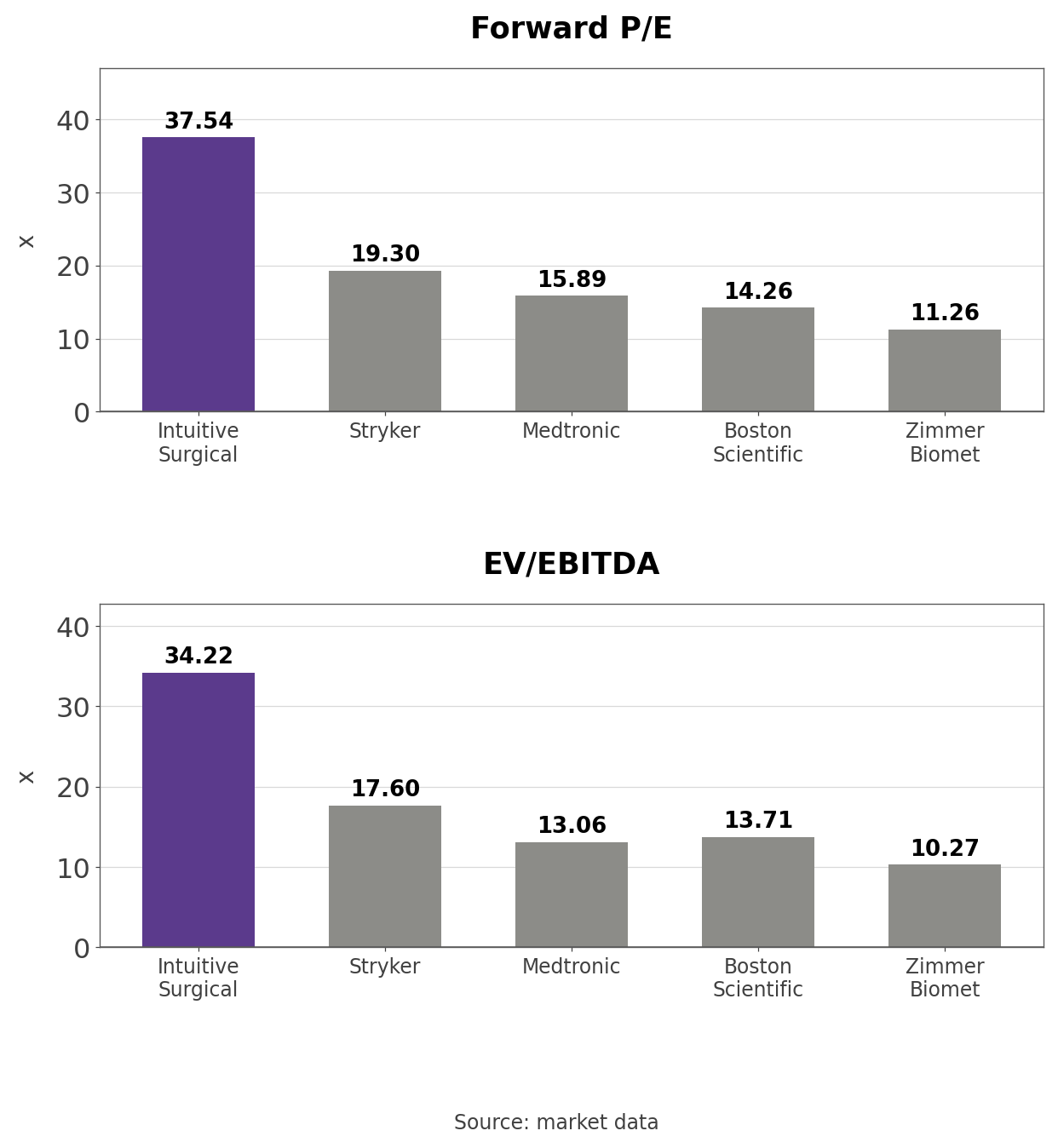
- Own calculation (relative premium): Intuitive's forward P/E is 1.95 times Stryker's, and its trailing revenue growth is 2.4 times Stryker's.
P/E on Non-GAAP EPS Over 83 Months
- On trailing non-GAAP diluted EPS of $10.83, Intuitive trades at 41.76 times, the 10th percentile of the 83 months since December 2019, against a median of 62.05. The low was 34.54 in July 2026 and the high 80.65 in November 2024. Price to sales is 13.54, the 15th percentile, against a median of 18.19.
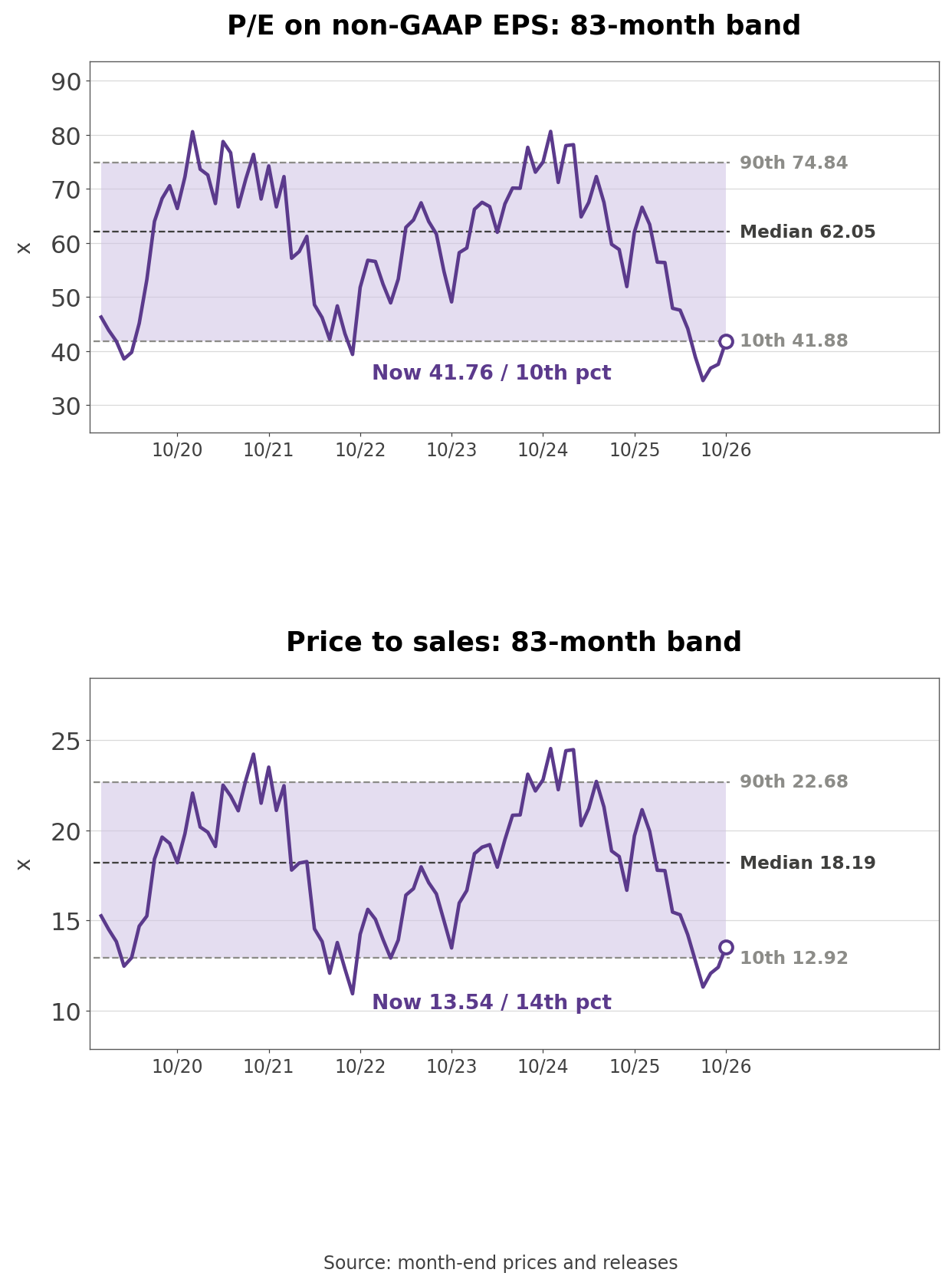
- The gap between third-quarter GAAP operating income of $593 million and non-GAAP operating income of $1.27 billion is mostly $213 million of share-based compensation and $455 million of litigation charges. On trailing GAAP EPS of $8.27 the P/E is 54.69, and adding back the $0.99 per share of settlement cost gives $9.26 and 48.84. In July, when the multiple hit its 83-month low, Intuitive bought 3.63 million shares at an average $364.74, and in August 4.16 million at $387.71, for a third-quarter average of $377.01. The share price is 20.0% above that average. Nine-month buybacks of $4.42 billion compare with free cash flow of $2.87 billion, cash and investments fell from $9.03 billion at the start of the year to $6.80 billion, and about $1.8 billion of authorization remains.
Three Conditions That Move the Stock
- Da Vinci procedure growth is guided at 14% to 15% for 2026. If procedure growth in 2027 stays well above the 3% to 5% price cut and the U.S. reaccelerates from the low teens, instrument revenue keeps its pace; if U.S. growth drops to single digits, the price cut comes straight out of revenue growth.
- Instrument revenue per da Vinci procedure was about $1,860 in the third quarter. Holding the mid-$1,800s through da Vinci 5 and SP mix and Force Feedback adoption would bury the pricing in mix; drifting toward $1,767 would mean the top end of the company's estimate is showing up in the numbers.
- Cash and investments stand at $6.80 billion. If free cash flow still covers buybacks after the remaining $1.8 billion authorization and the $450 million settlement payment, the share count keeps falling; if inventory moved into leased equipment and the Penang plant squeeze free cash flow, buybacks slow first.
The 2027 Procedure Outlook and the Pricing Rollout
- The numbers to watch in the fourth-quarter report are the 2027 da Vinci procedure growth outlook, instrument revenue per procedure in the fourth quarter, the first with the China cut, the timing of U.S. 510(k) clearance for extended-use instruments, and court approval of the settlement. The SIS case could return to the district court depending on the en banc petition.
- One question this piece cannot settle: if instrument growth again falls below procedure growth as it did after the 2020 program, will price-sensitive benign procedures abroad grow fast enough to fill the gap while U.S. procedures sit in the low teens?
Related Analysis
- Medtronic (MDT) Stock Analysis: Revenue Growth vs Flat EPS: the largest of the medtech peers here, useful for comparing how revenue growth turns into EPS at a slower-growing device maker.
- Trip.com (TCOM) Stock Analysis: Antitrust Fine and Guidance: an antitrust outcome where changes to business practices mattered more than the fine, a frame for a settlement that pairs a payment with injunctive relief.
- Booking Holdings (BKNG) Stock: Buybacks Beyond Cash Flow: another company buying back more than its free cash flow, a comparison for Intuitive's nine-month buybacks at 154% of free cash flow.
#IntuitiveSurgical #ISRGStock #MedtechStocks #SurgicalRobots #daVinci #ShareBuybacks #USStocks #StockAnalysis #EquityResearch #GlobalStockBrief
'US Stock Analysis' 카테고리의 다른 글
| Netflix (NFLX) Stock: A $2.8B Warner Fee and Record Buybacks (0) | 2026.10.25 |
|---|---|
| General Motors (GM) Stock: EV Add-Backs and a $20B Buyback (0) | 2026.10.25 |
| SpaceX (SPCX) Stock: One Customer and a 90-Day Exit Clause (0) | 2026.10.24 |
| IBM (IBM) Stock: Organic Software Growth Is Just Over 4% (0) | 2026.10.24 |
| GE Aerospace (GE) Stock: Allowances Behind the Cash Flow (0) | 2026.10.24 |


