- GE Aerospace (NYSE: GE) grew third-quarter adjusted EPS +35.5% to $2.25 and raised every line of its 2026 guidance, yet free cash flow fell -13.5% to $2.04 billion. Nine-month free cash flow rose 13.4%, but that figure includes a $1.56 billion build in sales discounts and allowances, money owed back to customers later; without it, nine-month free cash flow was down 4.0%. The question is what a stock at 37 times adjusted earnings, near the bottom of its standalone range, is pricing in.
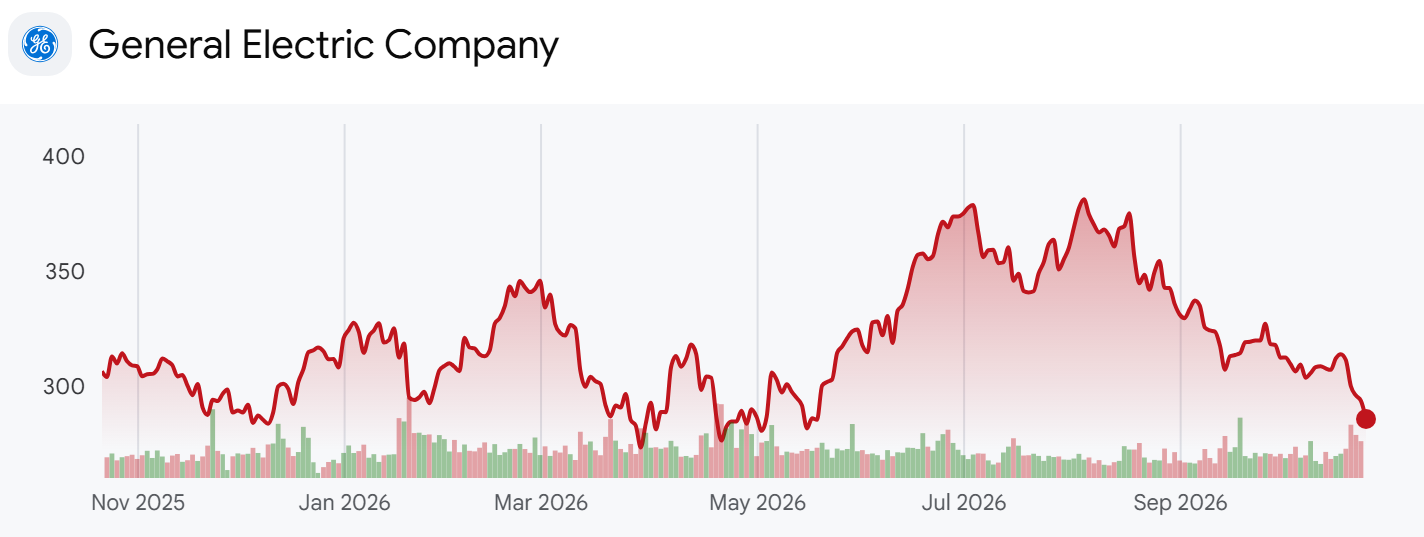
- GE Aerospace builds the LEAP engine for the Airbus A320neo and Boeing 737 MAX through CFM International, its 50-50 venture with Safran, and earns most of its money servicing engines and selling parts for decades after delivery. The shares trade at $285.64 for a market value of $295.2 billion on 1.033 billion shares, -24.1% below the weekly high of $376.47 set in the week of July 2, 2026, and they fell 9.0% in the week of the results. EPS and operating profit here are company-adjusted (non-GAAP) figures that exclude the run-off insurance business and separation costs; third-quarter GAAP continuing EPS was $2.32. GE does not report sales allowances by quarter, so quarterly figures are backed out of 10-Q year-to-date totals.
What the Q3 Presentation Says About Orders and Margins
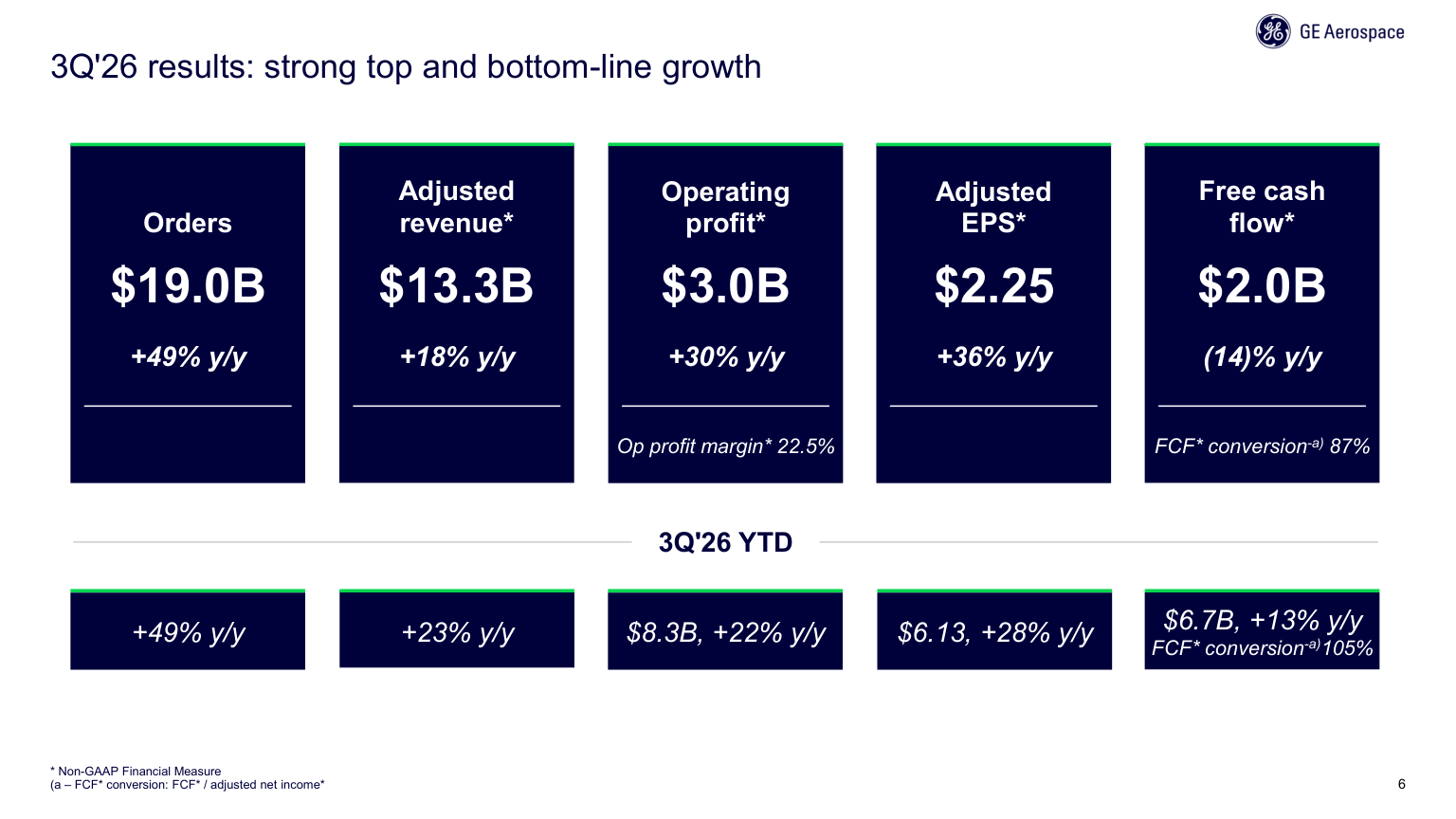
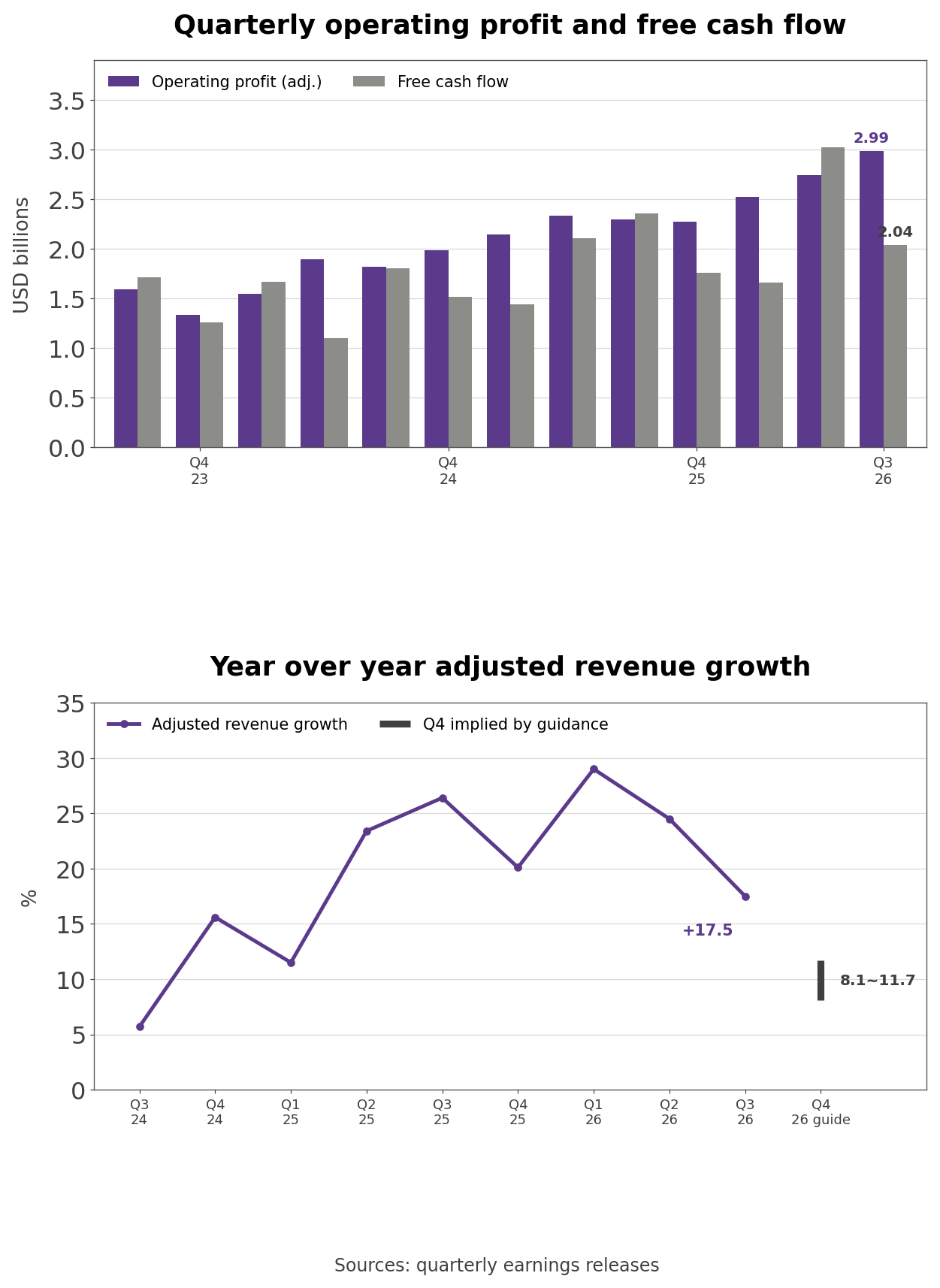
- Page 6 of the third-quarter presentation lines up orders of $19.0 billion (up 49%), adjusted revenue of $13.3 billion (up 18%), operating profit of $3.0 billion (up 30%), adjusted EPS of $2.25 (up 36%), and free cash flow of $2.0 billion (down 14%). Below that it shows nine-month operating profit of $8.3 billion, adjusted EPS of $6.13, free cash flow of $6.7 billion, and a free cash flow conversion rate, FCF over adjusted net income, of 87% in the quarter and 105% year to date.
- Page 8 shows Commercial Engines & Services (CES) revenue of $10.3 billion, up +21%, and operating profit of $2.9 billion, up 21%, with the margin down 10 basis points to 27.9%. Services grew 17%, with internal shop visit revenue up 12% on LEAP volume up more than 40%, and spare parts grew more than 20%. Equipment revenue grew 38% on engine deliveries up 8%, including LEAP up 5%, and higher GEnx output.
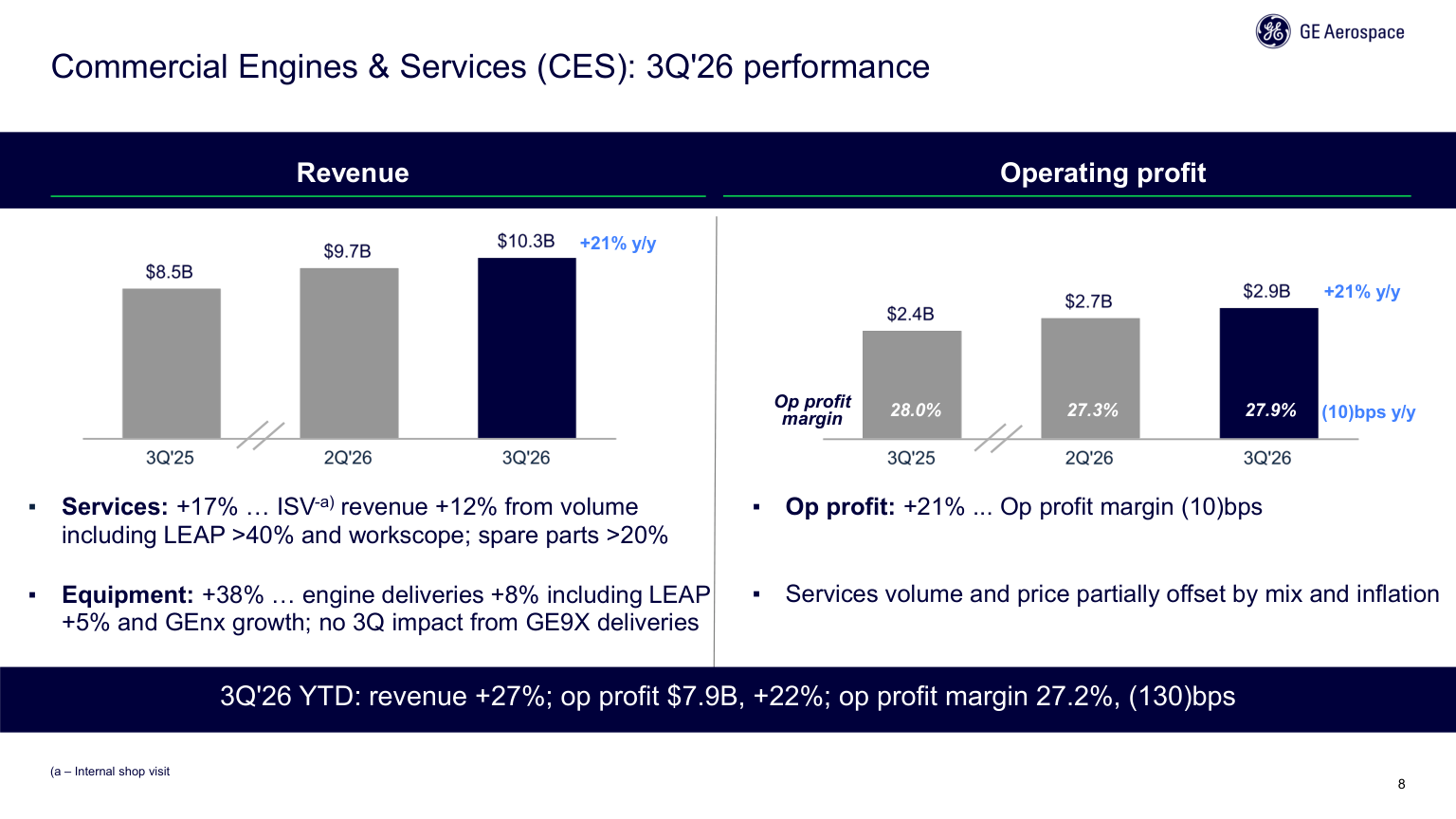
- Chief financial officer Rahul Ghai explained the cash on the call: "Working capital was a use as receivables grew from timing of services billings and an increase in balance due from airframers." For the nine months he said: "This reflects 105% conversion with continued favorability in net contract assets and liabilities." He did not mention sales allowances. The CES slide adds that GE9X deliveries had no third-quarter impact and that the nine-month CES operating profit was $7.9 billion, up 22%.
- Page 4 covers output. Material input from priority suppliers rose double digits, LEAP turnaround time fell about two weeks, which helped bring aircraft grounded for engines to nearly zero, and LEAP fan assembly output more than doubled. Page 7 splits the 59-cent EPS increase: 43 cents from the two segments, 12 cents from lower corporate cost, and the rest from 24 million fewer diluted shares, at an adjusted tax rate of 15.2%.
- Own calculation (services and equipment mix): CES services revenue was $7.74 billion, up 16.7%, and equipment revenue was $2.61 billion, up 37.8%, putting services at 74.8% of CES. Faster engine deliveries raise the share of lower-margin equipment, and the nine-month CES margin of 27.2% was 1.3 points lower than a year ago.
The Raised 2026 Outlook and a Slower Fourth Quarter
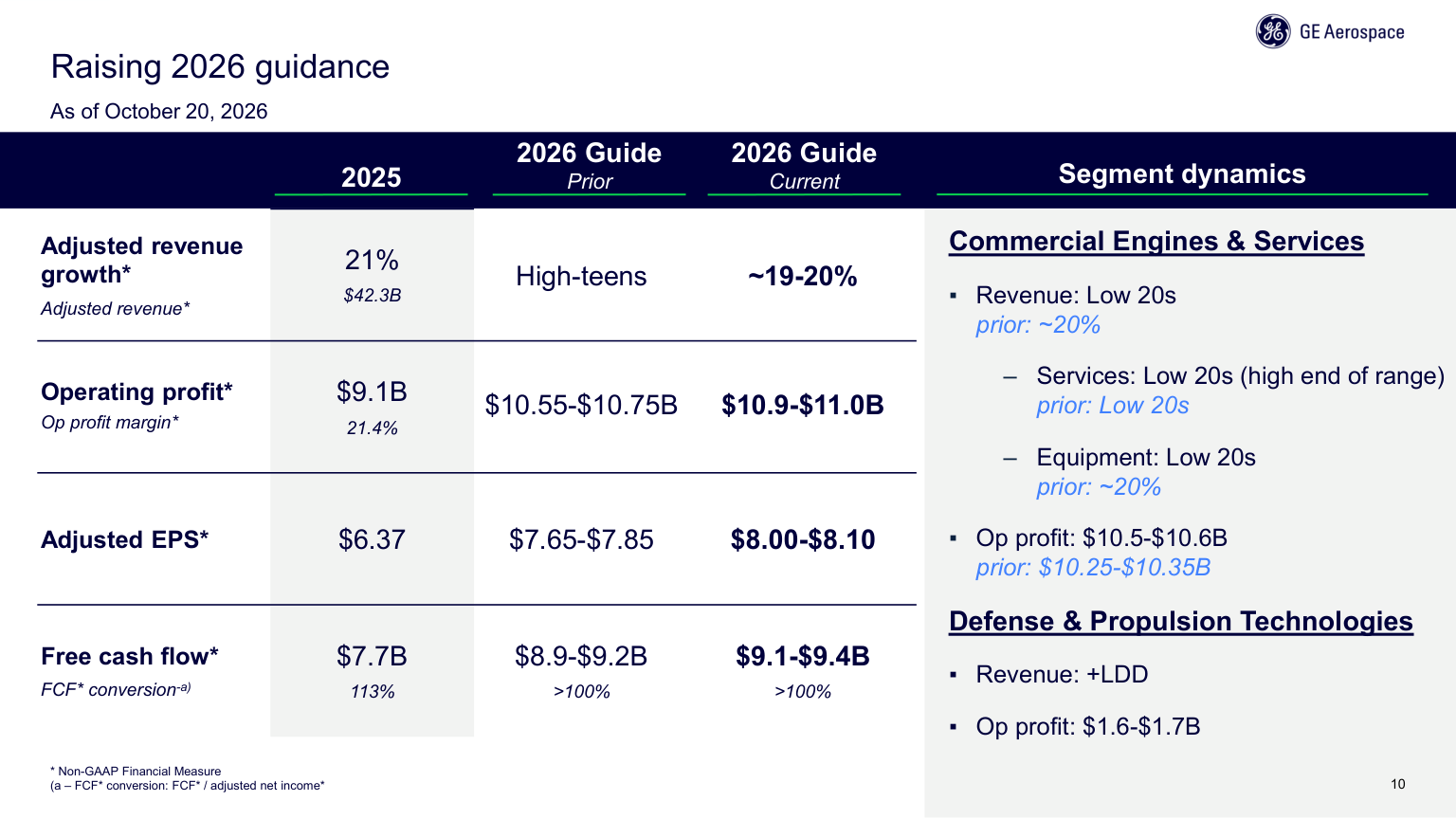
- Page 10 raises the 2026 outlook on every line: adjusted revenue growth from high teens to about 19% to 20%, operating profit from $10.55 billion to $10.75 billion to $10.9 billion to $11.0 billion, adjusted EPS from $7.65 to $7.85 to $8.00 to $8.10, and free cash flow from $8.9 billion to $9.2 billion to $9.1 billion to $9.4 billion. Of the $250 million increase in CES operating profit, the finance chief attributed about $100 million to a smaller GE9X impact and $150 million to services growth. Page 14 keeps DPT at low double-digit revenue growth and $1.6 billion to $1.7 billion of operating profit, and puts corporate costs and eliminations at the low end of $1.2 billion to $1.3 billion.
- Company disclosure (Q3 release and call, 2027 view): Commercial services orders rose 23% in the quarter and 30% year to date. The chief executive said: "We are raising our 2026 guidance across the board, and we now expect 2027 commercial services to grow low-double-digits supported by our over $170 billion commercial services backlog."
- Own calculation (fourth-quarter math): Growth of 19% to 20% for the year implies fourth-quarter adjusted revenue of $12.83 billion to $13.25 billion, up 8.1% to 11.7% from $11.87 billion, against 17.5% in the third quarter; the analyst average of $13.33 billion sits above that range. Fourth-quarter adjusted EPS would be $1.87 to $1.97, up 19.1% to 25.5%, and free cash flow $2.37 billion to $2.67 billion, up 34.8% to 51.8%.
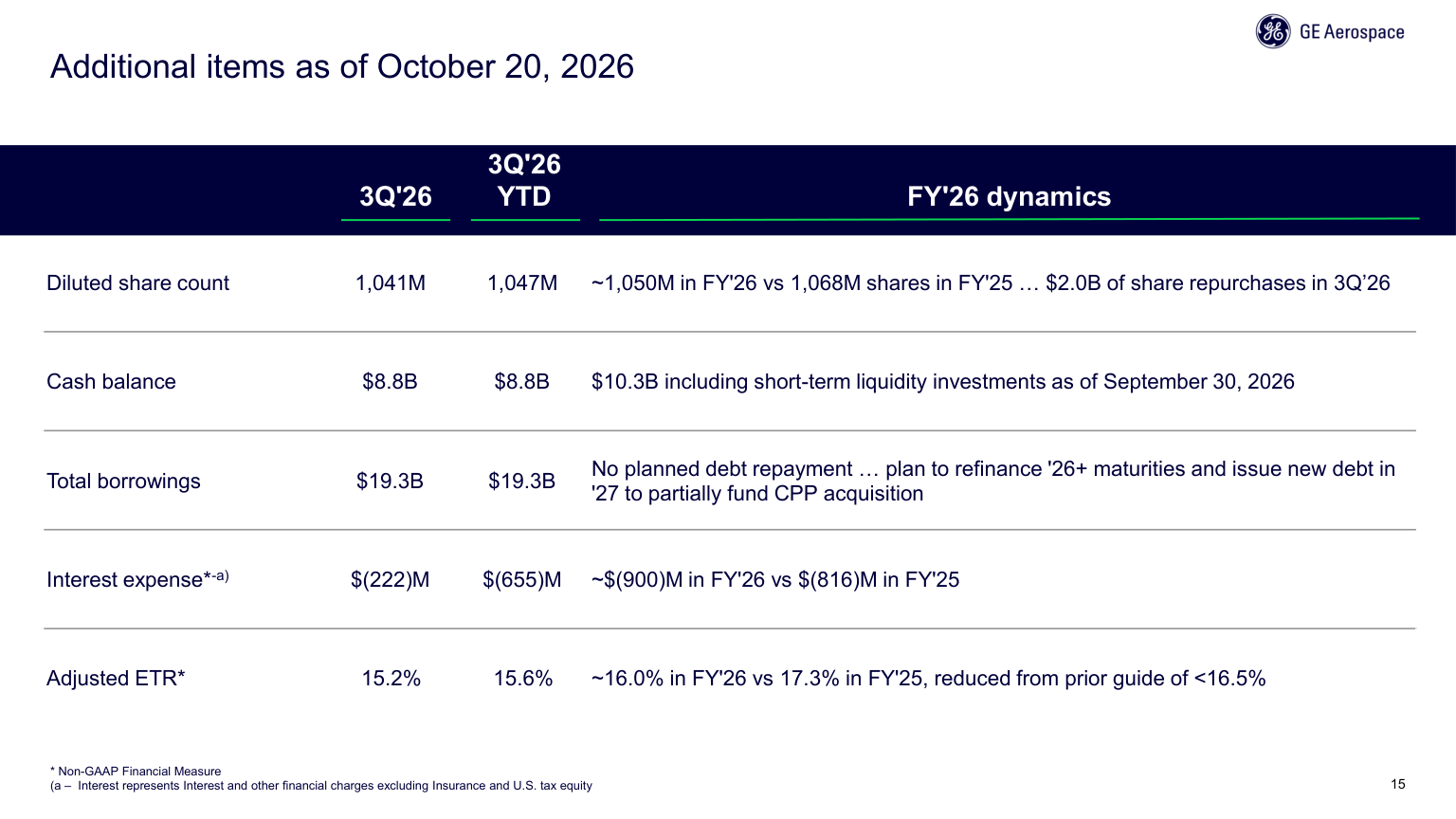
- Page 15 shows diluted shares of 1.041 billion in the third quarter against 1.068 billion for 2025, after $2.0 billion of buybacks in the quarter. Cash was $8.8 billion ($10.3 billion with short-term liquidity investments) against $19.3 billion of borrowings; the company plans to refinance 2026 and later maturities and issue new debt in 2027 to fund part of the CPP purchase. Interest expense is expected at about $900 million for 2026 and the adjusted tax rate at about 16%, down from 17.3% in 2025.
The Bull and Bear Case for GE Aerospace Shares
- The bullish case starts with orders. Nine-month orders rose 49%, the services backlog stands at $178.7 billion, and the adjusted P/E of 37.10 sits at the 6th percentile of the 31 months since GE Vernova was spun off. The company raised all of its 2026 targets.
- The bearish case is about pace and cash. Commercial services growth steps down from the low 20s in 2026 to low double digits in 2027, and the guidance implies fourth-quarter revenue growth of only 8.1% to 11.7%. Nine-month free cash flow growth is explained by the allowance build, buybacks and dividends exceed free cash flow, and an $11.75 billion acquisition is waiting.
- Outside view (sell-side research aggregate, October 2026): Of 23 analysts, 16 rate the stock Strong Buy, 3 Buy, 3 Hold, and 1 Sell, with an average price target of $391.19, 37.0% above the share price. The average 2027 EPS estimate is $9.11. Several brokers cut their targets the day after the results while keeping Buy ratings.
From an 1892 Conglomerate to a Pure Engine Maker
- General Electric started in 1892 from the merger of Edison General Electric and Thomson-Houston. The board named Larry Culp chairman and chief executive on October 1, 2018. GE carried out a 1-for-8 reverse split in August 2021, sold its aircraft leasing arm GECAS to AerCap that November, spun off GE HealthCare on January 4, 2023, and spun off GE Vernova on April 2, 2024, leaving the aircraft engine business as GE Aerospace.
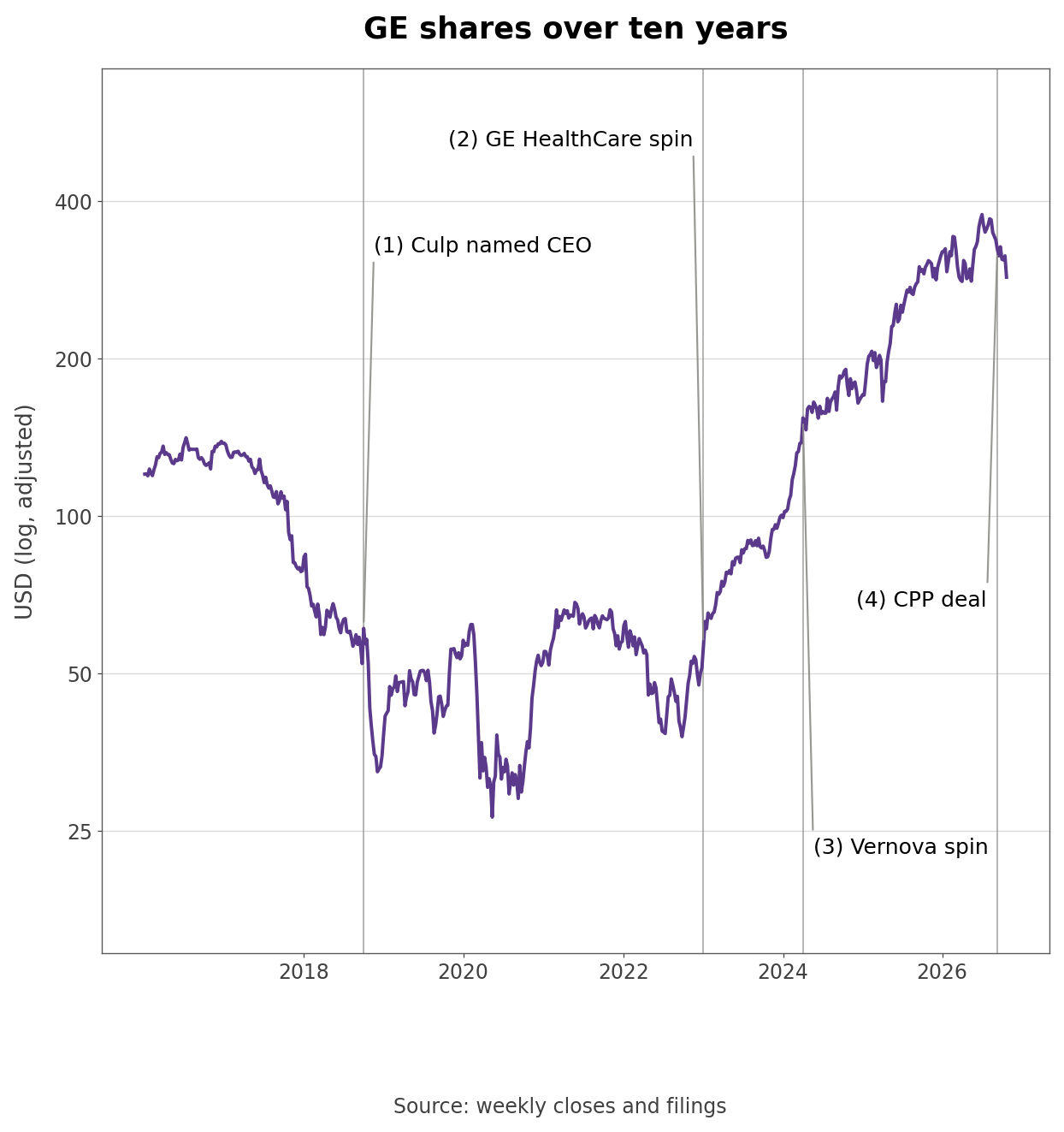
- The shares fell 42.9% in 2017 and 55.7% in 2018. On adjusted weekly closes the stock went from $120.05 in the first week of 2016 to a low of $26.52 in the week of May 15, 2020, and $285.64 is 2.38 times the 2016 level. The shares gained +95.7% in 2023, 68.1% in 2024, and 86.1% in 2025, and are down 8.9% in 2026. On September 8 the company agreed to buy the castings maker CPP for $11.75 billion.
How Much Free Cash Flow Came From Sales Allowances?
- The change in sales discounts and allowances added to operating cash flow went from minus $203 million in 2023 and minus $266 million in 2024 to plus $562 million in 2025 and plus +$1.56 billion in the first nine months of 2026. By quarter it was $1.00 billion in the first quarter, minus $44 million in the second, and $608 million in the third. The liability on the balance sheet rose from $3.48 billion at the end of 2024 to $4.04 billion at the end of 2025 and $5.60 billion at the end of September.
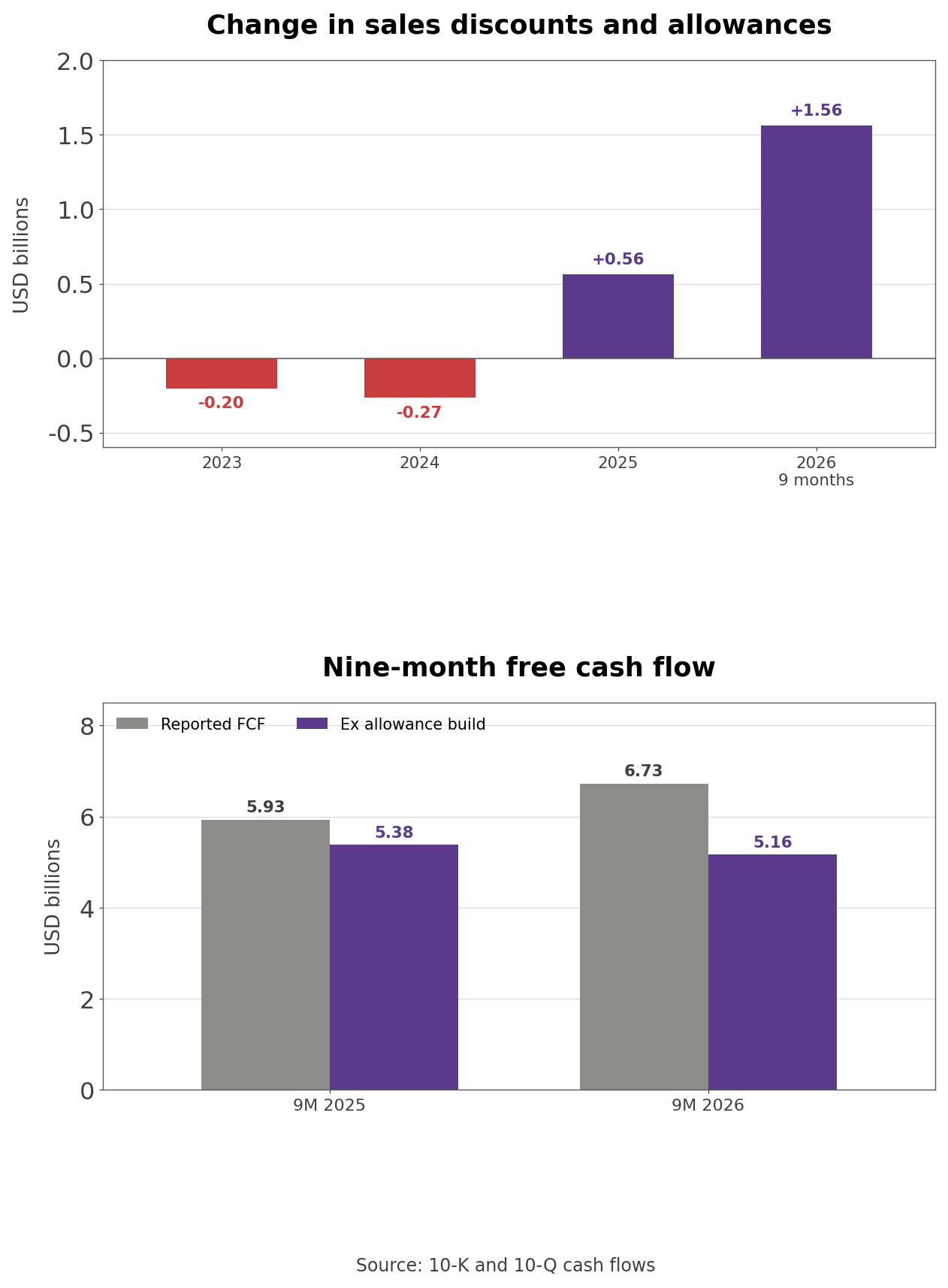
- The third-quarter 10-Q says the cash from allowances rose "primarily due to increases in allowances on new engine installs and spare parts in CES," and its liabilities note adds product durability reserves. The company books the amount it will credit back to customers as a reduction of revenue now and pays it later, so operating cash flow is higher while the balance builds. In the fourth quarter of 2024, $597 million flowed out in a single quarter.
- Own calculation (cash flow without the allowance build): Excluding the change in allowances, nine-month free cash flow was $5.16 billion, down 4.0% from $5.38 billion, and third-quarter free cash flow was $1.43 billion, down 36.4%. The allowance build equals 23.2% of reported nine-month free cash flow. For full-year 2025 the same adjustment still leaves $7.13 billion, up 10.2%.
- Current receivables used $1.66 billion in the third quarter against $113 million a year earlier, which explains most of the drop in conversion from 134% to 87%.
What the CPP Deal Costs and How It Is Funded
- CPP makes precision castings for aircraft engines, defense, and power generation, with about $2.0 billion of expected 2027 revenue and about 6,600 employees. The acquisition release says the price "Values CPP at ~18x 2027 EBITDA including expected net synergies, multiple of ~26x without," with net synergies of about $200 million. GE expects the deal to add to adjusted EPS and free cash flow in the first year and to earn a double-digit return on invested capital by year five. It will pay about $7 billion in cash and borrow the rest, with closing expected in the second half of 2027.
- Own calculation (deal and capital returns): At 26 times, CPP's pre-synergy EBITDA is about $452 million, and the price is 5.88 times revenue and 4.0% of GE's market value. Buybacks of $6.51 billion and dividends of $1.36 billion in the first nine months of 2026 total $7.87 billion, 116.9% of free cash flow and 152.4% of free cash flow excluding the allowance build. Adding $4.75 billion of new debt would lift borrowings to $24.05 billion.
- The company said the deal does not change its capital allocation plans, and diluted shares fell 2.5% from 1.068 billion in 2025 to 1.041 billion in the third quarter.
Insurance Reserves and Deferred 777X Engine Revenue
- The run-off insurance business, excluded from adjusted results, lost $210 million in the third quarter after earning $361 million a year earlier. The 10-Q says the 2026 annual review of future policy benefit reserve assumptions led to a $328 million pre-tax charge, mainly from claims experience and long-term care cost inflation. Insurance liabilities total $34.12 billion.
- The GE9X powers the Boeing 777X. GE delivered GE9X engines with an upgraded midseal in the quarter but will recognize the revenue only after Federal Aviation Administration certification.
How the Engine Aftermarket Makes Money
- GE Aerospace has an installed base of about 50,000 commercial and 30,000 military engines, and the 10-Q says aftermarket services represent about 70% of revenue. Engines earn little when they are delivered to airframers; the money comes as those engines fly for decades and return to the shop for overhauls and parts. Page 11 of the presentation puts the fleet at about 80,000 engines with more than 2.3 billion flight hours.
- LEAP and the older CFM56 power single-aisle jets, while GEnx and GE9X power widebodies such as the Boeing 787 and 777X. LEAP deliveries topped 500 for a fifth straight quarter and are up 26% year to date, while widebody engine deliveries rose more than 50% in the quarter and GEnx shipments nearly doubled. Parts have been the bottleneck: supplier material input has risen sequentially for ten straight quarters. At Farnborough GE announced commitments for more than 1,800 engines, including the largest LEAP order ever, more than 1,000 LEAP-1A engines for IndiGo, and Turkish Airlines later ordered more than 300 LEAP-1B engines.
- Services revenue grew 17% in the quarter, and spare parts delinquency rose sequentially as demand outran supply. Remaining performance obligations total $178.75 billion for services and $33.34 billion for equipment, with 12% of the services amount expected within one year and 67% within ten. Flying activity drives that revenue; on airline departures, management said "we saw the third quarter up 1%, widebody is particularly strong," and expects departures to grow in 2027 despite fuel pressure. Long-term service agreements bill on utilization and recognize revenue as work is done, and the gap sits in contract assets and liabilities.
- Defense & Propulsion Technologies (DPT) grew revenue +6.7% to $3.47 billion and operating profit 8.0% to $475 million, a 13.7% margin; the aeroderivative business moved into DPT from CES in 2026. Defense & Systems grew 5% and Propulsion & Additive Technologies, which includes Avio Aero and Unison, grew 10%. GE signed an F414 support contract worth up to $2.9 billion, its GEK800 with Kratos was picked as the second-source engine for the JASSM missile, and the XA102 moved to hardware procurement in the NGAP program. GE spends more than $3 billion a year on R&D.
Four Peers in Engines and Aftermarket Parts
- Trailing twelve-month revenue was $96.0 billion at RTX, $52.6 billion at GE Aerospace, $10.0 billion at TransDigm, $9.1 billion at Howmet, and $5.2 billion at HEICO. HEICO grew fastest at 20.7%, followed by GE at +19.6%, Howmet at 18.1%, TransDigm at 16.6%, and RTX at 11.6%.
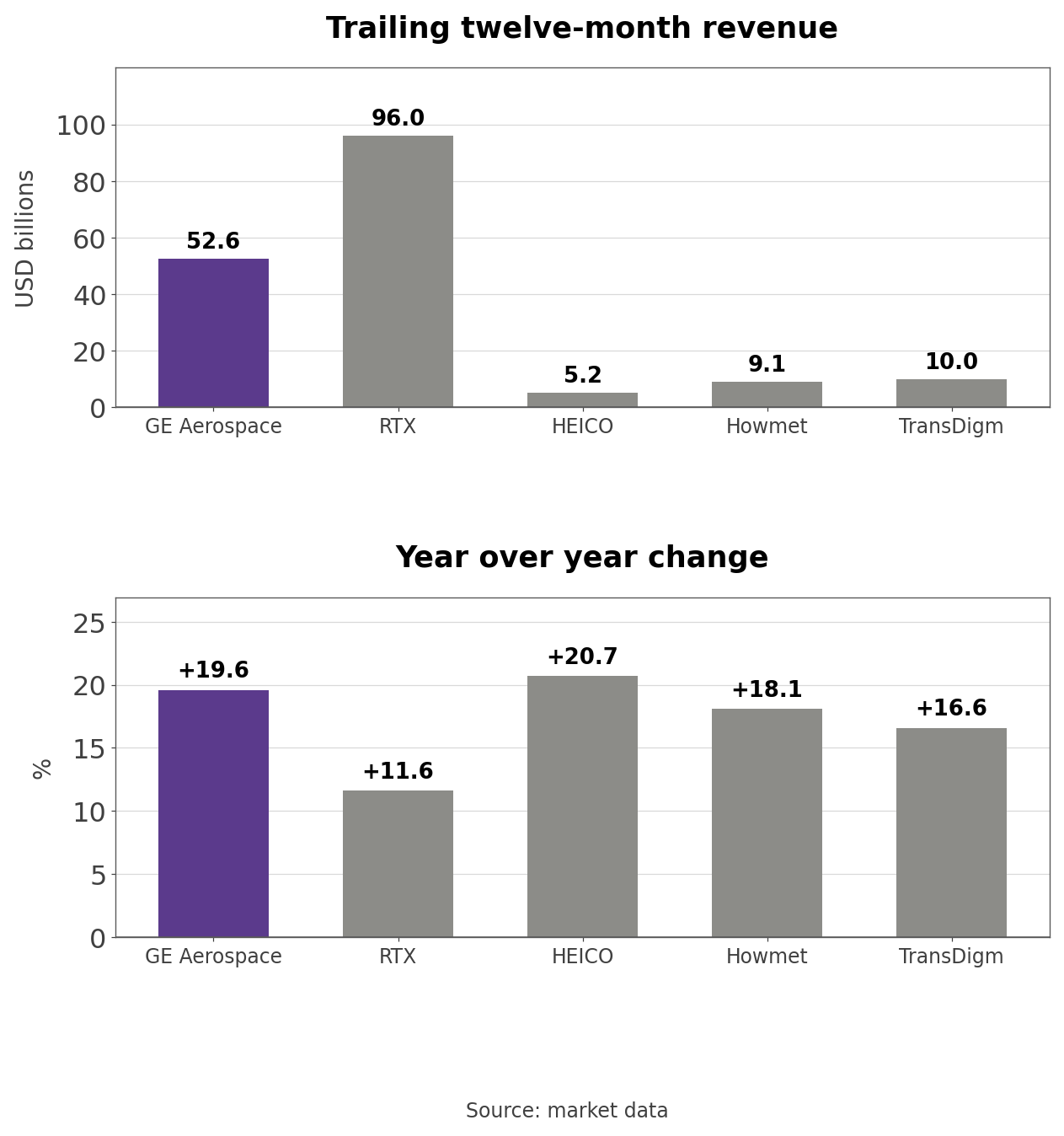
- RTX's Pratt & Whitney GTF competes with LEAP on the A320neo. Howmet makes engine castings and forgings, supplies GE, and competes with CPP. HEICO and TransDigm sell aftermarket parts, and HEICO's approved replacement parts overlap with GE's spare parts business. That is why this piece pairs forward P/E with FCF yield.
- Forward P/E is 42.82 at HEICO, 32.15 at GE, 31.44 at Howmet, 24.62 at RTX, and 23.71 at TransDigm, and trailing FCF yield is 3.68% at RTX, 3.18% at TransDigm, 2.72% at GE, 2.48% at HEICO, and 2.42% at Howmet; Howmet's figures run through June and the others through September. Operating margin is 46.01% at TransDigm, 28.50% at Howmet, 25.14% at HEICO, 18.49% at GE on a GAAP basis that includes insurance, and 15.54% at RTX. Over one year RTX gained 7.0%, while GE fell -7.5% and TransDigm fell 15.6%.
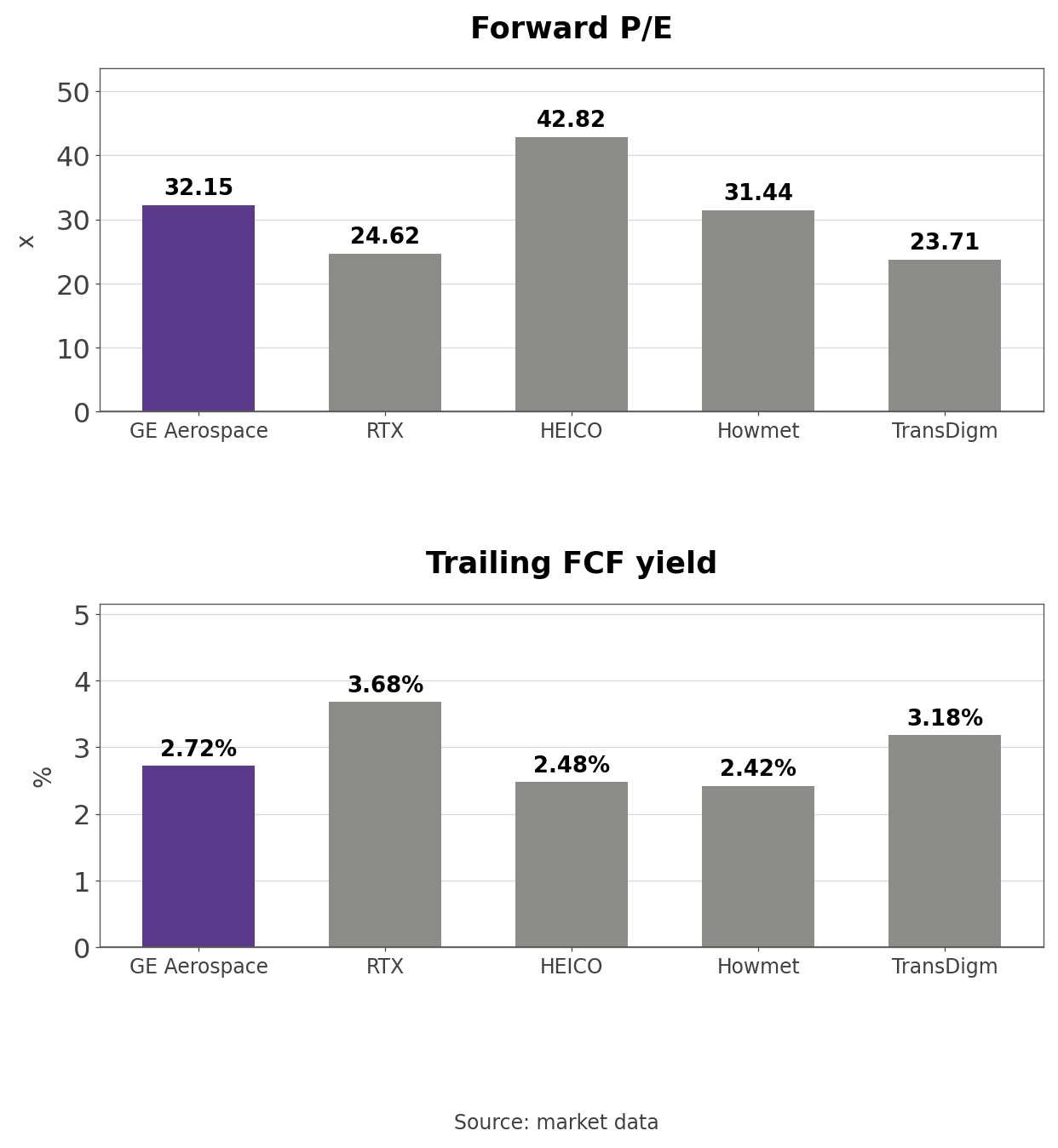
- Own calculation (FCF yield without the allowance build): GE's own trailing free cash flow of $8.49 billion is 2.88% of its market value, or 2.34% at $6.92 billion without the allowance build. On that basis GE yields less than Howmet's 2.42% while trading at 32.15 times forward earnings against RTX's 24.62.
P/E on Adjusted EPS Over 31 Months
- On trailing adjusted EPS of $7.70, GE trades at 37.10 times, the 6th percentile of the 31 months since April 2024, against a median of 47.22. The low was 36.26 in December 2024 and the high 53.65 in February 2026. On GAAP continuing EPS of $8.76 the multiple is 32.61, the 16th percentile, against a median of 38.67.
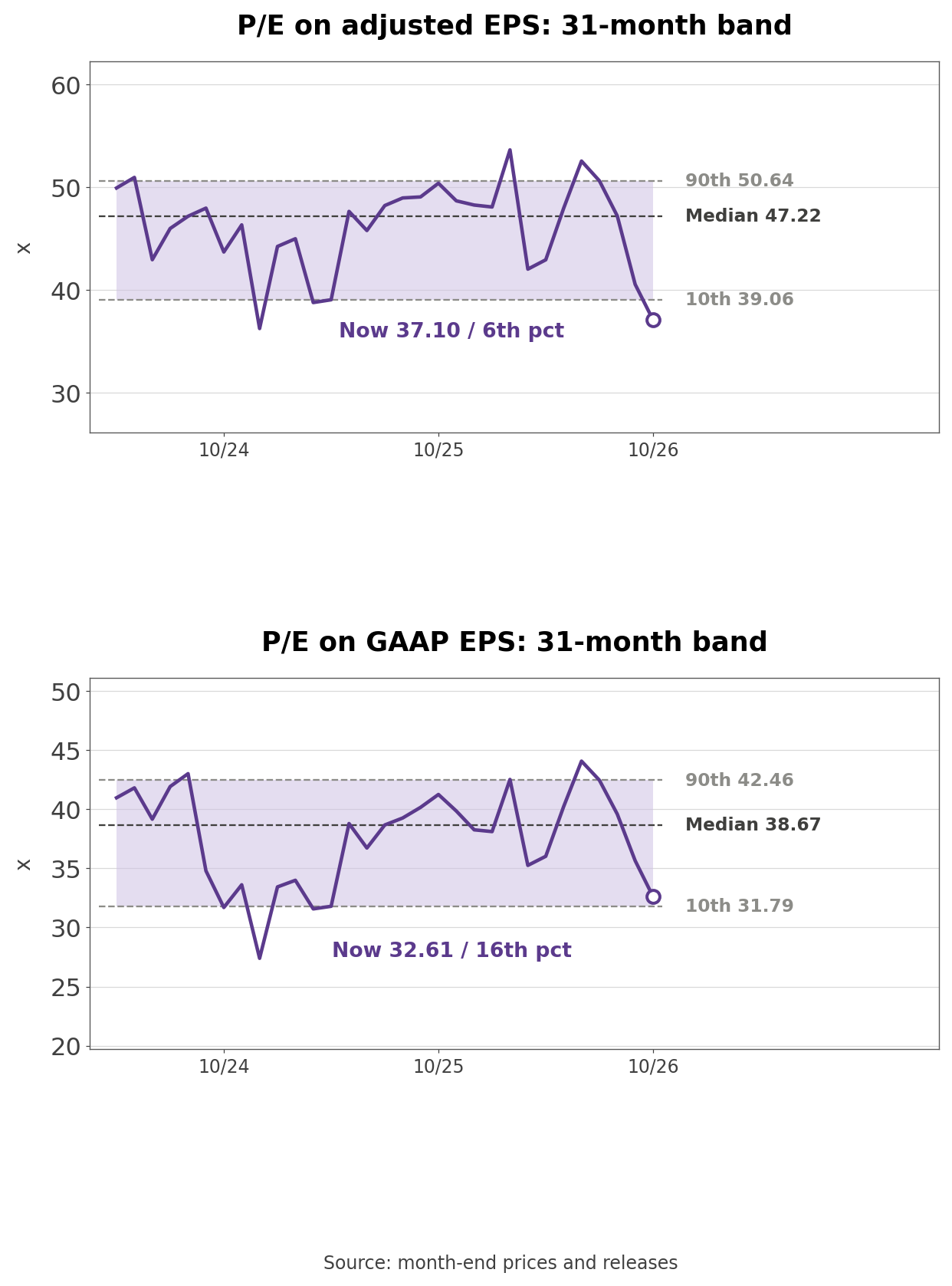
- GAAP EPS runs above adjusted EPS because insurance results, non-operating pension income, and equity mark-to-market sit only in GAAP; fourth-quarter 2025 GAAP EPS was $2.31 against adjusted EPS of $1.57. At the $8.05 guidance midpoint the multiple is 35.48, and on the 2027 estimate of $9.11 it is 31.35. The dividend of $1.88 a year yields 0.66%.
Three Conditions That Move the Stock
- Commercial services growth is in the low 20s for 2026, and the company sees low double digits for 2027. If the 2027 outlook in the January 21 fourth-quarter report holds services near 12% and spare parts delinquency eases, the multiple has room to move back toward its median; a single-digit services outlook would push it lower.
- The sales allowance balance was $5.60 billion at the end of September. Hitting $9.1 billion to $9.4 billion of free cash flow while that balance shrinks in the fourth quarter, as it did in 2024, would show earnings converting to cash; if the balance keeps building to carry free cash flow, the 2.34% yield without the build is the better yardstick.
- CPP will take about $7 billion of cash and $4.75 billion of debt. With nine-month returns at 116.9% of free cash flow, keeping buybacks steady while paying for CPP would push borrowings above $24 billion, while cutting buybacks would shrink the EPS lift that a falling share count has provided.
The 2027 Outlook and Closing the CPP Deal
- The numbers to watch are the 2027 services growth and free cash flow outlook in the January 21 report, the year-end sales allowance balance, and the timing of GE9X midseal certification. CPP is expected to close in the second half of 2027 after regulatory approval.
- One question this piece cannot settle: will the allowances on new engines and spare parts keep building as LEAP deliveries rise, or will they flow out in cash at once as they did in the fourth quarter of 2024?
Related Analysis
- Raytheon (RTX) Stock: EPS Growth Is 18% Without the Refund: Pratt & Whitney's parent and LEAP's rival on the A320neo, useful for comparing how one-time items shape EPS growth at the two engine makers.
- Delta Air Lines (DAL) Stock: 23.6% EPS Guidance Cut on Fuel: a major GE engine customer cutting guidance on fuel costs, the airline side of the departure trends that drive GE's services revenue.
- Booking Holdings (BKNG) Stock: Buybacks Beyond Cash Flow: another company returning more than its free cash flow, a frame for GE's buybacks at 117% of free cash flow ahead of the CPP payment.
#GEAerospace #GEStock #JetEngines #LEAP #AerospaceStocks #Aftermarket #USStocks #StockAnalysis #EquityResearch #GlobalStockBrief
'US Stock Analysis' 카테고리의 다른 글
| Schlumberger (SLB) Stock: Organic Sales Fall and a $4.1B Bet (0) | 2026.10.23 |
|---|---|
| Meta (META) Stock: Negative FCF Meets Non-Voting Class C (0) | 2026.10.23 |
| Tesla (TSLA) Stock: 62% of Q3 Operating Income Was a Refund (0) | 2026.10.22 |
| Raytheon (RTX) Stock: EPS Growth Is 18% Without the Refund (0) | 2026.10.22 |
| Sanofi (SNY) Stock: Dupixent at 44% and Pipeline Write-Offs (0) | 2026.10.22 |


