- Tesla, Inc. (NASDAQ: TSLA) earned $718 million of operating income in the third quarter of 2026, -56% from a year earlier, and the 10-Q shows that a net $447 million of it came from refunds of IEEPA tariffs that the Supreme Court struck down. Without that refund, operating income was $271 million and the operating margin was 0.95%. Revenue held flat at $28.05 billion while the company said capital spending will exceed $20 billion in 2026, so the question is how much of a $1.53 trillion valuation rests on the current business and how much on targets written into the 2025 CEO Performance Award.
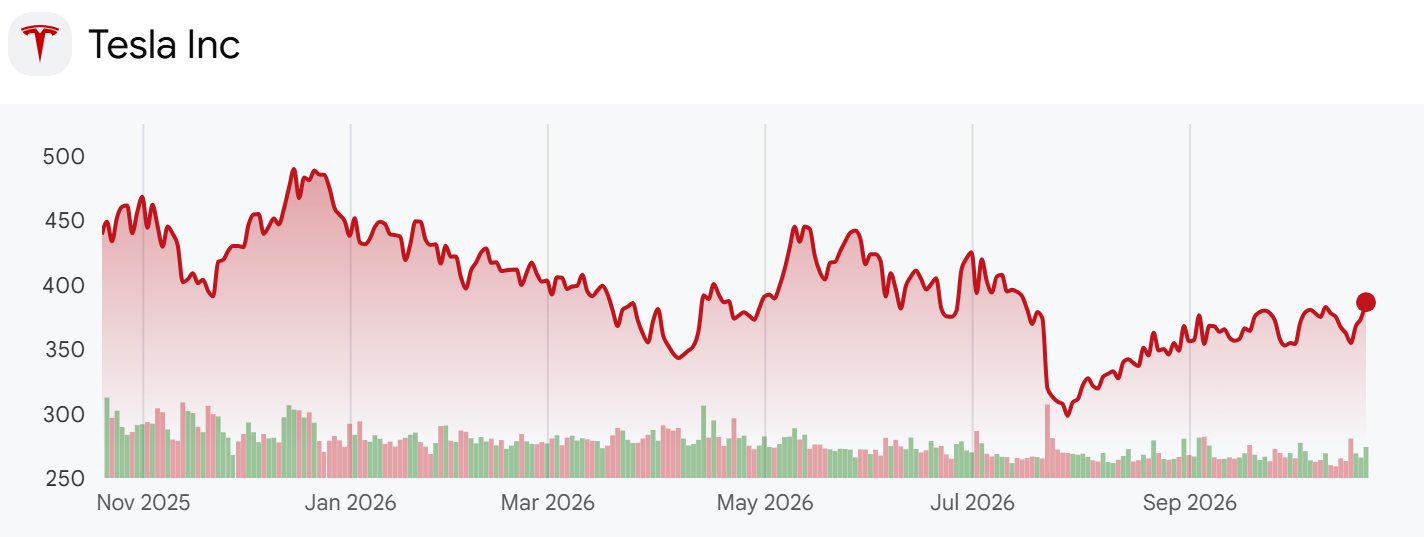
- Tesla sells electric cars, Megapack and Powerwall energy storage, FSD (Supervised) software, and charging, repair, insurance, and used-car services. The shares trade at $386.47, for a market value of $1.528 trillion on 3.953 billion shares outstanding, -19.7% below the weekly high of $481.20 set in the week of December 19, 2025. EPS here is Tesla's non-GAAP measure, which excludes stock-based compensation and mark-to-market gains and losses on digital assets and the SpaceX stake; third-quarter GAAP EPS was $0.22. Per-share figures use 3.541 billion diluted shares, and management's views come from the Update, the 10-Q, and an 8-K.
What the Third-Quarter Update Shows on FSD and Robotaxi
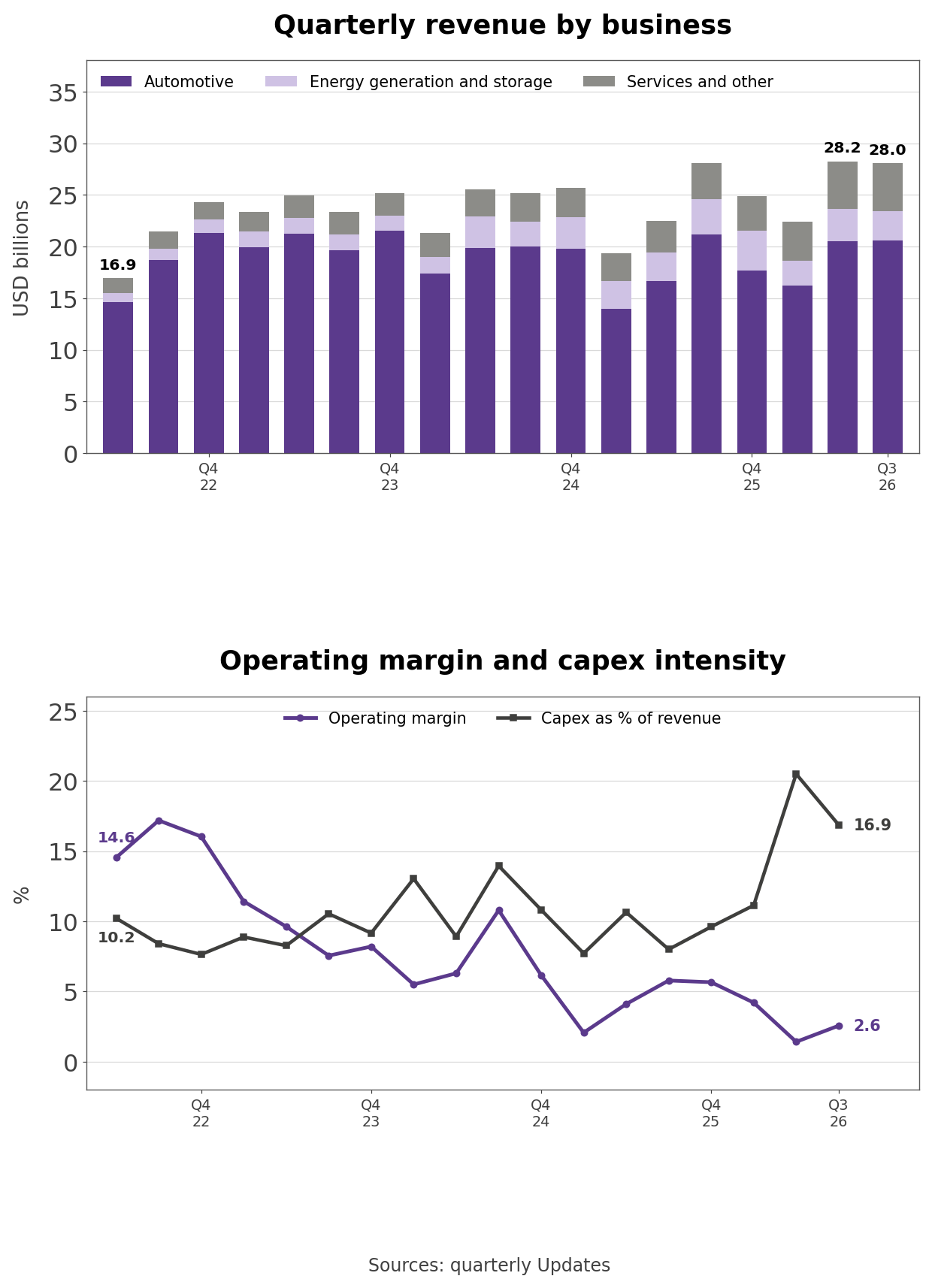
- Page 3 of the third-quarter Update says trailing twelve-month revenue topped $100 billion for a second straight quarter, that the passenger-vehicle backlog is the largest in four years, and that "battery availability continued to be the limiting factor in increasing auto volumes in the quarter." Third-quarter revenue alone, though, was $28.05 billion against $28.10 billion a year earlier. Page 25 lists the reasons: lower energy revenue (partly tariff-related customer refunds), a lower average selling price, fewer regulatory credits, and fewer deliveries, offset by services growth, a $0.3 billion currency benefit, and more FSD subscriptions.
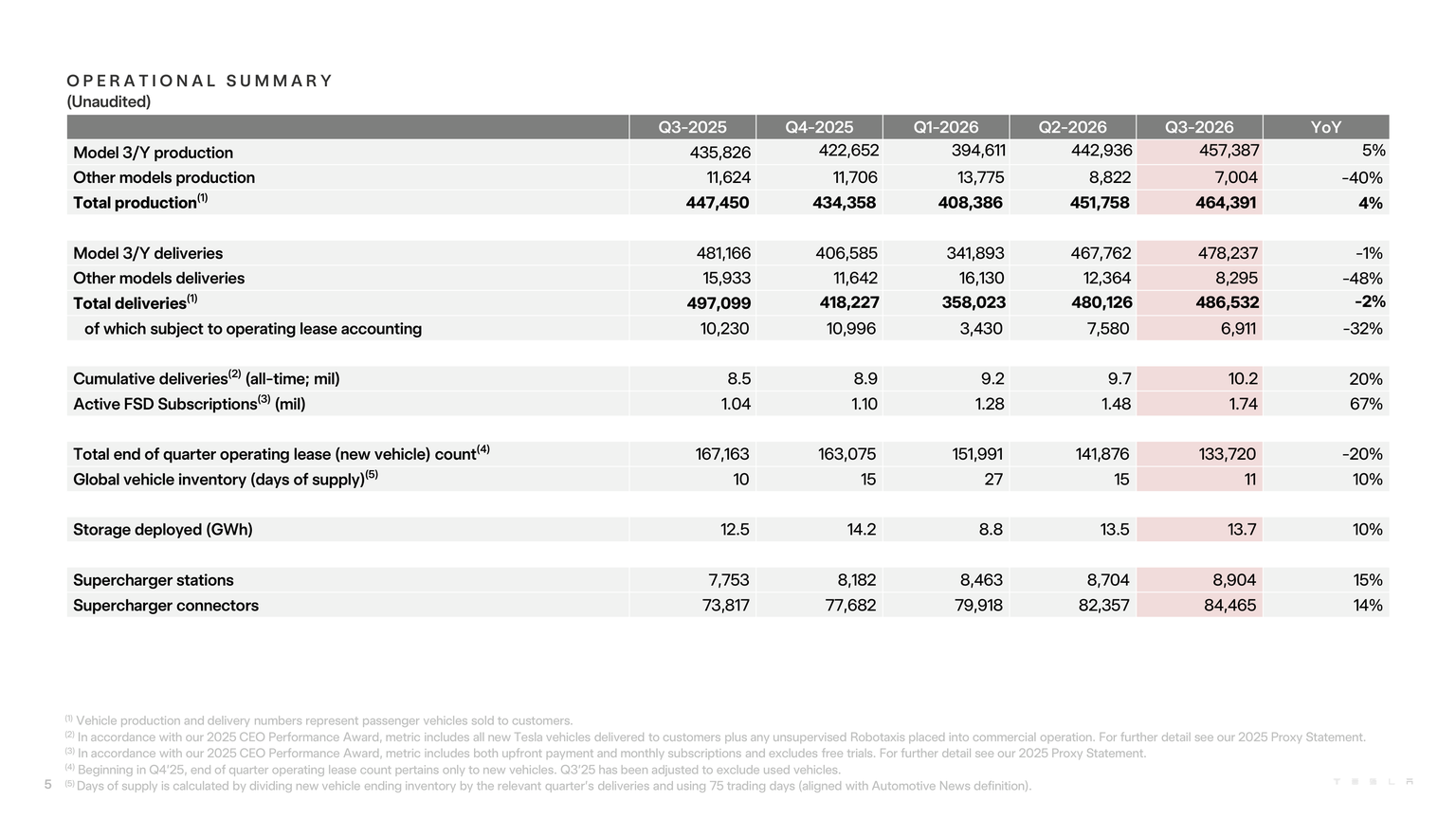
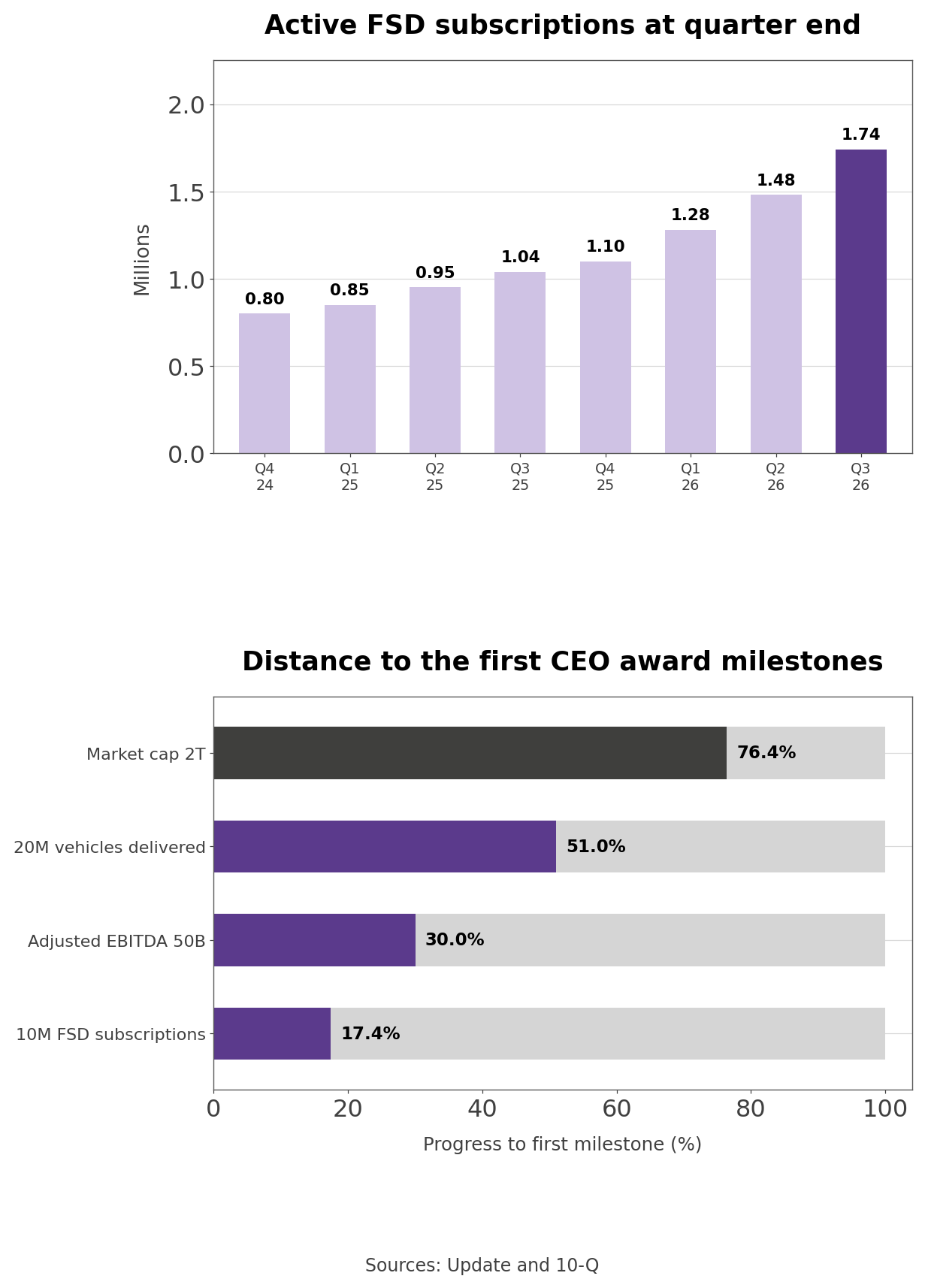
- The operational summary on page 5 places cumulative deliveries of 10.2 million and active FSD subscriptions of 1.74 million directly under production and deliveries. Both rows carry the same footnote: the metric is counted "In accordance with our 2025 CEO Performance Award." Cumulative deliveries include unsupervised Robotaxis placed into commercial operation, and FSD subscriptions combine upfront purchases with monthly plans while excluding free trials. Tesla has used these definitions since the fourth-quarter 2025 Update. Subscriptions rose +67% from 1.04 million a year ago, while deliveries fell -2% to 486,532. Deliveries ran 22,141 units ahead of production, and days of inventory fell from 15 in the second quarter to 11.
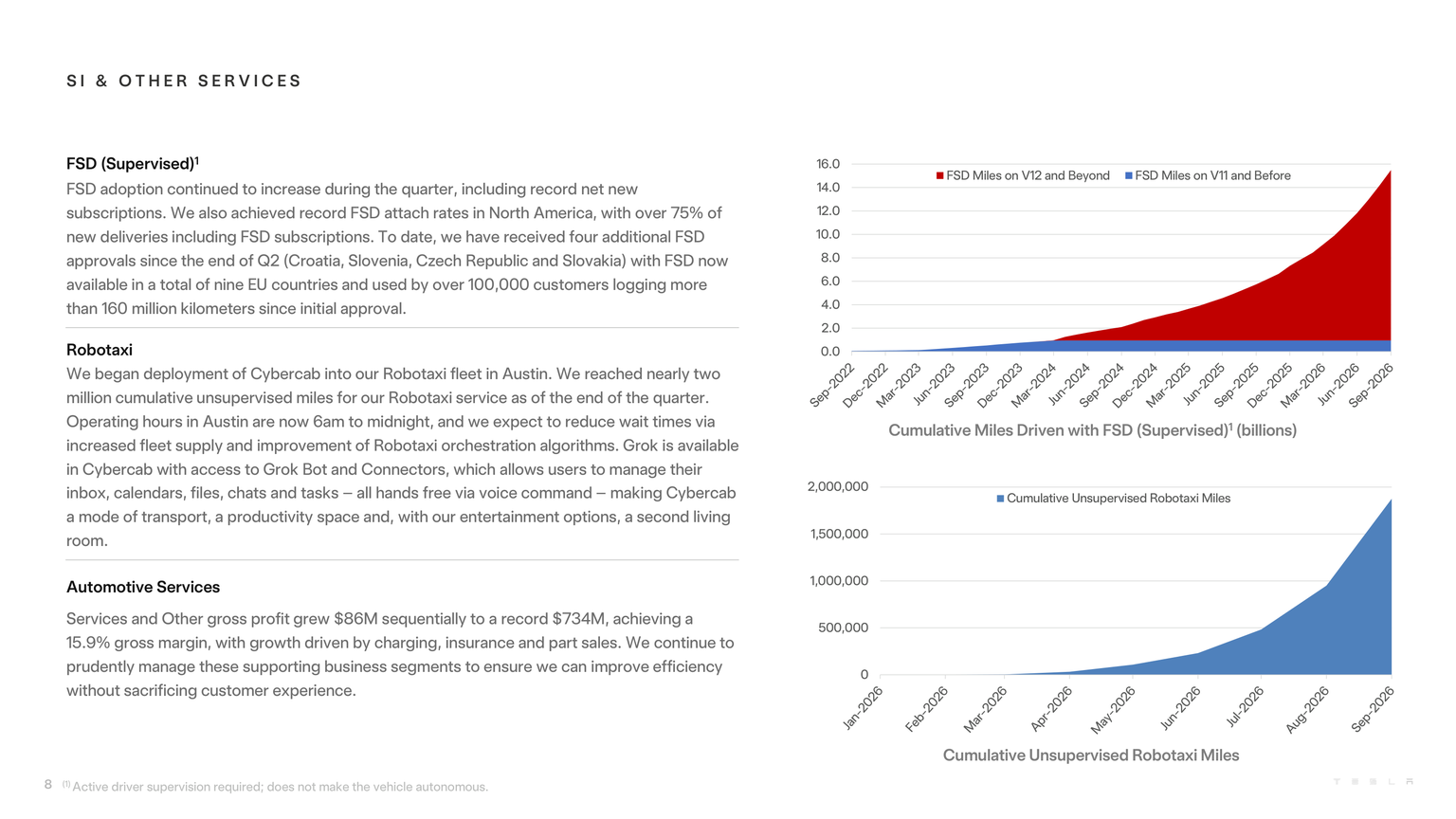
- Page 8 says more than 75% of new North American deliveries included an FSD subscription, and that approvals in Croatia, Slovenia, the Czech Republic, and Slovakia since the end of the second quarter bring the number of EU countries with FSD to nine. The highlights page adds: "We believe that FSD is driving demand in markets where it is available." Robotaxi rides in Cybercabs began in Austin on September 3, and cumulative unsupervised Robotaxi miles reached nearly two million by quarter end, eight times the prior quarter.
- Own calculation (FSD pace): Net new FSD subscriptions were 260,000 in the third quarter. At that pace, reaching the award's 10 million subscription milestone would take 31.8 quarters, and reaching 20 million cumulative vehicles at the trailing four-quarter delivery rate of 1.743 million would take 5.6 years.
SI Compute and Battery Spending in Trailing Cash Flow
- Page 7 says SI (Super Intelligence, Tesla's term for its AI training and inference work) training compute runs above 105 MW at Cortex 1 and above 120 MW at Cortex 2 in Texas and will reach 400 MW by year end. Its chart shows capacity climbing in steps from near zero in 2021 to roughly 270 MW in the third quarter of 2026, with a dotted line to 400 MW. Construction continues on the Austin Fab, where Tesla plans to start commissioning equipment in 2027. The battery list covers more than 40 GWh of 4680 cells, 10 GWh of cathode materials, and 30 GWh of lithium refining in Texas, plus 7 GWh of LFP cells in Nevada, and the first Megapacks built entirely with Tesla's own LFP cells have shipped.
- Page 6 records the start of production at Megafactory Texas (50 GWh), volume production of the Semi in Nevada, and Optimus production in Fremont. On Optimus, Tesla writes that "we have proven that the current manufacturing process for Optimus is suitable for a commercial product," yet the capacity table lists California as early ramp and Texas as under construction, with no unit figures.

- The trailing twelve-month charts on page 24 show deliveries holding between 1.64 million and 1.81 million at all 12 points. Operating cash flow of $18.71 billion is the highest of the 12, but $15.41 billion of capital spending leaves free cash flow of $3.30 billion, down from $5.76 billion a quarter earlier. Adjusted EBITDA of $15.00 billion has stayed between $14.6 billion and $16.6 billion throughout, while GAAP net income has fallen into the $3 billion range since the fourth quarter of 2025 and stands at $3.22 billion. The reconciliation on page 31 shows the gap is mostly $6.70 billion of depreciation, amortization, and impairment and $4.30 billion of stock-based compensation.
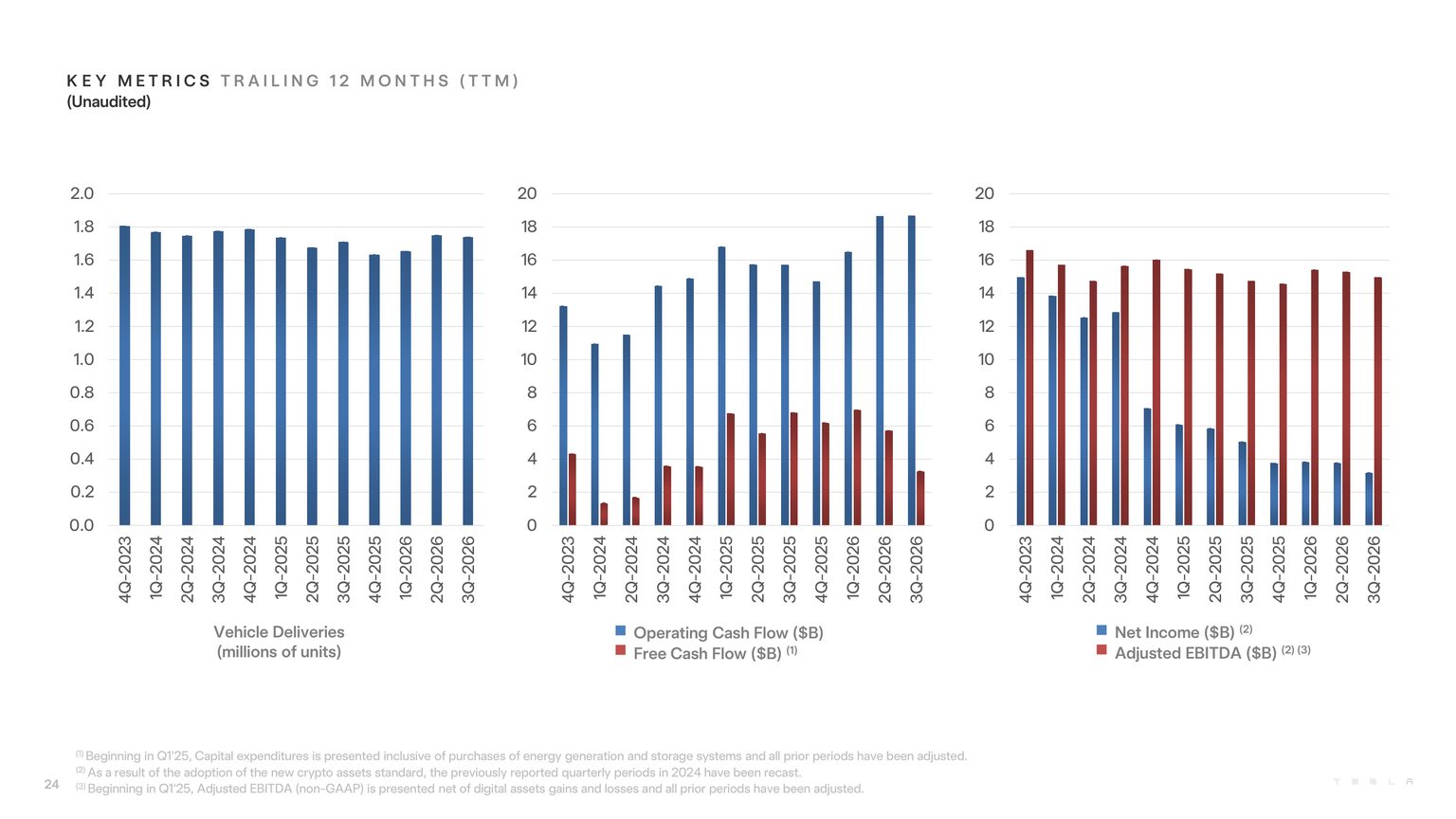
- Company disclosure (Q3 Update outlook, page 9): Tesla is focused on maximum capacity utilization, and deliveries depend on demand, supply chain readiness, and allocation between sales to customers and its own fleet. It will use existing capacity before building new factories, and "over time, we expect our hardware-related profits to be accompanied by an acceleration of SI, software and fleet-based profits."
The Bull and Bear Case Behind Tesla's Valuation
- The bullish case rests on growth rates outside the core car business. FSD subscriptions rose 67%, unsupervised Robotaxi miles grew eightfold in a quarter, and Tesla reported its highest-ever energy storage order rate and backlog. Cash and short-term investments of $45.45 billion compare with $9.52 billion of debt, most of it non-recourse.
- The bearish case starts with current profit. Revenue matched the prior year while research and development rose 69.4% and SG&A rose 29.0%, operating income fell by more than half, and 62.3% of what remained came from the tariff refund. Capital spending in 2026 will be at least 2.35 times the 2025 level, nine-month free cash flow of $1.88 billion is -60.8% from a year earlier.
- Outside view (sell-side research aggregate, October 2026): Of 44 analysts, 15 rate the stock Strong Buy, 4 Buy, 21 Hold, 2 Sell, and 2 Strong Sell, with an average price target of $397.83. The average 2027 EPS estimate is $2.15, down from $2.24 ninety days ago.
- That target sits only 2.9% above the share price, and Hold is the most common rating. The fourth-quarter EPS estimate also slipped from $0.49 to $0.44 within a week.
From Model 3 to Robotaxi and the CEO Award
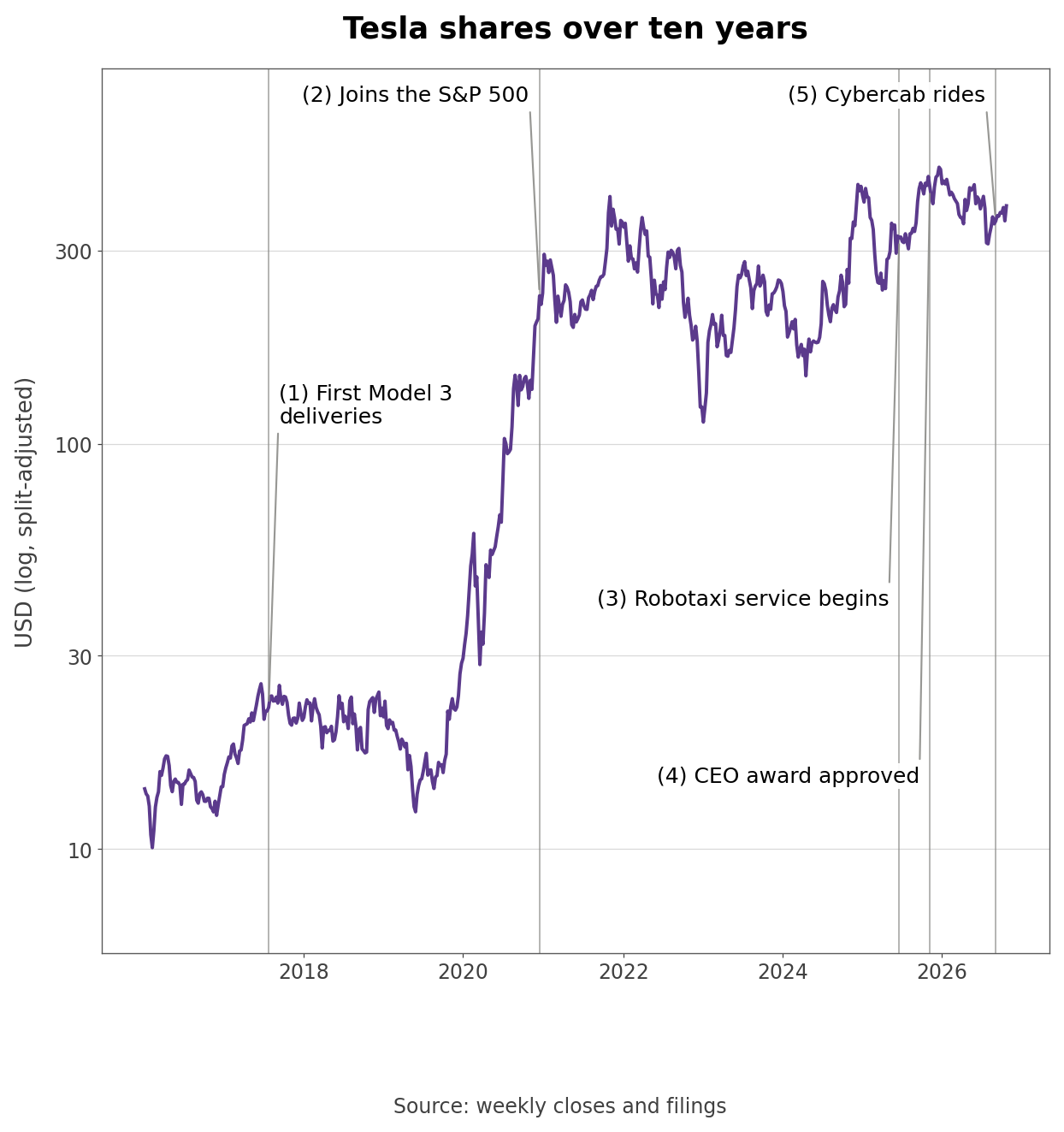
- Tesla was founded in 2003, listed on Nasdaq in 2010, and moved its incorporation from Delaware to Texas on June 13, 2024. On a split-adjusted basis the stock has risen from $14.07 in the first week of 2016 to $386.47, a multiple of 27.47.
- The first turning point was the first Model 3 delivery on July 28, 2017, when a maker of expensive sedans moved into the mass market. The stock gained +719.8% in 2020 and joined the S&P 500 that December, then fell 65.0% in 2022 before gaining 101.7% in 2023 and 73.7% in 2024.
- In 2025 the story changed. Robotaxi service started in Austin in June, and on November 6 shareholders approved the 2025 CEO Performance Award of 423.7 million restricted shares. The stock, at $429.52 in the week of the vote, peaked six weeks later at $481.20. In 2026 Tesla ended Model S and Model X production, converted a planned preferred investment in xAI into $2.00 billion of SpaceX common stock in March, and started Cybercab rides in September. The shares have fallen 18.7% in 2026.
How Much Operating Profit Is Left Without the Tariff Refund?
- Note 11 of the third-quarter 10-Q says Tesla recognized IEEPA tariff refunds of $526 million as a reduction to energy cost of revenues and $260 million as a reduction to automotive cost of revenues, and it cut energy revenue by $339 million for refunds owed to certain storage customers. Amounts in the first half were immaterial. The Update's revenue bridge mentions the customer refunds, but its list of operating income drivers does not mention the cost-side refunds.
- Own calculation (refund-free operating profit): The $786 million of cost refunds less $339 million of customer refunds leaves a net $447 million, or 62.3% of third-quarter operating income of $718 million. Without it, operating income was $271 million, down 83.3% from $1.624 billion, for a margin of 0.95%. At the quarter's 15.9% effective tax rate the refund is worth about $376 million after tax, or $0.11 a share, which would put non-GAAP EPS near $0.37 instead of $0.48, about 17.8% below the $0.45 consensus.
- Energy changes the most. Adding back the customer refunds, energy revenue was $3.22 billion, -5.7% year over year, and gross margin falls from a reported 33.1% to 23.8%, below 31.4% a year ago. The automotive gross margin excluding regulatory credits, which the Update puts at 18.1%, drops to 16.8% without the $260 million refund, still +1.4 points above 15.4% a year earlier. Total GAAP gross margin falls from 19.6% to 17.8%, about where it was a year ago at 18.0%.
- Costs did the rest. Research and development reached $2.761 billion, +69.4%, rising from 5.8% to 9.8% of revenue, and the 10-Q cites SI, Optimus, silicon, battery, and new vehicle programs plus higher stock compensation. SG&A rose 29.0%, and $870 million of its $1.65 billion nine-month increase was stock compensation, primarily from the CEO award. Regulatory credit revenue fell -72.9% from $417 million to $113 million.
The 2025 CEO Performance Award and Stock Compensation
- The 10-Q describes the award as 12 tranches of 35,311,992 restricted shares. Tranche n is earned when the market value reaches its milestone, $2.0 trillion rising in $0.5 trillion steps to $6.5 trillion and then $7.5 trillion and $8.5 trillion, and when any n of 12 operational milestones are met. Those milestones are 20 million vehicles delivered, 10 million active FSD subscriptions, 1 million bots delivered, 1 million Robotaxis in commercial operation, and adjusted EBITDA of $50 billion, $80 billion, $130 billion, $210 billion, $300 billion, and $400 billion three times. Market value is measured on both six-month and 30-day trailing averages.
- Company disclosure (Q3 10-Q, CEO award note): As of September 30, the only operational milestone considered probable is 20 million vehicles delivered. Unrecognized compensation tied to it is $9.74 billion, to be expensed over 8.9 years, and Tesla recorded $275 million in the quarter and $802 million over nine months. For the milestones considered not probable, unrecognized compensation is $105.82 billion to $120.37 billion. Earned shares vest after 7.5 or 10 years, and unless the CEO pays in cash, vested shares are reduced by an offset of $334.09 per share.
- Own calculation (award progress): Against the first operational milestones, cumulative deliveries are 51.0% of the way, FSD subscriptions 17.4%, and trailing adjusted EBITDA 30.0% ($15.00 billion against $50 billion). The $1.528 trillion market value is 30.9% short of the first $2.0 trillion milestone, equal to a share price of $505.98. The unrecognized expense for the not-probable milestones equals 32.9 to 37.4 times trailing GAAP net income of $3.22 billion.
- Once another milestone is judged probable, the expense for that tranche starts flowing into GAAP earnings; non-GAAP EPS leaves it out. Third-quarter stock compensation was $1.165 billion, +75.7%, and the trailing $4.30 billion equals 28.7% of trailing adjusted EBITDA. Because the award's EBITDA definition also adds back stock compensation, larger award expense does not slow progress toward its EBITDA milestones. The Update gives no count of bots or commercial Robotaxis, so those two milestones cannot be measured.
Capital Spending Plans and New Credit Facilities
- The 10-Q says Tesla expects "capital expenditures to be in excess of $20 billion in 2026," driven first by SI compute infrastructure and data centers. Spending through September was $13.01 billion, already above the $8.53 billion spent in all of 2025, so the fourth quarter alone needs at least $6.99 billion. Capital spending was 16.9% of third-quarter revenue against 8.0% a year earlier.
- Third-quarter operating cash flow of $6.26 billion included a $3.99 billion increase in payables and accrued liabilities and a $1.26 billion increase in deferred revenue. Those two items total $5.25 billion, or 83.8% of operating cash flow.
- The September 29 8-K and the 10-Q describe new credit lines: a $20 billion three-year delayed-draw term loan whose undrawn commitments shrink to zero after 18 months, plus revolving facilities of $8 billion over five years and $2 billion over 364 days. The $30 billion total replaces a $5 billion revolver and may be used for general corporate purposes. A company holding $45 billion of cash and investments has added a $20 billion facility that lapses if it is not used within 18 months.
How Tesla Earns Revenue Across Three Businesses
- Revenue comes from three lines. Of $94.83 billion in 2025, automotive was 73.3%, energy generation and storage 13.5%, and services and other 13.2%; by region the United States was 50.2%, China 22.1%, and the rest of the world 27.7%. Revenue fell 2.9% in 2025 as automotive declined 9.8% and energy grew 26.6%, and in the third quarter the mix was 73.3% automotive, 10.3% energy, and 16.4% services.
- Automotive revenue has three parts, vehicle sales, regulatory credits, and leasing, and sales of $20.09 billion dominate. Almost all of it is Model 3 and Model Y: 478,237 of 486,532 third-quarter deliveries, while other models fell 48% to 8,295 after Model S and Model X were retired. Shanghai holds 42.2% of at least 2.25 million units of Model 3 and Y capacity across California, Shanghai, Berlin, and Texas, and annualized third-quarter Model 3 and Y output of 1.83 million is at most 81.3% of it.
- FSD, sold upfront or monthly, is booked in vehicle sales, which fell only 1% despite fewer deliveries thanks to a weaker dollar and higher FSD revenue. The line-up now reaches the Semi, a next-generation Roadster unveiled in October, and the Cybercab, while the Optimus humanoid robot has no revenue line yet. Tesla sells directly without dealers and runs its own service and charging networks.
- The energy business sells Megapack utility-scale storage, Powerwall home batteries, and solar. Storage deployments rose +10% to 13.7 GWh, and Megapack capacity totals 110 GWh across California, Shanghai, and Texas. SpaceX is a customer: the related-party note shows $221 million of Megapack revenue in the quarter, 7.7% of energy revenue, and $626 million over nine months, with $729 million receivable from SpaceX at quarter end.
- Services and other covers used cars, out-of-warranty repair and collision work, paid Supercharging, insurance, and parts. Revenue rose 32.5% to $4.61 billion at a 15.9% gross margin. The network reached 8,904 Supercharger stations and 84,465 connectors, 14% more than a year ago. Tesla also holds $2.00 billion of SpaceX common stock at cost, carried at a fair value of $2.87 billion.
Tesla Against Four Other Automakers

- Trailing twelve-month revenue was $319.7 billion at Toyota, $188.0 billion at Ford, $187.0 billion at GM, $103.6 billion at Tesla, and $5.9 billion at Rivian. Growth was 14.2% at Rivian, +8.3% at Tesla, 7.2% at Toyota, 1.5% at Ford, and -0.3% at GM. Tesla's revenue is 14.9% of the Toyota, GM, and Ford total, yet its market value is 4.5 times theirs combined.
- Multiples sit in a different range. Price to sales is 14.77 for Tesla (on shares outstanding), 3.07 for Rivian, 0.72 for Toyota, 0.34 for GM, and 0.25 for Ford, so Tesla's ratio is 33.8 times the average of the three incumbents. Forward P/E is 184.43 for Tesla, 14.24 for Toyota, 6.79 for Ford, and 5.43 for GM, while Rivian has no earnings. Over one year Tesla shares fell -15.4% while GM gained 11.1%.
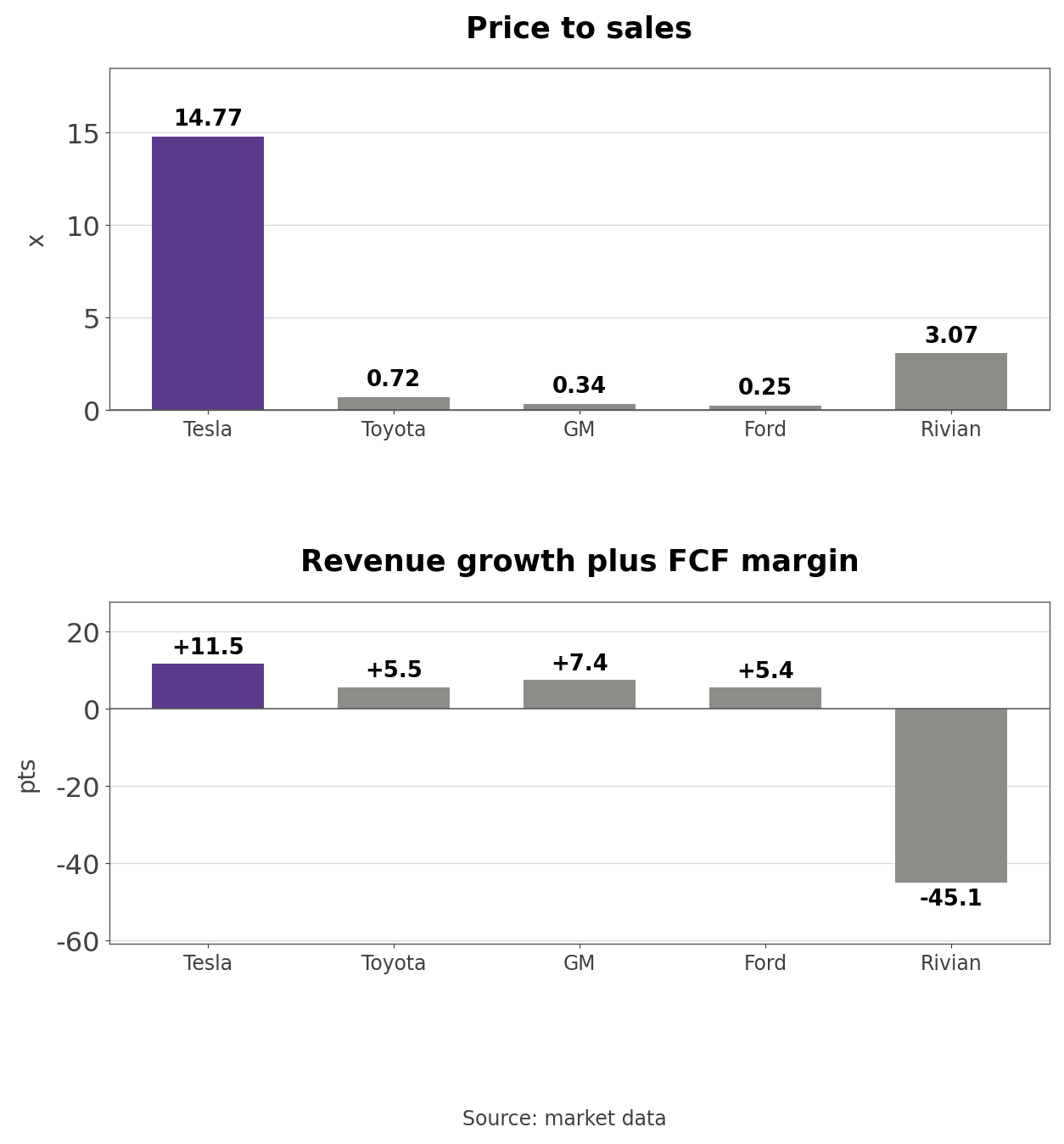
- This piece uses the Rule of 40, revenue growth plus free cash flow margin, because Tesla is priced as a growth company, and a growth company should either grow fast or throw off cash. Toyota, GM, and Ford run dealer networks and captive finance arms, while Rivian, like Tesla, builds only electric vehicles and sells them directly.
- Own calculation (Rule of 40): Adding revenue growth to free cash flow margin, derived from the aggregator's free cash flow yield times market value divided by revenue, gives 11.5 for Tesla, 7.4 for GM, 5.5 for Toyota, 5.4 for Ford, and -45.1 for Rivian. Tesla's 3.2% margin matches trailing free cash flow of $3.30 billion over revenue of $103.57 billion in the Update. Tesla scores highest of the five but far from 40.
P/E on Non-GAAP EPS Over 44 Months
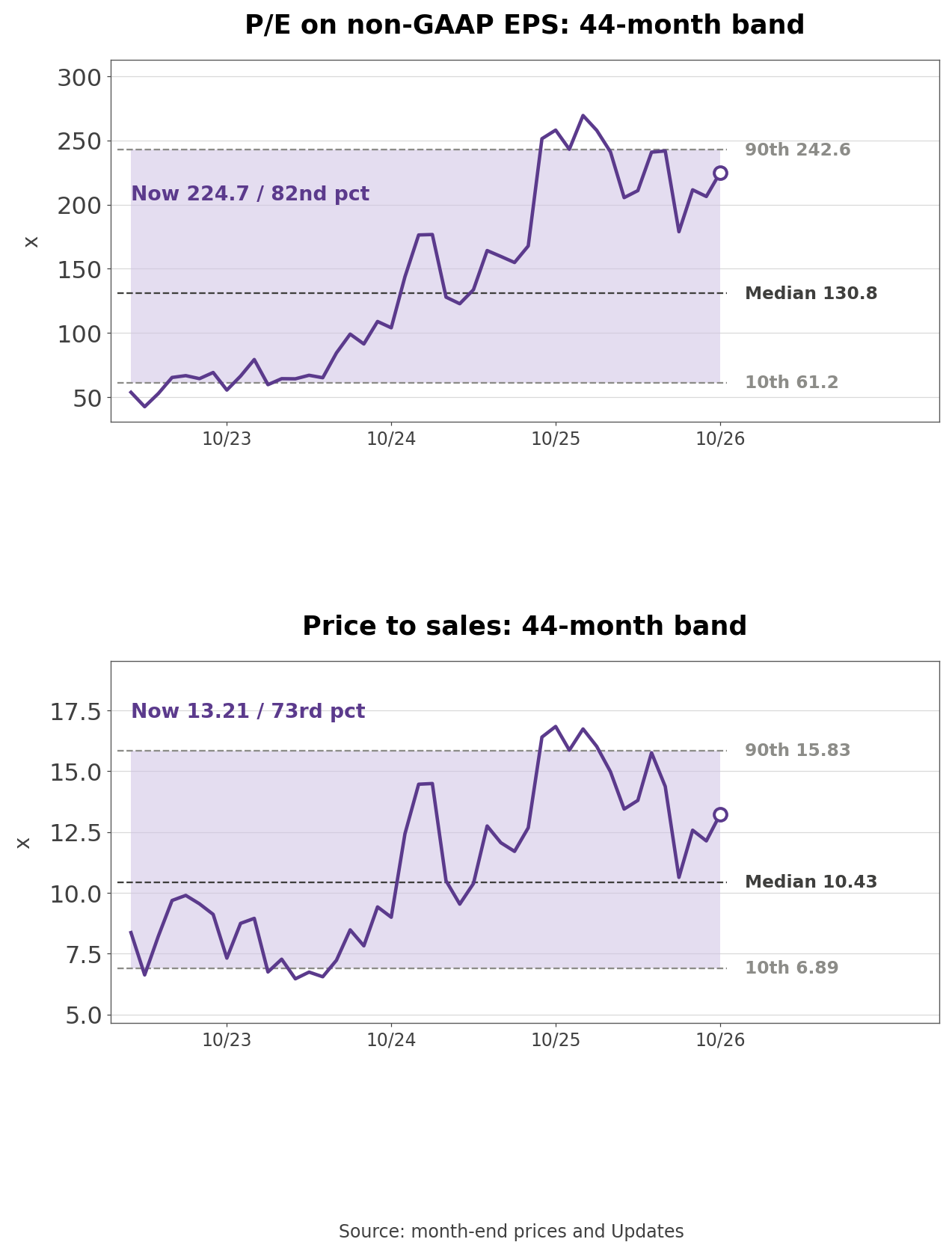
- On trailing non-GAAP EPS of $1.72, Tesla trades at 224.69 times, the 82nd percentile of the 44 months since March 2023, against a median of 130.83. The low was 42.68 times in April 2023 and the high 269.29 times in December 2025. Price to sales is 13.21, at the 73rd percentile, against a median of 10.43.
- The band uses weighted diluted shares, the same denominator as EPS, while the peer figure of 14.77 uses shares outstanding, which include the unvested award stock. On 2027 estimated EPS of $2.15 the multiple is 179.8, and on trailing GAAP EPS of $0.91 it is 424.7. Taking the $0.11 after-tax refund out of trailing EPS leaves $1.61 and a P/E of 240.0.
Three Conditions That Move the Stock
- The refund-free operating margin was 0.95% in the third quarter, with research and development at 9.8% of revenue. If, in quarters without refunds, the automotive margin excluding credits clears the 16.8% refund-free level and energy margin moves back toward last year's 31.4%, core profit starts catching up with spending; if the operating margin stays near 1%, little in current earnings supports a multiple above 220.
- Net FSD subscription additions were 260,000 in the third quarter. Faster additions and more European approvals would shorten the path to 10 million, and if Tesla starts reporting how many Robotaxis are in commercial operation, a second milestone becomes measurable. Slower additions would weaken the metric that both the award and the valuation lean on.
- Fourth-quarter capital spending needs to reach at least $6.99 billion to meet the full-year outlook. If operating cash flow covers it without help from working capital, the credit lines can stay undrawn; if free cash flow turns negative and term loan draws begin, the premise of a company with $35.9 billion more cash than debt changes.
The SpaceX Special Committee and the 2027 Capex Plan
- The next numbers to watch arrive with the fourth-quarter Update in late January: actual capital spending, the 2027 investment plan, a refund-free operating margin, and net FSD additions.
- The 10-Q also says the board has formed a special committee of disinterested directors to explore a deeper relationship with SpaceX, which could include a business combination. Any transaction would need the committee's affirmative recommendation and any required shareholder approval, and the filing says "there is no assurance that any such Transaction will be consummated."
- One question this piece cannot settle: if a combination with SpaceX goes ahead, whose numbers will the award's $2.0 trillion market value milestone and $50 billion adjusted EBITDA milestone be measured against?
Related Analysis
- Uber (UBER) Stock Analysis: Gross Bookings vs Revenue Gap: the ride-hailing economics a Tesla Robotaxi network would have to match.
- Oracle (ORCL) Stock Analysis: Cash Flow and Capex Gap: another AI capex build that outran free cash flow, a frame for Tesla's $20 billion year.
- NVIDIA (NVDA) Stock Analysis: Guarantees and Cash Flow: the supply side of AI compute, a frame for what Tesla's 400 MW of SI training capacity costs.
#TSLA #TSLAStock #Tesla #EVStocks #Robotaxi #IEEPA #USStocks #StockAnalysis #EquityResearch #GlobalStockBrief
'US Stock Analysis' 카테고리의 다른 글
| Raytheon (RTX) Stock: EPS Growth Is 18% Without the Refund (0) | 2026.10.22 |
|---|---|
| Sanofi (SNY) Stock: Dupixent at 44% and Pipeline Write-Offs (0) | 2026.10.22 |
| Delta Air Lines (DAL) Stock: 23.6% EPS Guidance Cut on Fuel (0) | 2026.10.21 |
| Vertex (VRTX) Stock: 96% CF Revenue and a $10B Deal (0) | 2026.10.20 |
| T-Mobile (TMUS) Stock: Phone Metrics It Stopped Reporting (0) | 2026.10.19 |


