
- Vertex Pharmaceuticals (NASDAQ: VRTX) grew second-quarter 2026 revenue +12% to $3.334 billion and raised its full-year revenue guidance from $12.95 billion to $13.1 billion up to $13.1 billion to $13.2 billion. Non-GAAP EPS rose only +4.6% to $4.73. On July 6 it agreed to buy Crinetics Pharmaceuticals, an endocrinology drugmaker, for an equity value of about $10.0 billion in cash, and the deal closed on September 1.
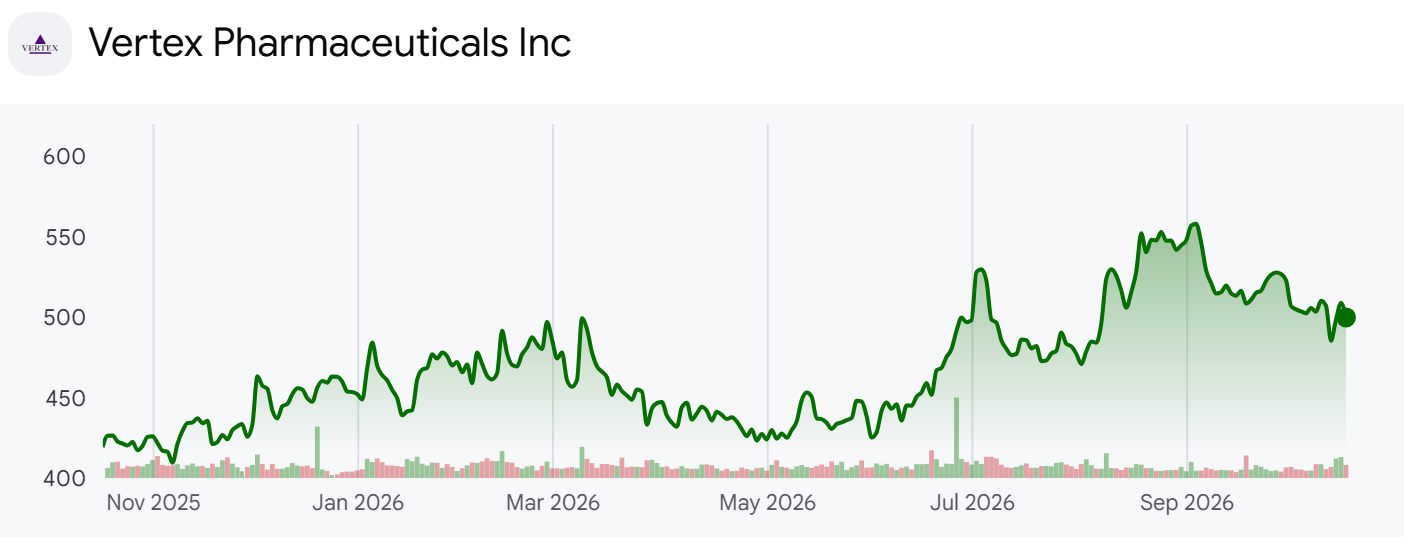
- Vertex is a Boston biotech whose cystic fibrosis (CF) medicines produced 96.2% of second-quarter product revenue. The stock trades at $499.74 for a market value of $126.66 billion. On a weekly basis it peaked at $548.05 in the week of August 21 and now sits -8.8% below that level, while still +17.4% higher than a year ago.
- This piece follows seven years of January revenue guidance against actual revenue, built from 35 quarterly earnings releases, and the mark two acquisitions have left on non-GAAP EPS. Third-quarter results, the accounting for Crinetics, and updated guidance are not out yet; they are due in early November. EPS here is Vertex's non-GAAP measure, which since 2022 has included acquired in-process R&D.
What Vertex's Second-Quarter Deck Says About Crinetics
- Page 11 of the August 3 results presentation is titled "Vertex to acquire Crinetics Pharmaceuticals for $10B (~$8.8B net of cash)." The price is $85 a share in cash, and the slide puts the combined peak sales opportunity of the acromegaly drug Palsonify and the Phase 3 congenital adrenal hyperplasia candidate atumelnant at more than $5 billion. It describes Palsonify as the first once-daily oral therapy for adults with acromegaly, launched in the US in October 2025 with strong early uptake, and notes that atumelnant has also shown potential in Cushing's syndrome in Phase 2.
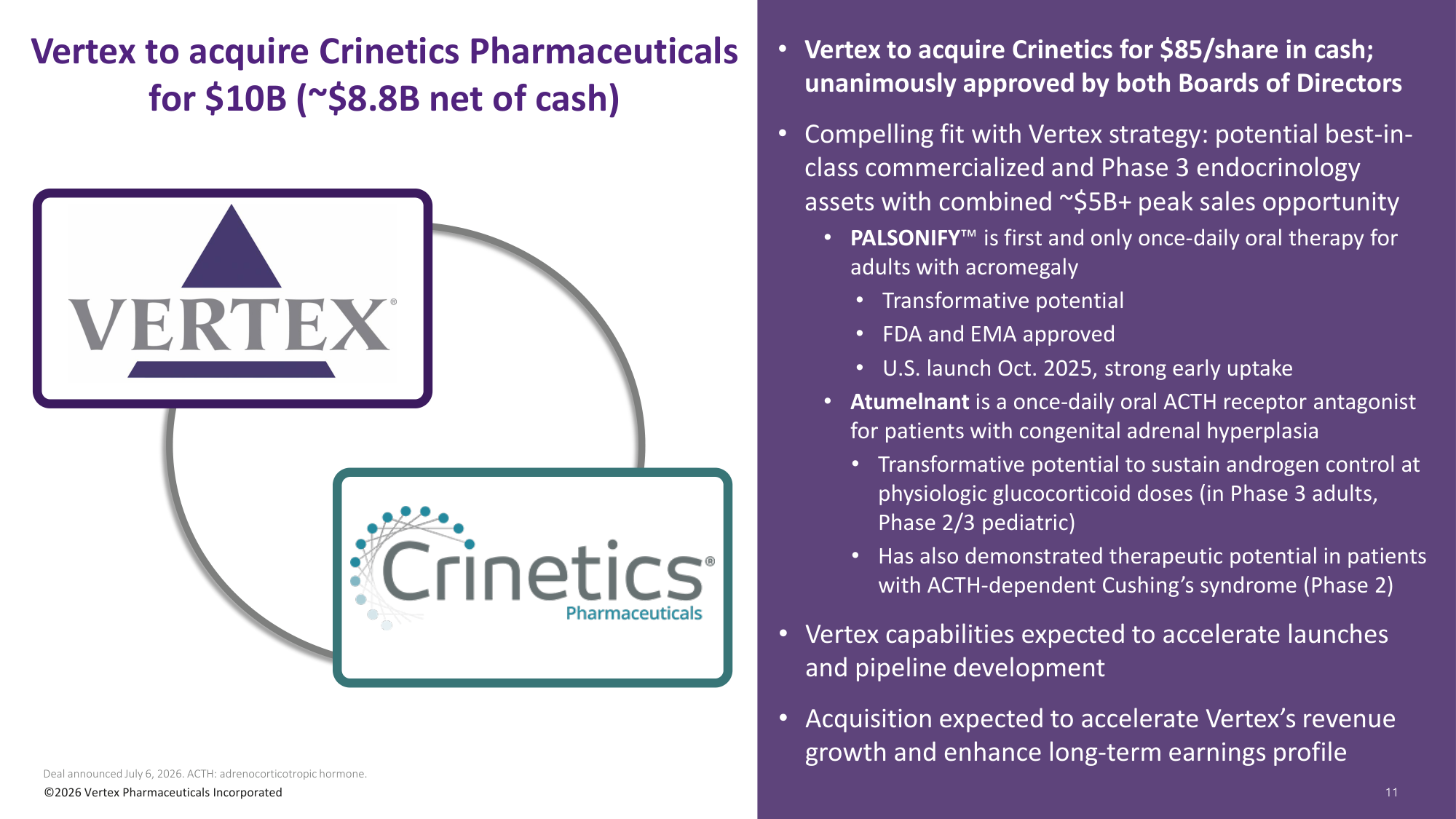
- Company disclosure (July 6 deal presentation and second-quarter call): The deal accelerates revenue growth and improves the long-term earnings profile. It is "Expected to become accretive to non-GAAP operating income in 2029." Funding comes from cash on hand and a $4.5 billion term loan. Given the closing date, the effect on 2026 revenue and costs is modest, and guidance will be updated at closing.
- Crinetics' own second-quarter release shows the scale. Revenue was $25.1 million, of which Palsonify contributed $24.0 million, up from $10.3 million in the first quarter. The net loss was $120.9 million, and cash stood at $1.2 billion at the end of June. Crinetics received 245 enrollment forms in the quarter, counted 385 prescribers in its first three launch quarters, and reported more than 70% of patients on reimbursed therapy. It spent $99.9 million on R&D and $57.6 million on SG&A, and it withdrew its guidance after the deal was announced.
- Own calculation (Crinetics losses against Vertex income): Crinetics' second-quarter net loss of $120.9 million equals 10.0% of Vertex's non-GAAP net income of $1.207 billion and is almost exactly Vertex's second-quarter net interest income of $120.6 million. The $8.8 billion net price is 64.7% of the $13.6 billion of cash and investments Vertex held at the end of June.
- The second-quarter 10-Q describes the $4.5 billion term loan signed on July 30: $1.0 billion due after one year, $1.0 billion after two years, and $2.5 billion after three, priced at SOFR plus 0.875 to 1.625 points. Under the July 8-K, Crinetics would have owed a $350.5 million termination fee had it walked away for a better offer.
Alyftrek Switching and the Non-CF Revenue Goal
- Page 13 says the newest CF drug, Alyftrek, passed a $1 billion first-half revenue milestone. The product table in the release adds up to $998.0 million, so the slide rounds up. The same page says most US Alyftrek revenue comes from patients switching from Trikafta, and that more than one in three eligible patients in the UK and Germany now take it.
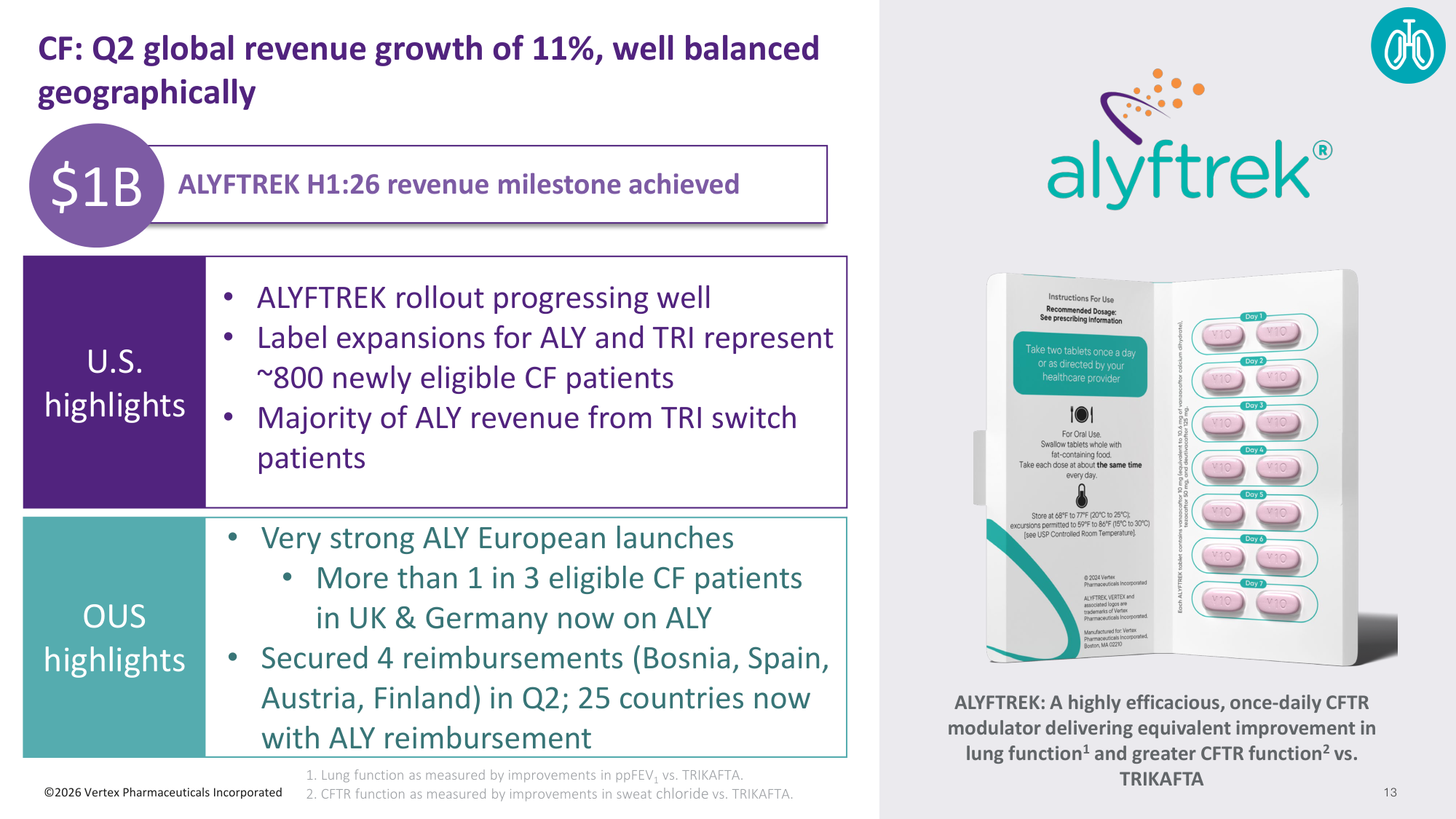
- The second-quarter table shows the weight of that switch. Alyftrek reached $573.6 million, 17.9% of CF revenue, while Trikafta fell -2.1% to $2.497 billion. CF revenue overall rose +10.6%. On the call, Vertex said first-half CF growth of 8% included a prior-year US price increase and currency, and that both would contribute less in the second half.
- Page 14 calls Casgevy's progress an acceleration "towards multi-$B potential," and its second-quarter revenue of $76.4 million was +78% above the first quarter. Page 15 says Journavx is "On track to deliver >3x Rx growth and >3x revenue growth 2026 vs 2025," with about 18,000 new prescribers in the quarter and about 260 million covered lives.

- Own calculation (what the non-CF goal requires): Three times 2025 Journavx revenue of $59.6 million is $178.8 million, which leaves $100.2 million needed in the second half after $78.6 million in the first. For the company's $500 million non-CF goal, first-half Casgevy and Journavx revenue of $197.9 million leaves $302.1 million for the second half, a quarterly average of $151.1 million that is 19.9% above the second quarter's $126.0 million. Management added that heavy use of a free-drug bridge program, needed while insurance coverage catches up with prescriptions, delays normal Journavx revenue recognition to the first half of 2027.
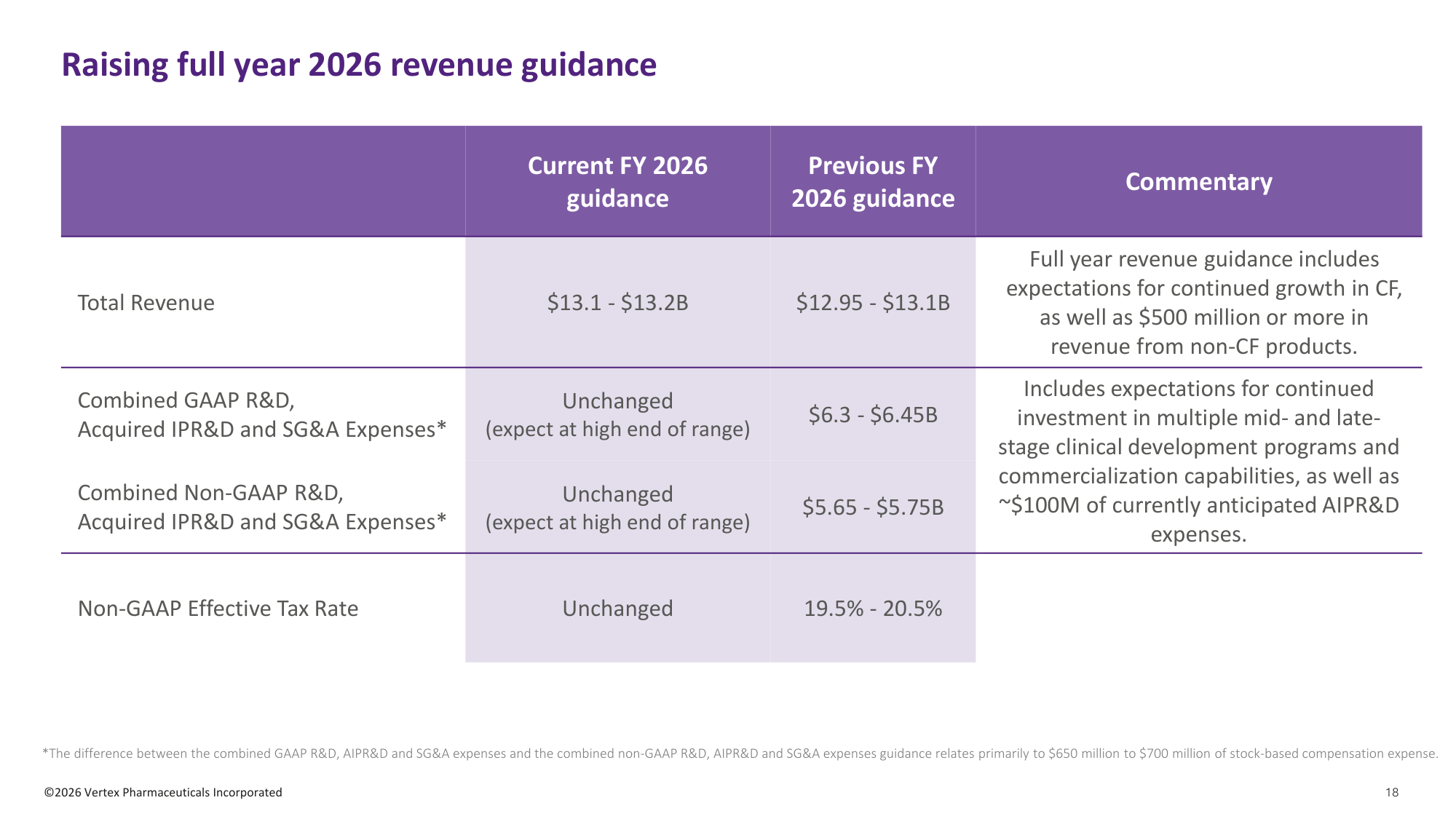
- Page 18 raises revenue guidance to $13.1 billion to $13.2 billion, keeps non-CF revenue at $500 million or more, and says non-GAAP operating expenses will land at the high end of their range. A footnote says expense guidance includes about $100 million of acquired IPR&D, and Crinetics is not yet in any of it.
The Market Case for Vertex
- The bullish case is that Alyftrek extends the CF franchise again while cash from it builds pain, blood disorder, kidney, and endocrine businesses. Povetacicept, the kidney drug that came with the 2024 Alpine acquisition, has a US decision date of November 30. The bearish case starts with 96% of revenue still tied to one disease, non-CF revenue at only $126 million a quarter, and acquisition and sales-force costs that slow earnings growth before new products pay off.
- Outside view (sell-side research aggregate, October 2026): Of 56 analysts, 47 rate the stock Buy, 8 Hold, and 1 Sell, with a 12-month price target of $573. The 2026 non-GAAP EPS estimate fell from $19.03 ninety days earlier to $17.83.
From Trikafta to the Crinetics Deal
- The October 2019 US approval of the triple-combination CF drug Trikafta changed the scale of the company. Revenue went from $4.163 billion in 2019 to $6.206 billion in 2020, up +49.1%, and grew between 8.9% and 22.1% a year through 2025. From a weekly close of $73.67 in December 2016, the stock rose 7.4 times to its August 2026 peak.
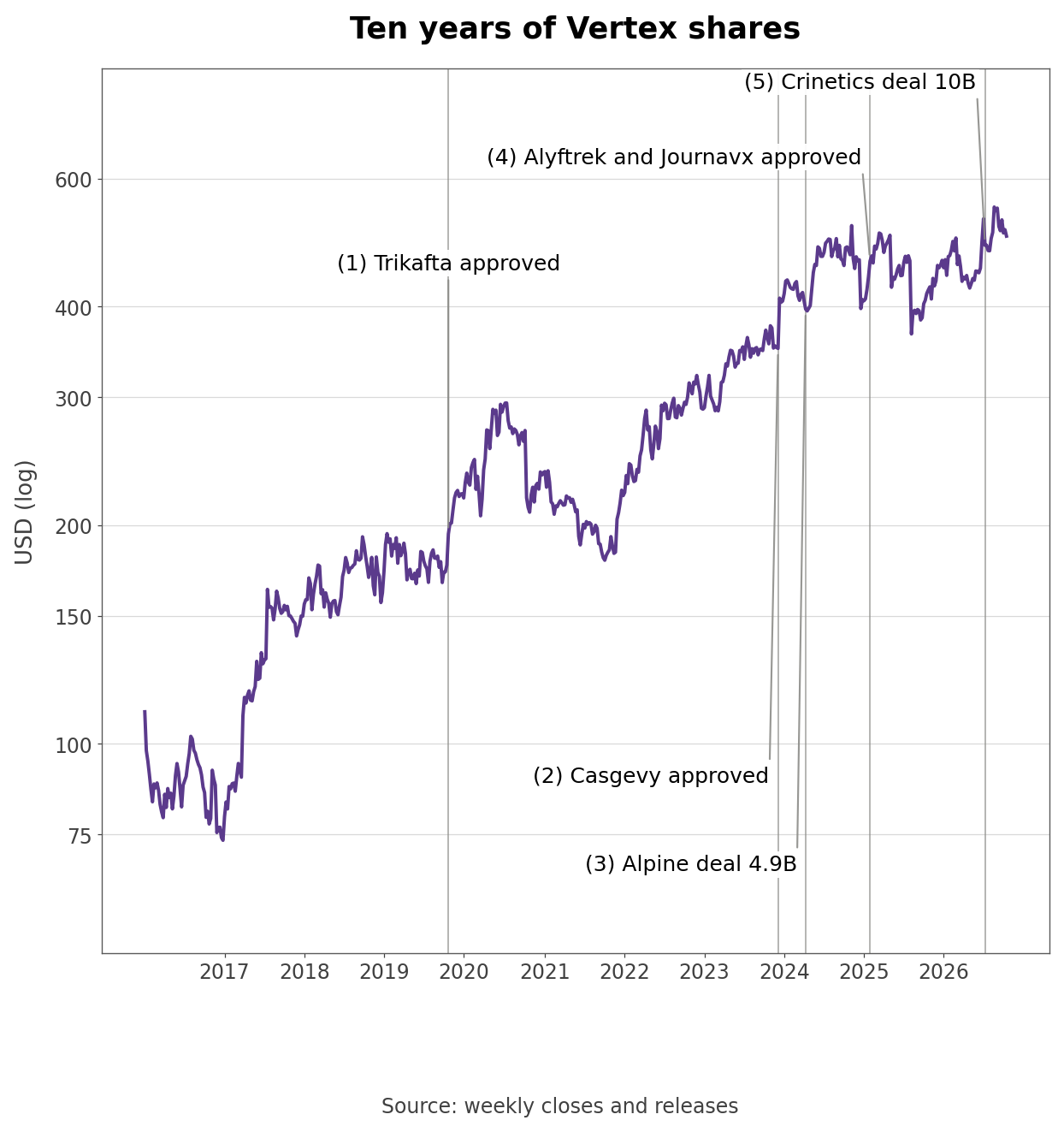
- The push beyond CF began with the December 2023 approval of Casgevy, a gene-edited cell therapy. In April 2024 Vertex bought Alpine Immune Sciences for $65 a share, about $4.9 billion, and expensed $4.4 billion of acquired IPR&D in the second quarter. Alyftrek and Journavx were approved in December 2024 and January 2025. In the week Vertex announced the Crinetics deal, the stock fell -8.1%.
How Far Has Vertex Beaten Its January Revenue Guidance?
- From 2020 through 2025, Vertex finished every year at or above the top of its January revenue guidance and raised the range two or three times a year. The margin over the top of the January range shrank from +17.1% in 2020 to 9.8% in 2021, 3.8% in 2022, 1.7% in 2023, and 2.5% in 2024. In 2025 actual revenue of $12.001 billion met the $12.0 billion top almost exactly.
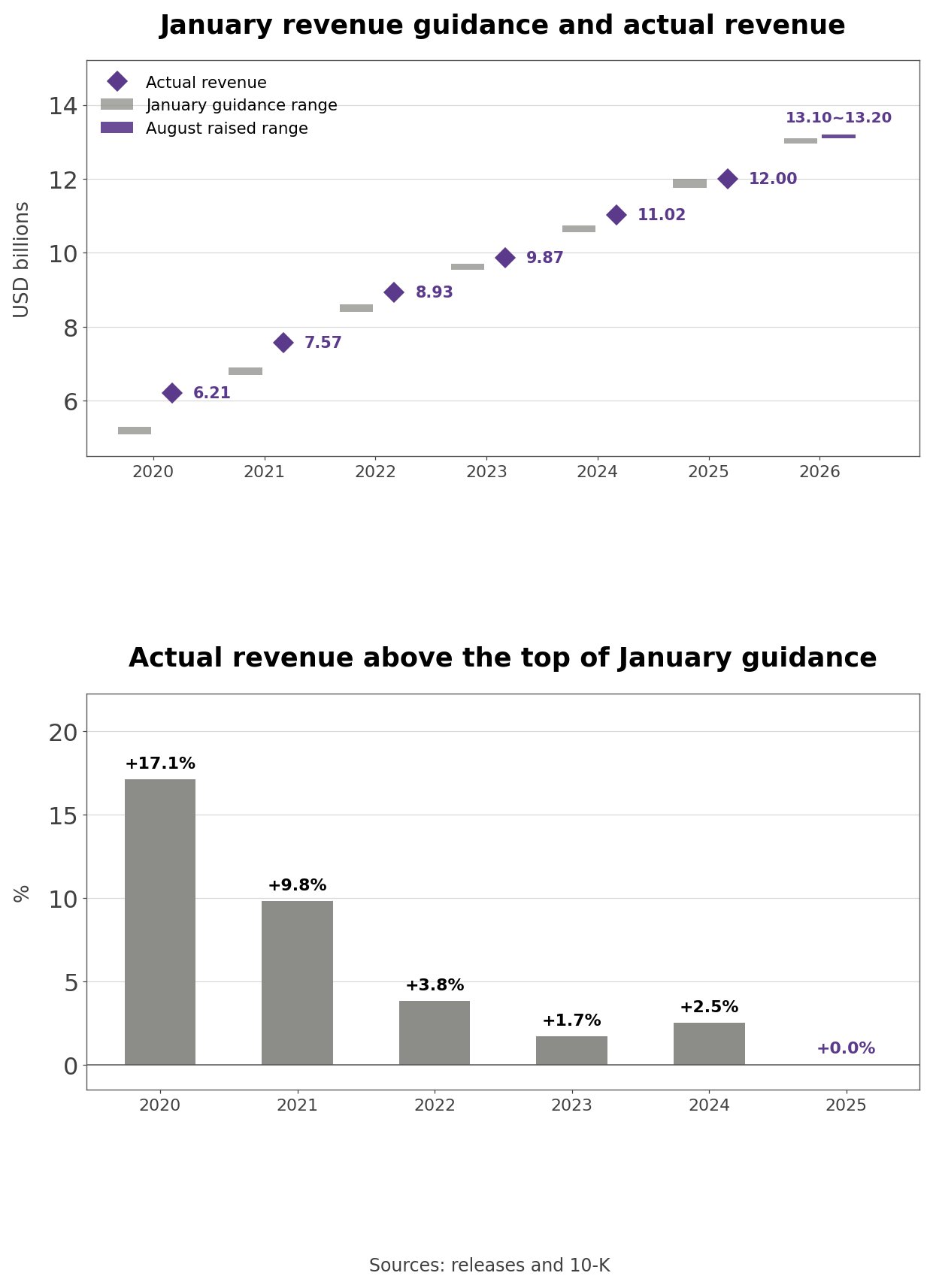
- In 2026, guidance went from $12.95 billion to $13.1 billion in January to $13.1 billion to $13.2 billion in August, lifting the midpoint 1.0%. The guidance basis was product revenue through 2024 and total revenue from 2025.
- Subtracting first-half revenue of $6.321 billion, the full-year range implies second-half revenue of $6.779 billion to $6.879 billion. That is 8.2% to 9.8% above the second half of 2025, slower than first-half growth of 10.2%, consistent with management's comment that price and currency tailwinds fade.
Cystic Fibrosis Revenue Moving From Trikafta to Alyftrek
- Quarterly CF revenue rose from $2.691 billion in the first quarter of 2024 to $3.208 billion in the second quarter of 2026. Trikafta peaked at $2.721 billion in the fourth quarter of 2024, dropped to $2.355 billion in the first quarter of 2026, and recovered to $2.497 billion. Alyftrek climbed from $53.9 million in the first quarter of 2025 to $573.6 million, while the three older CF drugs fell from $193.7 million to $137.1 million over the past year.
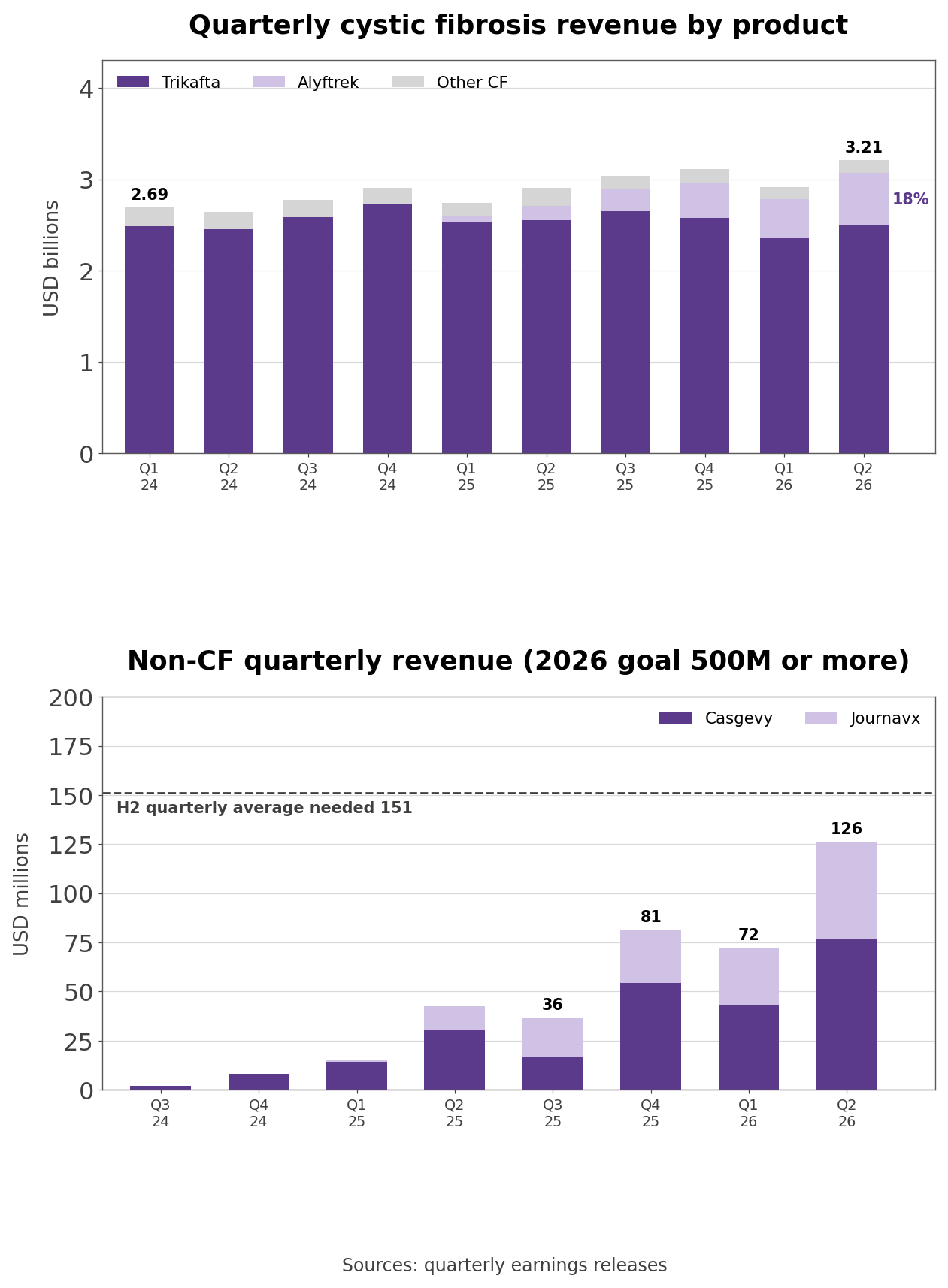
- Non-CF revenue started with $2 million from the first Casgevy infusions in the third quarter of 2024 and reached $126.0 million in the second quarter of 2026, or 3.8% of product revenue.
Why Non-GAAP EPS Grew Slower Than Revenue
- Second-quarter non-GAAP net income rose 3.2% to $1.207 billion, and a lower diluted share count of 255.2 million, down from 258.9 million, lifted EPS growth to 4.6%. Non-GAAP SG&A rose +45% to $520 million, which management split roughly evenly between the pain and kidney sales forces, while non-GAAP R&D rose 1% to $889 million. GAAP EPS rose 8.0% to $4.31.
- The non-GAAP gross margin of 85.6% was lower than in the first quarter because higher-cost Casgevy is a growing share and manufacturing investment is rising, and Vertex expects the full-year figure just under 86%. The non-GAAP operating margin slipped from 45% to 43%.
- The top of the 2026 non-GAAP expense guidance, $5.75 billion, is 12.3% above 2025's $5.12 billion, while the revenue guidance midpoint of $13.15 billion is 9.6% above 2025. Quarterly non-GAAP EPS growth ran 9.6% in the third quarter of 2025, 26.4% in the fourth, 10.1% in the first quarter of 2026, and 4.6% in the second.
How Acquired IPR&D Runs Through Vertex's Non-GAAP EPS
- Since the first quarter of 2022, Vertex has not excluded upfront and milestone payments for collaborations, asset acquisitions, and licenses from non-GAAP earnings. The Alpine charge therefore drove second-quarter 2024 non-GAAP EPS to -$12.83, and full-year 2024 non-GAAP EPS was $0.42, -97.2% below 2023's $15.23. GAAP EPS for 2024 was -$2.08.
- Crinetics will be accounted for in the third quarter. The 10-Q says only that the deal will be recorded in the period it closes, without saying whether it is a business combination or an asset acquisition. Under US GAAP, IPR&D bought in an asset acquisition with no alternative future use is expensed immediately, while in a business combination it is capitalized along with goodwill.
- Analyst estimates show the split. The average third-quarter non-GAAP EPS estimate fell from $4.90 ninety days ago to $0.04, with a range of -$29.51 to $5.25.
- Own calculation (what the low estimate assumes): Multiplying the lowest estimate of -$29.51 by 255.2 million diluted shares gives about $7.53 billion, which would mean expensing 85.6% of the $8.8 billion net deal price in a single quarter.
How Vertex Makes Money Beyond Cystic Fibrosis
- Vertex's CF drugs correct the function of the CFTR protein that causes the disease instead of treating symptoms. CF is an inherited disease in which thick mucus builds up in the lungs and digestive tract. Vertex says its medicines can treat about 95% of people with CF in core markets, from infants as young as one month, in more than 60 countries. The lineup is Trikafta (Kaftrio in Europe), once-daily Alyftrek, and the older Symdeko, Orkambi, and Kalydeco. Vertex says Alyftrek matches Trikafta on lung function and delivers greater CFTR function, and a Phase 3 study in children aged 2 to 5 brought 65% below the carrier-level sweat chloride threshold of 30 mmol/L.
- In the second quarter, US revenue rose 11% to $2.06 billion and revenue outside the US rose 14% to $1.28 billion, so 61.8% came from the US. Currency added about 1.7 points to growth. Alyftrek is reimbursed in 25 countries, and the next-generation corrector VX-828 has proof-of-concept data due in the second half.
- Three products sit outside CF. Casgevy, approved in 39 countries, edits a patient's own stem cells outside the body with CRISPR/Cas9 to treat sickle cell disease and transfusion-dependent beta thalassemia; a July US label expansion to children aged 2 and older added about 5,500 eligible patients, and patient initiations topped 100 for a third straight quarter. Journavx, a non-opioid NaV1.8 pain blocker, had about 535,000 prescriptions in the second quarter after about 550,000 in all of 2025, split evenly between hospitals and retail, with about 300 sales reps.
- Povetacicept, a dual BAFF and APRIL inhibitor for IgA nephropathy, targets about 330,000 US patients; Vertex has hired a kidney sales force, 90% of whom have nephrology experience. Crinetics adds two once-daily oral small molecules that Vertex says offer attractive margins. Vertex calls CF, blood disorders, pain, kidney, and endocrine its five disease-area pillars, and says Crinetics completed its 2023 goal of five launches in five years early.
- Capital goes to deals and buybacks. Vertex repurchased 1.8 million shares for $799.5 million in the first half, has $2.6 billion left under its authorization, and pays no dividend.
How Vertex Compares With Four Large Biotech Peers
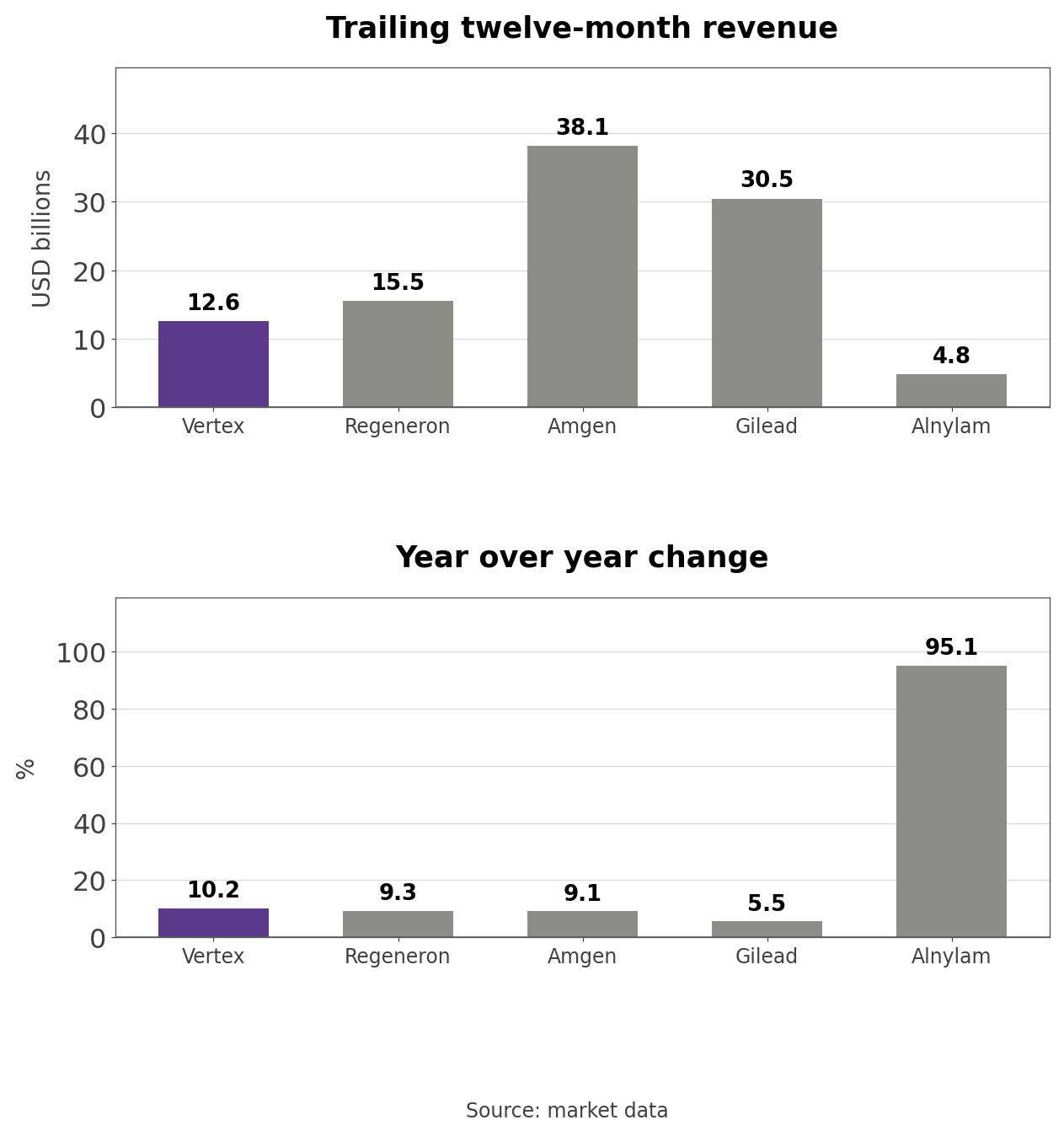
- Over the trailing twelve months, revenue was $38.1 billion at Amgen, $30.5 billion at Gilead, $15.5 billion at Regeneron, $12.6 billion at Vertex, and $4.8 billion at Alnylam. Leaving aside Alnylam's 95.1%, growth sits in a narrow band: Vertex 10.2%, Regeneron 9.3%, Amgen 9.1%, and Gilead 5.5%. Regeneron has more revenue than Vertex but a market value of $78.96 billion, 62.3% of Vertex's.
- Vertex carries the richest multiples. Its price to sales of 10.06 times compares with 6.46 for Alnylam, 6.36 for Gilead, 6.14 for Amgen, and 5.08 for Regeneron, and its forward P/E of 34.48 is 2.8 times Regeneron's 12.34. Over one year, Amgen rose +48.9%, Gilead 33.6%, Regeneron 21.9%, Vertex 17.4%, and Alnylam fell -49.2%.
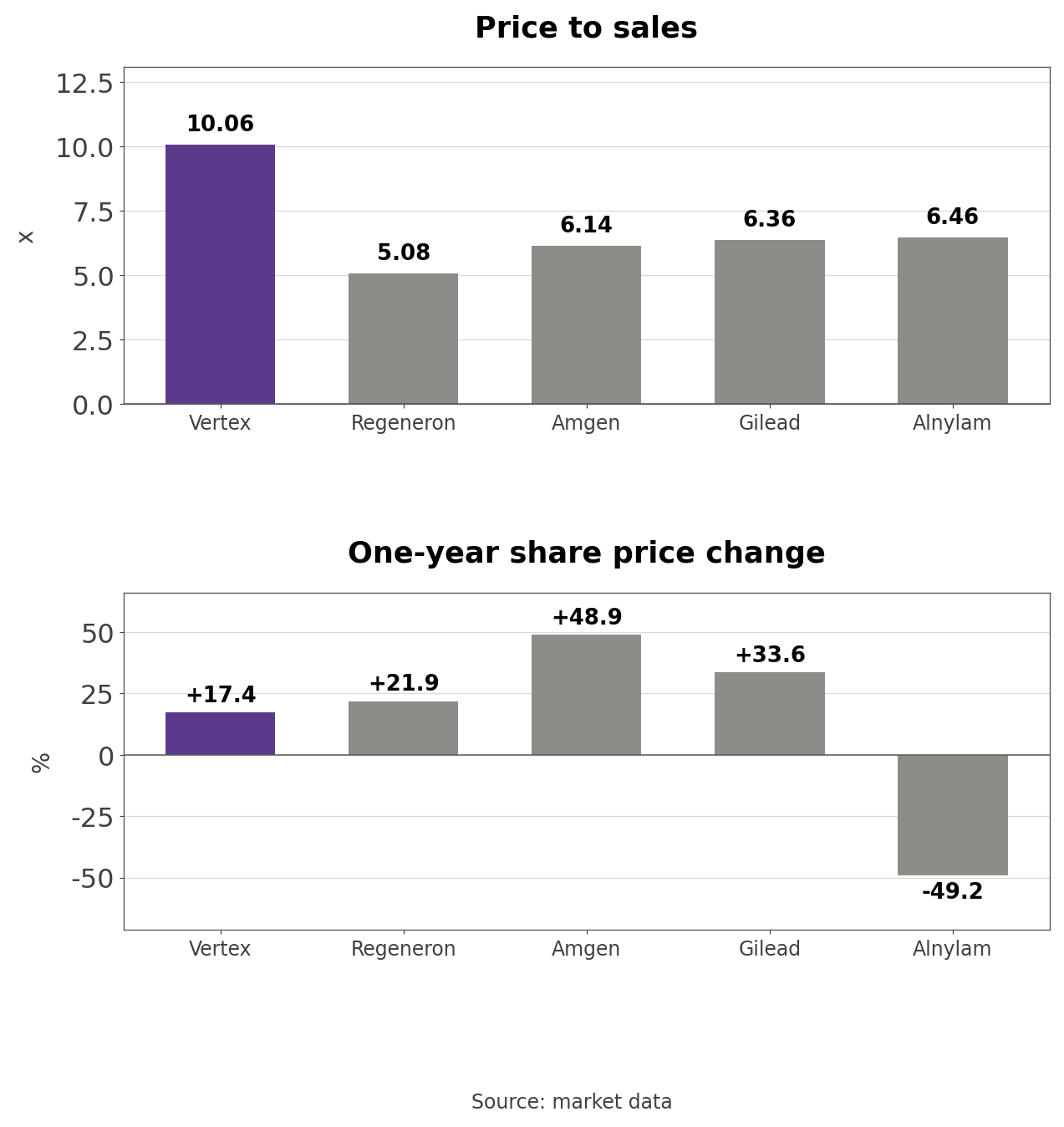
- Own calculation (growth-adjusted price to sales): Dividing price to sales by revenue growth gives 0.99 for Vertex, 1.16 for Gilead, 0.67 for Amgen, and 0.55 for Regeneron. Against peers growing at similar rates, Vertex is 1.5 to 1.8 times more expensive, a gap that CF durability and the acquired pipeline have to justify. Gilead's trailing GAAP loss leaves it without a meaningful trailing P/E.
VRTX P/E on Non-GAAP EPS Over 70 Months
- On trailing non-GAAP EPS of $19.03, Vertex trades at 26.26 times, at the 84.5th percentile of the 58 valid months in a 70-month window, against a median of 22.63 times. Price to sales of 10.13 times is above its 9.52 times median.
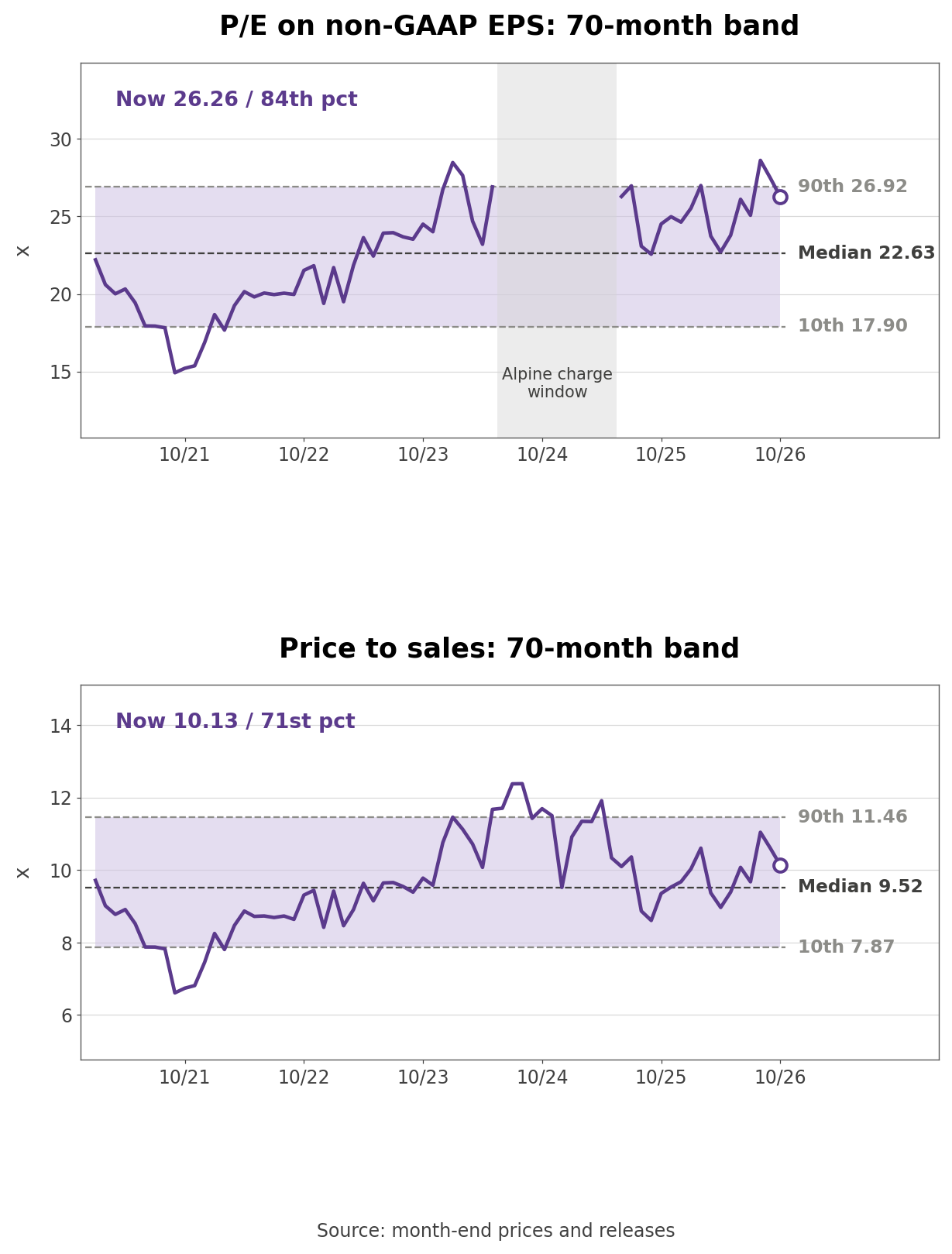
- The twelve months from June 2024 to May 2025 are left blank because the Alpine charge pushed trailing EPS close to zero or below. The highest P/E was 28.61 times in August 2026 and the lowest 14.92 times in September 2021. On the 2026 consensus EPS of $17.83 the multiple is 28.03 times, and on 2027's $20.39 it is 24.51 times.
Three Conditions That Move the Stock
- The pace of non-CF revenue comes first. Delivering $302.1 million in the second half keeps the $500 million goal intact, and a November 30 approval for povetacicept would add kidney revenue from 2027. A longer free-drug bridge for Journavx or delayed Casgevy infusions would show up first as a miss on that goal.
- Crinetics accounting and the earnings path come next. If much of the price is expensed as acquired IPR&D in the third quarter, full-year non-GAAP EPS dips for a year as it did in 2024; if it is a business combination, the cost shows up as amortization that Vertex excludes from non-GAAP results. Either way, about $120 million of quarterly Crinetics losses and lower interest income weigh on earnings until 2029.
- The quality of CF growth is third. Guidance implies second-half growth of 8.2% to 9.8%, and if Alyftrek switching, younger patients, and rare mutations outrun fading price and currency effects, 2026 becomes the seventh straight year above the top of the January range.
What the Third-Quarter Report Should Show
- The first items to check in the early November report are how Crinetics is accounted for, the size of any acquired IPR&D charge, and revised 2026 revenue and expense guidance that includes Crinetics. Next come progress toward the $302.1 million of second-half non-CF revenue, the timing of normal Journavx revenue recognition, and the November 30 povetacicept decision.
- One question this piece cannot settle is the gap between Vertex's peak sales claim and Palsonify's starting point of $24 million a quarter. Can Palsonify and atumelnant grow fast enough by 2029 to cover roughly $480 million of annual Crinetics losses and the interest income that the purchase price used to earn?
Related Analysis
- Medtronic (MDT) Stock Analysis: Why EPS Stayed Flat Despite 10-Year-High Revenue Growth: another healthcare company whose adjusted EPS lagged revenue, useful for comparing how launch spending and costs absorb sales growth.
- CrowdStrike (CRWD) Stock Analysis: GAAP vs Non-GAAP Results: a case study in how a company's non-GAAP definition shapes reported EPS, a useful frame for Vertex's choice to keep acquired IPR&D inside non-GAAP earnings.
#VertexPharmaceuticals #VRTX #VRTXStock #BiotechStocks #CysticFibrosis #RareDisease #USStocks #StockAnalysis #EquityResearch #GlobalStockBrief
'US Stock Analysis' 카테고리의 다른 글
| T-Mobile (TMUS) Stock: Phone Metrics It Stopped Reporting (0) | 2026.10.19 |
|---|---|
| KLA (KLAC) Stock: Net Income Up 19% and Cash Flow Flat (0) | 2026.10.18 |
| Halozyme (HALO) Stock: 2033 Convertible Notes, Dilution (0) | 2026.09.21 |
| Illumina (ILMN) Stock Analysis: Organic Growth vs M&A (0) | 2026.09.20 |
| AutoZone (AZO) Stock Analysis: ROIC Down 11 Quarters (0) | 2026.09.17 |


