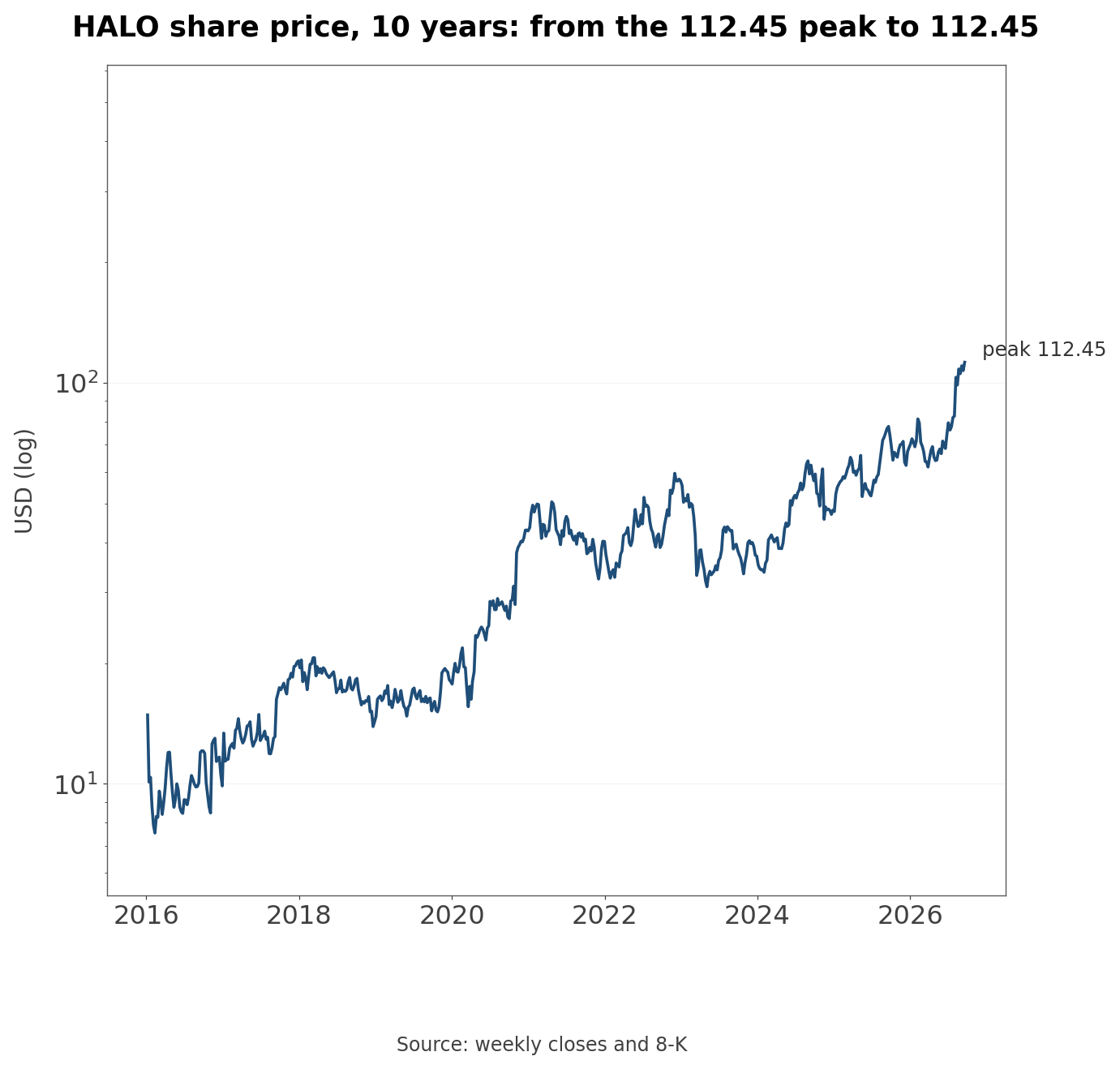
- Halozyme Therapeutics (NASDAQ: HALO) earned an operating margin of 59.8% in the second quarter of 2026. Revenue was $481.0 million, operating income was $287.7 million, and royalties alone brought in $307.7 million, or 64.0% of the total.
- Stockholders' equity at the end of that quarter was $143.5 million. The shares trade at $112.45 for a market value of $12.76 billion, which puts the book value at about 1.1% of the market capitalisation. In September the company issued $1.3 billion of new convertible notes.
- Three questions follow from that combination.
- How the equity of a company earning a 60% margin fell to $143.5 million
- Why the quarter with the highest revenue on record produced an operating loss
- Where the $1.3 billion of new notes goes and how many shares it could create
- One limit up front. Royalties come from products sold by partners, so Halozyme does not control the revenue line directly. Contract royalty rates are not disclosed and this piece does not estimate them. Share count is the 118,017,000 shares on the cover of the 10-K, and balance-sheet figures are as of June 30, 2026.
What the Q2 2026 Earnings Presentation Shows
- The fifteen-page deck for the quarter sets out three things the company wants read together: guidance raised for the second time, royalty growth of 50%, and a capital allocation plan. The first two can be checked against the filings. The third is a statement of intent, and the September notes offering is the first test of it.
Guidance Raised for the Second Time
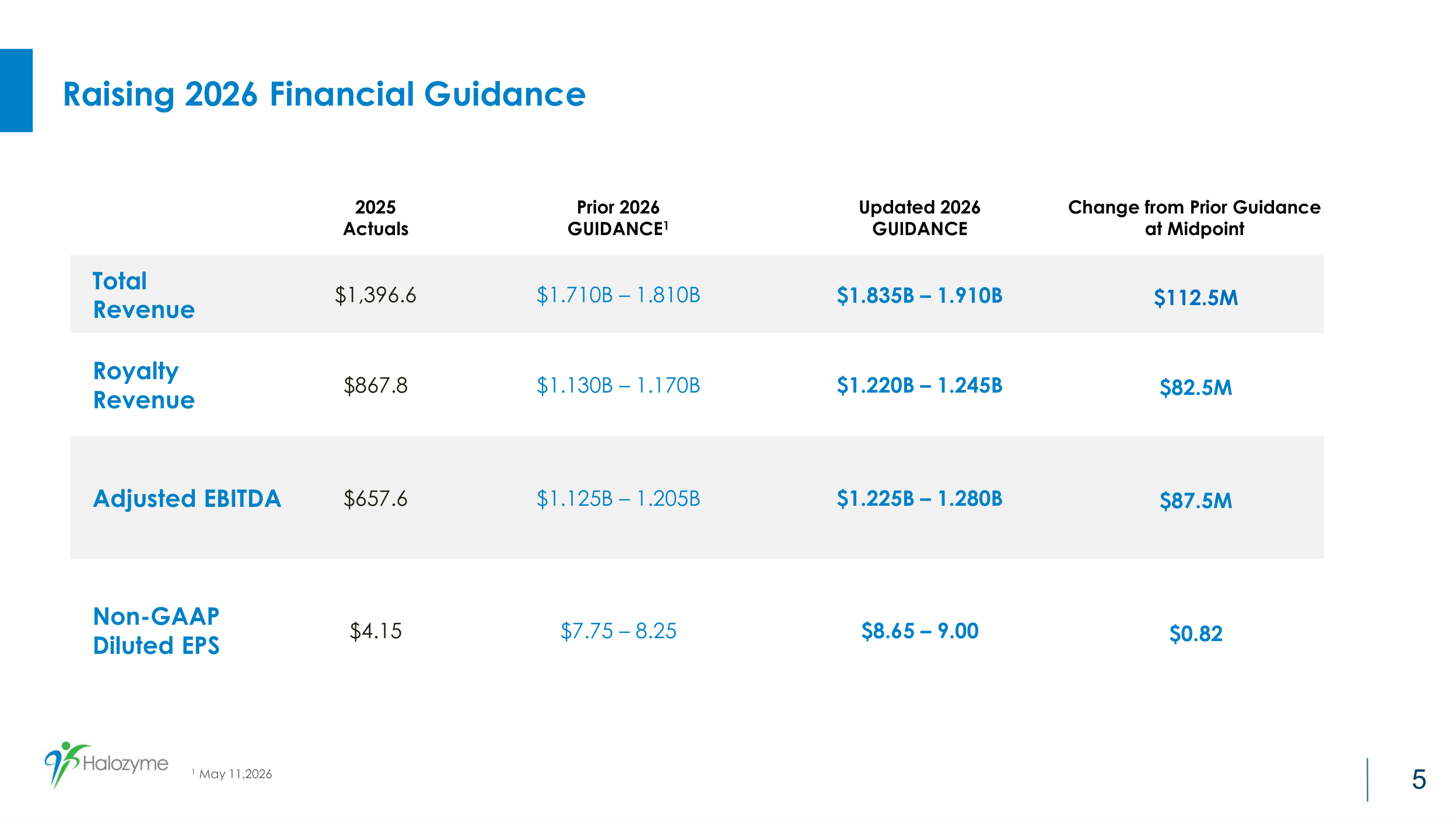
- Company disclosure (Q2 2026 earnings presentation, page 5): total revenue of $1.835-$1.910 billion, up 31-37% year over year; royalty revenue of $1.220-$1.245 billion, up 41-43%; adjusted EBITDA of $1.225-$1.280 billion, up 86-95%; and non-GAAP diluted EPS of $8.65-$9.00, up 108-117%.
- The same page carries the increases over prior guidance at the midpoint: $112.5 million on total revenue, $82.5 million on royalties, $87.5 million on adjusted EBITDA and $0.82 on non-GAAP EPS. Royalties account for 73% of the revenue increase.
- Four growth rates sit side by side, and they are not measured from the same base. Revenue and royalty growth are measured against 2025 revenue of $1,396.6 million. The 86-95% on adjusted EBITDA and the 108-117% on EPS are measured against a year in which a single acquisition charge of $284.9 million ran through the income statement. The base year is depressed, and the growth rate inherits that.
- The deck also restates the 2025 baseline on the same page: total revenue of $1,396.6 million, royalties of $867.8 million, adjusted EBITDA of $657.6 million and non-GAAP EPS of $4.15. Set against guidance of $1.225-$1.280 billion, adjusted EBITDA roughly doubles this year. The charge that held 2025 down is the reason the doubling looks as large as it does.
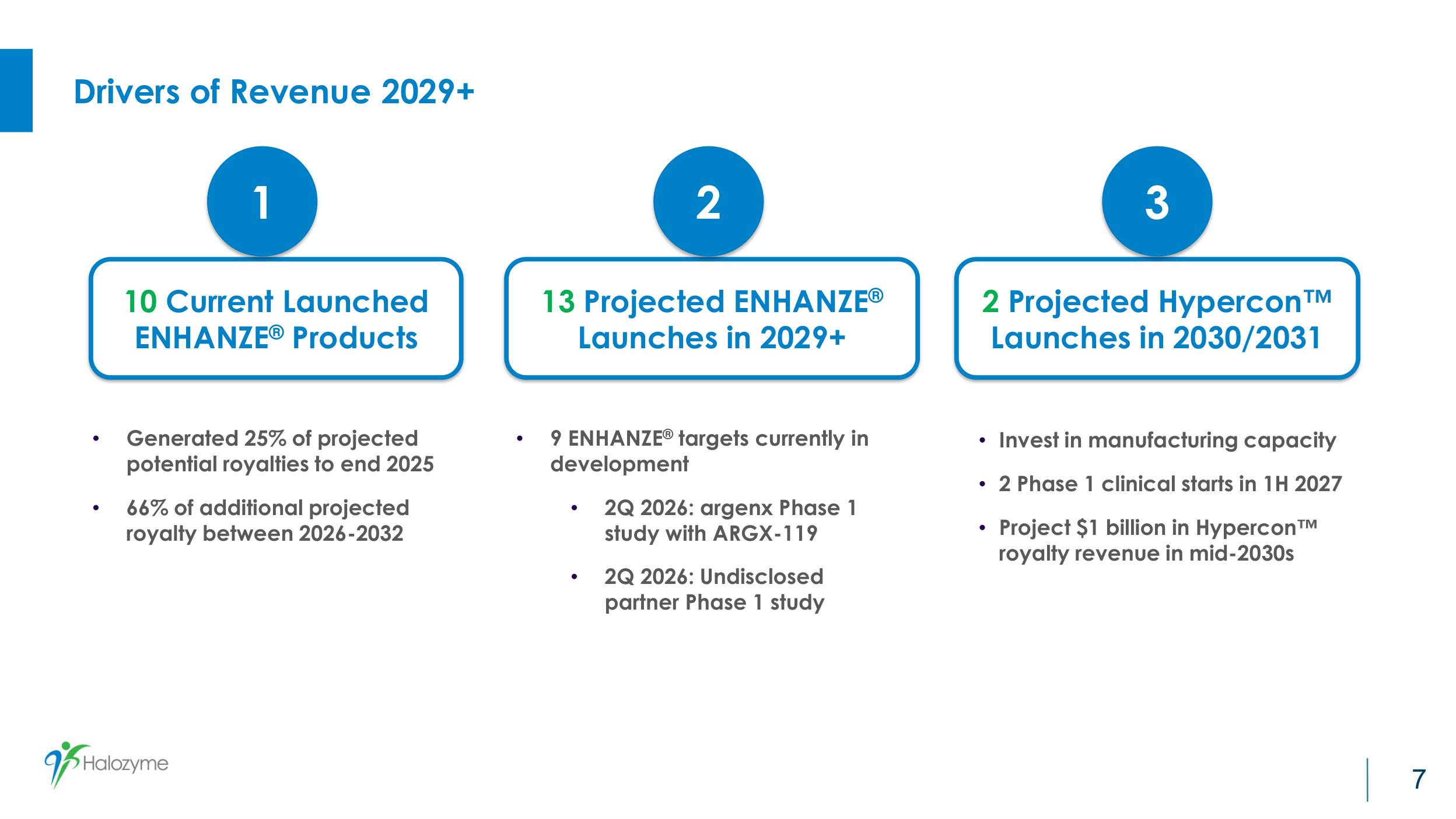
- Company disclosure (Q2 2026 earnings presentation, page 7): ten ENHANZE products are launched today, thirteen more ENHANZE launches are projected for 2029 and beyond, and two Hypercon launches are projected on top of those.
- Page 3 summarises the quarter in four lines: record royalty growth of 50%, collaboration targets exceeded, guidance raised, and buybacks continuing. All four are verifiable in the filings, and the order is presumably the order the company considers important. What the page does not carry is the $1.938 billion of long-term debt sitting on the same balance sheet.
- Ten products pay royalties now, fifteen are expected to. The timing on the second group is 2029 and later, which means 2027 and 2028 depend on how much the existing ten sell. Five new collaboration agreements signed this year, against a target of three, feed the group that starts paying at the end of the decade.
Royalties and the Adjusted Measure
- The deck spends more space on royalty growth than on anything else, and the split below shows why.
- Revenue splits three ways: royalties of $307.7 million, product sales of $129.6 million, and collaboration revenue of $43.7 million. Against the prior year, royalties are up 49.6% and product sales up 59.0%.
- Royalty mix is what lifts the margin. A year ago royalties were 63.1% of revenue and the operating margin was 62.2%; this quarter the mix is 64.0% and the margin is 59.8%. The slight decline comes from amortisation of intangibles, which rose from $17.8 million to $29.5 million after the Elektrofi purchase.
- On the 10-Q income statement, revenue of $481.0 million less cost of sales of $79.2 million, amortisation of $29.5 million, R&D of $27.7 million and SG&A leaves operating income of $287.7 million, or 59.8% of revenue. The quarterly figures in this piece come from the Form 10-Q for the quarter ended June 30, 2026, the 2025 Form 10-K and the September 8-K exhibits.
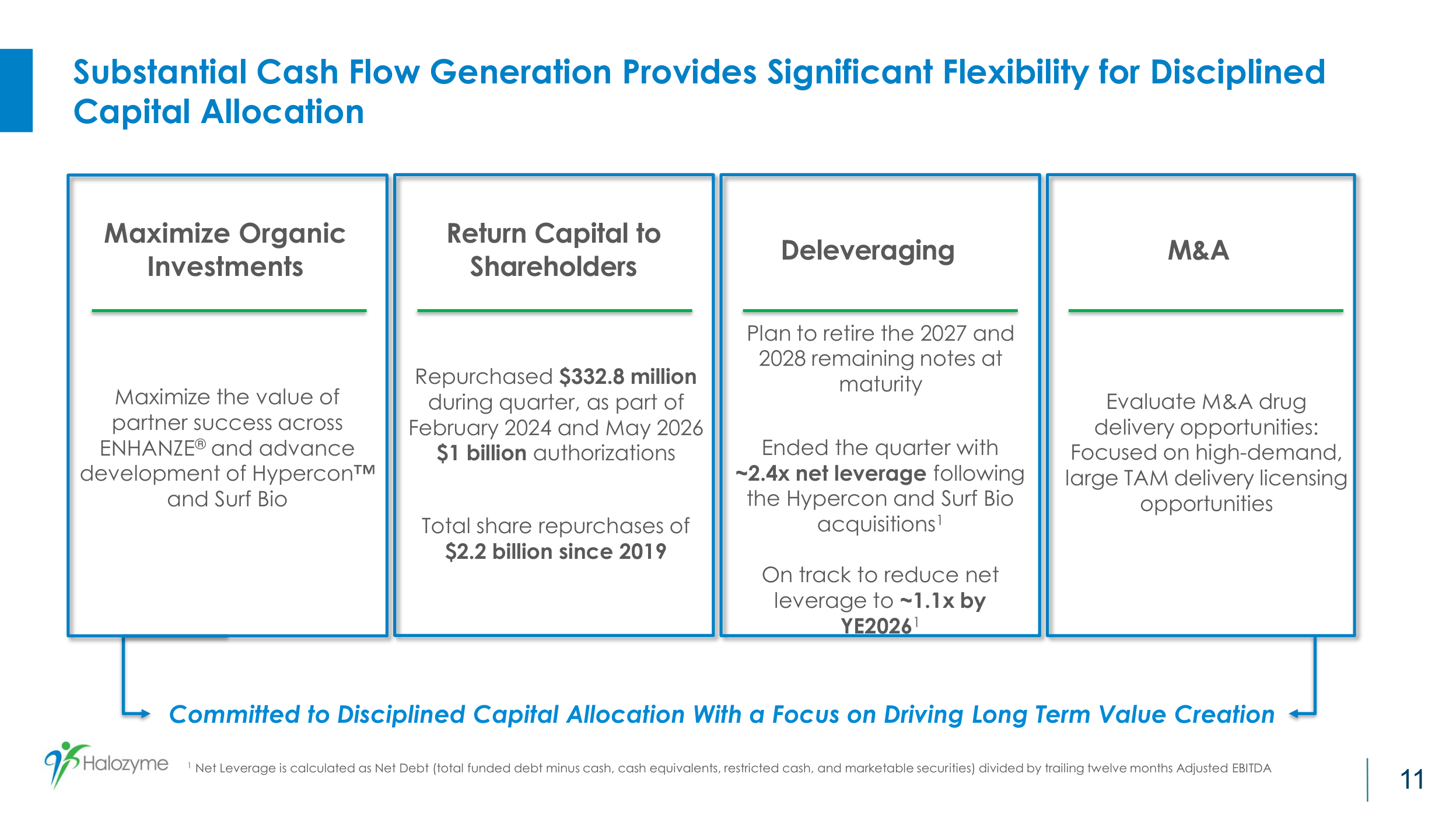
- Page 11 is headed capital allocation, and it lists buybacks, debt repayment and business development together. The quarter's actual spending was weighted to the first: $332.7 million of stock, which exceeds the quarter's operating income. Debt did not come down, and in September the company borrowed again.
- Two of those three lines on page 11 did not move this quarter. Debt repayment comes later, in the form of the September repurchases, and business development is the line the new notes are meant to fund.
- The profit measure in the deck is adjusted EBITDA. The footnote on page 14 shows what comes out of it: interest, taxes, depreciation and amortisation, and also litigation costs. Excluding legal expense is a common adjustment and not improper on its own. It does mean that if litigation runs for several years, several years of adjustments follow.
What the Market Says and What the Filings Show
- Three claims check out. Royalties grew 49.6% year over year, guidance was raised twice, and five new agreements were signed against a target of three. The 59.8% operating margin recomputes from the GAAP statement.
- The rest carry conditions. Adjusted EBITDA growth of 86-95% is measured from a base year that absorbed a $284.9 million charge; against 2024 the rate is well under half of that. The claim that buybacks are funded from spare cash is also partly true at best: the $332.7 million spent in the quarter was more than the operating income earned in it, and quarter-end cash fell to $163.1 million.
- The valuation arguments misfire in both directions. Price-to-book of 95x says nothing about the price and everything about the denominator, which is $143.5 million. Price-to-earnings is quoted at 20.98x on one screen and 33.25x on another, because one uses the company's adjusted figure and the other uses reported earnings.
How the ENHANZE Royalty Model Was Built
- The core technology is an enzyme, recombinant human hyaluronidase, that loosens tissue under the skin long enough to inject a large volume at once. Drugs that took hours by intravenous infusion can be given subcutaneously in minutes. Halozyme licenses it as ENHANZE and collects royalties when the partner's drug sells.
- The model settled in the middle of the last decade. The company had been developing its own cancer drug, and after a late-stage failure it shifted weight to licensing. Selling fewer of its own products and converting other companies' drugs is what produced the current margin. R&D at 5.8% of revenue is unusual for a drugmaker.
- The largest royalty stream is DARZALEX FASPRO, Janssen's multiple myeloma therapy. Page 6 of the deck puts the US subcutaneous conversion rate at 97%, so the patients who were going to switch have largely switched.
- In November 2025 Halozyme bought Elektrofi and renamed it Hypercon, a high-concentration formulation technology that shrinks injection volume further when paired with ENHANZE. Agreements with Janssen, Lilly and argenx followed. Buying technology to sign more agreements is the growth mechanism of this business.
Why Did a Record Quarter Lose Money?
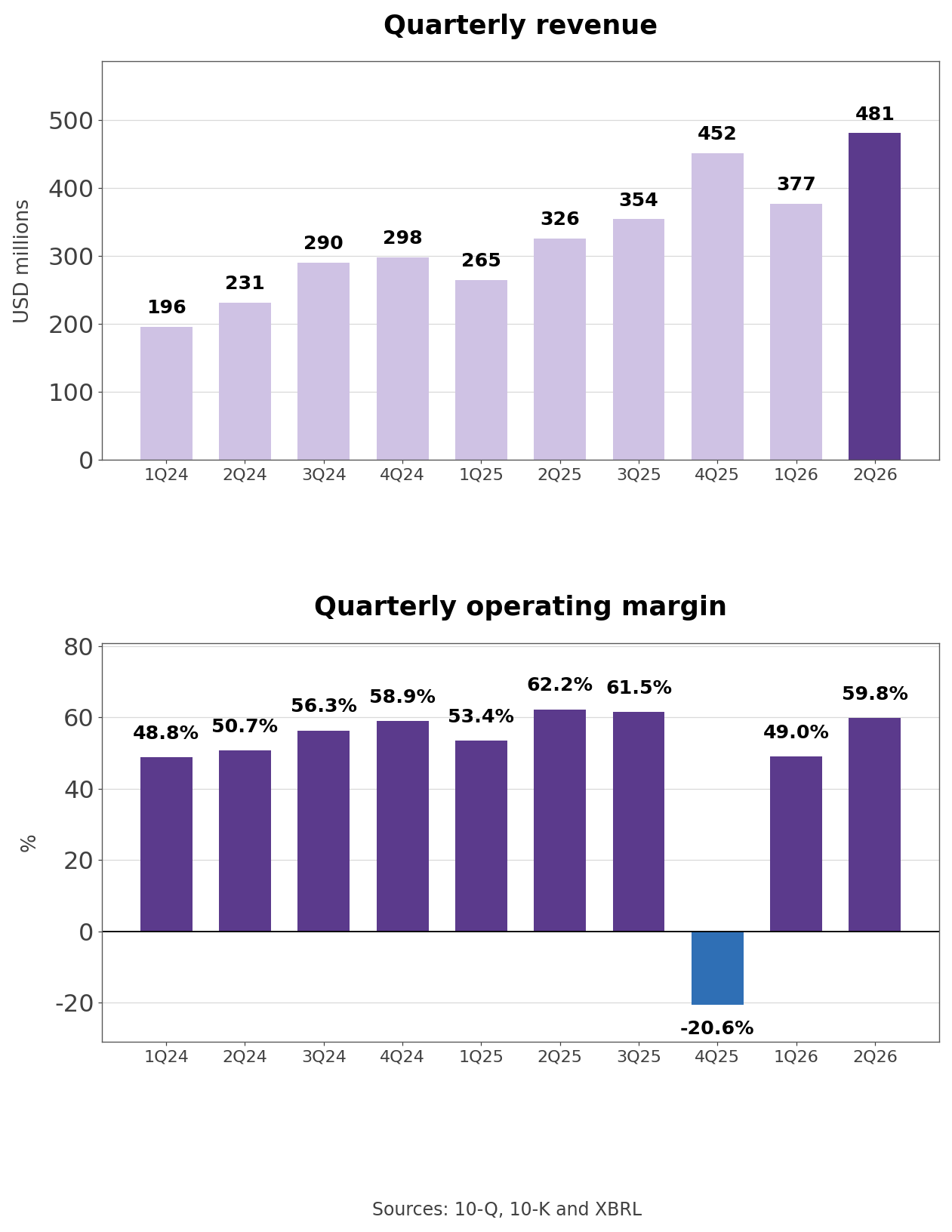
- Revenue in the fourth quarter of 2025 was $451.8 million, the highest quarterly figure to that point. The operating result was a loss of $92.9 million.
- Filing note (2025 10-K, operating expense table): of $927.6 million in 2025 operating expenses, $284.9 million was acquired in-process research and development and $48.7 million was an intangible asset impairment. Both lines were zero in 2024.
- The Elektrofi purchase price ran through that quarter in one piece. When the value of an acquired company sits in a single unapproved technology, the transaction is an asset acquisition rather than a business combination, and acquired research assets are expensed on the spot.
- Quarterly operating margins put the shape of it plainly: 53.4%, 62.2% and 61.5% through 2025, then -20.6%, then 49.0% and 59.8% in 2026. One quarter out of six sits below zero.
- That matters for reading this year's growth rates. The 2025 operating income of $469.0 million includes the charge. Added back, it is $753.9 million, and measured from there the increase guided for 2026 is considerably smaller than the headline suggests.
Where the Equity Went
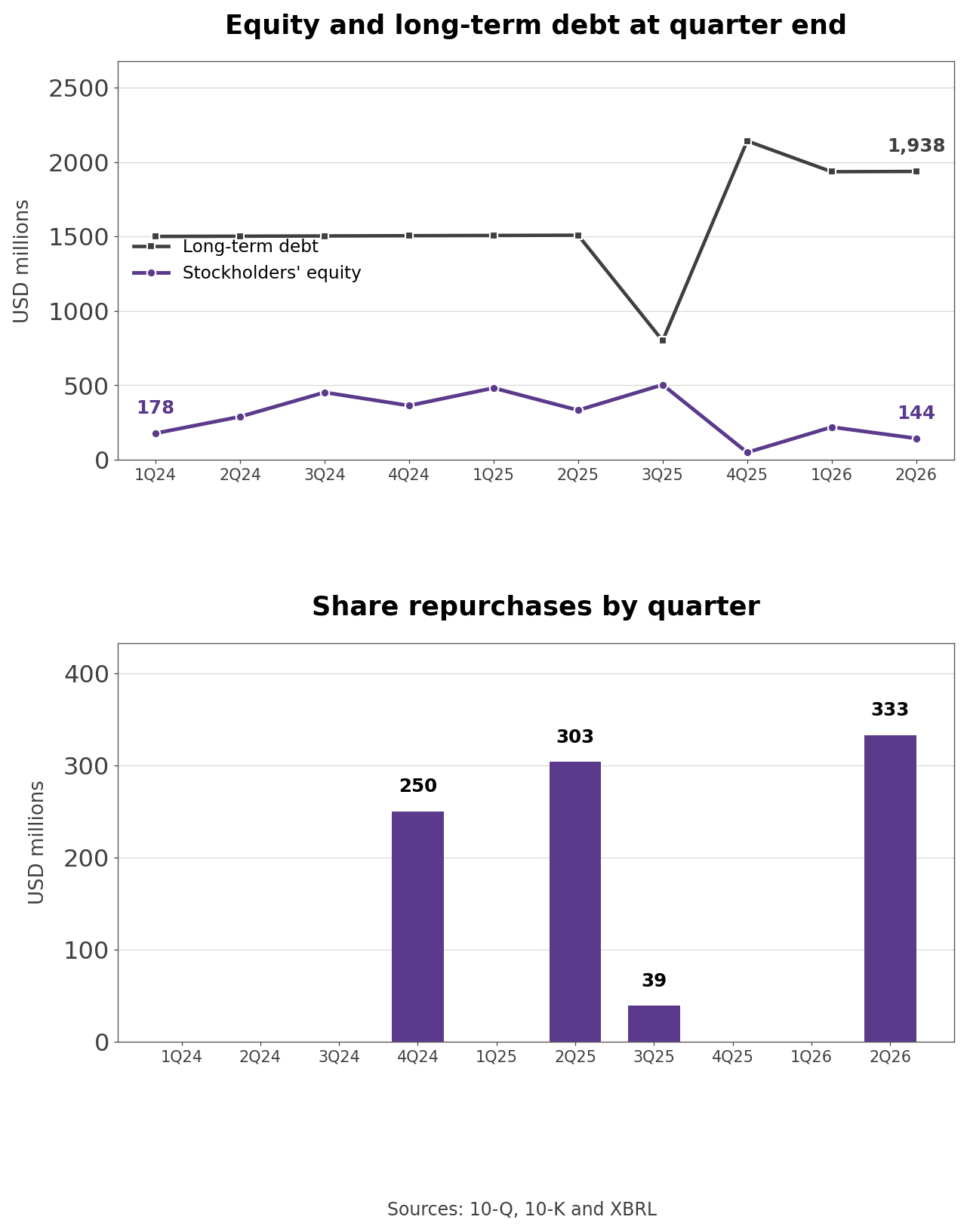
- Quarter-end equity ran from $177.8 million in the first quarter of 2024 up to $503.9 million in the third quarter of 2025, then fell to $48.8 million at the end of 2025 and stands at $143.5 million. Long-term debt over the same stretch went from about $1.5 billion to $1.938 billion.
- Two things absorbed the cash. One is the acquisition charge above. The other is buybacks.
- Own calculation (10-Q cash flow statements and earnings releases): $250.0 million in the fourth quarter of 2024, $303.5 million in the second quarter of 2025, $38.9 million in the third, and $332.7 million in the second quarter of 2026. That is $925.1 million over two years.
- The most recent purchase was 4.8 million shares at an average of $69.30. In May the company announced a new $1.0 billion authorisation running to 2028, with at least $400 million intended for this year.
- This is what drives the price-to-book multiple to 95x. The five-year median is 27x, so the equity was thin before and is thinner now. The multiple is a statement about the denominator.
$1.3 Billion of New Notes and $652 Million of Repurchases
- In September the company priced $1.3 billion of 1.50% convertible senior notes due 2033. The offering was upsized from $1.05 billion, with a 13-day option on another $200 million.
- Filing note (8-K dated September 17, 2026, press release): the conversion price is about $139.84 per share, a 27.5% premium to the $109.68 close on the pricing date, at a rate of 7.1509 shares per $1,000. Net proceeds are about $1.275 billion.
- Where that money goes is set out in the same release. Halozyme repurchases $151.7 million principal of its 0.25% notes due 2027 for about $217.0 million, and $220.0 million principal of its 1.00% notes due 2028 for about $435.5 million.
- Own calculation (principal and repurchase cost in the same release): $371.7 million of face value costs $652.5 million to retire. The $280.8 million difference is what the share price added to notes that are now deep in the money.
- Cheap borrowing returns expensive. The 2028 notes cost nearly twice their face value to take back. In exchange, the dilution those notes would have created disappears, and the company bought capped call transactions on the new issue that offset dilution up to $208.39 per share, about 1.9 times the current price.
- The remainder is earmarked for working capital, capital expenditure and potential acquisitions and strategic transactions. Ten months after the Elektrofi purchase, the same sentence is back in a filing.
What Halozyme Actually Sells
- Royalties are 64.0% of revenue, product sales 26.9% and collaboration revenue 9.1%.
- An ENHANZE agreement pays in three stages: an upfront fee, development milestones, and royalties once the drug sells. The first two land in collaboration revenue and the last in royalties. An agreement typically takes years to reach the third stage, which is why five new deals this year move collaboration revenue only 13.2%.
- Product sales come from the enzyme itself and from auto-injector products the company manufactures. They rose 59.0% year over year, moving with royalties rather than against them, because partners selling more drug also buy more material.
- Ten products pay royalties today, among them DARZALEX FASPRO and RYBREVANT from Janssen, subcutaneous Herceptin and Phesgo from Roche, HYQVIA from Takeda, and VYVGART Hytrulo from argenx. In December 2025 the company signed a new agreement with Takeda.
- The customers here are drugmakers, not patients. That keeps the customer list short and the contracts long, but it also means a partner's patent expiry or a competing launch passes straight through to this company's royalty line.
Five Royalty-Model Companies Compared
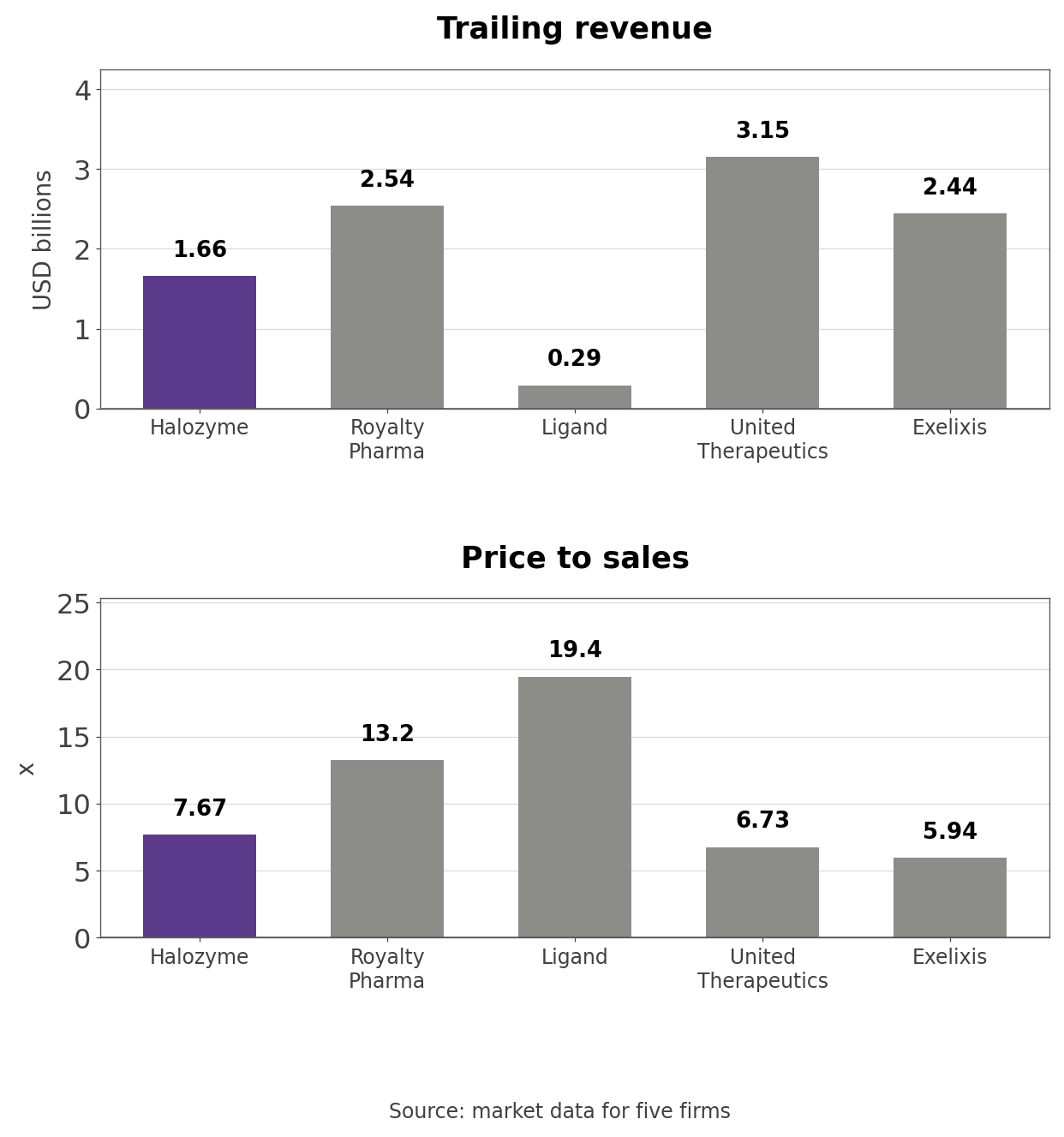
- On aggregated market data for the five companies, trailing twelve-month revenue is $3.15 billion at United Therapeutics, $2.54 billion at Royalty Pharma, $2.44 billion at Exelixis, $1.66 billion at Halozyme and $290.5 million at Ligand.
- P/S runs 19.45x at Ligand, 13.24x at Royalty Pharma, 7.67x at Halozyme, 6.73x at United Therapeutics and 5.94x at Exelixis. The heavier the royalty mix, the higher the sales multiple, because a dollar of royalty revenue carries less cost behind it.
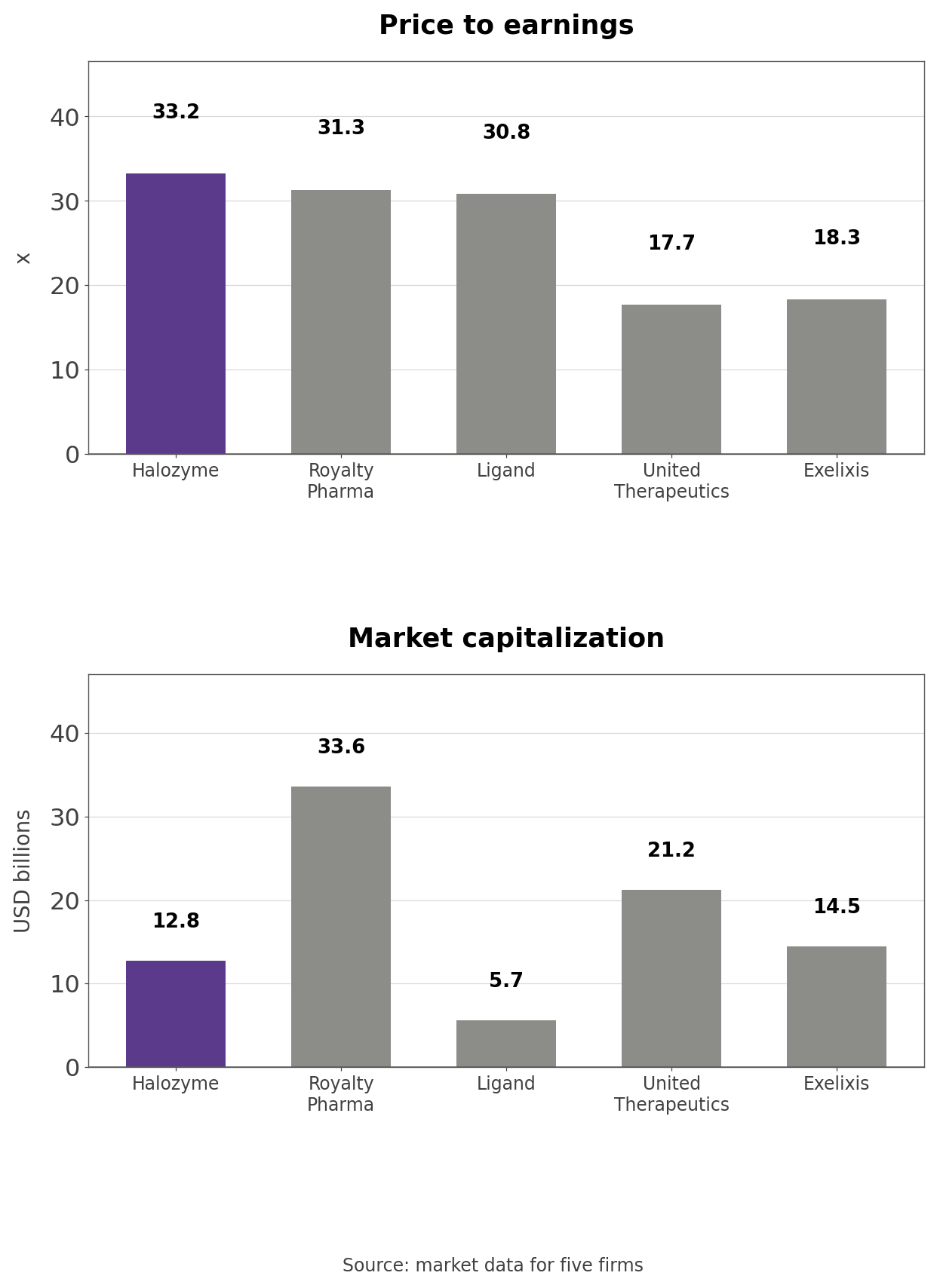
- On P/E the order changes. Halozyme at 33.25x is the highest, followed by Royalty Pharma at 31.33x, Ligand at 30.84x, Exelixis at 18.32x and United Therapeutics at 17.70x. Market values run from $33.59 billion at Royalty Pharma down to $5.65 billion at Ligand, with Halozyme at $12.76 billion.
- On returns the comparison breaks down. With equity of $143.5 million the denominator is too small for return on equity to mean much, and net cash is negative: $163.1 million of cash against $1.938 billion of long-term debt. United Therapeutics and Exelixis are in net cash and fund shareholder returns from within equity. Royalty Pharma pays a dividend alongside buybacks; Halozyme returns cash through buybacks only.
Price-to-Sales and Price-to-Earnings Over 60 Months
- Price-to-sales is 8.19x, at the 65th percentile of the last 60 months. The five-year median is 7.71x and the range was 5.42x to 14.65x.
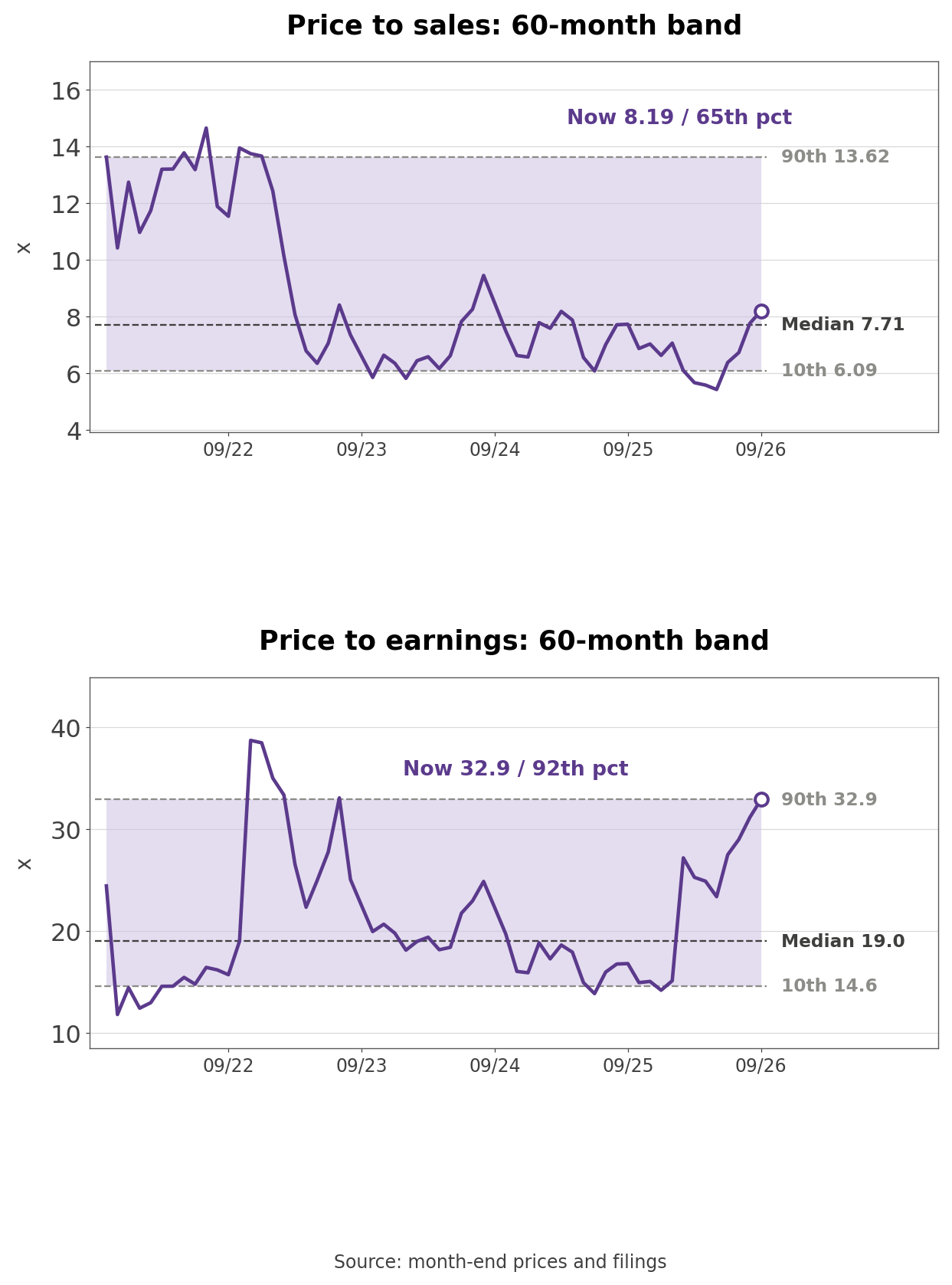
- Price-to-earnings is 32.88x, at the 92nd percentile of the same window, against a median of 18.97x and a five-year high of 38.69x. Ordinary on sales and high on earnings, and the reason is the denominator: trailing four-quarter earnings still include the fourth quarter of 2025.
- That quarter drops out of the trailing window when fourth-quarter 2026 results are reported. If guidance holds, trailing earnings rise and the multiple falls at an unchanged share price. Read the other way, today's 32.88x carries a charge that has already happened.
Three Conditions That Move the Stock
- The heaviest item is the royalty growth rate. Full-year royalty guidance of $1.220-$1.245 billion requires the second half to deliver more than the $548.4 million booked in the first. Third-quarter results are the first check, and with US subcutaneous conversion at 97% on the largest product, the remaining growth has to come from Europe and from newer launches. Patent life sits underneath the same line: the 10-K risk factors say partners have less reason to keep paying once the enzyme patents expire, and expiry dates differ by patent.
- Dilution is the second, and the share price itself is the trigger. Above $139.84 the new notes can convert, and the capped call covers the gap only to $208.39. Above that, share count rises.
- The third is another acquisition, which is an accounting question more than an earnings one. The use of proceeds names it, and if the next one is structured as an asset acquisition the way Elektrofi was, another quarter goes negative on the operating line because the whole price passes through as expense. An 8-K would show it, and the cash competes with buybacks: of at least $400 million planned for this year, $332.7 million went in the second quarter, and the cash flow statement shows what follows.
What Would Change the Call
- One question this piece cannot answer is how many shares the new notes ultimately create. Face value of $1.3 billion at $139.84 is 9.296 million shares, or 7.9% of the 118.0 million outstanding. The capped call is meant to offset that to $208.39, and how much it actually offsets depends on the share price path to 2033.
- So the next filing is worth reading for two numbers: the diluted share count, and how much of the old notes was actually retired. The $280.8 million gap between face value and repurchase cost also has to land somewhere. Booked as a loss on extinguishment it compresses net income in that quarter; allocated to equity it shows up less in the income statement.
Related Analysis
- CrowdStrike (CRWD) Stock Analysis: GAAP vs Non-GAAP Earnings: the same question of which earnings measure to carry into a multiple, in a company where the adjustment is stock compensation rather than an acquisition charge.
- Plug Power (PLUG) Stock Analysis: Fair Value Charges and Losses: what happens to book value and per-share figures when one non-operating line dominates a quarter, which is what the fourth quarter of 2025 did here.
- Lennar (LEN) Stock Analysis: Incentives and Book Value: a balance sheet read through book value rather than earnings, useful when equity is the number doing the work.
#Halozyme #HalozymeTherapeutics #HALO #HALOStockAnalysis #RoyaltyModel #ConvertibleNotes #Pharmaceuticals #USStocks #StockAnalysis #EquityResearch #GlobalStockBrief
'US Stock Analysis' 카테고리의 다른 글
| Illumina (ILMN) Stock: What Is Left After Acquisitions (0) | 2026.09.20 |
|---|---|
| AutoZone (AZO) Stock: 36.3% ROIC and a 19.6x P/E (0) | 2026.09.17 |
| NVIDIA (NVDA) Stock Analysis: Guarantees and Cash Flow (0) | 2026.09.17 |
| Lennar (LEN) Stock: 12.9% Incentives and a 0.89x P/B (0) | 2026.09.15 |
| Plug Power (PLUG) Stock Analysis: GAAP vs Operating Loss (0) | 2026.09.15 |


