- RTX Corporation (NYSE: RTX) grew third-quarter 2026 adjusted EPS +33% to $2.26, but $0.25 of that came from refunds of IEEPA tariffs that the Supreme Court struck down. Without the refund, growth was +18%. The company raised its full-year adjusted EPS outlook from $7.10 to $7.25 up to $7.65 to $7.75, and its backlog reached a record $340 billion, 36% higher than a year earlier. The question is how much of the raise is recurring, and how much of the backlog is priced.
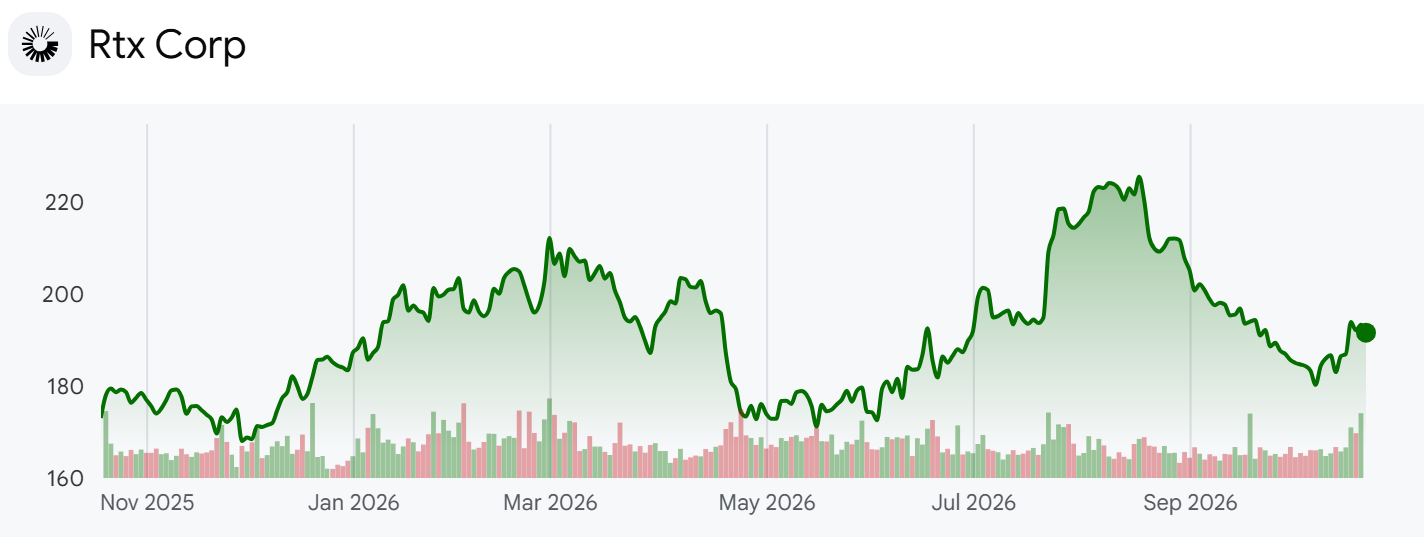
- RTX, formerly Raytheon Technologies, runs three segments: Collins Aerospace, which makes aircraft systems; Pratt & Whitney, which makes engines; and Raytheon, which makes missiles and radars. The shares trade at $191.60 for a market value of $258.23 billion, -14.1% below the weekly high of $222.97 set in the week of August 14. EPS here is RTX's adjusted measure, which excludes acquisition accounting adjustments and restructuring and other one-off items; third-quarter GAAP EPS was $1.89.
What the Third-Quarter Deck Says About the IEEPA Refund
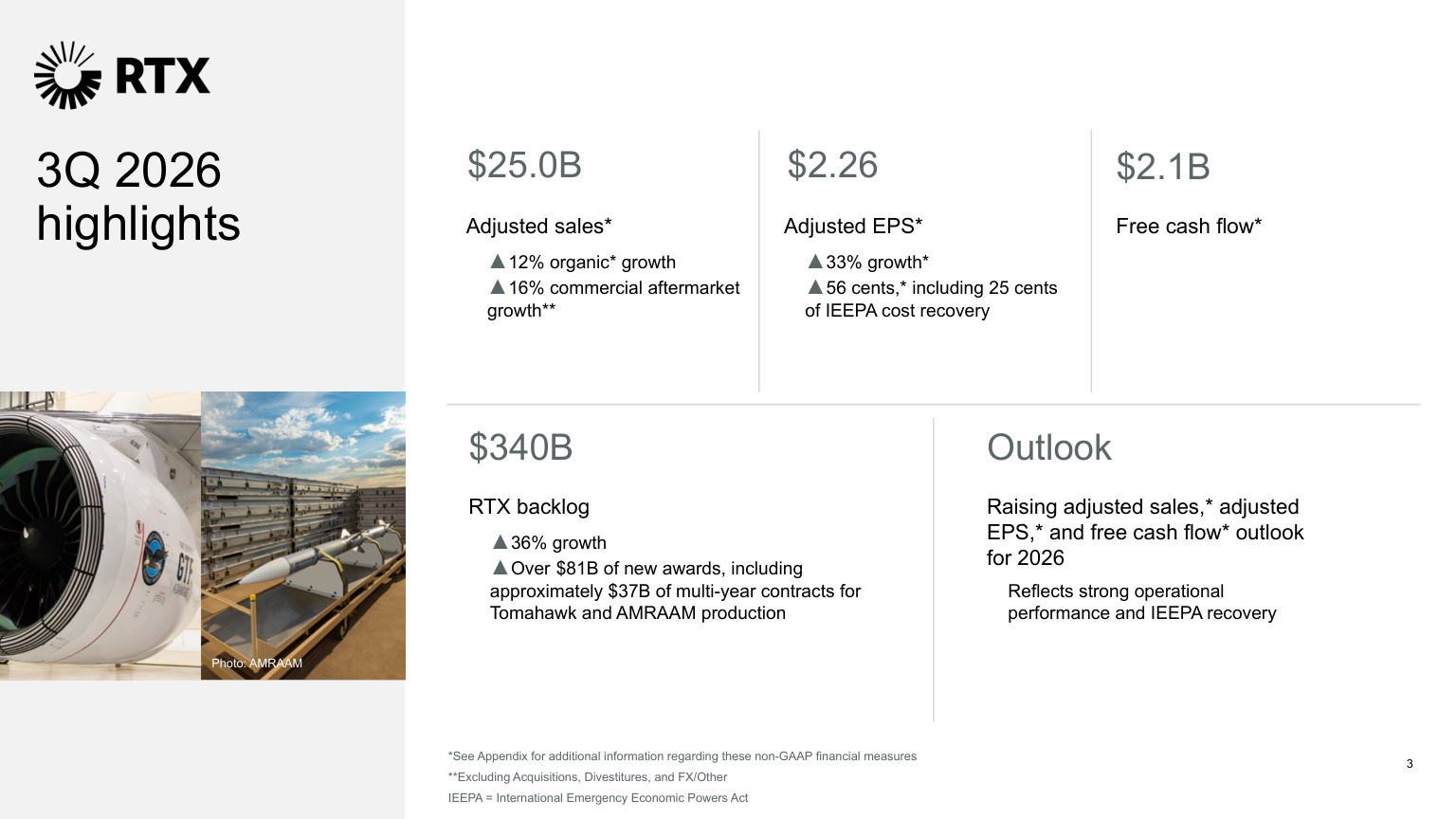
- Page 3 of the October 20 earnings presentation puts adjusted sales of $25.0 billion (organic growth of 12%), adjusted EPS of $2.26 (up 33%), free cash flow of $2.1 billion, and backlog of $340 billion on one slide. Under the 56-cent EPS increase it notes that 25 cents was IEEPA cost recovery, and it explains the higher outlook in five words: "Reflects strong operational performance and IEEPA recovery." Page 5 adds that adjusted segment operating profit grew 39% with 310 basis points of segment margin expansion, about 160 of which came from IEEPA recovery. New awards topped $81 billion, including about $37 billion of multiyear Tomahawk and AMRAAM production contracts.
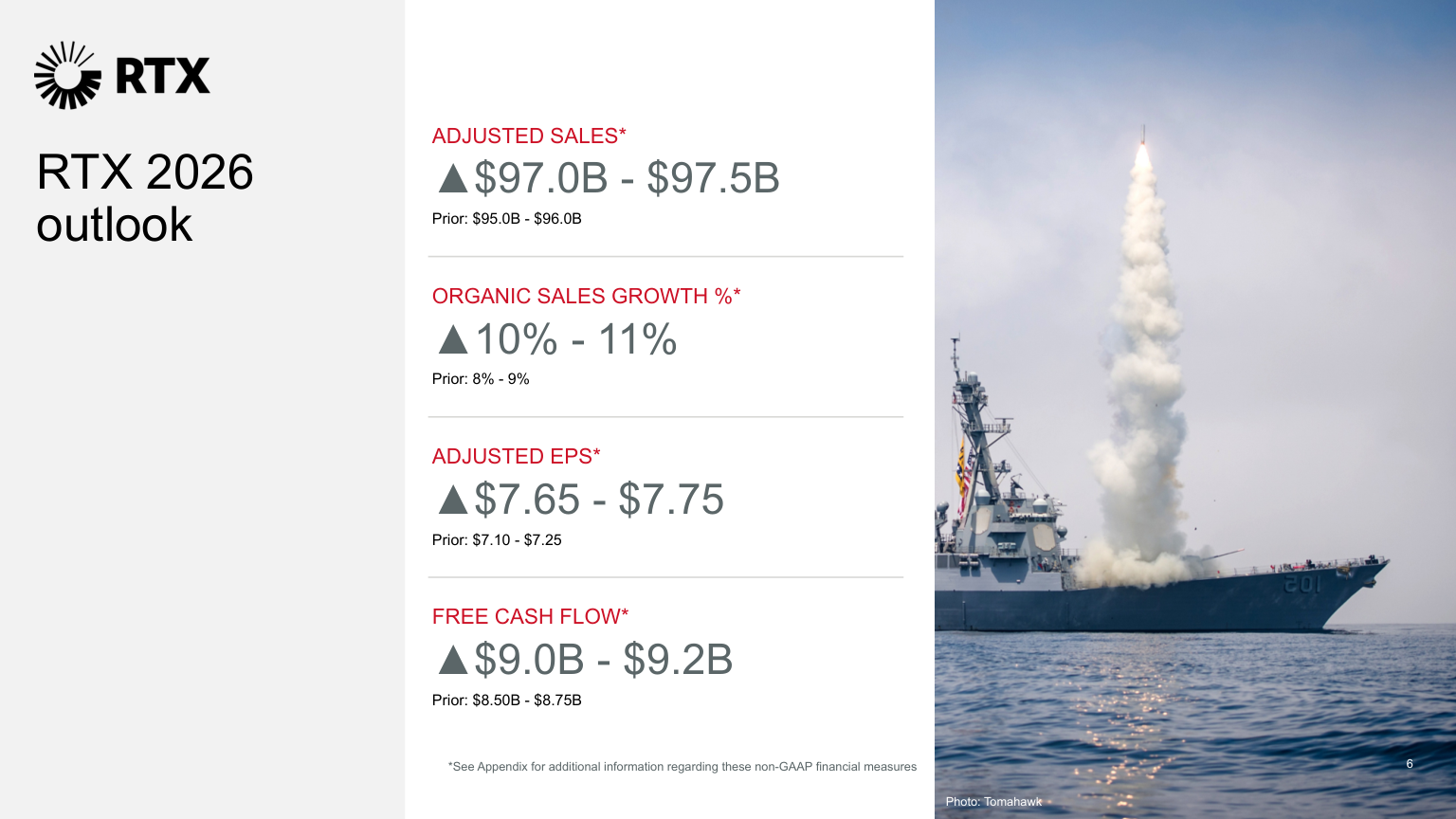
- Page 6 lifts 2026 adjusted sales to $97.0 billion to $97.5 billion from $95.0 billion to $96.0 billion, organic growth to 10% to 11% from 8% to 9%, adjusted EPS to $7.65 to $7.75 from $7.10 to $7.25, and free cash flow to $9.0 billion to $9.2 billion from $8.50 billion to $8.75 billion. On the call, chief financial officer Neil Mitchill split the midpoint increase into about 28 cents of operational performance and about 25 cents of IEEPA recovery. Page 15 kept the adjusted tax rate at about 18.0% to 18.5% and non-service pension income at about $1.4 billion, while trimming interest expense to about $1.6 billion and corporate and unallocated costs to about $175 million.
- Company disclosure (third-quarter 10-Q): In February 2026 the Supreme Court ruled that tariffs imposed under the International Emergency Economic Powers Act were unauthorized. RTX had paid about $0.5 billion of those tariffs, and by September 30 it had recognized about $0.4 billion of approved refunds, of which about $0.3 billion had been received. The government appealed the refund order on June 2, but the appeal has not stopped refunds so far.
- Own calculation (how much of the raise is the refund): The 25-cent refund is 47.6% of the 52.5-cent increase in the guidance midpoint. Excluding it, 2026 adjusted EPS guidance is $7.40 to $7.50, up 17.6% to 19.2% from $6.29 in 2025, and the average analyst estimate of $7.48 sits inside that range. Subtracting nine-month adjusted EPS of $5.93 implies fourth-quarter EPS of $1.72 to $1.82, up 11.0% to 17.4% from $1.55.
Munitions Contracts at Raytheon and Margins at Pratt
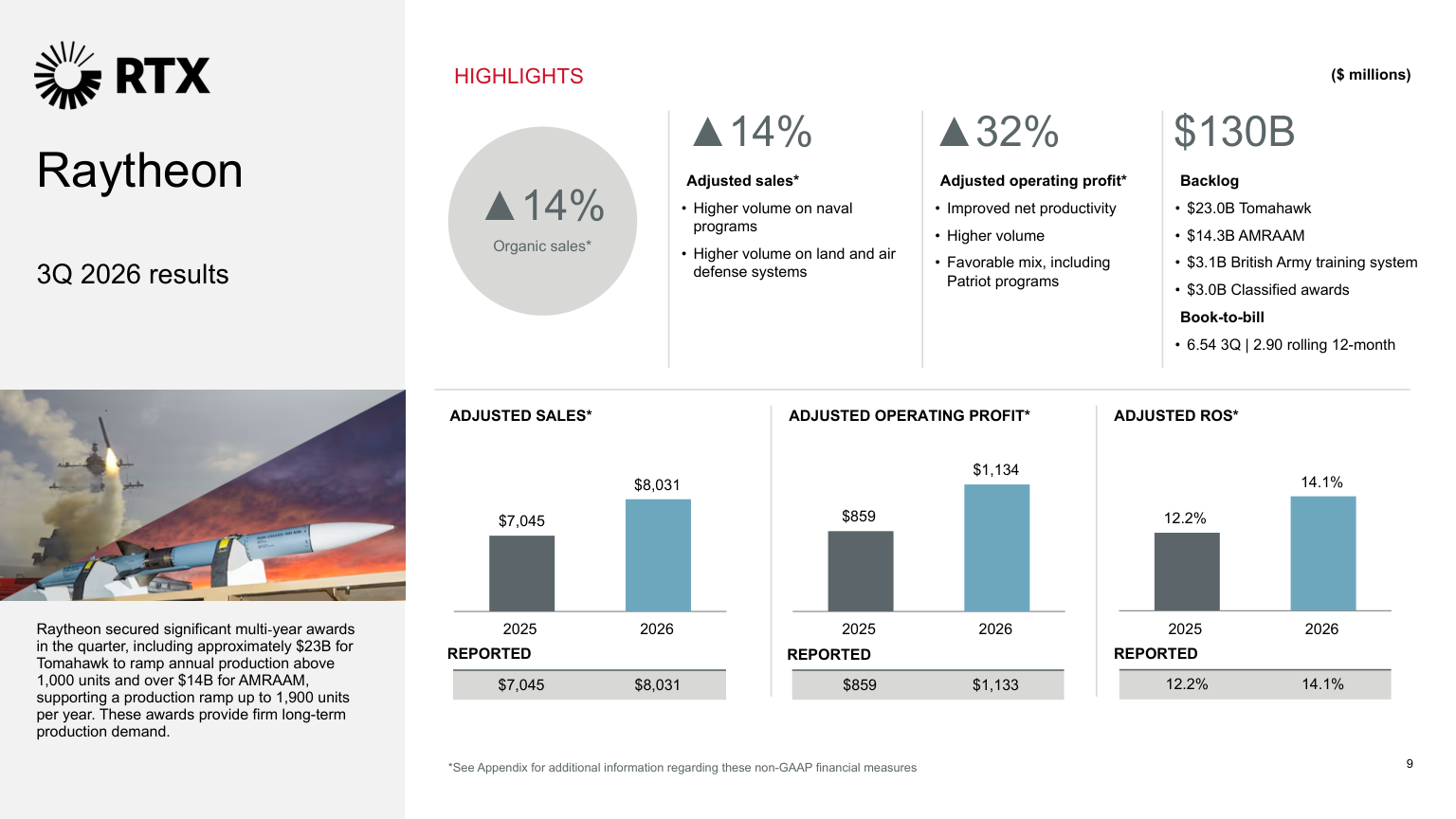
- Page 9 puts Raytheon's backlog at $130 billion and lists third-quarter awards of $23.0 billion for Tomahawk, $14.3 billion for AMRAAM, $3.1 billion for a British Army training system, and $3.0 billion of classified work. Book-to-bill was 6.54 for the quarter and 2.90 over 12 months. The slide says the contracts ramp Tomahawk production above 1,000 units a year and AMRAAM to 1,900, adding that "These awards provide firm long-term production demand." Raytheon sales rose 14% to $8.031 billion, and adjusted operating margin rose from 12.2% to 14.1%, with reported and adjusted profit nearly identical at $1.133 billion and $1.134 billion.
- The third-quarter 10-Q adds that these are undefinitized contract actions (UCAs), meaning prices are not yet final. In the third quarter and early in the fourth, the Department of War awarded four: a seven-year Tomahawk UCA worth up to about $23 billion and five-year UCAs with two one-year options for AMRAAM (up to $20.7 billion), SM-6 (up to $24.4 billion), and SM-3 IB (up to $6.3 billion). Funding for each is subject to annual appropriations, and Raytheon has contractual recovery remedies if funding is not provided. The release says Raytheon's quarter also included about $85 million from an international contract modification and an offset obligation adjustment.
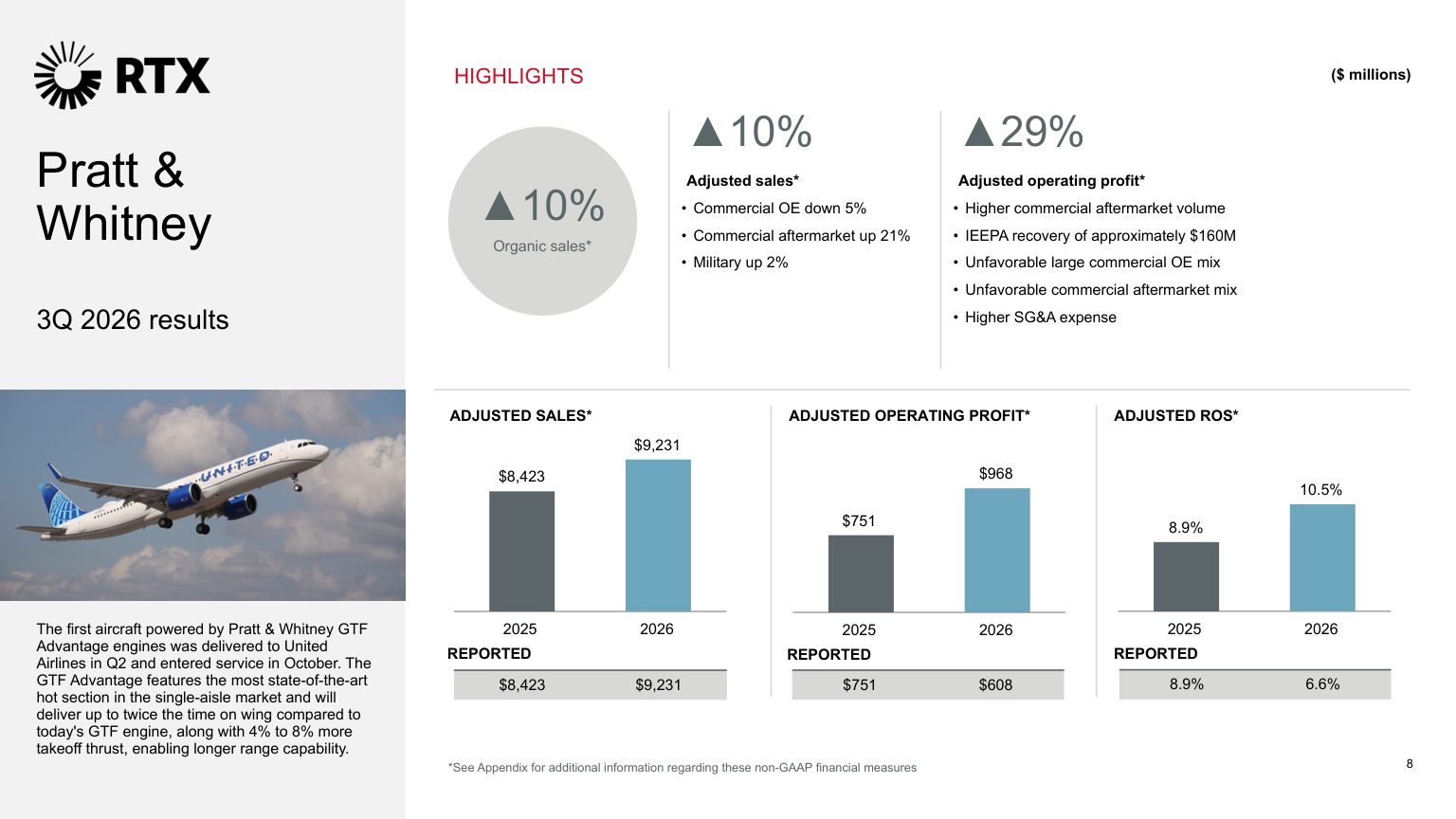
- Page 8 shows Pratt & Whitney sales up 10% to $9.231 billion, with commercial aftermarket +21%, military +2%, and commercial original equipment -5%. Adjusted operating profit of $968 million rose 29% and included about $160 million of IEEPA recovery, while reported operating profit fell to $608 million after a $363 million charge tied to a customer bankruptcy, leaving reported margin at 6.6% against adjusted margin of 10.5%. Mitchill said on the call that the 10.5% included 170 basis points from IEEPA. Page 7 credits Collins' 50% adjusted profit increase to commercial volume, mix, and about $250 million of IEEPA recovery.
- Own calculation (Pratt without the refund): Taking the $160 million refund out of Pratt's adjusted operating profit leaves $808 million, an 8.75% margin, below 8.9% a year earlier. Raytheon, even without the $85 million of one-offs, earned 13.06%, still above 12.2%.
The Bull and Bear Case for a Record Backlog
- The bullish case starts with size. At $340 billion, backlog equals 3.54 years of trailing adjusted sales, and defense backlog grew +59.2% in a year. GTF engine overhauls drove Pratt's aftermarket up 21%, and Collins earned an 18.35% adjusted margin even without the refund. The 10-Q notes that the fiscal 2027 defense budget request is $1.5 trillion. Chief executive Chris Calio said in the release that "Demand for our products remains robust with over $81 billion of new commercial and defense awards, resulting in a record backlog of $340 billion."
- The bearish case looks at earnings quality. Nearly half of the third-quarter EPS increase was a tariff refund, and Pratt's margin was lower than a year ago once the refund is removed. The multiyear munitions contracts are unpriced, and the federal government is on a continuing resolution through December 11. The 10-Q also warns that an executive order may limit distributions and buybacks at underperforming defense contractors, and that "a limitation on our ability to issue distributions or engage in share repurchases related to the defense contractor performance executive order could adversely affect the market price of our common stock."
- Outside view (sell-side research aggregate, October 2026): Of 24 analysts, 10 rate the stock Strong Buy, 6 Buy, and 8 Hold, with an average price target of $227.78. The average 2027 EPS estimate of $7.97 is 6.6% above the 2026 estimate of $7.48.
From the 2020 Merger to Multiyear Missile Deals
- RTX was formed on April 3, 2020, when United Technologies and Raytheon merged into Raytheon Technologies, and it has used the RTX name since its second-quarter 2023 release. It is based in Arlington, Virginia, and employs more than 180,000 people. On a dividend-adjusted basis the stock is 4.46 times its level in the week of the merger, when it closed at $43.00. In its first quarter as a merged company, a Collins goodwill and intangibles impairment tied to the pandemic pushed GAAP EPS to -$2.56.
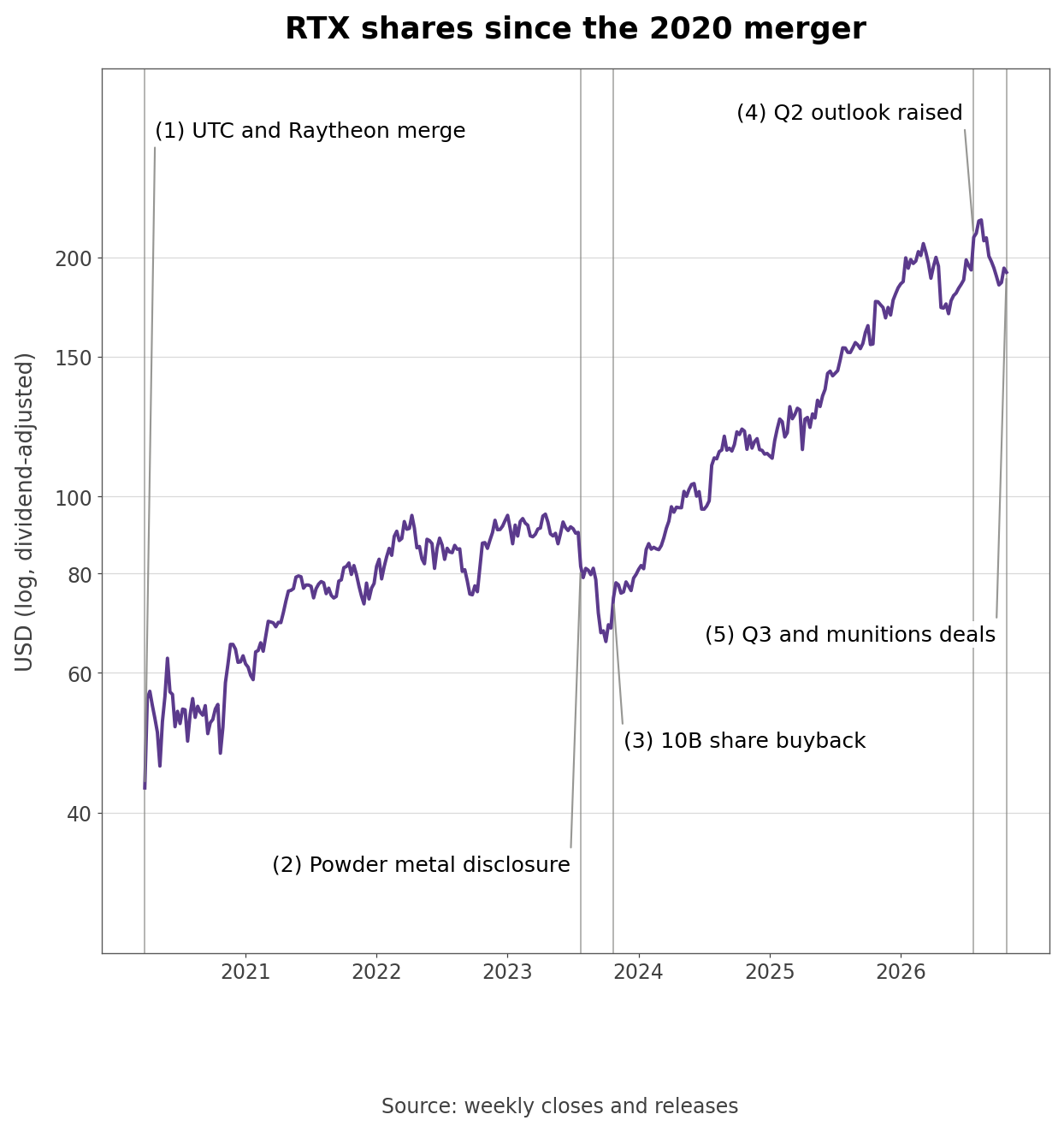
- The defining setback came with the second-quarter 2023 release on July 25, 2023. RTX said a rare condition in powder metal used in PW1100 GTF engine parts, which power the A320neo family, required accelerated inspections. The stock fell -9.4% that week and was 24.8% lower by the end of September. In the third quarter, the charge cut reported sales to $13.5 billion against adjusted sales of $19.0 billion, and GAAP EPS was -$0.68.
- RTX answered with a $10 billion accelerated share repurchase on October 24, 2023, which cut the diluted share count from 1.448 billion in the third quarter of 2023 to 1.337 billion in the first quarter of 2024. The stock gained +42.0% in 2024 and +61.6% in 2025. In 2026 it rose 10.0% in the week of the second-quarter guidance raise but fell 1.2% in the week of the third-quarter raise.
How Fast Is Adjusted EPS Growing Without the Refund?
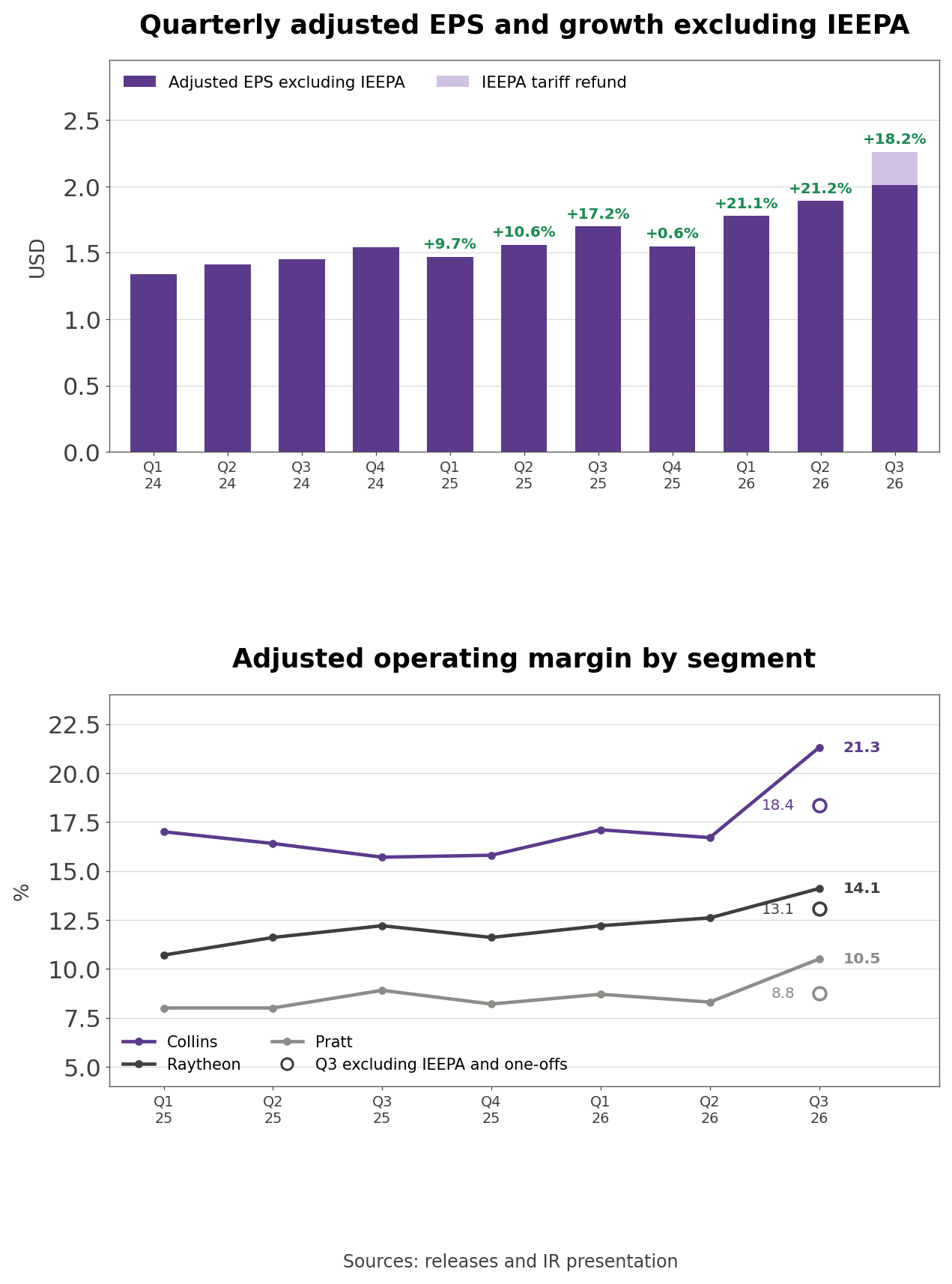
- Quarterly adjusted EPS growth ran 9.7%, 10.6%, 17.2%, and 0.6% through 2025, then 21.1% and 21.2% in the first two quarters of 2026. Removing the 25-cent refund turns third-quarter growth of 32.9% into 18.2%, below the first-half pace. GAAP EPS of $1.89 carried $0.26 of acquisition accounting adjustments and $0.11 of restructuring and other items, which adjusted EPS adds back, and the Pratt customer bankruptcy charge was also excluded from adjusted profit.
- Against the consensus of $1.78, the quarter beat by 27.0%, but by 12.9% without the refund, close to the 13.7% beat in the second quarter. The release says adjusted net income growth came from $1.1 billion of segment profit growth, $0.4 billion of it from IEEPA, partly offset by higher taxes and lower pension income.
- Own calculation (segment profit without the refund): Combined adjusted operating profit for the three segments rose 38.7% from $2.804 billion to $3.890 billion, or 24.1% without the $410 million of refunds. By segment, Collins growth drops from 49.7% to 28.8%, Raytheon grows 22.1% without its one-offs, and Pratt falls from 28.9% to 7.6%, slower than its 10% sales growth.
A Defense Backlog Built on Unpriced Contracts
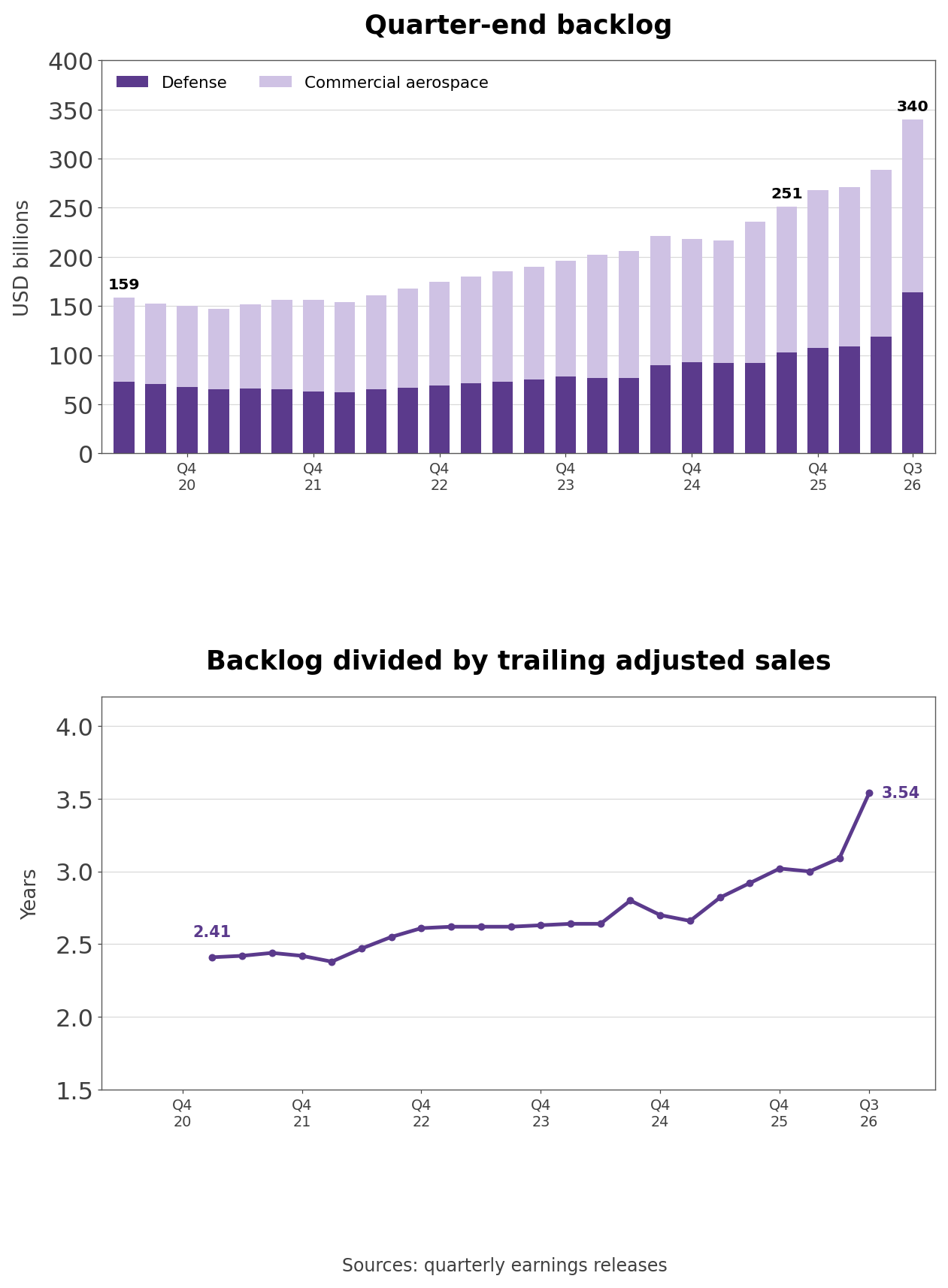
- Backlog has grown from $158.7 billion in the second quarter of 2020 ($85.6 billion commercial and $73.1 billion defense) to $340 billion ($176 billion commercial and $164 billion defense). Divided by trailing adjusted sales, that is 3.54 years, up from 2.41 years in the first quarter of 2021. Defense backlog stayed between $62 billion and $78 billion until the second quarter of 2024 and has more than doubled in the nine quarters since.
- Backlog rose $51 billion in the third quarter alone, and Tomahawk and AMRAAM accounted for $37.3 billion, or 73.1%, of that increase. The 2025 10-K defines backlog as remaining performance obligations and excludes unexercised contract options.
- Own calculation (the unpriced share of defense backlog): The four UCAs are worth up to $74.4 billion combined. The $37.3 billion booked in the third quarter equals 22.7% of the $164 billion defense backlog, so more than one in every five defense backlog dollars sits in contracts whose prices are not yet final. The SM-6 and SM-3 IB awards from early October are not yet in third-quarter backlog.
GTF Aftermarket Revenue and Powder Metal Payments
- Overhauls are the center of Pratt's growth. Commercial aftermarket rose 21% in the third quarter, mostly from the GTF, and page 4 of the deck says PW1100 maintenance output was up more than 35% from a year ago. Large commercial engine shipments, by contrast, were almost flat at 269 against 266, and commercial original equipment sales fell 5% on engine mix. The first aircraft with the GTF Advantage engine went to United Airlines in the second quarter and entered service in October.
- The powder metal issue now shows up in cash rather than earnings. Management said third-quarter free cash flow of $2.1 billion absorbed about $165 million of customer compensation and included about $300 million of IEEPA inflows, and the 10-Q says the 2026 decline in the accrual mainly reflects credits issued to customers.
- Customer bankruptcy charges have appeared twice, $108 million in the second quarter of 2025 and $363 million in the third quarter of 2026, both excluded from adjusted results. RTX said about 80% of GTF contracts are long-term agreements, mostly paid when engines come in for repair, and that Pratt can reach margins in the low to mid teens over time. Its 2025 adjusted margin was 8.3%.
2027 EPS Estimates and the Drop From the August Peak
- The shares are down 14.1% from the August weekly high. Over the past 90 days the average 2026 EPS estimate rose from $6.98 to $7.48, while the 2027 estimate moved less, from $7.59 to $7.97. That 2027 figure is only 3.5% above the company's 2026 guidance midpoint of $7.70.
- Management expects revenue and profit growth and margin expansion in 2027 even without the refund, but it did not give a 2027 free cash flow outlook and repeated only its long-term aim of converting 90% to 100% of adjusted net income into free cash flow as powder metal payments decline. Analysts expect 2027 sales of $104.36 billion, +7.6%. On the call, analysts pressed on the 2027 defense budget and airline cost pressures, and management declined to speculate while the budget is unsettled.
How RTX Makes Money Across Three Segments
- The three segments sell to different customers. Of 2025 segment sales before eliminations, Pratt & Whitney contributed $32.916 billion (36.1%), Collins $30.196 billion (33.1%), and Raytheon $28.043 billion (30.8%). Collins produced the largest share of adjusted operating profit at 45.1%, ahead of Raytheon at 29.8% and Pratt at 25.1%, and 2025 adjusted margins were 16.2%, 11.5%, and 8.3%.
- Collins makes electric power, environmental control, flight control, air data and sensing, engine control, nacelle and thrust reverser, lighting, and cargo systems, and sells spare parts, overhaul, training, and other aftermarket services. In the third quarter, commercial original equipment rose +23%, aftermarket 9%, and defense 7%. Boeing and Airbus together were 16% of Collins sales in 2025, down from 19% in 2023, and a new Etihad Engineering venture will more than double Collins' nacelle repair capacity in the Middle East from early 2027.
- Pratt & Whitney makes and services large engines for narrowbody and widebody jets, military engines for fighters, bombers, and transports, and small engines and auxiliary power units through Pratt & Whitney Canada; management describes the business as half commercial engines, a quarter military, and a quarter Canada. The GTF powers the A320neo family and has more than 8,000 engines in backlog after over 800 orders and commitments this year. The F135 is the only engine for Lockheed Martin's F-35 and passed one million flight hours in 2025.
- Raytheon makes integrated air and missile defense, precision weapons, missiles, sensors, and radars, including Patriot, LTAMDS, NASAMS, AMRAAM, StormBreaker, LRSO, Tomahawk, SM-6, SM-3, and the AN/TPY-2 radar. U.S. government sales were $33.279 billion in 2025, 38% of the total, down from 46% in 2023, and international sales were $41.312 billion, or 47%. RTX plans about $3.1 billion of capital spending in 2026, paid $2.882 billion of dividends in the first nine months, and bought back no stock.
RTX Against GE Aerospace and Three Defense Primes
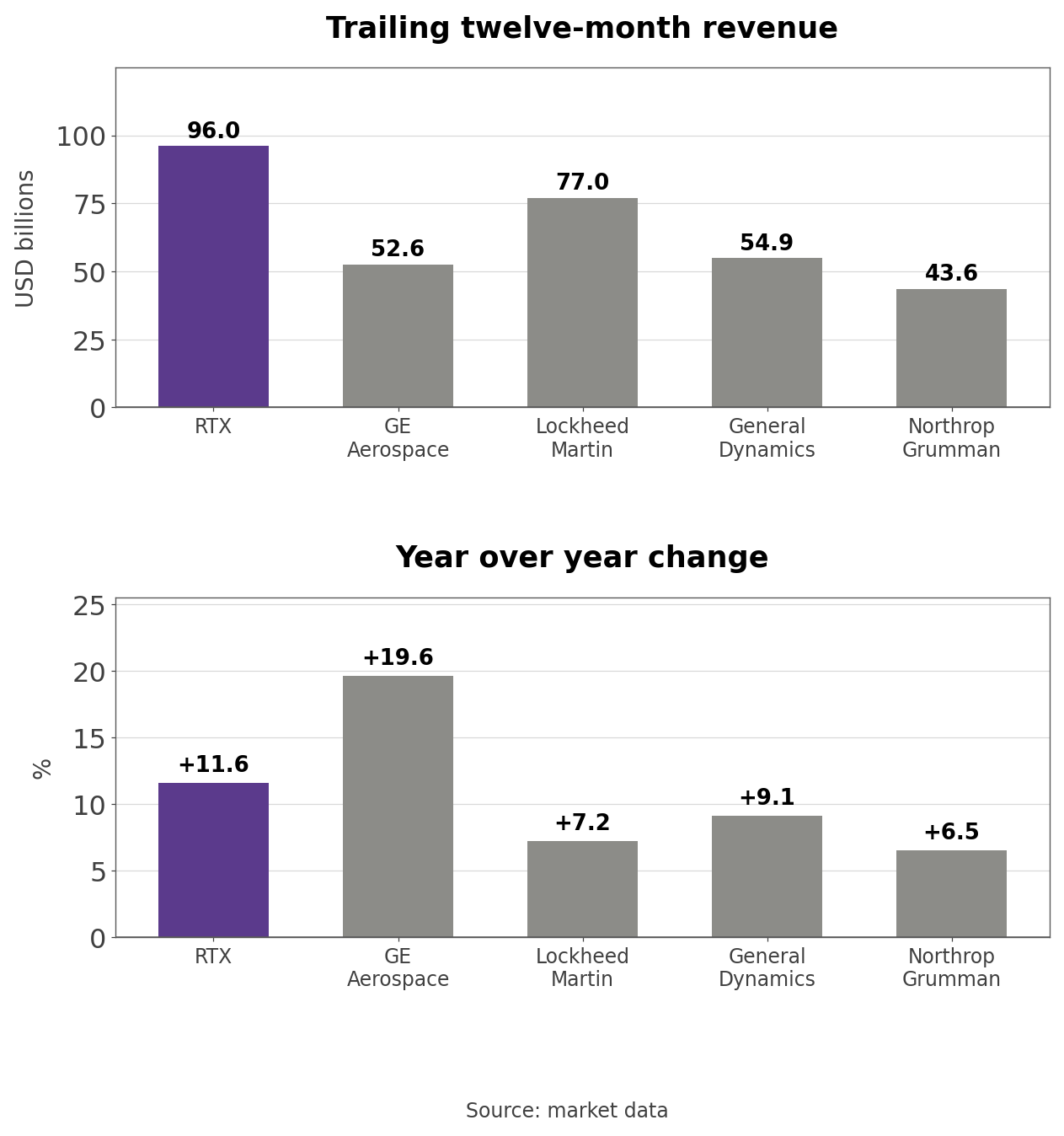
- Trailing twelve-month revenue was $96.0 billion at RTX, $77.0 billion at Lockheed Martin, $54.9 billion at General Dynamics, $52.6 billion at GE Aerospace, and $43.6 billion at Northrop Grumman. Growth was 19.6% at GE Aerospace, 11.6% at RTX, 9.1% at General Dynamics, 7.2% at Lockheed Martin, and 6.5% at Northrop Grumman, so RTX grows faster than the defense-heavy three and slower than the engine-heavy GE.
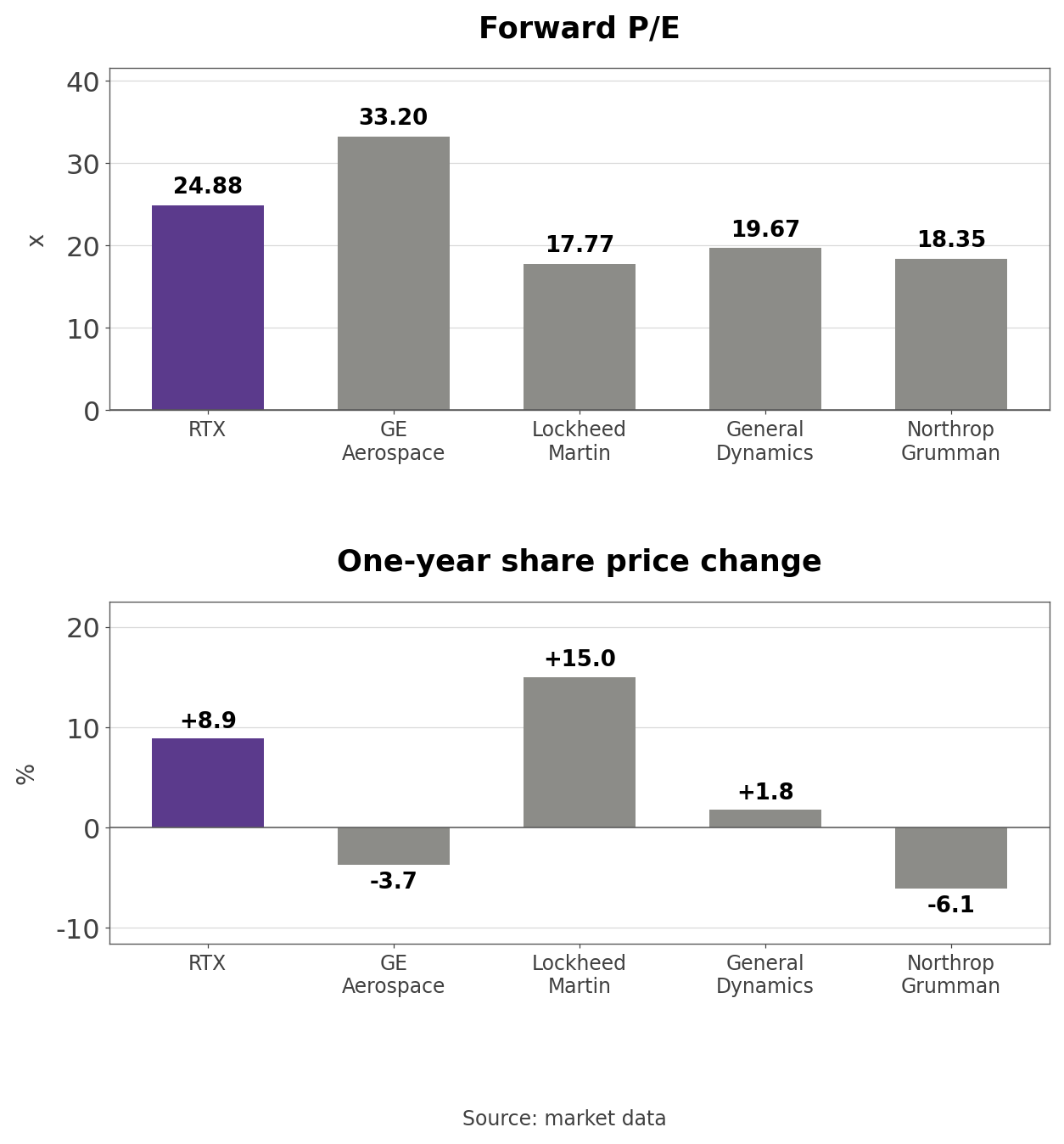
- Multiples line up the same way. Forward P/E is 33.20 for GE Aerospace, 24.88 for RTX, 19.67 for General Dynamics, 18.35 for Northrop Grumman, and 17.77 for Lockheed Martin, and RTX's trailing GAAP P/E of 31.15 trails only GE's 34.80. Price to sales is 5.81 for GE, 2.69 for RTX, 1.76 for Northrop, 1.70 for General Dynamics, and 1.65 for Lockheed.
- This piece uses a growth-adjusted multiple, forward P/E divided by revenue growth, because the question for a mixed commercial and defense company is where it falls between defense multiples and engine multiples. The peers are also partners and rivals: Lockheed builds the F-35 that Pratt's F135 powers, A320neo buyers choose between the GTF and the CFM LEAP from GE and Safran, and General Dynamics pairs submarines and combat vehicles with Gulfstream business jets.
- Own calculation (growth-adjusted forward P/E): The ratio is 1.69 for GE Aerospace, 2.14 for RTX, 2.16 for General Dynamics, 2.47 for Lockheed Martin, and 2.82 for Northrop Grumman. Against its growth, RTX is cheaper than the defense primes and dearer than GE, while its 1.52% dividend yield trails Lockheed's 2.61%, General Dynamics' 1.85%, and Northrop's 1.83%. Over one year, Lockheed gained 15.0%, RTX 8.9%, and General Dynamics 1.8%, while GE fell 3.7% and Northrop 6.1%.
P/E on Adjusted EPS Over 58 Months
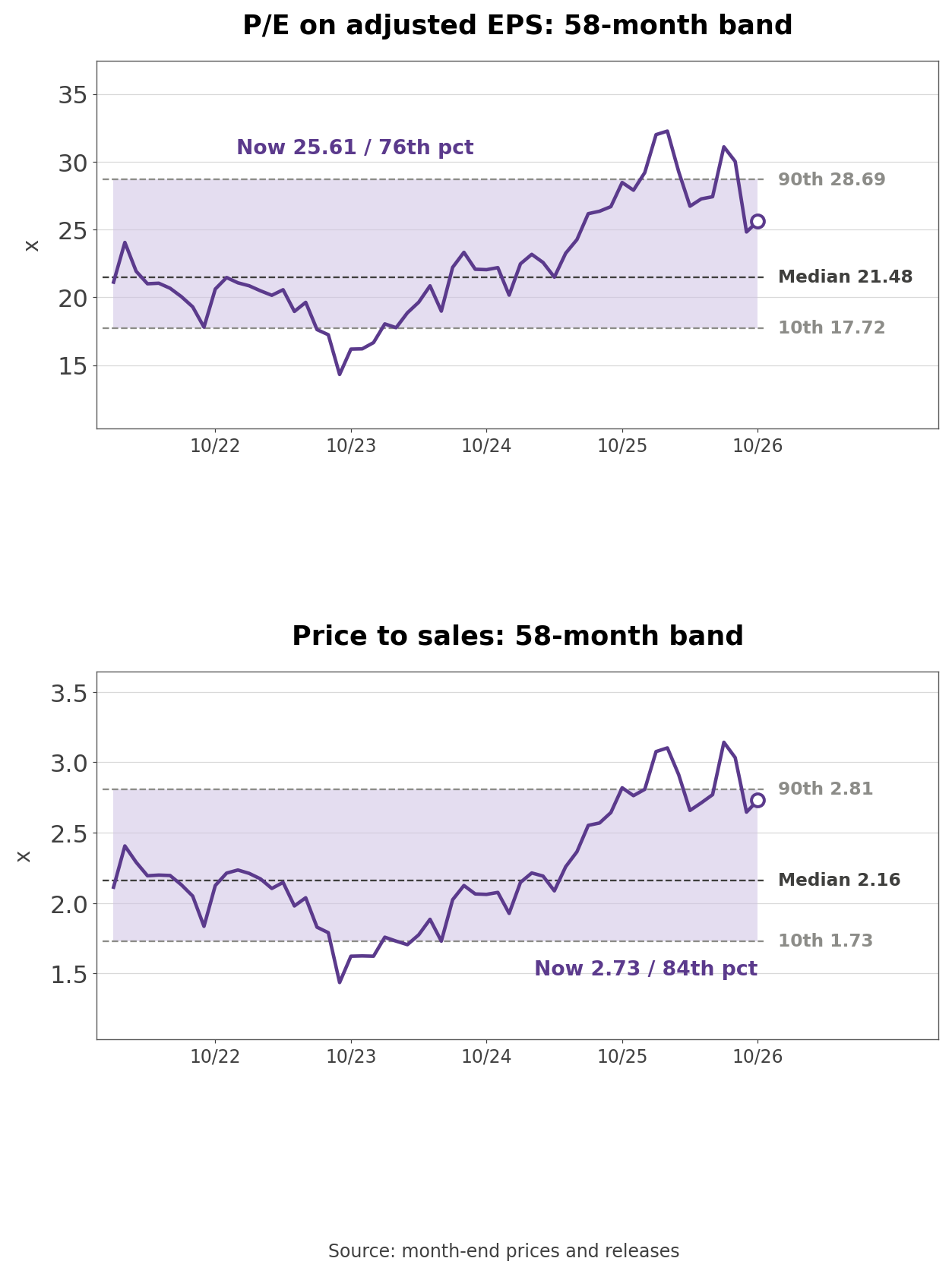
- On trailing adjusted EPS of $7.48, RTX trades at 25.61 times, the 76th percentile of the 58 months since January 2022, against a median of 21.48. The low was 14.31 times in September 2023, right after the powder metal charge, and the high was 32.26 times in February 2026. Price to sales on adjusted sales is 2.73 times, at the 84th percentile, against a median of 2.16.
- The 2020 and 2021 quarters, when adjusted EPS ran between $0.40 and $0.90 a quarter during the pandemic, are left out because the multiple loses meaning, and price to sales uses adjusted sales to avoid the third quarter of 2023, when the powder metal charge cut reported sales. Excluding the refund, trailing EPS is $7.23 and the P/E is 26.50. On the 2026 guidance midpoint of $7.70 the stock trades at 24.88 times, on the refund-free $7.45 at 25.72 times, and on 2027's $7.97 at 24.04 times.
Three Conditions That Move the Stock
- Pricing and funding of the munitions UCAs come first. The four contracts worth up to $74.4 billion turn into revenue and profit only after definitization and annual appropriations. If a fiscal 2027 budget close to the request passes after the continuing resolution ends on December 11, Raytheon's production ramp shows up in the numbers; if not, backlog stays large while revenue recognition slips.
- Pratt's margin without the refund is next. It was 8.75% in the third quarter, below 8.9% a year ago, and bankruptcy charges have hit twice. If GTF overhaul volume, the GTF Advantage, and upgraded parts push it above 9% without help from refunds, the path to the low to mid teens becomes visible; if aftermarket mix and SG&A keep weighing, segment profit keeps lagging sales.
- The final condition is the refund itself and limits on shareholder returns. About $0.4 billion of recognized refunds depends on the government's appeal, and 2027 will not have a refund of the same size, which makes the comparison harder. If the executive order on defense contractor distributions is applied to RTX, a return policy that now consists only of dividends would come under pressure.
What the 2027 Outlook Has to Show Without the Refund
- The late-January fourth-quarter report should show whether adjusted EPS lands in the implied $1.72 to $1.82 range on sales of $25.25 billion to $25.75 billion, and it will bring the first 2027 outlook. After that come the timing of UCA definitization, Pratt's refund-free margin, and the outcome of the IEEPA appeal.
- One question this piece cannot settle: in 2027, without the refund, can a backlog worth 3.54 years of sales, half of it defense and more than a fifth of that defense portion unpriced, drive EPS growth faster than the 6.6% analysts now expect?
Related Analysis
- Medtronic (MDT) Stock Analysis: Why EPS Stayed Flat Despite 10-Year-High Revenue Growth: a company whose profit lagged its sales growth, useful for reading Pratt's refund-free profit growth of 7.6% against 10% sales growth.
- CrowdStrike (CRWD) Stock Analysis: GAAP vs Non-GAAP Results: a case study in how adjustments shape reported EPS, a frame for separating RTX's IEEPA refund, acquisition accounting, and bankruptcy charges.
#RTX #RTXStock #Raytheon #DefenseStocks #AerospaceStocks #IEEPA #USStocks #StockAnalysis #EquityResearch #GlobalStockBrief
'US Stock Analysis' 카테고리의 다른 글
| Tesla (TSLA) Stock: 62% of Q3 Operating Income Was a Refund (0) | 2026.10.22 |
|---|---|
| Sanofi (SNY) Stock: Dupixent at 44% and Pipeline Write-Offs (0) | 2026.10.22 |
| Delta Air Lines (DAL) Stock: 23.6% EPS Guidance Cut on Fuel (0) | 2026.10.21 |
| Vertex (VRTX) Stock: 96% CF Revenue and a $10B Deal (0) | 2026.10.20 |
| T-Mobile (TMUS) Stock: Phone Metrics It Stopped Reporting (0) | 2026.10.19 |


