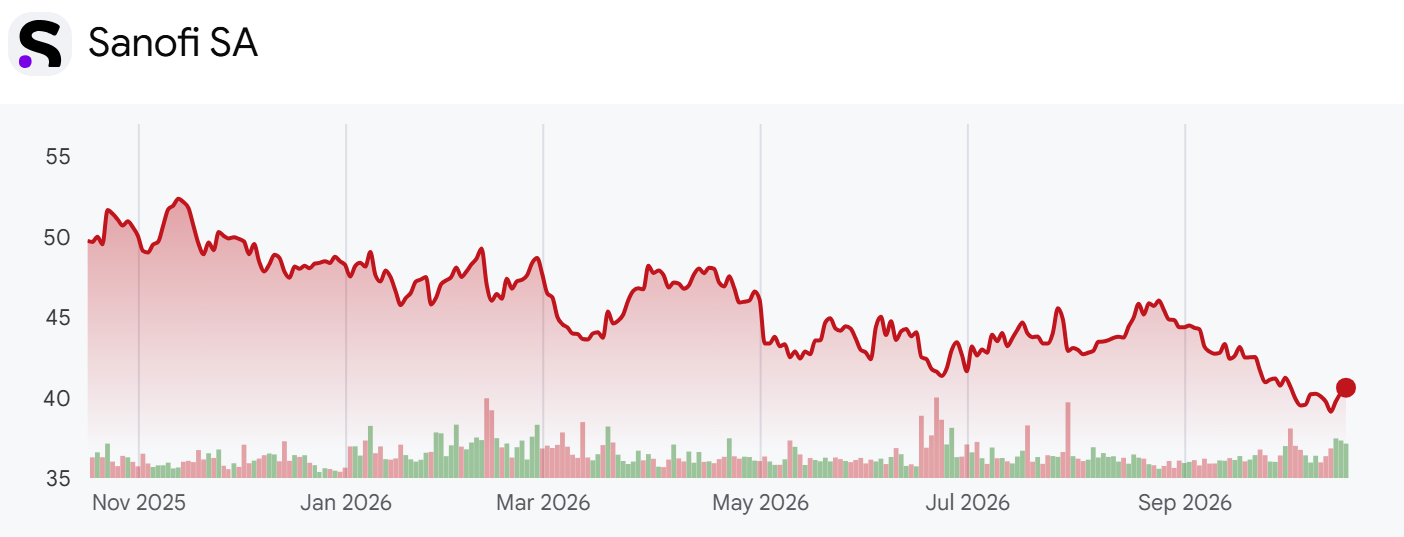
- Sanofi (NASDAQ: SNY) grew second-quarter 2026 net sales +17.8% at constant exchange rates to €11.597 billion and lifted business EPS, its non-IFRS measure, +33.3% to €2.09, then raised its 2026 sales growth guidance from a high single-digit rate to about 10%. In the same quarter, IFRS basic EPS fell -91.0% to €0.29. Dupixent, the eczema and asthma antibody Sanofi shares with Regeneron, reached 44.4% of net sales, up from 10.5% six years earlier, and two drug candidates bought to follow it were written off within twelve months. The ADR trades at $40.61, -16.5% over the past year, for a market value of $96.96 billion.
- Sanofi is a Paris-based drugmaker, and each Nasdaq-listed ADR represents half of an ordinary share. Its accounts are in euros and the ADR trades in dollars, so the valuation math below converts at the dollar-euro rate. Third-quarter results come out on October 30, which leaves this piece with figures through June.
What Sanofi's Second-Quarter Slides Flag as One-Offs
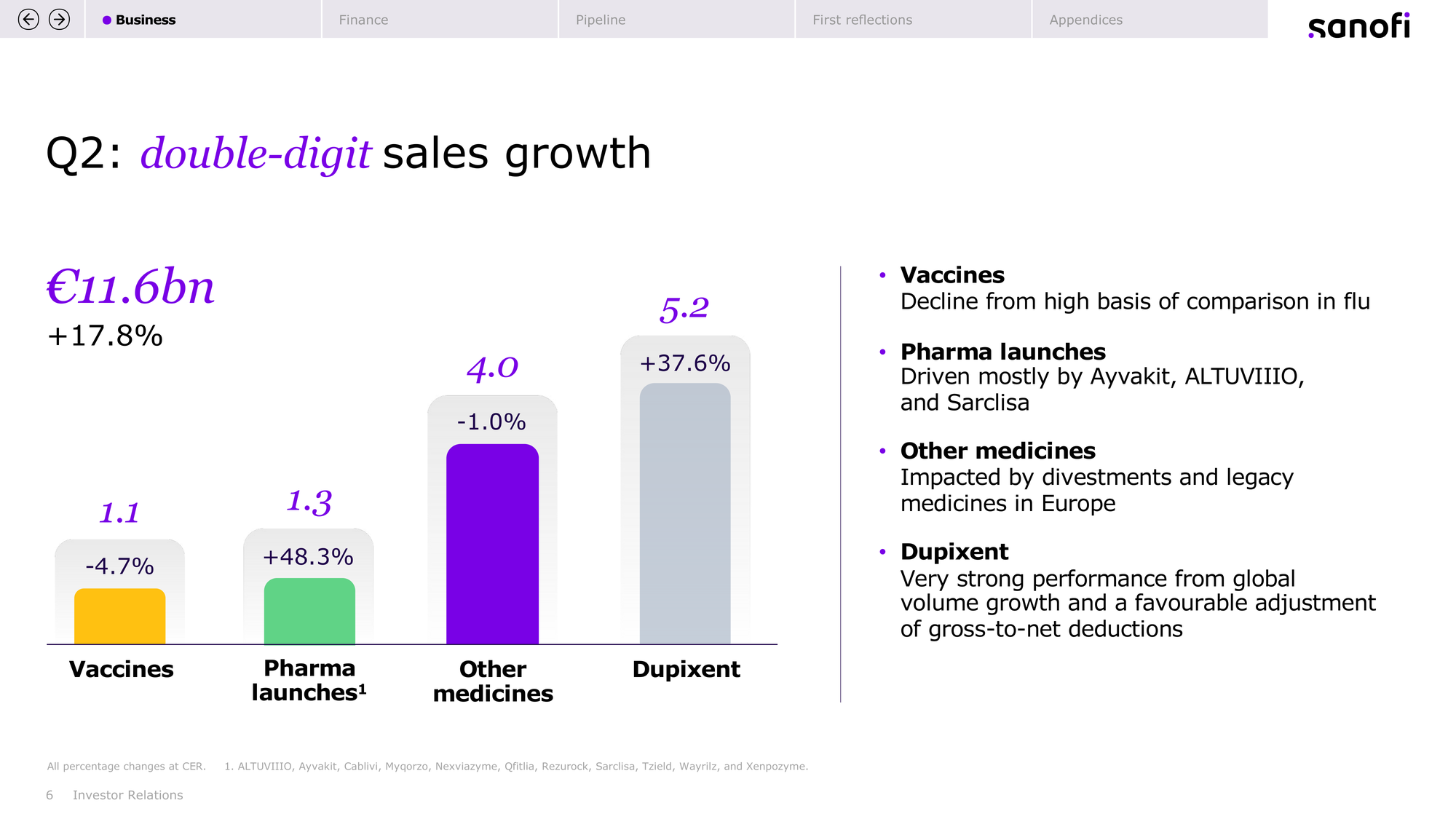
- Sanofi's 52-page second-quarter results presentation splits sales into four groups on page 6: Dupixent €5.2 billion, up 37.6%, pharma launches €1.3 billion, up 48.3%, vaccines €1.1 billion, down 4.7%, and other medicines €4.0 billion, down 1.0%. Next to Dupixent the slide credits global volume growth and "a favourable adjustment of gross-to-net deductions."
- Page 13 carries the title "Q2: strong quarter, partly supported by positive one-offs," and the call filled in the size of each item.
- Company disclosure (Q2 2026 results presentation, page 13, and earnings call): Restating last year for the Blueprint and Dynavax acquisitions, sales growth would have been around 15%. Sales included a couple of hundred million euros of positive gross-to-net adjustments. Excluding the reversal of inventory provisions after the Sarclisa subcutaneous approval, the underlying gross margin improvement was around 1.7 percentage points out of 3.7, and underlying business operating income growth was around 20% against a reported 35.8%.
- The cost lines on the same page point the same way. Research and development rose 17.9% to €2.233 billion, which Sanofi tied to wind-down costs from pipeline decisions and to its 2025 acquisitions, and selling and general expenses rose 9.0% to €2.465 billion. Other operating income and expenses, the line that carries Regeneron's share of Dupixent profits, went from a net €1.116 billion expense to €1.446 billion. The business operating margin still widened 3.8 points to 28.4%.
- The IFRS income statement in the second-quarter press release shows gross profit of €9.283 billion, €128 million below the business figure of €9.411 billion. The reconciliation table attributes that gap to inventory that was marked up to fair value when Sanofi bought Blueprint and Dynavax.
- Page 7 lists second-quarter sales for fourteen launch products. ALTUVIIIO for hemophilia led with €349 million, then Nexviazyme for Pompe disease at €218 million, Ayvakit from Blueprint at €190 million, and the multiple myeloma drug Sarclisa at €187 million, for a total of €1.53 billion, up 61.1%.
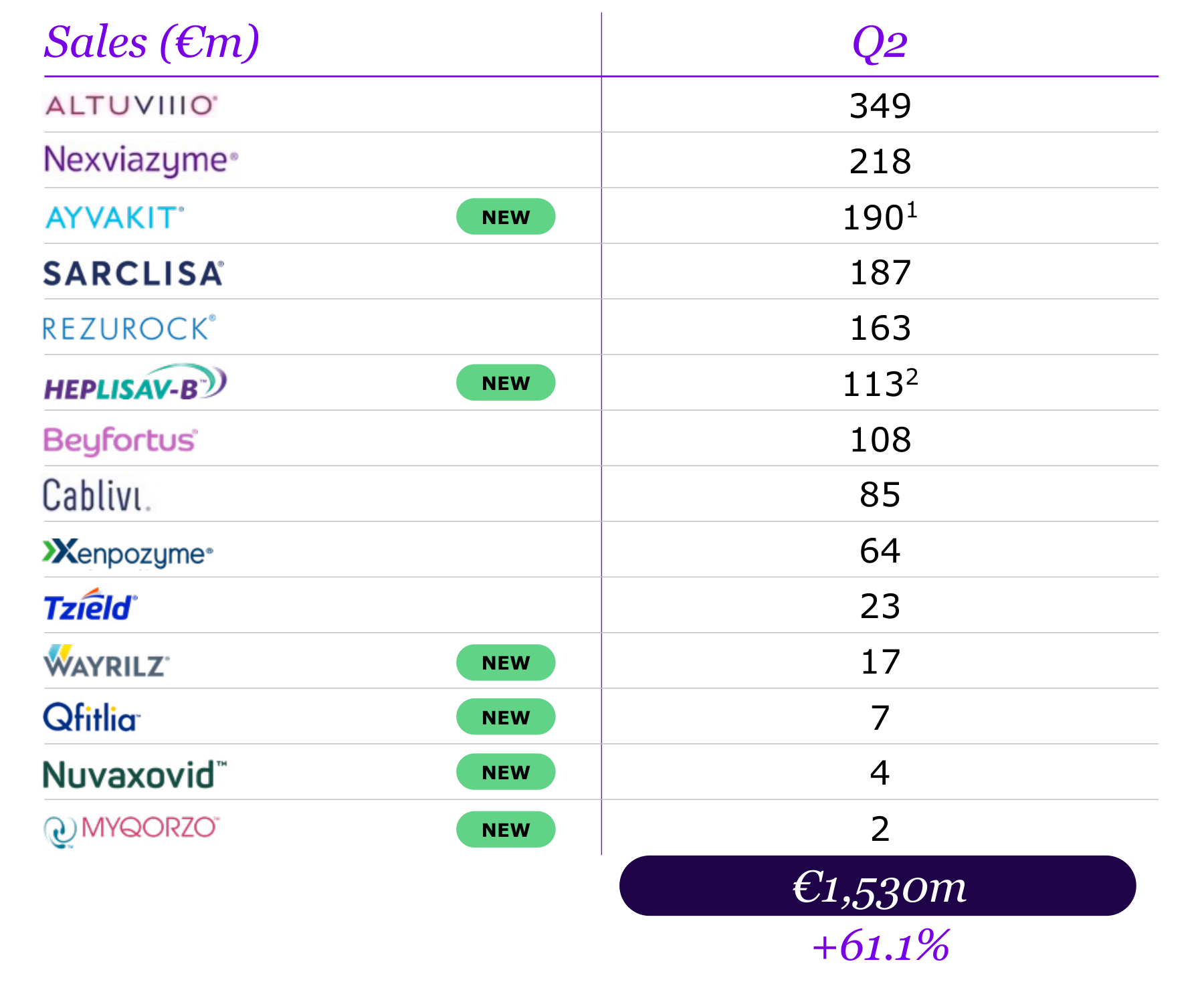
- The €225 million difference between the €1.3 billion on page 6 and the €1.53 billion on page 7 comes from three vaccine launches, Heplisav-B, Beyfortus, and Nuvaxovid, which page 7 counts as launches and page 6 books under vaccines. The launch total equals 13.2% of second-quarter net sales and 29.7% of Dupixent alone.
Sanofi's 2030 Targets for Dupixent and Vaccines
- On page 17, Sanofi raised 2026 sales growth guidance to about 10% and kept business EPS growing slightly faster than sales before buybacks. For 2030 it lifted the Dupixent ambition from about €22 billion to about €25 billion, held pharma launches at about €10 billion, and cut vaccines from about €10 billion to about €9 billion. A footnote says roughly half of the combined upgrade came from currency.
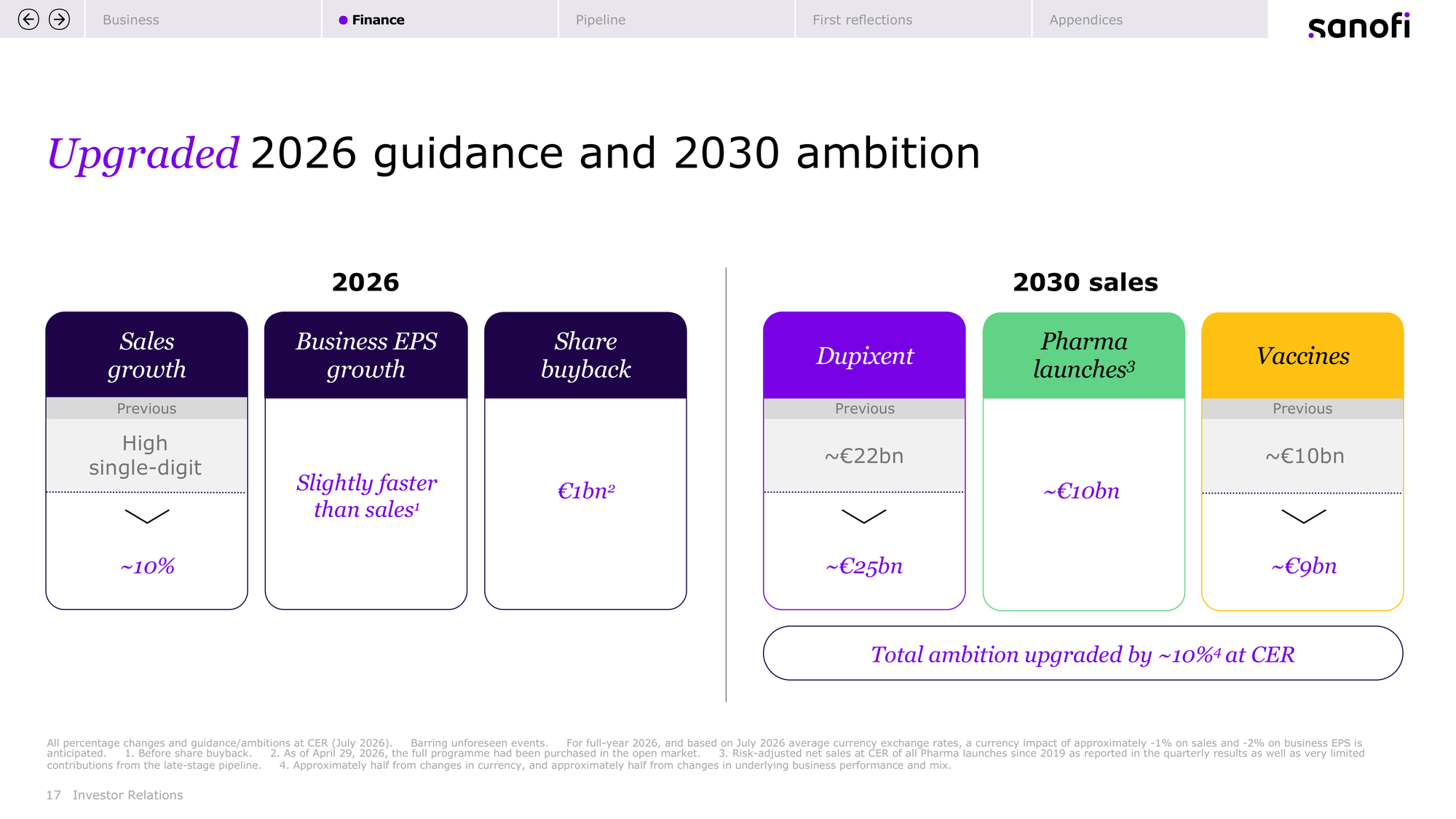
- Own calculation (2025 Dupixent sales against the 2030 target): Moving from €15.714 billion in 2025 to about €25 billion in 2030 takes 1.59 times the sales, or +9.7% a year. That is less than half of 2025's +20.2% growth rate, and the US compound patent on Dupixent expires the following March, in 2031.
- Page 16 shows one income stream ending and another growing. Regeneron had been keeping back part of its profit share to repay development costs, worth about €1.1 billion to Sanofi in 2025 and about €0.6 billion in 2026, and that reimbursement finished at the end of the second quarter. Royalties on Alnylam's heart drug Amvuttra are set to rise from about €0.5 billion in 2025 to about €1.0 billion in 2026.

- The chief financial officer said on the call that the royalty increase fully offsets the lost reimbursement in 2026 but leaves a gap of about €200 million in business operating income in 2027. Page 15 lists the rest of the 2026 picture: about €200 million of sales lost to divestments of older medicines, a moderate rise in research spending, higher financial expenses from 2025 and 2026 deals, about €400 million of capital gains, and Regeneron profit sharing that grows faster than sales. The 2025 Form 20-F puts last year's reimbursement at €1.089 billion. A footnote on page 17 adds that the launch ambition covers drugs launched since 2019, risk-adjusted, with "very limited contributions from the late-stage pipeline."
The Market Case for Sanofi
- The bullish case has three legs: Dupixent keeps growing past €5 billion a quarter, the launch portfolio reaches €10 billion by 2030, and a multiple at a five-year low plus 31 straight years of dividend increases limit the downside. The bearish case starts with the March 2031 patent date and a pipeline that has lost its leading candidates to replace Dupixent.
- Outside view (sell-side research aggregate, October 2026): The consensus of 27 analysts is Hold, with a 12-month price target of $50. RBC started coverage on September 9 with a Sector Perform rating.
From the Principia and Kymab Deals to a New CEO
- Both written-off candidates came through acquisitions. In August 2020, Sanofi agreed to buy Principia Biopharma for $100 a share, an equity value of about $3.68 billion, gaining the brain-penetrant BTK inhibitor now called tolebrutinib. In January 2021 it bought Kymab for about $1.1 billion upfront and up to $350 million in milestones, adding the OX40L antibody KY1005, now amlitelimab.
- On October 27, 2023, Sanofi said it would no longer target a 32% business operating margin for 2025 so that it could spend more on research. The ADR fell -17.1% that week, from $52.05 to $43.13. The consumer health separation announced the same day ended in April 2025, when Sanofi sold 50% of Opella to CD&R, received €10.4 billion in cash, and kept 48.2%.
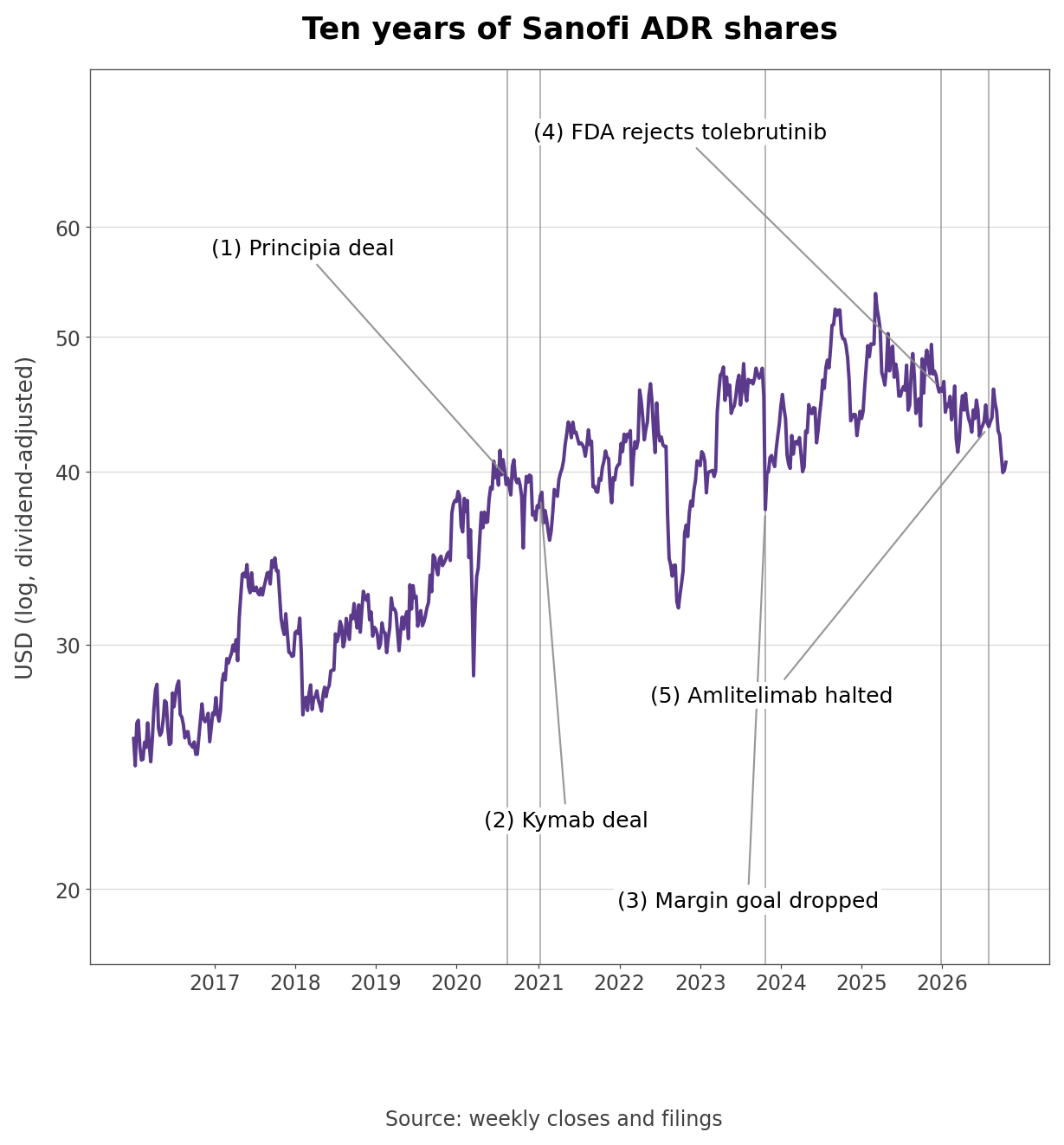
- On December 24, 2025, the FDA issued a complete response letter on tolebrutinib. On February 12, 2026, the board declined to renew Paul Hudson's director mandate and named Belén Garijo, the former chief executive of Merck KGaA, as his successor; she took over after the April 29 annual meeting. The board's release said her priority would be to strengthen the productivity, governance, and innovation capacity of research and development.
- On July 24, Sanofi decided not to take amlitelimab to regulators and ended the itepekimab and balinatunfib programs. The ADR's dividend-adjusted weekly close peaked at $53.73 in March 2025 and now sits -24.4% below that level.
How Much of Sanofi Rests on Dupixent?
- Dupixent rose from 10.5% of net sales in the second quarter of 2020 to 44.4% in the second quarter of 2026. On a full-year basis it was 13.9% in 2021 and 36.0% in 2025, and 42.2% in the first half of 2026. Second-quarter sales of €5.154 billion were the first quarter above €5 billion.
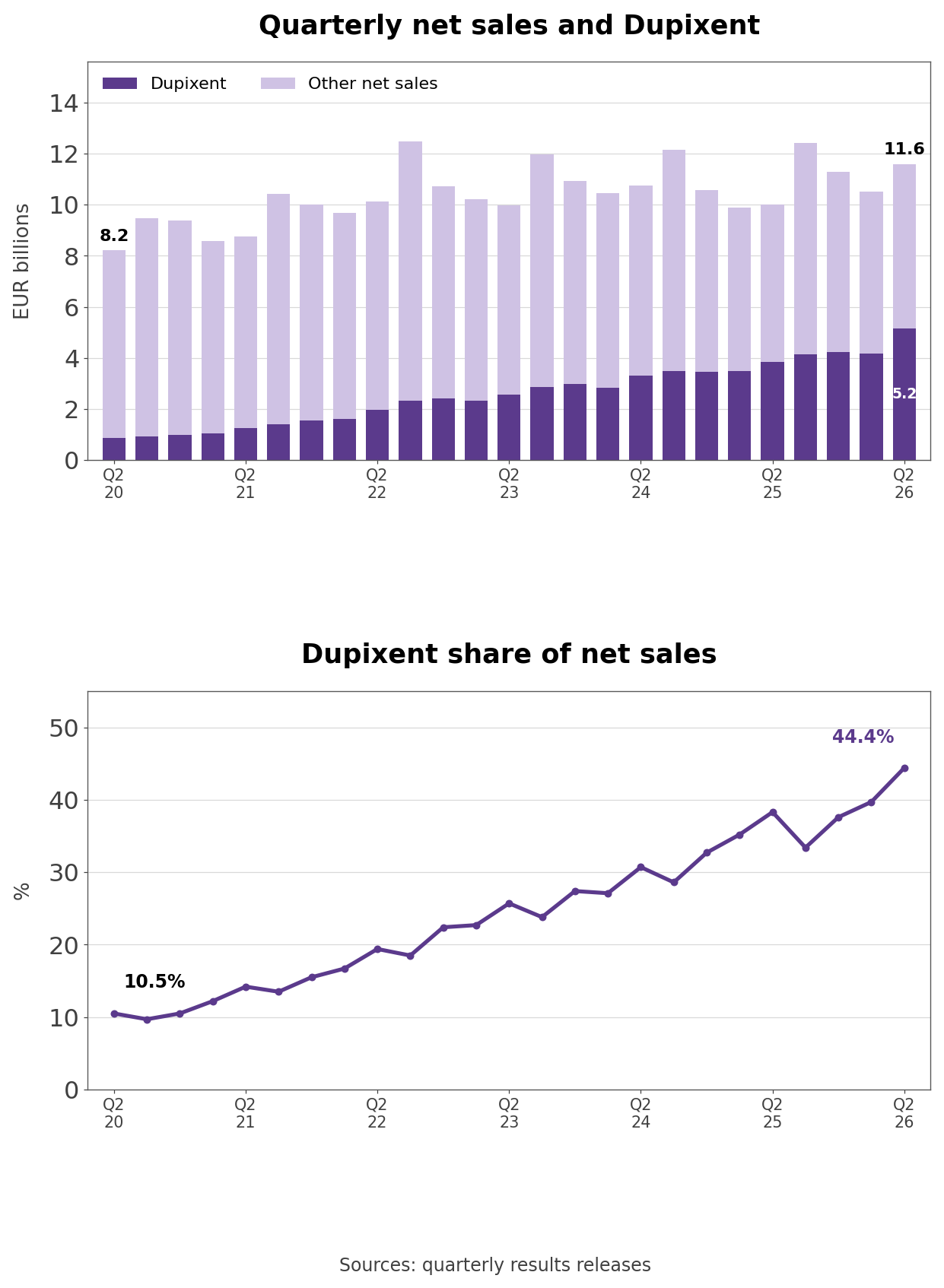
- Putting all 25 quarterly releases side by side, net sales outside Dupixent fell from €7.349 billion in the second quarter of 2020 to €6.443 billion in the second quarter of 2026. The scope is not identical, since Opella left in 2025 and Blueprint and Dynavax arrived, but most of six years of sales growth came from one drug.
- Company disclosure (Q2 2026 results presentation, page 33): The Dupixent US compound patent expires in March 2031. Sanofi holds issued patents and pending applications expiring from 2031 to 2045 and plans a vigorous defense, while developing a higher dose to extend dosing to every four weeks and a co-formulation.
- Asked on the call about biosimilar timing, management said it was too early to speculate on dates and that it expects Dupixent to be protected beyond March 2031. Merck faces the same kind of cliff, with Keytruda at 48.7% of 2025 sales and a US patent ending in 2028, yet over the past year Merck shares rose +74.7% while Sanofi's fell -16.5%. The filings alone do not explain why two companies facing similar patent dates were priced so differently.
Why IFRS Net Income Fell 91% While Business EPS Rose
- IFRS net income attributable to shareholders was €343 million in the second quarter, about one-seventh of business net income of €2.501 billion. Much of the -91.3% drop reflects a comparison base that included €2.707 billion of income from the discontinued Opella business a year earlier. On a continuing-operations basis, basic EPS went from €1.02 to €0.29.
- The rest came from €1.031 billion of intangible asset impairments, €952 million of it on amlitelimab. The half-year report describes that charge as the entire carrying amount of the asset. Because the write-down is not tax-deductible, the first-half IFRS effective tax rate rose to 30.6% from 19.8%.
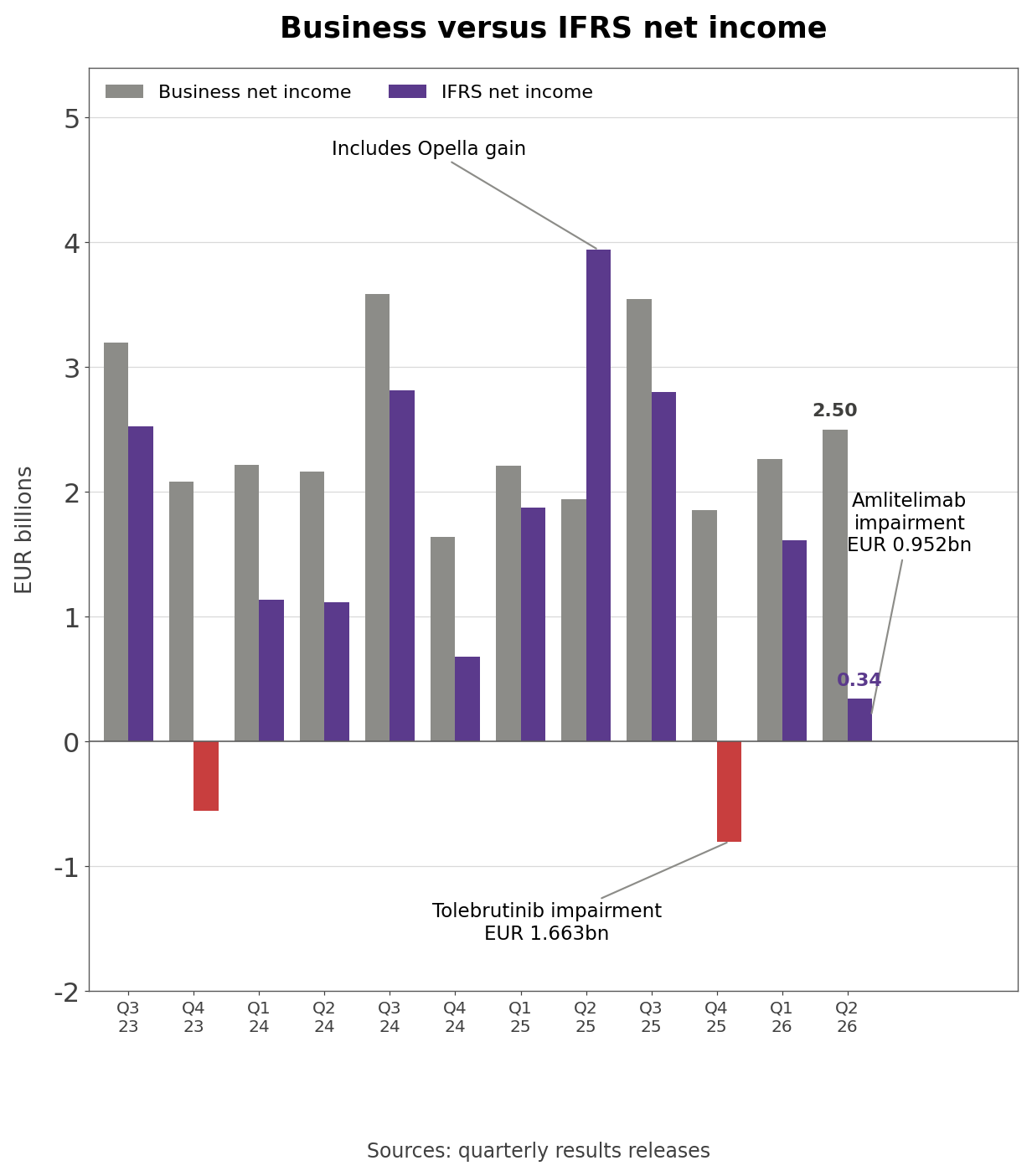
- The same pattern produced an IFRS net loss of €801 million in the fourth quarter of 2025. The 2025 Form 20-F records a €1.663 billion impairment on tolebrutinib, citing the negative phase 3 result in primary progressive multiple sclerosis and recent interactions with US and European regulators. Europe approved the drug as Cenrifki in June 2026 for non-relapsing secondary progressive multiple sclerosis, while the US path remains closed for now.
- Own calculation (two impairments): Tolebrutinib's €1.663 billion and amlitelimab's €952 million add up to €2.615 billion. The deals that brought them in were valued at about $3.68 billion for Principia's equity and about $1.1 billion upfront for Kymab.
The Pipeline Programs Sanofi Dropped and What Remains
- Three programs ended in the second quarter. Amlitelimab held its response through 72 weeks in a long-term extension study, but Sanofi concluded that the totality of efficacy and safety evidence did not support further development in atopic dermatitis. Itepekimab, an IL-33 antibody developed with Regeneron, was stopped in chronic obstructive pulmonary disease after two phase 3 readouts in May 2025 and changes in the competitive landscape, and balinatunfib missed internal efficacy expectations in phase 2 studies in Crohn's disease and ulcerative colitis.
- In the second-quarter release, Garijo said her first months had focused on assessing the challenges facing Sanofi and on an accelerated transformation roadmap that leverages commercial strengths and addresses the need for research and pipeline improvements.
- What remains in immunology includes duvakitug, developed with Teva, and lunsekimig, which met its primary and key secondary endpoints in phase 2 studies in asthma and chronic rhinosinusitis with nasal polyps in April. In rare diseases, venglustat is under priority review in the US for type 3 Gaucher disease. Paulo Fontoura became head of research and development on September 1.
How Sanofi Makes Money Across Four Product Groups
- Sanofi reports four sales groups. In the second quarter, Dupixent contributed €5.154 billion, other medicines about €4.0 billion, pharma launches €1.3 billion, and vaccines €1.1 billion.
- By region, the US produced €6.344 billion, or 54.7% of net sales, up 33.5%, and 75.6% of Dupixent sales came from the US. Europe grew 1.3% to €2.141 billion and the rest of the world grew 3.7% to €3.112 billion, with China down 4.9% to €676 million. The release credits US growth to launches, Dupixent, and the newly acquired Heplisav-B, and says European growth from launches and Dupixent was almost offset by declines in older medicines and most vaccines.
- Dupixent started in atopic dermatitis and now treats asthma, chronic rhinosinusitis with nasal polyps, eosinophilic esophagitis, COPD, and chronic spontaneous urticaria among nine indications, with more than 1.5 million patients on treatment. Launches center on rare disease drugs such as ALTUVIIIO and Nexviazyme, Blueprint's mast cell drug Ayvakit, and Sarclisa, which grew 35.7% in the quarter. Sanofi's remaining 48.2% stake in Opella is equity-accounted and sits outside business net income.
- Vaccines combine flu shots, the infant RSV antibody Beyfortus, and the adult hepatitis B vaccine Heplisav-B that arrived with Dynavax in February 2026. Sanofi guided third-quarter vaccine sales to a low to mid-teens percentage decline after a high flu comparison.
- Other medicines are older products. In the second quarter, Lantus insulin fell 7.0% to €394 million, Plavix fell 5.7% to €216 million, and the anticoagulant Lovenox fell 15.8% to €180 million, while Toujeo insulin rose 4.4% to €354 million and the cholesterol drug Praluent rose 19.0% to €164 million. On September 14, Sanofi agreed to transfer 20 such medicines and three plants to Cheplapharm in exchange for a 26.4% stake in Cheplapharm. In December 2025 it reached an agreement with the US government to supply certain medicines to state Medicaid programs at prices available in other high-income countries.
Sharing Dupixent Profits With Regeneron
- Dupixent was co-developed with Regeneron. According to the 2025 Form 20-F, Sanofi leads commercialization and records all sales. US profits are split 50/50, and outside the US Sanofi keeps 55% to 65% depending on sales. Regeneron's share does not reduce revenue; it flows through other operating expenses.
- The same alliance covers the rheumatoid arthritis drug Kevzara, whose second-quarter sales rose 35.1% to €177 million. Besides profit sharing, Sanofi reimburses Regeneron for selling expenses, €699 million in 2025.
- On October 1, the two companies added four long-acting antibodies invented by Regeneron. The IL-13 antibody REGN20423 is in a phase 1 study in atopic dermatitis, and the other three are expected to enter clinical studies in 2027. Regeneron receives $1 billion upfront and up to $7 billion in milestones, costs and profits are shared equally, and Regeneron gets an option to add lunsekimig after its phase 3 studies. Garijo called the deal "a deliberate first step in igniting Sanofi’s innovation engine."
- So Dupixent's 44.4% of sales does not translate one-for-one into Sanofi's profit. Net Regeneron-related other operating expense in the 20-F was €4.923 billion in 2025, up +29.9% from €3.789 billion and faster than Dupixent's +20.2% sales growth that year.
- Own calculation (Regeneron-related net cost against Dupixent sales): The net cost equaled 29.8% of Dupixent sales in 2023, 29.0% in 2024, and 31.3% in 2025. That figure already nets out the €1.089 billion Regeneron held back in 2025 to repay development costs, and that repayment ended in the second quarter of 2026. The 20-F put the remaining balance at €0.5 billion at the end of 2025, against cumulative development costs of €9.0 billion.
How Sanofi Compares With Four Big Pharma Peers
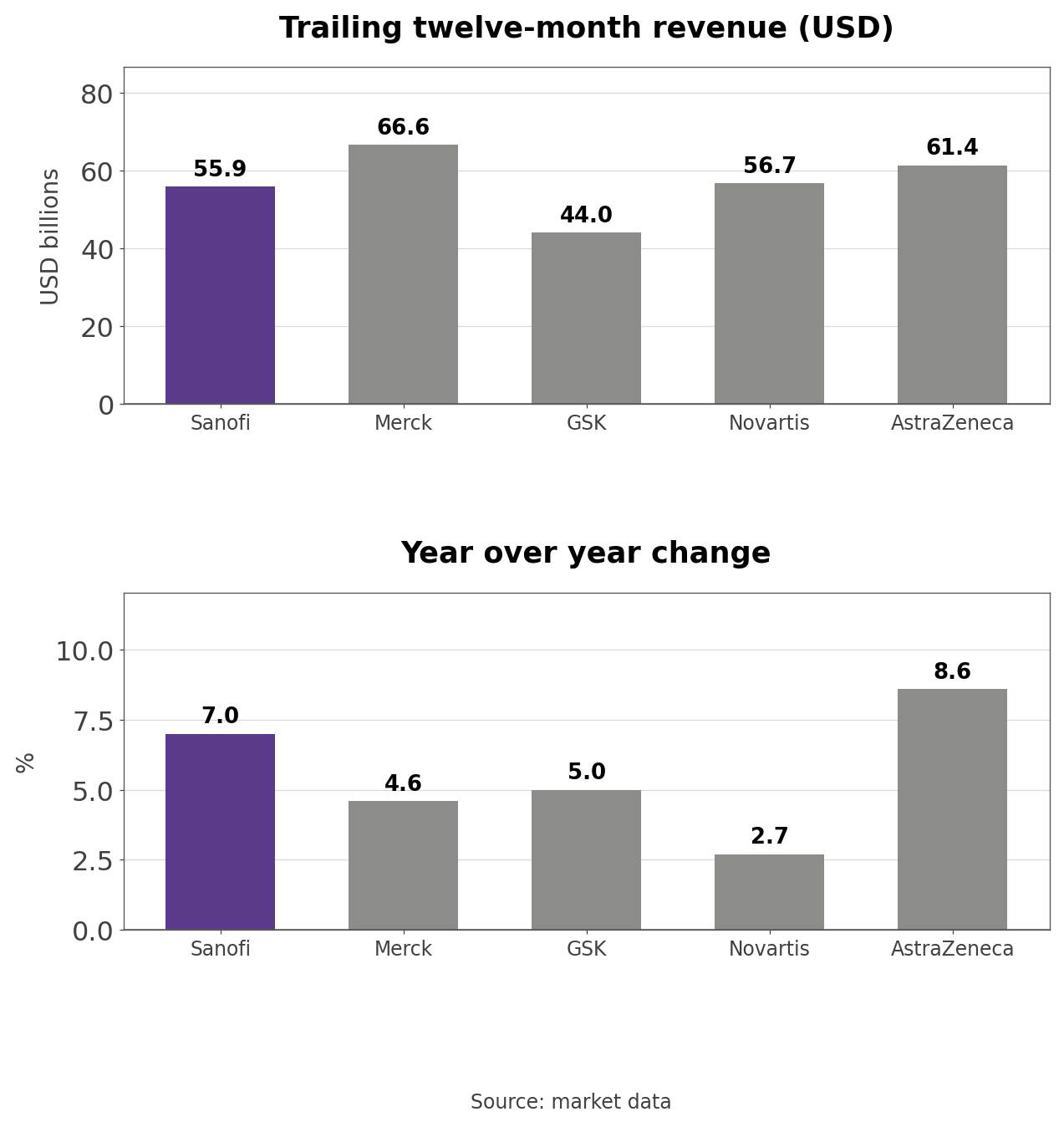
- In trailing twelve-month revenue converted to dollars, Sanofi's $55.89 billion is smaller than Merck at $66.57 billion, AstraZeneca at $61.37 billion, and Novartis at $56.69 billion, and larger than GSK at $44.05 billion. Sanofi's growth of 7.0% trails only AstraZeneca's 8.6%. In euros, trailing net sales of €45.843 billion grew 7.6%.
- Sanofi has the lowest forward P/E of the five at 8.31x, followed by GSK at 10.19x, AstraZeneca at 15.40x, Novartis at 16.24x, and Merck at 17.54x. Its dividend yield of 4.35% is the highest, ahead of GSK at 3.61%. Merck's $360.08 billion market value is 3.7 times Sanofi's. Over one year, Merck rose +74.7%, Novartis 25.4%, GSK 9.3%, AstraZeneca 2.8%, and Sanofi fell -16.5%.
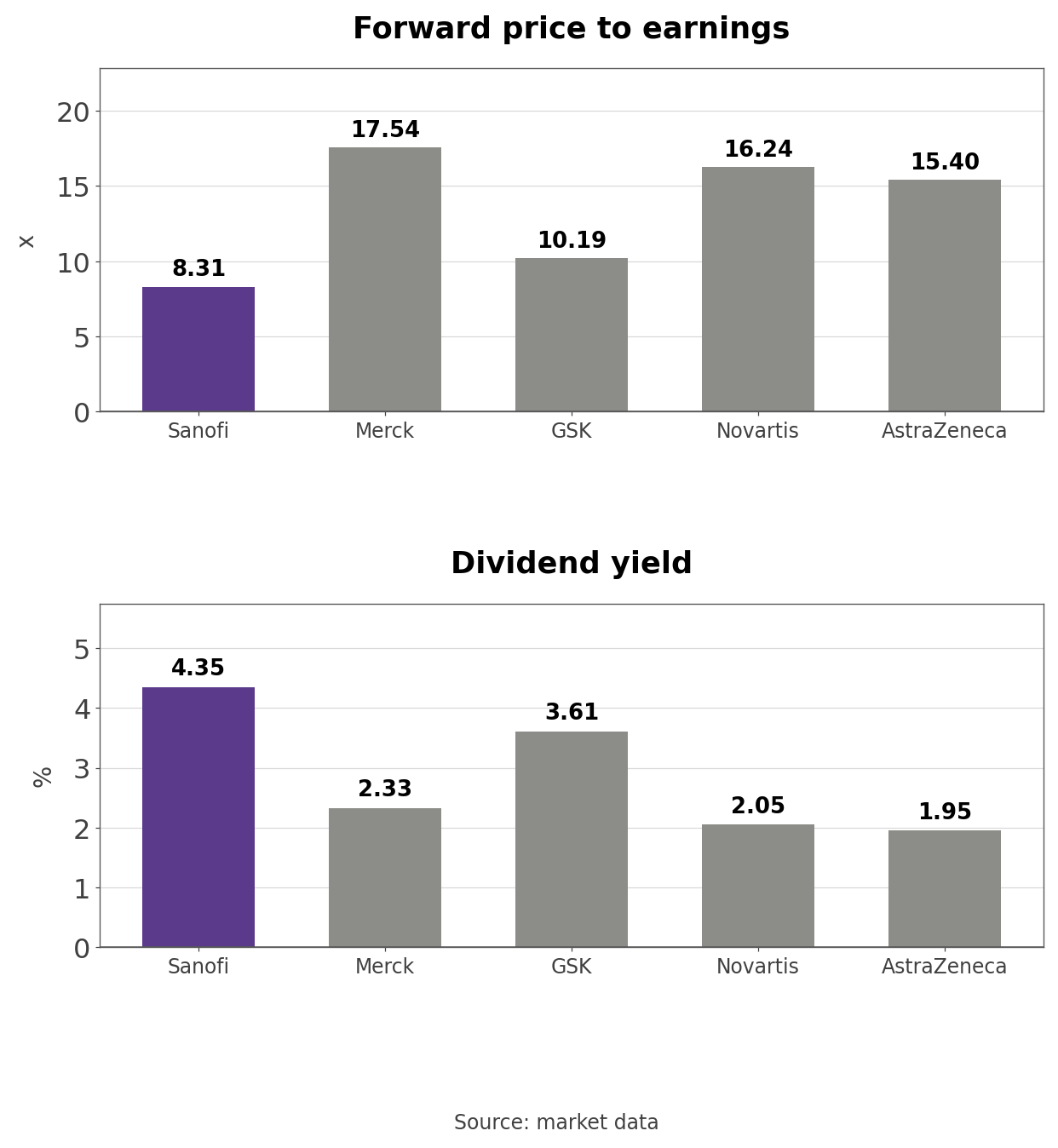
- Dividing forward P/E by trailing revenue growth gives a growth-adjusted multiple of 1.19 for Sanofi, 1.79 for AstraZeneca, 2.04 for GSK, 3.81 for Merck, and 6.01 for Novartis. Sanofi is the cheapest even after adjusting for growth, but that ratio assumes growth after Dupixent looks like growth today.
SNY P/E on Business EPS Over 61 Months
- On business EPS, Sanofi trades at 8.59 times earnings, the lowest reading in 61 months and 25% below the median of 11.42x. Price to net sales of 1.89x is also a 61-month low against a median of 2.62x.
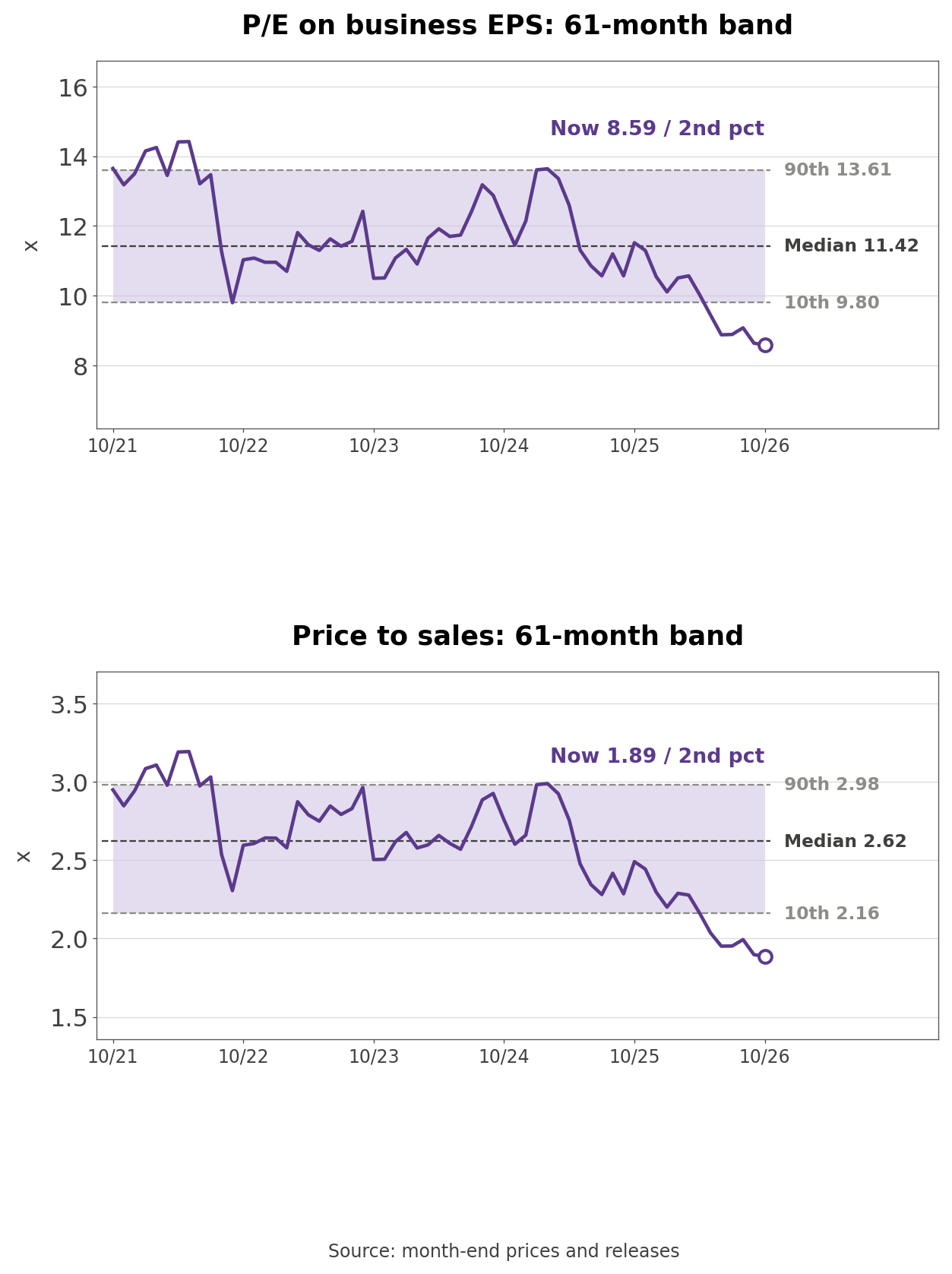
- Two ADRs equal one ordinary share, so $40.61 times two, divided by a dollar-euro rate of 1.1240, gives €72.26 per share. Dividing by trailing four-quarter business EPS of €8.41 gives 8.59x. Market data shows a trailing P/E of 21.78x on IFRS earnings, more than twice as high, because impairments and disposal gains swing IFRS profit.
- One caveat applies. Releases for the first two quarters of 2024 still included Opella, and Sanofi excluded it from the third quarter on, so the band mixes the two bases from late 2024 into spring 2025. The dividend also depends on the yardstick: Sanofi's €4.12 per ordinary share divided by €72.26 gives 5.70%, while the 4.35% in market data uses the $1.76 actually paid per ADR.
Three Conditions That Move the Stock
- Dupixent growth matters most. The €25 billion target needs only 9.7% a year, so if growth slows in the second half as guided but stays in the mid-teens, Sanofi buys time before 2031. If US pricing pressure or new competitors push growth into single digits while Dupixent makes up 61.5% of US sales, 44% of the company loses its footing at once.
- Business development comes next. Garijo has pledged more disciplined licensing and M&A, but net debt reached €15.513 billion at the end of June, up from €11.008 billion at the end of 2025, and the 2026 buyback of €1 billion is one-fifth of 2025's €5.03 billion. Late-stage assets bought within that debt capacity would give the multiple a reason to recover; another Principia or Kymab outcome would hit IFRS earnings and credibility together.
- Earnings quality is the third. The second quarter's gross-to-net adjustment, the inventory provision reversal, and the Regeneron reimbursement fade or disappear in the second half. If business EPS still grows faster than sales without them, the five-year-low multiple has room to rise; if Regeneron's share keeps outgrowing sales and pulls EPS growth below sales growth, today's multiple may not be the floor.
What the Third-Quarter Report Should Show
- Sanofi reports third-quarter results on October 30. The first figures to check are how far Dupixent growth slowed from 37.6% and whether vaccine sales fell by the low to mid-teens percentage the company guided. Next come underlying business operating income growth without one-offs and the Regeneron-related line in other operating expenses.
- One question this piece cannot settle is what fills Dupixent's place once its sales start to decline after March 2031. The 2030 ambition includes almost nothing from the late-stage pipeline, and the four Regeneron antibodies added in October are in phase 1 or earlier. The results of the pipeline review Garijo describes as ongoing will be the first real evidence.
Related Analysis
- Medtronic (MDT) Stock Analysis: Why EPS Stayed Flat Despite 10-Year-High Revenue Growth: another healthcare company where sales growth and adjusted earnings moved apart, useful for comparing how one-offs and acquisition costs shape reported EPS.
- Adobe (ADBE) Stock Analysis: Valuation After the CEO Change: a company whose multiple was reset around a leadership change, a useful frame for reading Sanofi's discount after Belén Garijo replaced Paul Hudson.
#Sanofi #SNY #SNYStock #Dupixent #PharmaStocks #PatentCliff #GlobalStocks #StockAnalysis #EquityResearch #GlobalStockBrief
'US Stock Analysis' 카테고리의 다른 글
| Delta Air Lines (DAL) Stock: 23.6% EPS Guidance Cut on Fuel (0) | 2026.10.21 |
|---|---|
| Vertex (VRTX) Stock: 96% CF Revenue and a $10B Deal (0) | 2026.10.20 |
| T-Mobile (TMUS) Stock: Phone Metrics It Stopped Reporting (0) | 2026.10.19 |
| KLA (KLAC) Stock: Net Income Up 19% and Cash Flow Flat (0) | 2026.10.18 |
| Halozyme (HALO) Stock: 2033 Convertible Notes, Dilution (0) | 2026.09.21 |


