- SLB N.V. (NYSE: SLB), the oilfield services company long known as Schlumberger, grew second-quarter 2026 revenue +5% to $8.972 billion, but only because of ChampionX, the chemicals and artificial lift business it bought in July 2025. Without ChampionX's $870 million, revenue was -5%, and EPS excluding charges and credits fell -26% to $0.55. On August 31 the company agreed to buy Kelvion, a maker of heat exchangers and cooling equipment, for about $4.1 billion including assumed debt. The question is how much of SLB's earnings the new businesses can carry, and what the market is paying for when it has doubled the P/E while EPS shrank.
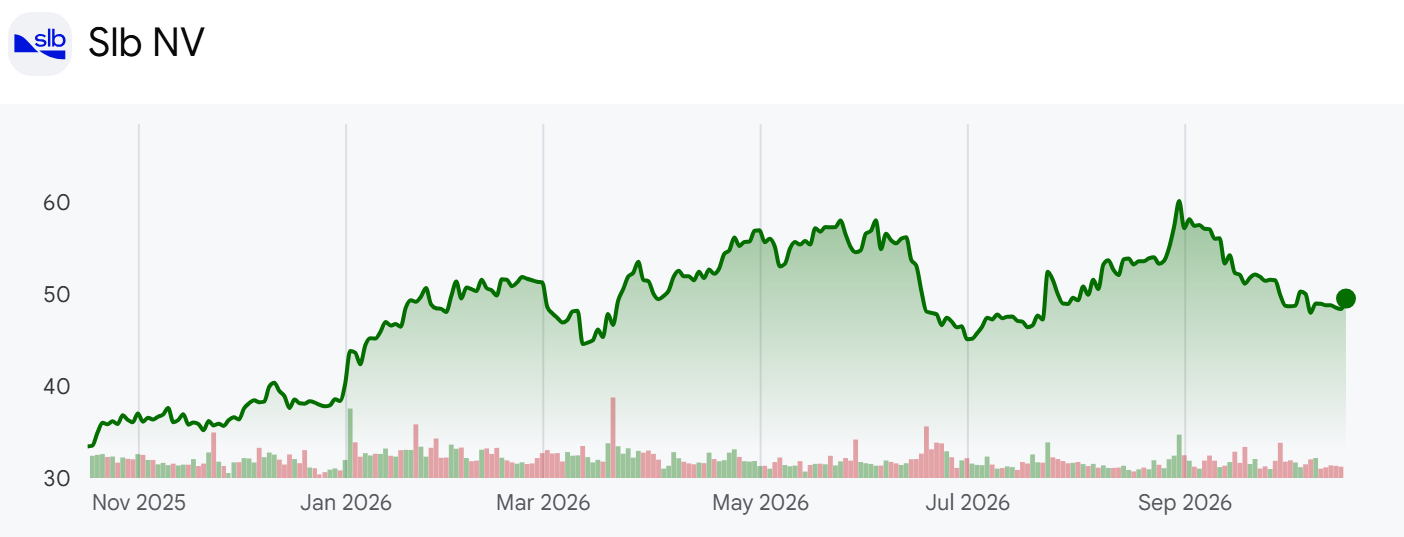
- The shares trade at $49.50 for a market value of $73.47 billion, +40.6% above a year ago. Third-quarter results are due in late October and Kelvion is not expected to close until the first half of 2027, so every Kelvion figure here is a company estimate. EPS in this piece is SLB's non-GAAP "excluding charges and credits" measure, and the share count already includes the 141 million shares issued for ChampionX.
What the Kelvion Deck Promises for Data Centers
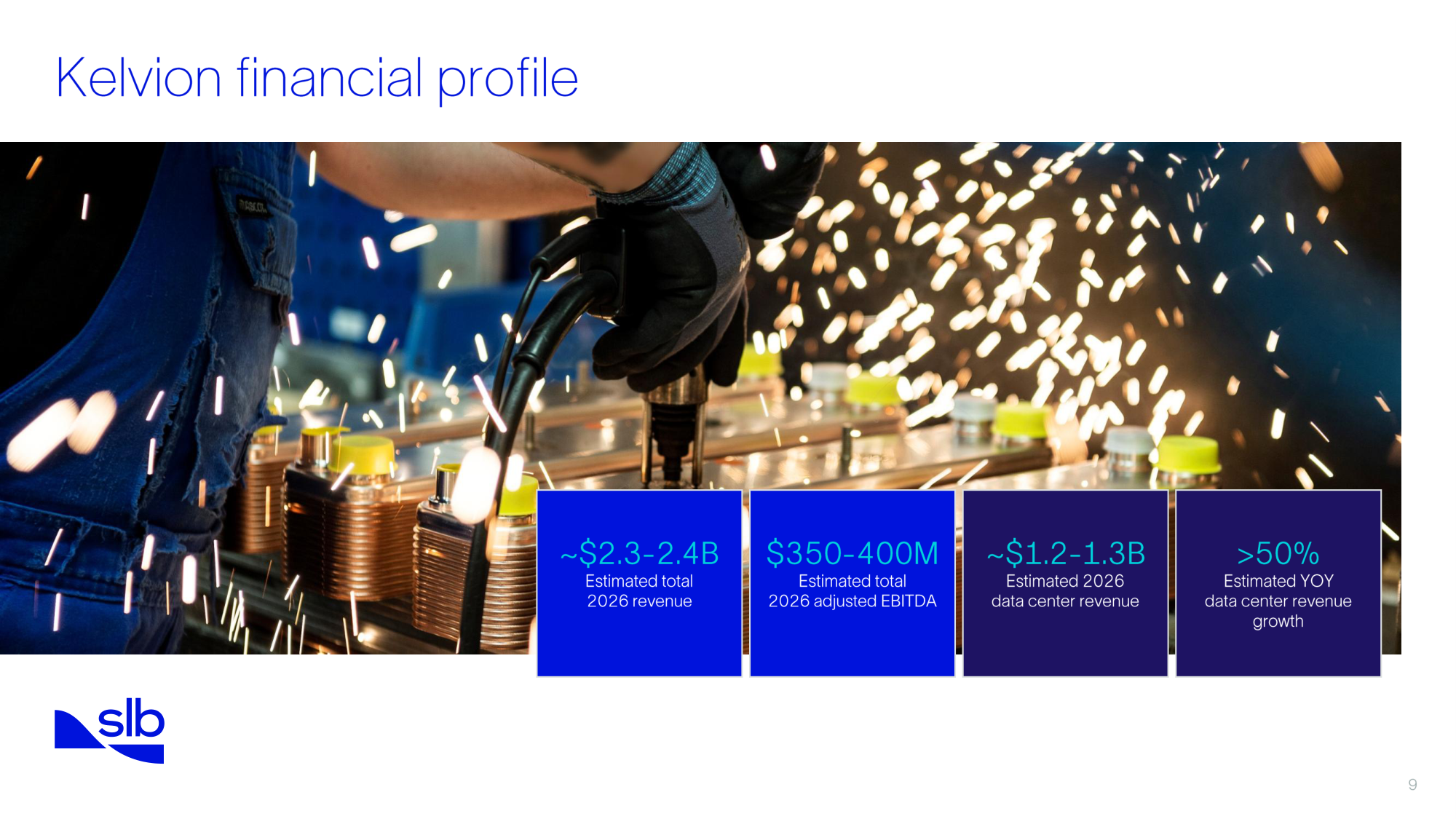
- Page 9 of the August 31 Kelvion presentation puts Kelvion's 2026 revenue at about $2.3 billion to $2.4 billion and adjusted EBITDA at $350 million to $400 million. Data centers are its largest end market, with expected 2026 revenue of $1.2 billion to $1.3 billion and growth of more than 50% year over year. Outside data centers, Kelvion sells thermal equipment into heat pumps, renewables, and carbon capture and processing.
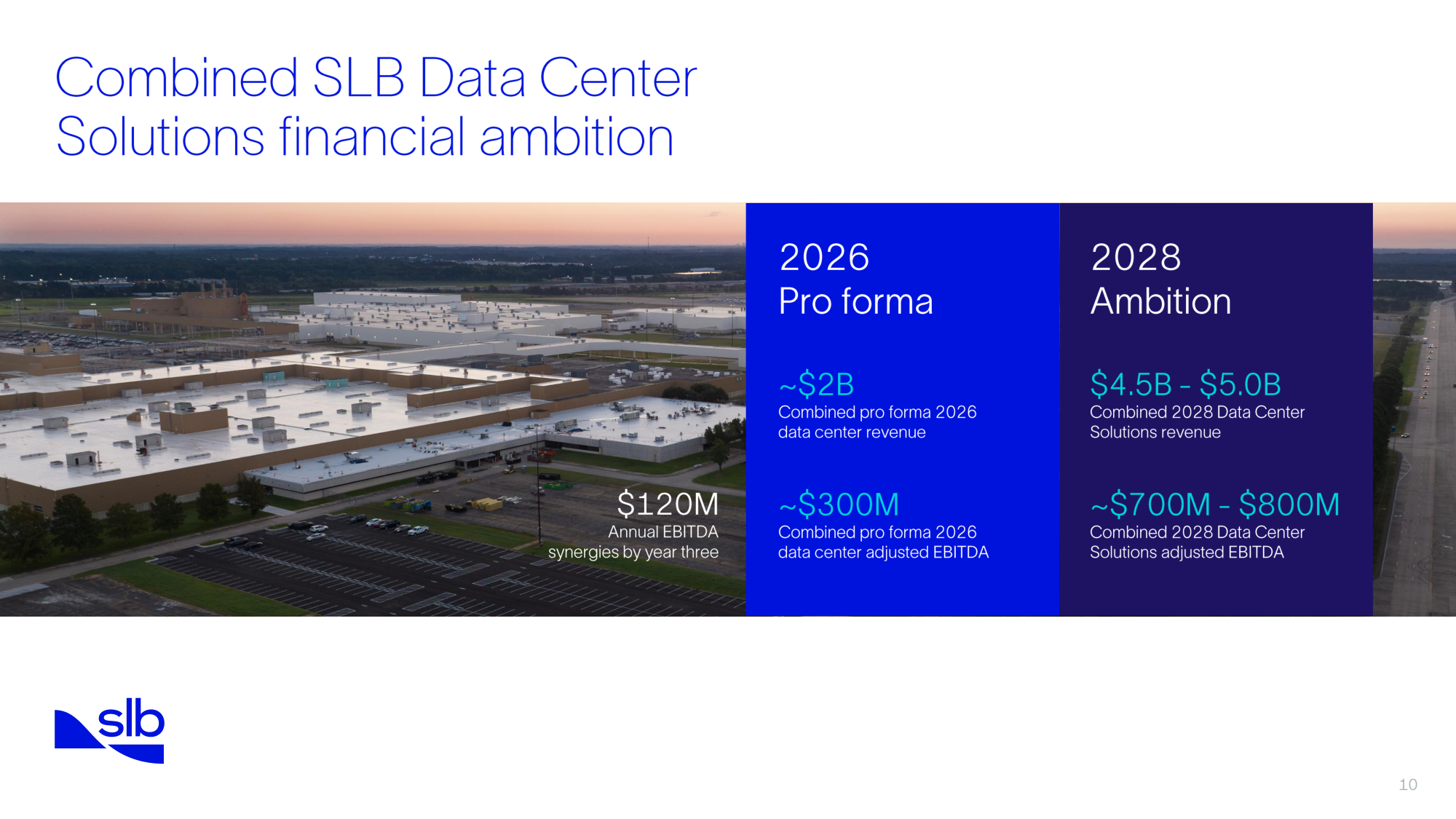
- Page 10 combines Kelvion with SLB's own Data Center Solutions business. The pair start from more than $2 billion of pro forma 2026 revenue and about $300 million of adjusted EBITDA, and SLB targets $4.5 billion to $5.0 billion of revenue and $700 million to $800 million of adjusted EBITDA in 2028. The deck adds about $120 million of annual EBITDA synergies within three years.
- Company disclosure (Kelvion release and deck page 11): SLB pays about $3.4 billion in cash and assumes about $0.7 billion of debt, which values Kelvion at about 11 times estimated 2026 EBITDA before synergies, or about 8.5 times with run-rate synergies. The deal is expected to add to EPS and free cash flow per share within 12 months of closing, net debt stays within the company's through-cycle ceiling of 1.5 times EBITDA, the commitment to return more than $4 billion to shareholders in 2026 stands, and 2027 returns are expected to be at least in line.
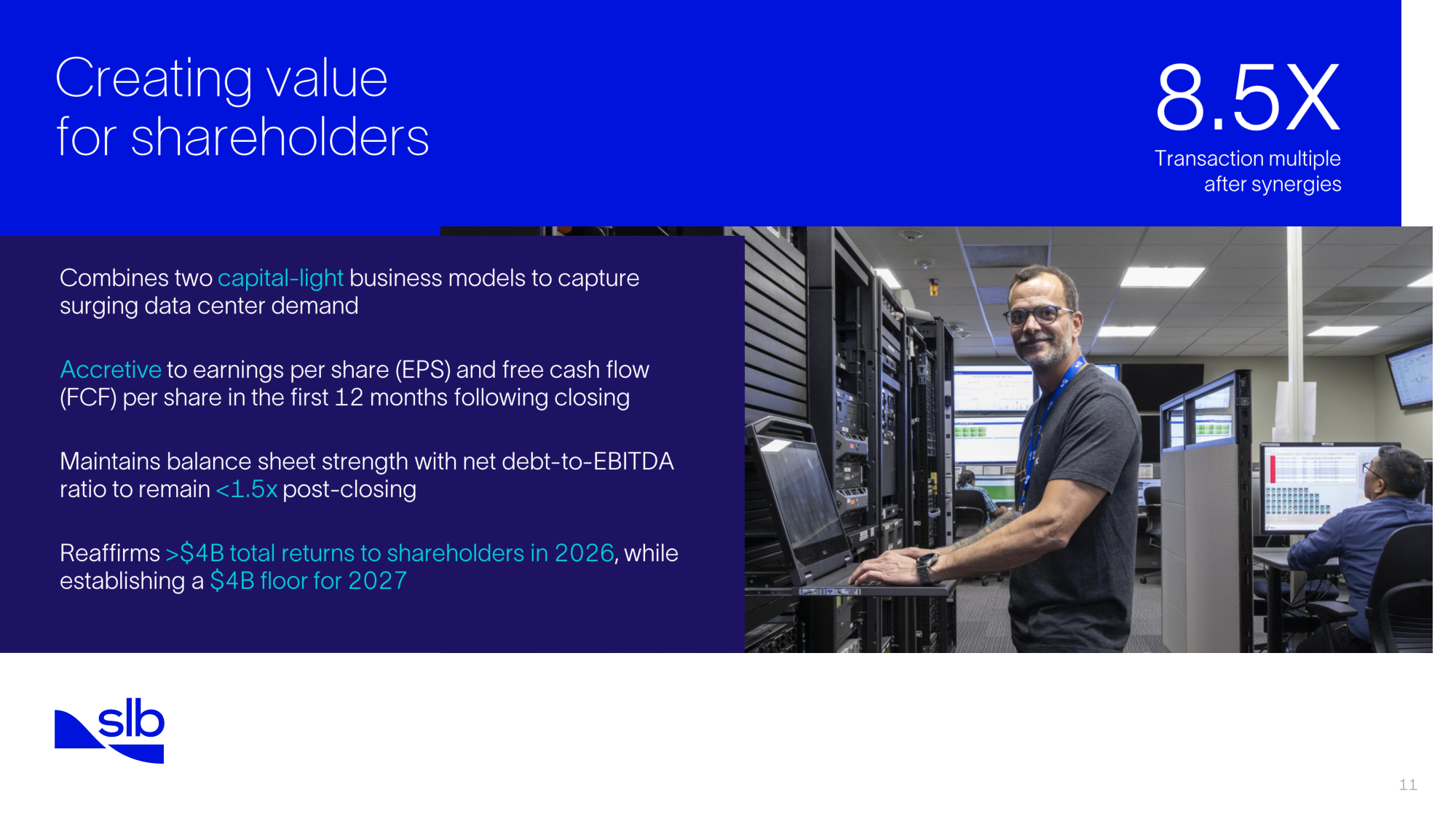
- The Kelvion release frames the deal around AI. "AI is driving the most significant infrastructure investment cycle in our lifetime," chief executive Olivier Le Peuch said, adding that Kelvion would expand the addressable market, "more than doubling our revenue opportunity per gigawatt of delivered capacity." SLB says its data center revenue will compound at more than 90% a year from 2024 to 2026 and that cumulative delivered capacity will pass 2 gigawatts by year end. Gavin Rennick, who runs New Energy and Industrial, said that "Thermal management is central to that challenge." Kelvion is majority owned by Apollo-managed funds, with a minority stake held by funds advised by Triton.
- Own calculation (what the data center numbers imply): Subtracting Kelvion's $1.2 billion to $1.3 billion of data center revenue from the combined $2 billion leaves $0.7 billion to $0.8 billion of 2026 revenue for SLB's own data center business. Kelvion's EBITDA margin works out to 14.6% to 17.4%, and the combined business runs at about 15.0% in 2026 and 15.6% to 16.0% at the 2028 target, below SLB's second-quarter adjusted EBITDA margin of 21.2%. Roughly half of Kelvion's revenue, $1.0 billion to $1.2 billion, is industrial thermal equipment rather than data centers.
Digital Targets and an Outlook Resting on the Middle East
- At the June 17 Digital Investor Day, chief financial officer Stephane Biguet said Digital generated about $2.7 billion of revenue in 2025, more than $900 million of adjusted EBITDA, and a 35% margin, with about $1 billion of annual recurring revenue (ARR). He told investors that "Digital has become a meaningful contributor to SLB’s financial performance in the past few years." Since 2021, Digital revenue has compounded at 16% and its adjusted EBITDA at 23%, against about 14% EBITDA growth for SLB overall.
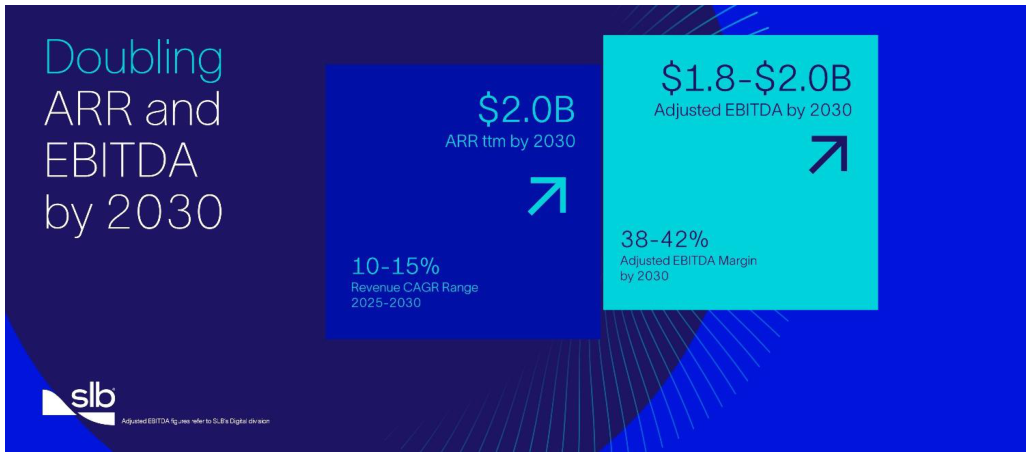
- The 2030 targets are $2 billion of ARR, adjusted EBITDA of $1.8 billion to $2.0 billion, and a margin of 38% to 42%, on revenue growth of 10% to 15% a year from 2025. SLB sizes the digital market at about $35 billion by 2030 and up to $50 billion if AI adoption runs faster. Within that, it expects Digital Operations to grow 11% a year against about 8% for the overall market, and says digital services are only about 1.5% of core equipment and services revenue today, with room to triple by 2030.
- The second-quarter release shows Digital revenue of $697 million, +18% year over year and up 12% without ChampionX's $34 million, with ARR of $1.04 billion, up 15%. Le Peuch said the quarter "marked a return to year-on-year revenue growth outside the Middle East." On the call, management guided third-quarter revenue up 3% to 4% sequentially with about 75 basis points of adjusted EBITDA margin expansion. A downside case, in which renewed escalation leaves Middle East revenue flat, would cut third-quarter revenue by about $150 million and EBITDA by about $75 million.
- The fourth-quarter outlook assumes Middle East revenue recovers to $2.1 billion to $2.2 billion, about 95% of the fourth quarter of 2025. On that basis SLB expects revenue to surpass $10 billion, about 5% growth year over year, and an adjusted EBITDA margin of about 24%.
- Own calculation (the recovery the outlook needs): Middle East revenue was $1.66 billion in the second quarter, so reaching $2.1 billion to $2.2 billion requires growth of 26.5% to 32.5% in two quarters. Adding about 5% to last year's fourth-quarter revenue of $9.745 billion gives roughly $10.2 billion, while the average analyst estimate for the quarter is $9.94 billion, below the company's outlook.
The Bull and Bear Case for the Pivot
- The bullish case has three legs. Once the Middle East conflict ends, repairs and production recovery should lift service demand; Digital, at a 35% margin, should grow 10% to 15% a year; and data centers should compound at more than 50% a year through 2028. On top of that, more than $4 billion of 2026 shareholder returns equals 5.4% of the market value.
- The bearish case starts from the reported numbers. Revenue excluding ChampionX has been lower than a year earlier for four straight quarters, and trailing EPS excluding charges of $2.54 is below the $3.41 earned in 2024. The data center business runs at about a 15% margin, so its growth pulls the company margin down, and Kelvion adds $4.1 billion to net debt.
- Outside view (sell-side research aggregate, October 2026): Of 30 analysts, 19 rate the stock Strong Buy, 7 Buy, 2 Hold, and 2 Sell or Strong Sell, with an average price target of $62.41. The 2026 EPS estimate fell from $2.53 ninety days earlier to $2.47, and 2027 from $3.30 to $3.18.
A Century From Schlumberger to Kelvion
- Founded in 1926 by the Schlumberger brothers, the company is incorporated in Curaçao with executive offices in Paris, Houston, and The Hague. Its 2025 10-K notes that it changed its brand name to SLB in 2022 and the legal name of the listed parent in 2025.
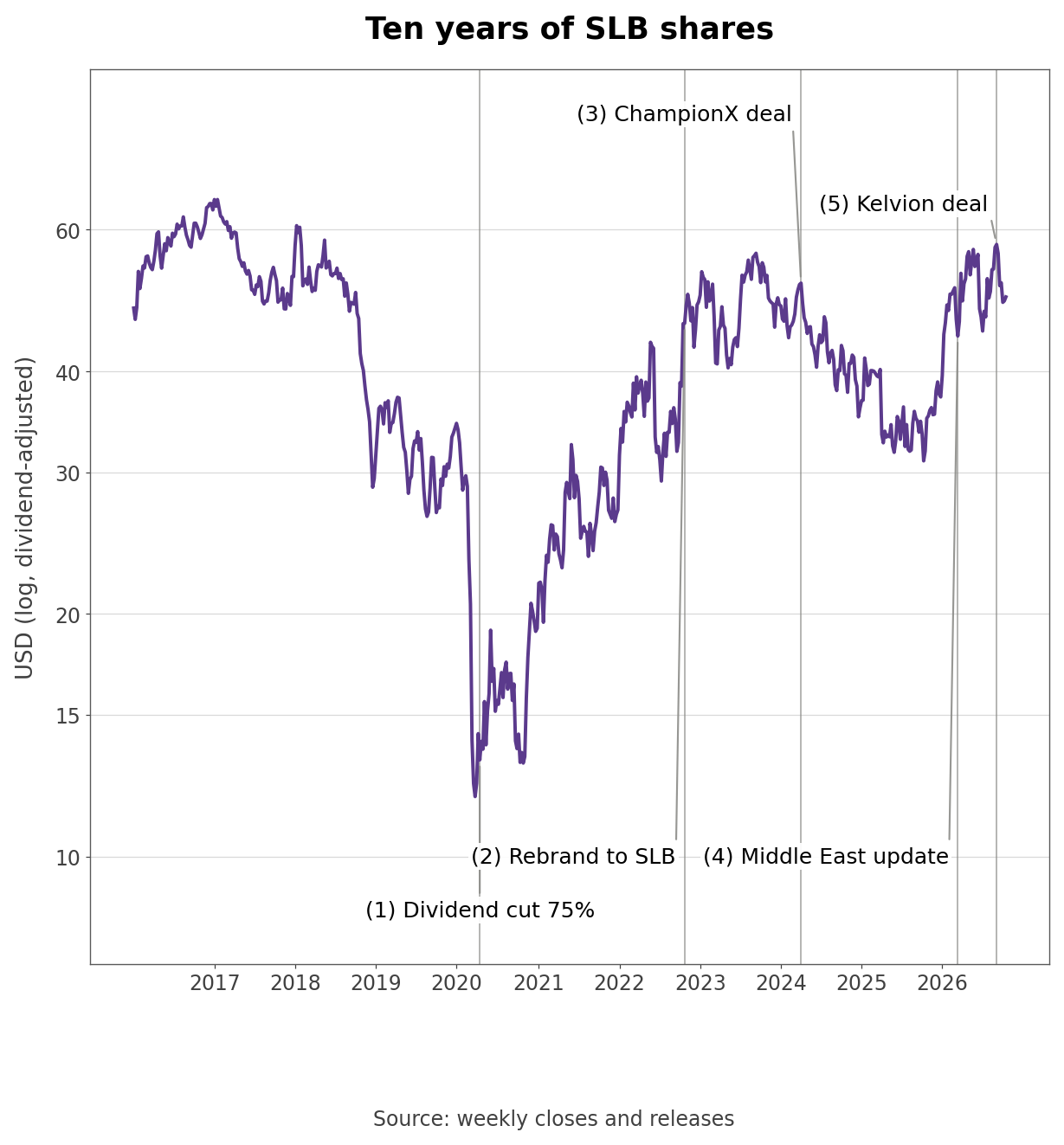
- On a dividend-adjusted basis, the stock went from $47.95 in January 2016 to a peak of $65.39 in January 2017 and a low of $11.87 in March 2020. In April 2020 the board cut the quarterly dividend 75%, from $0.50 to $0.125. The shares then gained +40.3% in 2021 and +81.2% in 2022 before falling -25.5% in 2024, and today they sit at 1.03 times their level of ten years ago.
- SLB agreed to buy ChampionX in April 2024 and closed the all-stock deal on July 16, 2025, issuing 0.735 SLB shares for each ChampionX share, or 141 million shares worth $4.936 billion. In March 2026 it warned that Middle East disruptions would cut first-quarter EPS by 6 to 9 cents, and on August 31 it announced Kelvion.
How Far Has Revenue Fallen Without ChampionX?
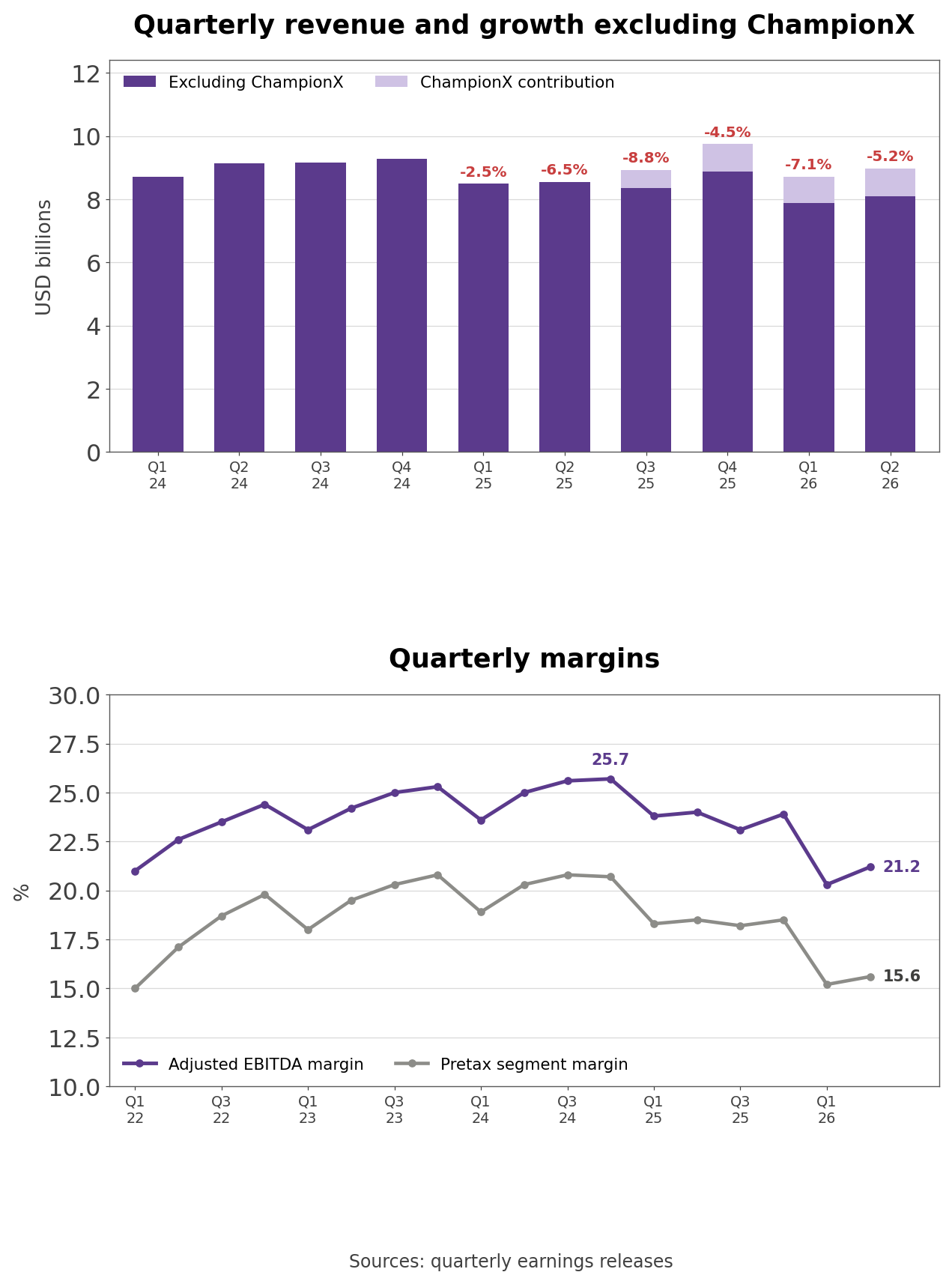
- In the four quarters since ChampionX arrived, reported revenue growth was -2.5%, +5.0%, +2.7%, and +5.0%. Stripping out ChampionX's contribution and comparing with a year earlier gives -8.8%, -4.5%, -7.1%, and -5.2%, a decline in every quarter. SLB's own releases report the same calculation as -7% for the first quarter of 2026 and -5% for the second.
- North American revenue of $2.244 billion rose +36% in the second quarter, but excluding ChampionX's $606 million it fell 1%. International revenue of $6.671 billion fell 3%, or 6% without ChampionX. The second-quarter 10-Q says first-half revenue excluding ChampionX fell $1.05 billion, of which $0.7 billion came from the Middle East.
- Own calculation (EBITDA without ChampionX): Taking ChampionX's $207 million out of second-quarter adjusted EBITDA of $1.899 billion leaves $1.692 billion, 17.5% below the $2.051 billion of a year earlier. ChampionX ran at a 23.8% EBITDA margin against 20.9% for the rest of SLB, so the acquired business held the company margin up.
Middle East Disruption and the Margin Slide
- Adjusted EBITDA margin peaked at 25.7% in the fourth quarter of 2024 and was 20.3% in the first quarter of 2026 and 21.2% in the second. The pretax segment margin fell from 18.5% to 15.6% over the year. Reservoir Performance dropped from 18.6% to 14.9% and Well Construction from 18.6% to 15.2%, and SLB attributed both mainly to the conflict.
- Middle East revenue fell 13% from the first quarter to $1.66 billion, about 65% of the Middle East and Asia area. In a March 8-K, SLB said it had suspended travel in the region and begun to demobilize in a few countries. The second-quarter release said activity had started to recover in some countries but that "the timing of a full recovery remains uncertain and will depend on a durable resolution of the conflict."
- Official statistics (FRED Brent price): Brent ended February at $71.32 and March at $126.69, a rise of 77.6%. It fell back to $70.46 at the end of June, then climbed to $115.91 at the end of September and $126.55 in mid-October.
- In September, when Brent rose +29.1%, SLB shares fell -18.5%, and Halliburton, Baker Hughes, Weatherford, and NOV fell between 11.7% and 19.5%. My reading is that this oil price rise came from supply disruption rather than demand, and that the market priced the risk of stalled work in Middle East and Asia, SLB's largest area by revenue. The downside case management laid out in July assumes exactly that kind of renewed escalation.
EPS Fell While the P/E Doubled
- EPS excluding charges rose from $2.18 in 2022 to $2.99 in 2023 and $3.41 in 2024, then fell to $2.93 in 2025; the trailing four quarters through June 2026 total $2.54. Second-quarter net income excluding charges fell 18.0% to $833 million, but diluted shares rose 10.2% from 1.366 billion to 1.506 billion, so EPS fell 25.7%.
- On trailing EPS excluding charges, the P/E was 9.78 times in May 2025, the lowest of the 58 months since January 2022, and is 19.49 times today. Over the same period the share price rose 49.8%, from $33.05 to $49.50, while trailing EPS fell 24.8%, from $3.38 to $2.54. All of the gain came from the multiple.
- Analysts expect 2027 EPS of $3.18, +28.7% above the 2026 estimate of $2.47. The third-quarter estimate of $0.61 is below last year's $0.69, and the fourth-quarter $0.76 is below $0.78. Over the past 30 days, nine analysts cut their 2026 estimate and none raised it.
How Much of EBITDA the New Businesses Could Be
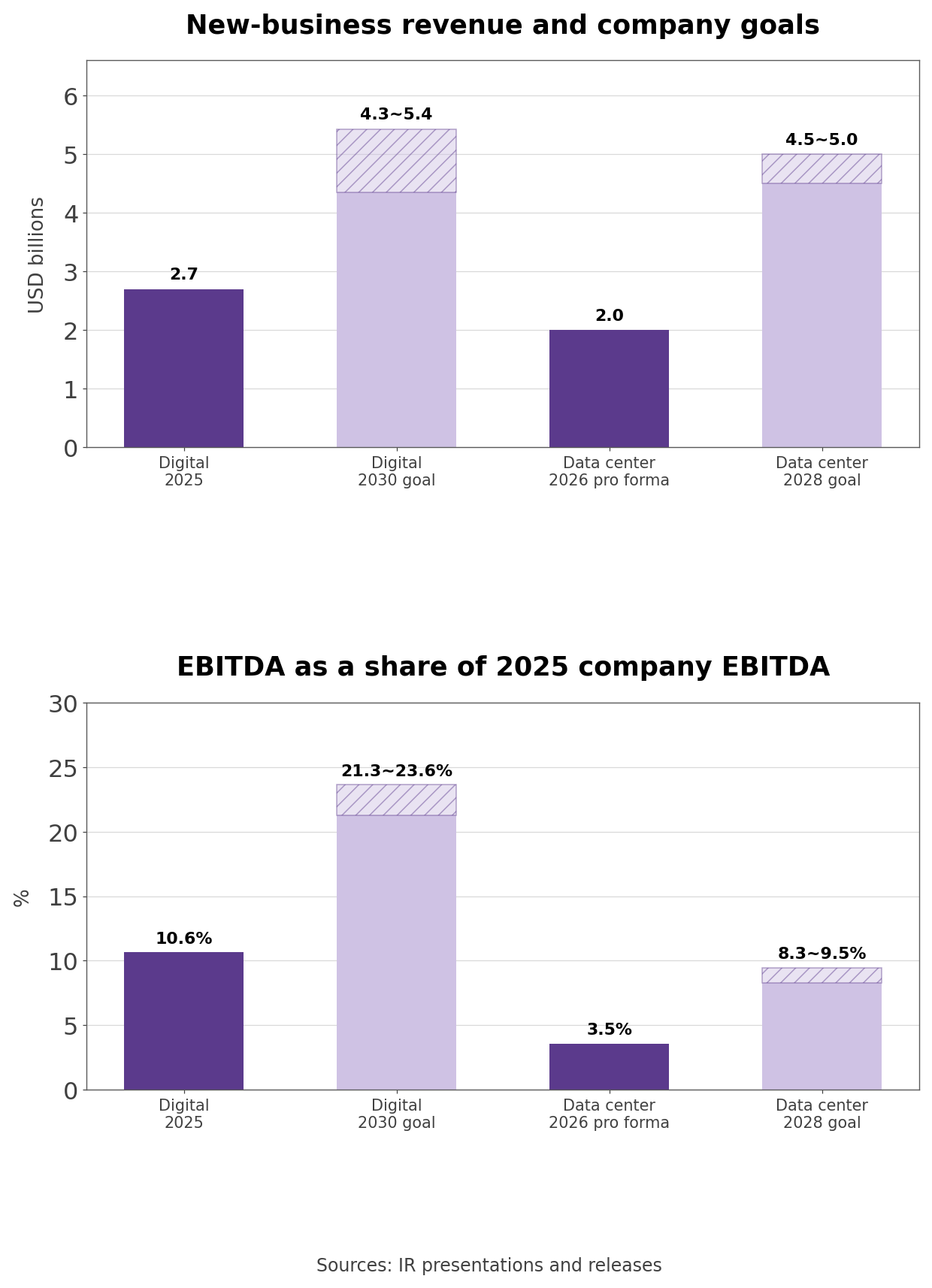
- Digital was 7.6% of 2025 revenue but 10.6% of adjusted EBITDA. Its 2030 EBITDA target of $1.8 billion to $2.0 billion equals 21.3% to 23.6% of SLB's 2025 adjusted EBITDA of $8.46 billion. Data centers, at $2 billion of pro forma 2026 revenue, are 5.5% of trailing revenue, and the 2028 EBITDA target of $700 million to $800 million is 8.3% to 9.5% of 2025 company EBITDA.
- Adding the two targets, though they fall in different years, gives new-business EBITDA of $2.5 billion to $2.8 billion, or 29.6% to 33.1% of 2025 EBITDA. Even if every target is met, more than two thirds of earnings still come from the core business tied to oil prices and customer budgets. Applying the 10% to 15% growth assumption, 2030 Digital revenue would be $4.35 billion to $5.43 billion.
- The two businesses pull margins in opposite directions. Digital's roughly 35% adjusted EBITDA margin lifts the company average, while data centers at 15% to 16% pull it down, so a bigger data center target makes a return to SLB's old margin harder.
How SLB Makes Money Across Four Divisions
- SLB sells equipment, services, and software at every step from finding oil and gas to producing it. Of $9.271 billion of second-quarter division revenue before eliminations, Production Systems contributed $3.771 billion (40.7%), Well Construction $2.742 billion (29.6%), Reservoir Performance $1.556 billion (16.8%), and Digital $697 million (7.5%).
- Well Construction bundles directional drilling, measurement while drilling, drilling fluids, drill bits, and rig equipment. Its revenue fell 7% year over year, with offshore drilling in Guyana, Brazil, and Mexico offsetting part of the Middle East decline. Reservoir Performance evaluates reservoirs through wireline logging and runs stimulation and intervention work to raise output.
- Production Systems combines subsea equipment from the SLB OneSubsea joint venture with artificial lift, valves, surface production systems, completions, and ChampionX's production chemicals. Its $586 million of pretax income was 37.3% of division income, the largest share. Without ChampionX, its revenue fell 1%, and outside the Middle East it grew 3%. In the quarter it won a contract from Eni for subsea production systems for 13 wells on the Baleine project.
- Digital earns money from cloud platforms such as Delfi and Lumi, applications such as Petrel, digital operations, exploration data licenses, and professional services, and its 27.8% pretax margin is the highest of the four. The "All Other" line holds Asset Performance Solutions, which runs three field projects in Ecuador, the data center business, and the SLB Capturi carbon capture venture. Data center revenue grew 33% from the first quarter and 80% from a year earlier, and SLB was chosen as a delivery partner for Meta's planned 1 gigawatt data center in Canada.
- Customers are national oil companies, large integrated oil companies, and independents, and no single customer exceeded 10% of revenue in 2023 through 2025. SLB employs about 109,000 people. It plans about $2.5 billion of capital investment in 2026, bought back $451 million of stock in the first quarter and $648 million in the second, targets at least $2.4 billion of buybacks for the year, and pays a quarterly dividend of $0.295.
- Net debt of $8.7 billion at the end of June is 1.08 times trailing adjusted EBITDA of $8.06 billion. Adding Kelvion's $3.4 billion cash price and $0.7 billion of assumed debt, and Kelvion's $350 million to $400 million of EBITDA, takes the ratio to about 1.52 times, right at the company's 1.5 times ceiling.
SLB Against Four Oilfield Service Peers
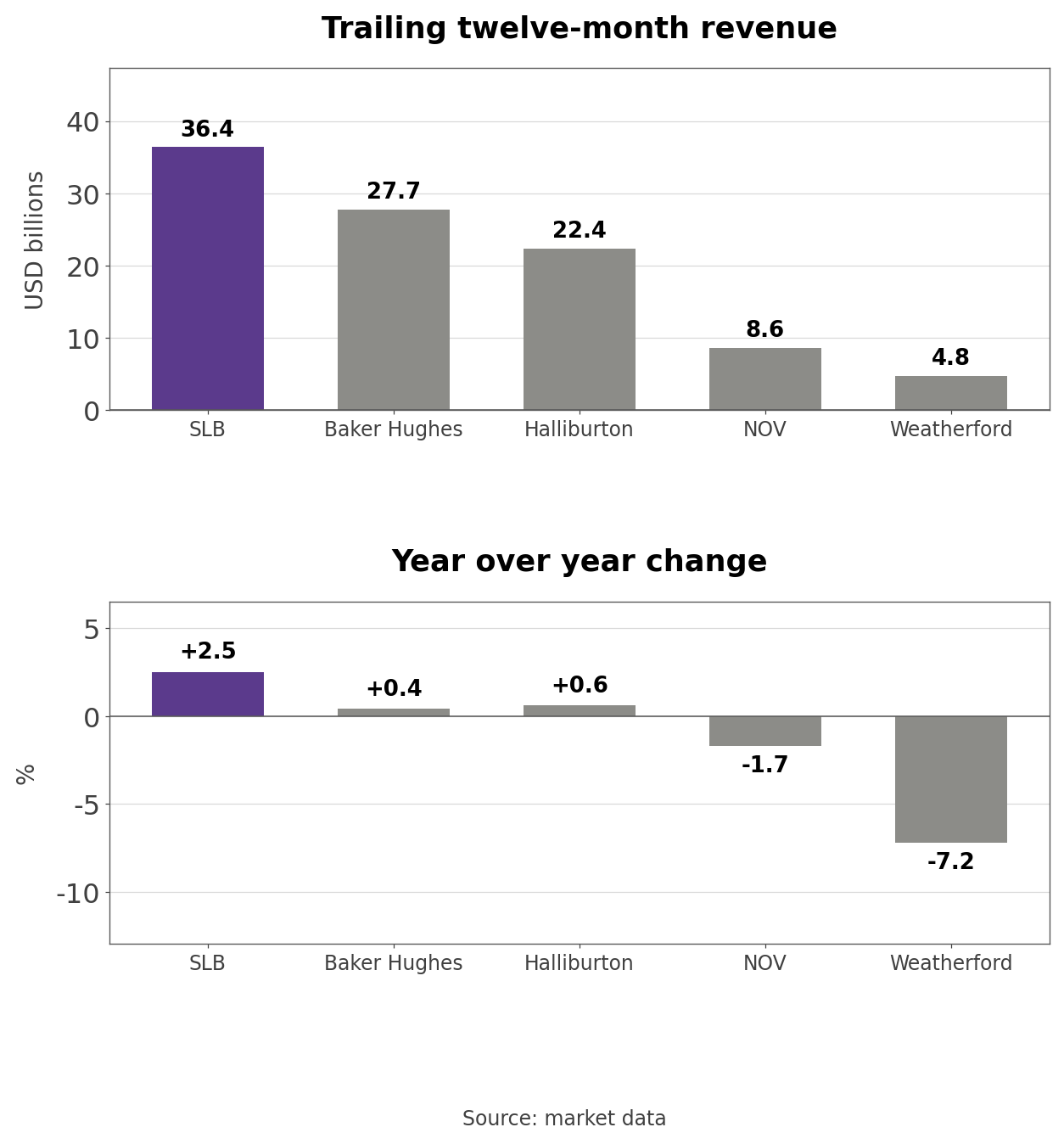
- Trailing twelve-month revenue was $36.37 billion at SLB, $27.73 billion at Baker Hughes, $22.37 billion at Halliburton, $8.64 billion at NOV, and $4.78 billion at Weatherford. SLB grew +2.5% with ChampionX's help, Halliburton 0.6%, Baker Hughes 0.4%, NOV fell 1.7%, and Weatherford fell -7.2%.
- SLB carries the richest multiples in the group. Price to sales is 2.02 times for SLB, 1.99 for Baker Hughes, 1.25 for Halliburton, 1.14 for Weatherford, and 0.78 for NOV. Trailing GAAP P/E is 24.0 times for SLB, 17.91 for Baker Hughes, 17.57 for Halliburton, and 15.02 for Weatherford, while NOV's thin earnings push its trailing P/E to 73.21. Only on forward P/E does Baker Hughes, at 20.72 times, sit above SLB's 17.79.

- Because earnings in this industry swing with the cycle, this piece compares peers on price to sales and shareholder returns. More than $4 billion of 2026 returns equals 5.4% of SLB's market value, roughly 3 points of buybacks on top of a 2.38% dividend yield, which matches NOV and exceeds Halliburton's 2.03%, Baker Hughes's 1.65%, and Weatherford's 1.44%. Over one year, SLB gained +40.6%, ahead of NOV at 32.6%, Halliburton at 27.3%, Baker Hughes at 16.9%, and Weatherford at 4.6%.
P/E on EPS Excluding Charges Over 58 Months
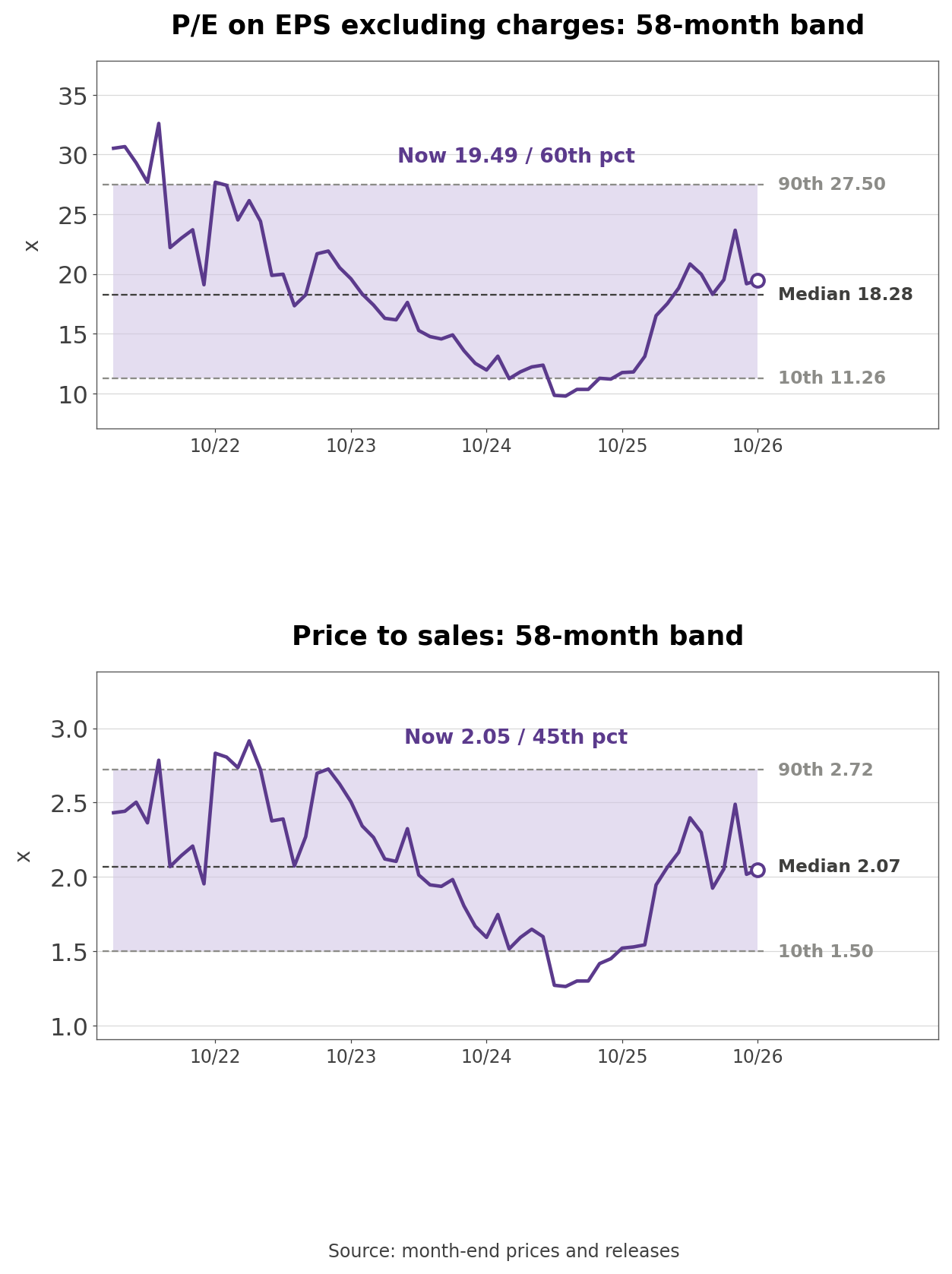
- On trailing EPS excluding charges of $2.54, SLB trades at 19.49 times, the 60th percentile of the 58 months since January 2022, against a median of 18.28 times. The high was 32.60 times in May 2022 and the low 9.78 times in May 2025. Price to sales of 2.05 times is close to its 2.07 times median.
- In a cyclical business, the P/E is highest when earnings are near the bottom. The May 2022 peak came while EPS was still recovering from the pandemic, and the May 2025 low came with EPS near its high. Months that include the 2020 pandemic quarters, when EPS was $0.05 and $0.16, are left out because the multiple loses meaning. On the 2026 EPS estimate of $2.47 the stock trades at 20.04 times, and on 2027's $3.18 at 15.57 times; market data put the trailing GAAP P/E at 24.0 and the forward P/E at 17.79.
Three Conditions That Move the Stock
- The pace of the Middle East recovery comes first. The fourth-quarter outlook rests on Middle East revenue returning from $1.66 billion to $2.1 billion to $2.2 billion. If Brent's return to the $126 range in October reflects an escalation that delays remobilization, the downside case of $150 million less revenue and $75 million less EBITDA in the third quarter shows up first.
- Adjusted EBITDA margin is next. Management guided to about 22% in the third quarter and about 24% in the fourth, which would bring the margin back to the 23.9% of the fourth quarter of 2025. If the recovery stalls, a 19.49 times P/E sits on top of shrinking EPS.
- Kelvion's closing and data center margins come last. The deal needs regulatory approval and is expected to close in the first half of 2027, when it will be clear whether net debt stays inside the 1.5 times ceiling and whether SLB's own data center business has passed a $1 billion annualized revenue run rate. If data center margins stay near 15%, every dollar of data center growth lowers the company margin.
What the Third-Quarter Report Should Show
- The late-October report should show Middle East revenue, the adjusted EBITDA margin against the roughly 22% guide, the data center run rate, and whether the fourth-quarter outlook of more than $10 billion of revenue still holds. After that come Kelvion's regulatory progress and the 2027 shareholder return plan.
- One question this piece cannot settle: even if every target is met, two thirds of earnings still come from the core oilfield business, so is the doubled multiple paying for the new businesses, or for a Middle East recovery that has not yet arrived?
Related Analysis
- Sumitomo Electric (5802) Stock Analysis: Data Center Optics: another industrial company whose multiple moved with data center exposure, useful for judging how much of SLB's rerating rests on Kelvion and Data Center Solutions.
- Dell (DELL) Stock Analysis: Q2 FY2027 Earnings and Guidance: a read on hyperscaler AI infrastructure spending, the same demand SLB's data center business and Kelvion depend on.
#SLB #SLBStock #Schlumberger #OilfieldServices #DataCenters #EnergyStocks #USStocks #StockAnalysis #EquityResearch #GlobalStockBrief
'US Stock Analysis' 카테고리의 다른 글
| Meta (META) Stock: Negative FCF Meets Non-Voting Class C (0) | 2026.10.23 |
|---|---|
| Tesla (TSLA) Stock: 62% of Q3 Operating Income Was a Refund (0) | 2026.10.22 |
| Raytheon (RTX) Stock: EPS Growth Is 18% Without the Refund (0) | 2026.10.22 |
| Sanofi (SNY) Stock: Dupixent at 44% and Pipeline Write-Offs (0) | 2026.10.22 |
| Delta Air Lines (DAL) Stock: 23.6% EPS Guidance Cut on Fuel (0) | 2026.10.21 |


