- Meta Platforms, Inc. (Nasdaq: META) grew third-quarter revenue +26.1% to $64.60 billion, but capital expenditures including finance-lease principal of $34.91 billion exceeded operating cash flow of $32.79 billion, leaving free cash flow at -$2.12 billion. On the same day the company announced a new class of non-voting Class C stock, to be distributed one for one on every existing share, and named capital raising, employee compensation, and acquisitions as its uses. The question is how much of the equity Meta may need is already reflected in a stock at 23 times earnings.
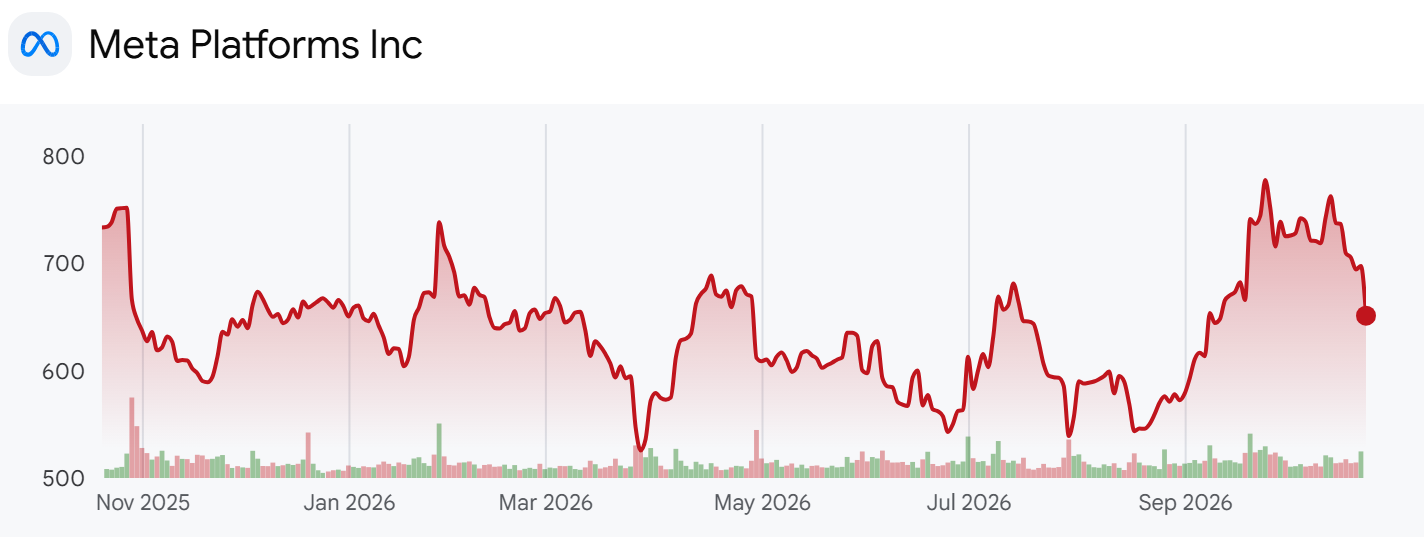
- Meta sells advertising on Facebook, Instagram, WhatsApp, Messenger, and Threads, and runs Reality Labs, which makes Quest headsets and AI glasses, as a separate segment. The shares trade at $697.52 for a market value of $1.783 trillion on 2.556 billion Class A and Class B shares, -10.8% below the weekly high of $782.15 set in the week of August 15, 2025. EPS multiples here start from GAAP diluted EPS and remove only the five one-time items whose per-share effect Meta disclosed: restructuring in late 2022 and early 2023, the third-quarter 2025 tax charge, the first-quarter 2026 tax benefit, and the third-quarter 2026 legal charge. The size and timing of any Class C issuance have not been set.
What the Third-Quarter Presentation Shows About Ad Pricing
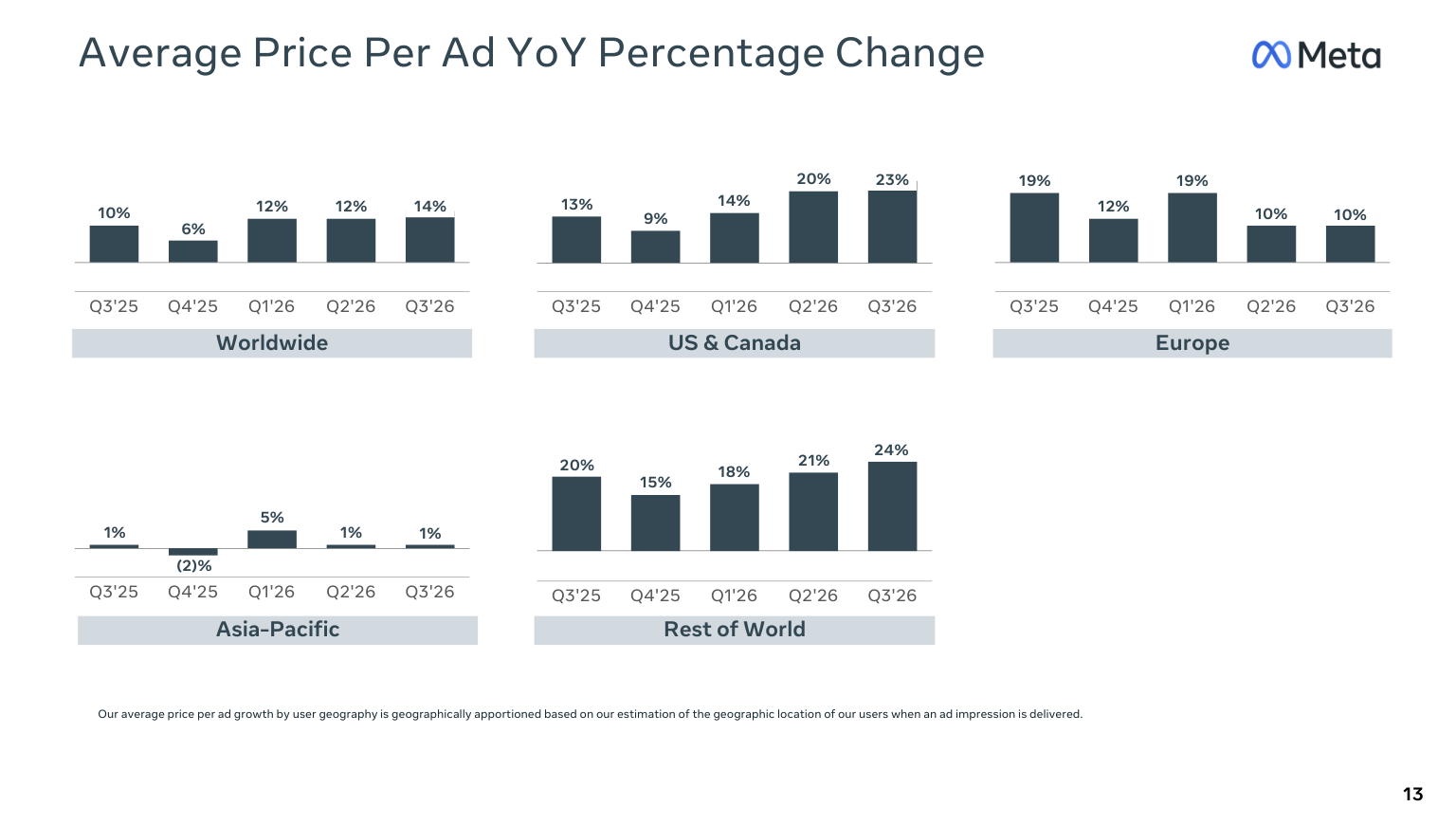
- Price per ad did the lifting in the third quarter. Page 13 of the earnings presentation shows the worldwide average price per ad up +14% from a year earlier, faster than 12% in each of the first two quarters, with Rest of World up 24%, US and Canada up 23%, Europe up 10%, and Asia-Pacific up 1%. Page 12 shows ad impressions growth slowing from 19% in the first quarter to 14% in the second and 10% in the third.
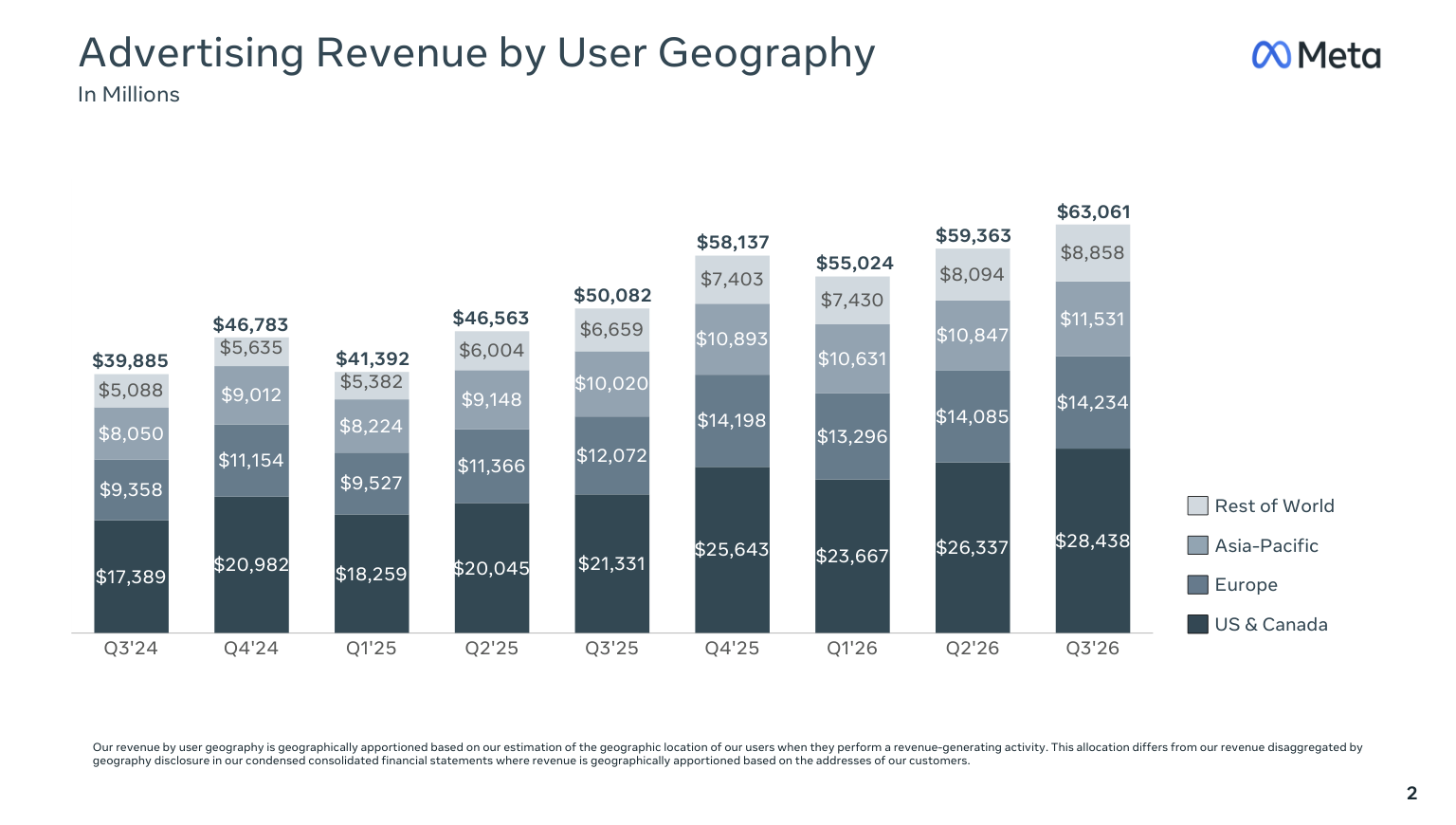
- Chief financial officer Susan Li said on the call that the increase was "driven by ad performance gains and improvements in macro conditions relative to Q3 of last year," partly offset by strong impression growth from lower-monetizing surfaces and regions. Page 2 shows US and Canada advertising revenue of $28.44 billion, up 33.3%, or 45.1% of the $63.06 billion total.
- Page 5 stacks expenses as a share of revenue. General and administrative expense jumped to 23% of revenue from 7% a year earlier, research and development was 31%, cost of revenue 21% against 18%, and marketing and sales 5%. Of $14.86 billion in G&A, $9.89 billion was the charge for the August agreement with 52 attorneys general.
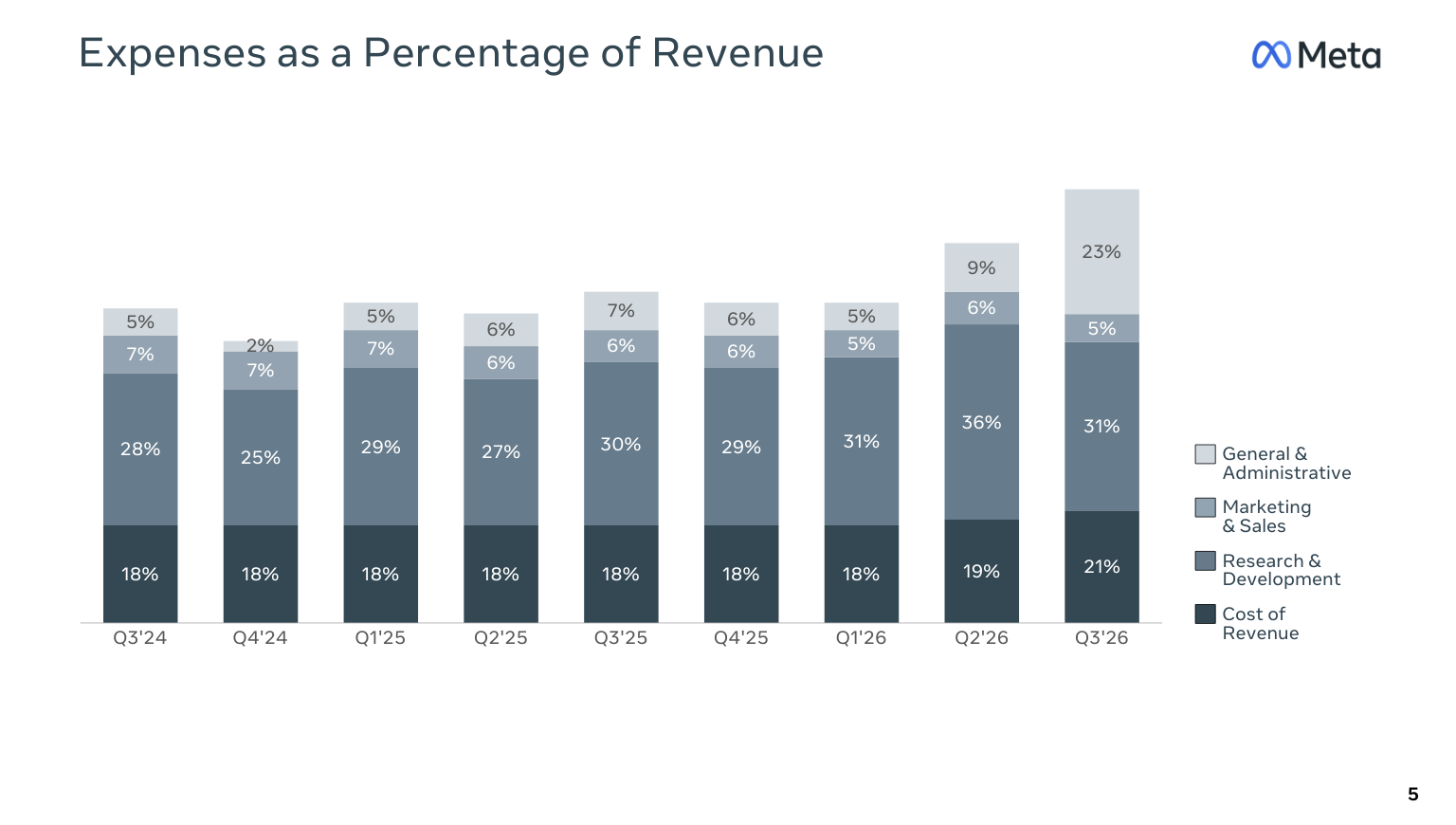
- On the call the company attributed expense growth to legal costs, infrastructure costs including third-party cloud and depreciation, and third-party AI token costs. Cost of revenue rose 45.2% and R&D 32.4%, and headcount of 66,775 was down 12% from the second quarter after a reduction of about 8,000 people in May. The segment table on page 4 shows Family of Apps operating income falling for three straight quarters from a peak of $30.77 billion in the fourth quarter of 2025 to $17.12 billion, while the operating margin went from 41% to 31% and then 20%.
- Own calculation (legal charge): Excluding the $9.89 billion charge, third-quarter operating income would be $22.88 billion, up 11.4%, for a margin of 35.4% against 40.1% a year ago. The company's EPS excluding the charge, $7.40, is only 2.1% above the $7.25 a year earlier excluding that quarter's tax charge.
The Fourth-Quarter Outlook and the 2026 Capex Plan
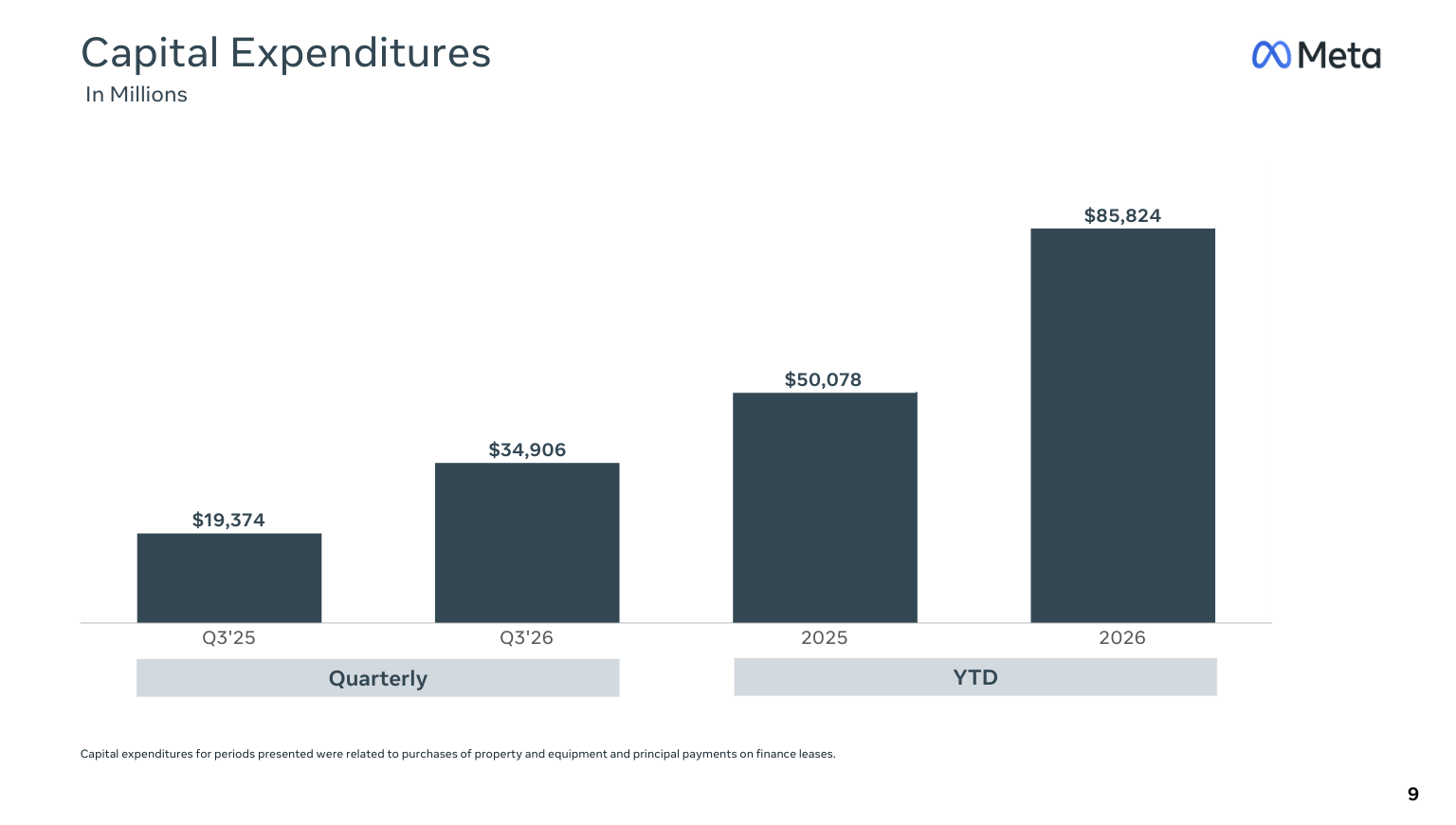
- Page 9 isolates capital expenditures. Including principal payments on finance leases, third-quarter capex was $34.91 billion, 1.8 times the $19.37 billion of a year earlier, and the nine-month total was $85.82 billion, up +71.4%, for servers, data centers, and network infrastructure.
- Company disclosure (Q3 release, CFO outlook): Fourth-quarter revenue of $73 billion to $76 billion, assuming about a 1% foreign exchange headwind. Full-year 2026 total expenses raised to $175 billion to $179 billion to include the $9.9 billion legal charge; excluding that charge, 2026 operating income is still expected above 2025. Reality Labs losses of $18 billion to $19 billion, capex of $135 billion to $145 billion narrowed from $130 billion to $145 billion, and a fourth-quarter tax rate of 15% to 17%.
- Own calculation (fourth-quarter math): The revenue range is 21.9% to 26.9% above last year's $59.89 billion, with the analyst average of $74.76 billion near the middle. Subtracting nine-month expenses of $127.08 billion leaves fourth-quarter expenses of $47.92 billion to $51.92 billion, up 36.3% to 47.7%. Fourth-quarter capex of $49.18 billion to $59.18 billion is more than double last year's $22.14 billion, and full-year capex is 86.9% to 100.8% above 2025. To keep operating income excluding the legal charge above 2025's $83.28 billion, Meta needs at least $18.75 billion in the fourth quarter.
- Page 6 shows a third-quarter tax rate of 24%, above the outlook range because part of the legal expense is not deductible; last year's 87% reflected a $15.93 billion non-cash charge on enactment of the One Big Beautiful Bill Act, and the first-quarter 2026 rate of -23% an $8.03 billion benefit that partly reversed it. Page 15 builds free cash flow from operating cash flow minus $33.94 billion of property and equipment purchases and $0.96 billion of finance-lease principal.
- Meta gave no 2027 revenue outlook. The release says "we are still developing our budget and capacity plans for next year, but we expect to continue investing aggressively to support both our core business and emerging AI initiatives," and expects Reality Labs losses to narrow to around $15 billion in 2027. The finance chief said 2027 numbers will come on the fourth-quarter call.
The Bull and Bear Case for Meta Shares
- The bullish case starts with ad pricing. Price per ad rose 14%, average revenue per person rose 22.5% against 2.8% growth in daily active people, and the top of the fourth-quarter outlook implies 26.9% growth. More than 10 million people in the US and Canada set up the Muse personal agent within a month and a half of launch.
- The bearish case starts with cash. Capex exceeded operating cash flow, buybacks were zero in the first nine months of 2026, and quarter-end cash of $82.4 billion sits below $83.7 billion of debt. Non-cancelable commitments are 5.6 times their level a year ago, and the Class C information statement says every long-term forecast shown to the board assumed raising hundreds of billions of dollars.
- Outside view (sell-side research aggregate, October 2026): Of 63 analysts, 47 rate the stock Strong Buy, 8 Buy, 7 Hold, and 1 Strong Sell, with an average price target of $814.51, 16.8% above the share price. The average 2026 EPS estimate is $29.38 and the 2027 estimate is $33.82, 15.1% higher.
From Facebook in 2004 to a Non-Voting Class C
- Meta started as Facebook in 2004 and listed on Nasdaq in May 2012. The release says its stock price "has increased by more than 1,700% since its IPO," against about 495% for the S&P 500. On adjusted weekly closes the stock has gone from $96.43 in the first week of 2016 to $697.52, a multiple of 7.23.
- After second-quarter results in July 2018 the shares fell -16.7% in a week. On October 28, 2021, the company renamed itself Meta Platforms, three days after announcing that Reality Labs would be reported as a separate segment. The stock fell -64.2% in 2022 and bottomed at $89.95 in the week of November 4.
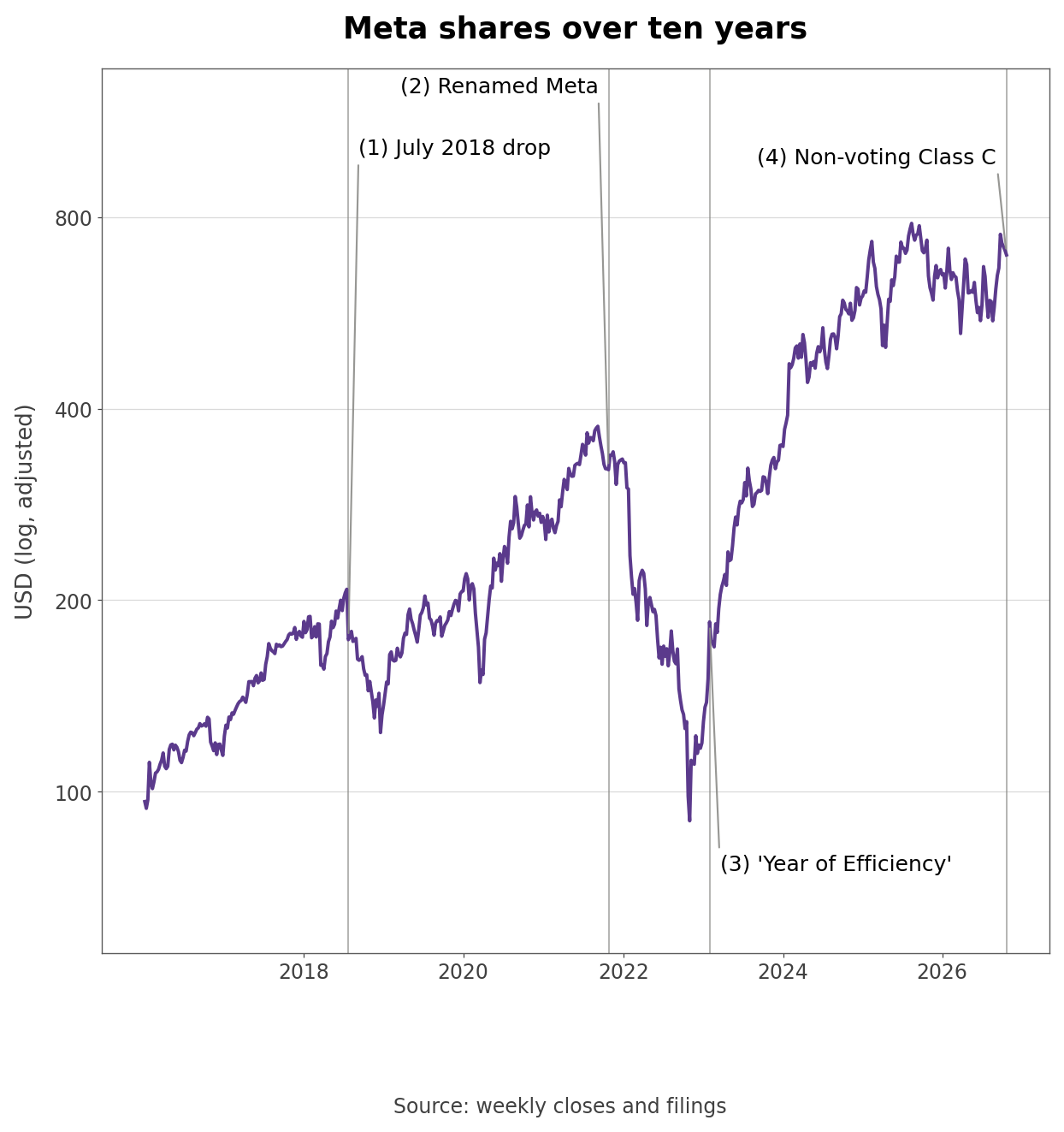
- On February 1, 2023, Mark Zuckerberg named that year the "Year of Efficiency," and the company added $40 billion to its buyback authorization; the shares rose +194.1% in 2023. Meta declared its first quarterly dividend of $0.50 a share on February 1, 2024. The stock gained 70.1% in 2024 and 10.9% in 2025, is up 5.4% in 2026, and on October 21 the company announced Class C alongside third-quarter results.
Capex Including Finance Leases Against Free Cash Flow
- Quarterly capex rose from $4.42 billion in the first quarter of 2021 to $34.91 billion, 7.9 times, and from 37.8% of revenue a year ago to 54.0%. In the third quarter Meta spent 106.5% of operating cash flow on property and equipment. Nine-month free cash flow fell -62.6% to $11.05 billion.
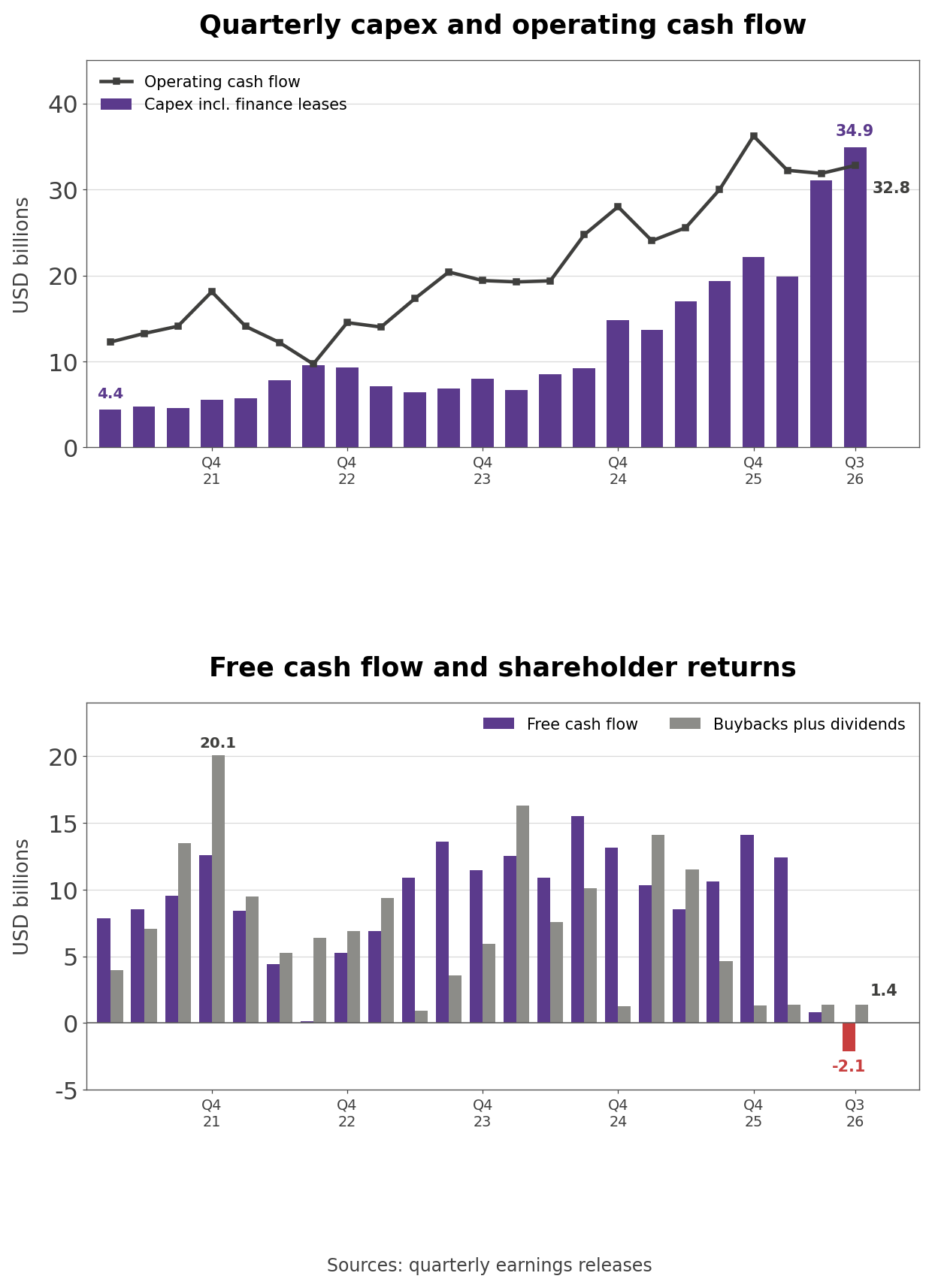
- Shareholder returns followed cash down. From 2021 through 2025 Meta repurchased $148.64 billion of stock, 76.2% of its free cash flow, but bought back nothing in the first nine months of 2026 and paid $4.06 billion in dividends. The 10-Q shows $12.77 billion paid in taxes on net share settlement of employee RSUs, which kept diluted shares at 2.573 billion against 2.572 billion a year earlier. Third-quarter interest expense of $977 million was 4.3 times the level of a year earlier and above interest income of $934 million.
Debt and Commitments That Cannot Be Canceled
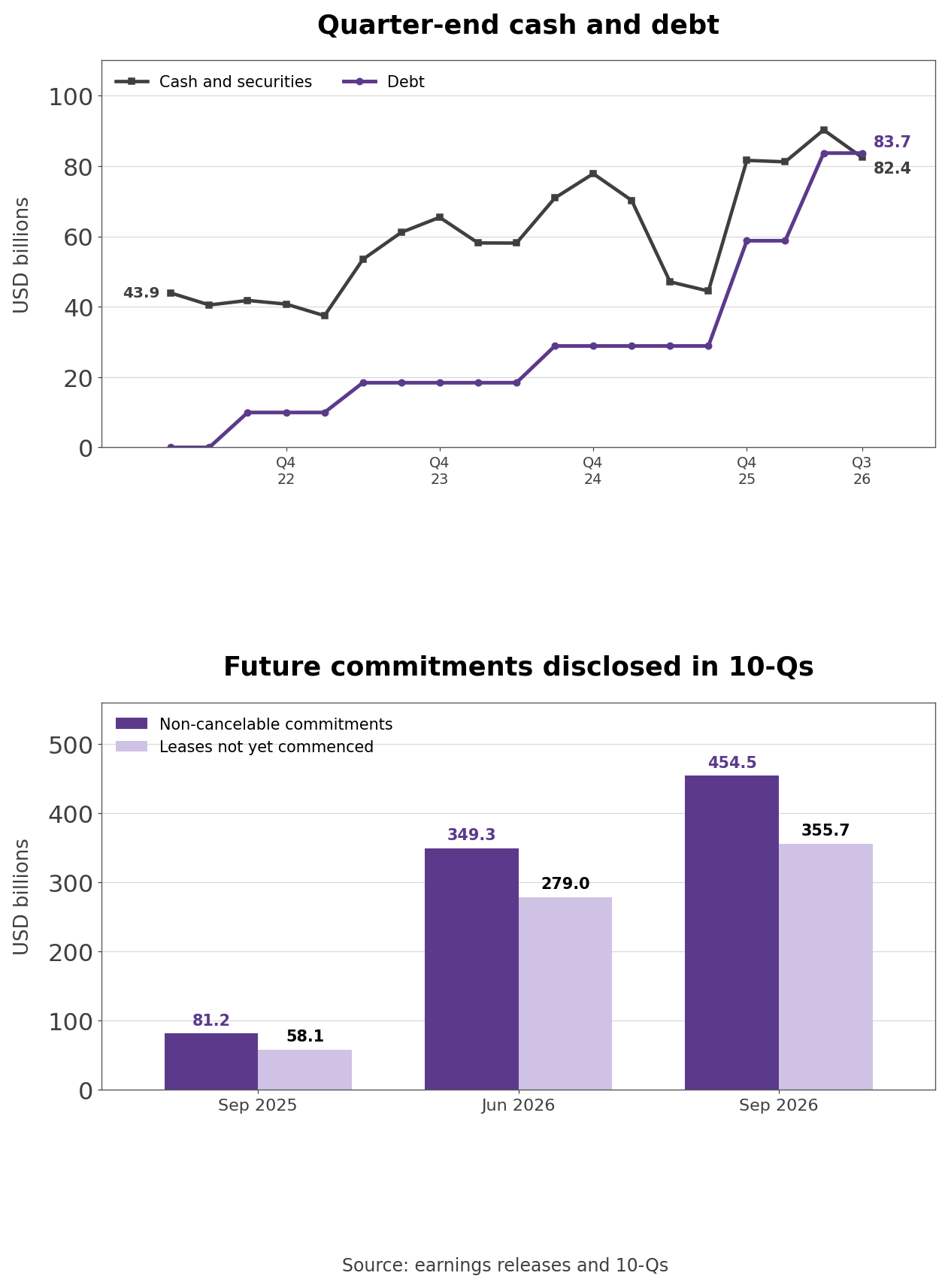
- Meta first issued bonds in the third quarter of 2022. Long-term debt grew from $9.92 billion then to $28.83 billion a year ago and $83.66 billion in the second quarter of 2026, after $25 billion of notes were sold in May. Principal outstanding is $84.00 billion, with $2.75 billion due in August 2027.
- Own calculation (net debt): Cash and marketable securities of $82.45 billion minus long-term debt of $80.92 billion and $2.75 billion due within a year leaves net debt of $1.22 billion, against net cash of $15.61 billion a year ago.
- The liquidity section of the third-quarter 10-Q carries a bigger number. Non-cancelable contractual commitments were $81.19 billion at the end of September 2025, $349.31 billion at the end of June 2026, and $454.52 billion at the end of September 2026, 5.60 times in a year. They mostly cover third-party cloud capacity, servers and network infrastructure, and data center energy, with $121.41 billion due in 2027, equal to 91.2% of trailing twelve-month (TTM) operating cash flow. Leases not yet commenced add $355.73 billion, 6.12 times a year earlier. The same filing says "From time to time we expect to seek to raise additional capital through debt, equity, or other financing arrangements."
Legal Accruals and the New Mexico Judgment
- In August Meta agreed with 52 attorneys general to resolve teen mental health and social media litigation for payments of up to about $18.59 billion, excluding cases brought by Florida, New Mexico, and the U.S. Virgin Islands. About $12.7 billion is payable over ten years, and $5.3 billion becomes payable only if peers such as YouTube and TikTok adopt teen protections and take on matching payments, which Meta has not accrued. Legal-related accruals rose from $7.32 billion at the end of 2025 to $19.88 billion.
- New Mexico sits outside the settlement. On September 25 a jury found Meta liable for more than 43 million violations of the state's Unfair Practices Act, and on October 21 the court imposed a $25 billion civil penalty with 15% post-judgment interest. The 10-Q says "We have accrued an amount for loss contingencies related to this matter and intend to appeal," without giving the amount, and adds that Meta may need to post a bond or other collateral.
- Own calculation (New Mexico): $25 billion is 30.3% of quarter-end cash and marketable securities, and 15% interest on it would be $3.75 billion a year.
Why Create Non-Voting Class C Shares Now?
- Class C is a listed share with no votes. The board approved it on the unanimous recommendation of a special committee of independent directors, and the amended charter takes effect on January 19, 2027. Each Class A and Class B share will receive one Class C share, which the company expects to work like a two-for-one split for the Class A price, and voting power does not change.
- The Class C information statement describes how it got there. Management told the committee's advisers that three long-term forecast cases presented to the board in May all showed a "need to raise hundreds of billions of dollars over a period of several years beginning as early as fall 2026." Moelis, the committee's financial adviser, estimated that Meta could raise about $700 billion of equity under the existing structure before Mark Zuckerberg's voting power would drop below 50%, and noted Alphabet's recent equity raise of about $80 billion. Zuckerberg's counsel said he recognized the need for substantial equity capital but was not expected to support issuing Class A shares for it. He held about 60.6% of the voting power as of October 1.
- On the call, Susan Li said: "We don't have any specific financing plans to announce at this time but we thought it was prudent to establish the appropriate capital structure framework to ensure that we have access to a diverse pool of funding sources."
- The Founder Alignment Agreement lets Zuckerberg sell 20% of the Class C he receives, 10% of his economic stake, right away, which could pay a potential California wealth tax. The other 80% is stapled: each sale must be matched by selling or converting the same number of Class A or Class B shares, and 2.5% is released in each quarter he stays in a full-time leadership role, over 32 qualifying quarters. When the 30-day average price first reaches two, four, or eight times the $580.60 reference price and the annualized shareholder return is at least 10%, every shareholder receives another Class C share per share held.
- Own calculation (Class C thresholds): The first doubling threshold is $1,161.20 a share, 66.5% above $697.52. The $700 billion Moelis limit is 39.3% of market value, and equity raised through Class C leaves voting percentages unchanged regardless of that limit.
How the Family of Apps and Reality Labs Make Money
- Advertising is 97.6% of revenue. Third-quarter advertising revenue of $63.06 billion rose +25.9%, and other revenue in the Family of Apps segment rose 59.0% to $1.10 billion, mainly from WhatsApp paid messaging and subscriptions. Reality Labs revenue fell -5.7% to $443 million on lower Quest sales, partly offset by growth in AI glasses. Revenue for 2025 was $200.97 billion, up 22.2%.
- The ad business runs on people and revenue per person. Daily active people (DAP) counts individuals, not accounts, who visit Facebook, Instagram, Messenger, or WhatsApp on a given day; it averaged 3.64 billion in September, up 2.8%, and average revenue per person (ARPP) was $17.72, up 22.5%. US and Canada account for 45.1% of ad revenue, Europe 22.6%, Asia-Pacific 18.3%, and Rest of World 14.0%.
- Ranking models carry the ad results. Expanding the GEM ads ranking model lifted conversions 1.7% for offsite conversion campaigns and 9.6% for app ads, and the Andromeda retrieval system lifted Facebook conversions 1.4%. Partnership ads, which let advertisers run ads with creators and brands, grew more than 97% to a run-rate above $15 billion, and the Meta One subscription bundle has passed 15 million subscriptions and trials.
- Segment profit split. Family of Apps operating income fell -31.4% to $17.12 billion because the legal charge sits in that segment; adding it back gives $27.01 billion, up 8.2%. Reality Labs lost $4.13 billion in the quarter and $12.78 billion over nine months.
- AI agents are the next candidate revenue line. Zuckerberg said shopping is the most common use of Muse, with an average purchase above $200, and that Meta shipped Muse Wonder as its first frontier model. Muse is free for most people, with fees on transactions and subscriptions for advanced models, extra tokens, and business features. The release says investments in Meta Superintelligence Labs will take longer to generate returns than those in the core business.
Four Peers in Advertising and AI Infrastructure
- Trailing twelve-month revenue was $775.7 billion at Amazon, $445.9 billion at Alphabet, $331.8 billion at Microsoft, $241.6 billion at Meta, and $6.35 billion at Snap. Meta grew fastest at +27.5%, ahead of Alphabet at 20.1%, Microsoft at 17.8%, Amazon at 15.8%, and Snap at 12.6%.
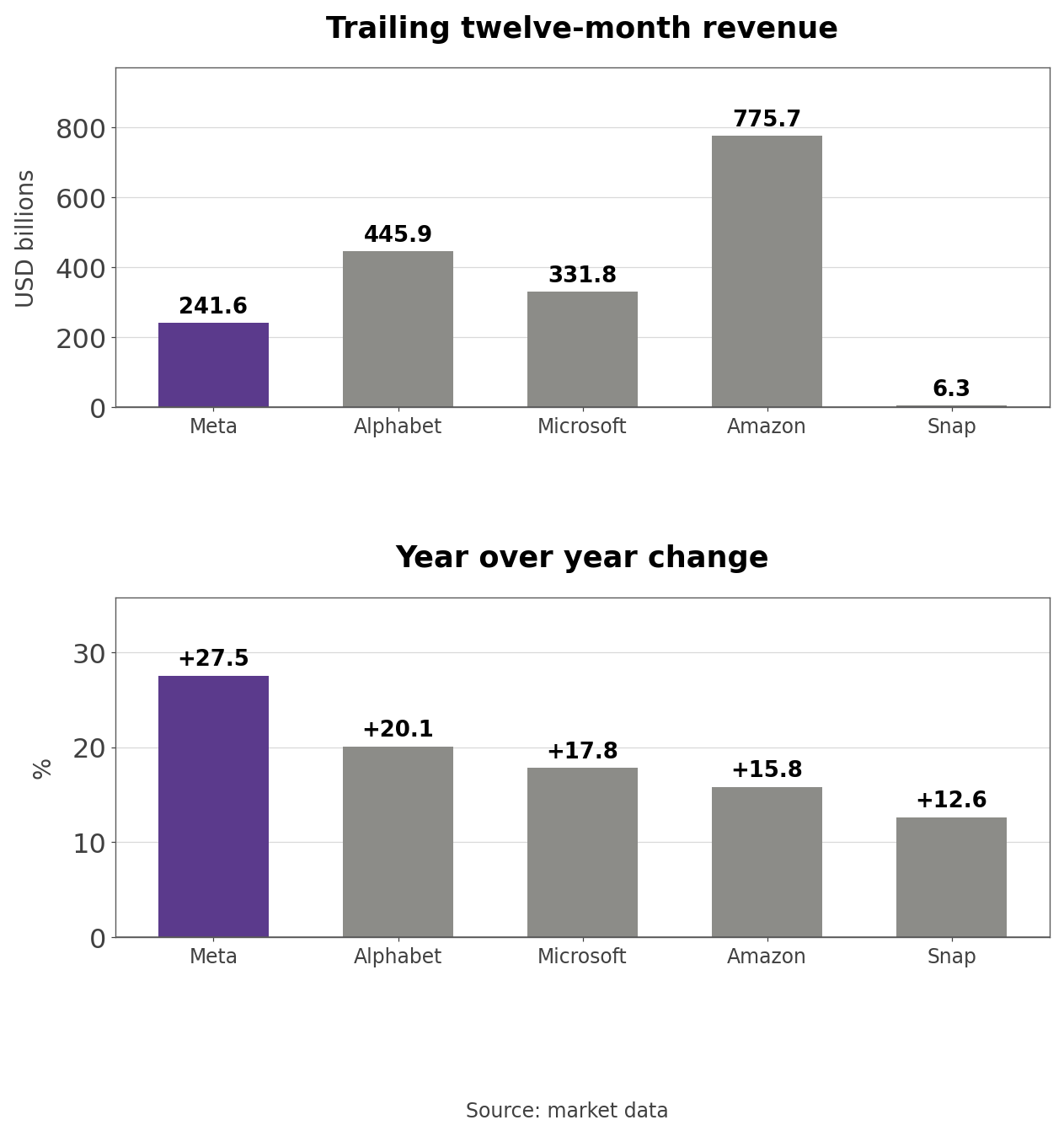
- Alphabet, Amazon, and Snap compete with Meta for ad budgets, while Alphabet, Microsoft, and Amazon compete for AI infrastructure and research talent. Unlike those three, Meta does not rent cloud capacity to others, so it has to recover data center spending through its own ads and AI services. That is why this piece pairs capex intensity with forward P/E.
- Capex excluding finance leases over the last four quarters was 43.2% of revenue at Meta, 34.9% at Microsoft, 29.7% at Alphabet, 22.3% at Amazon, and 3.4% at Snap; Meta's figures run through September and the others through June. Forward P/E is 26.84 at Amazon, 26.62 at Microsoft, 24.51 at Alphabet, 20.98 at Meta, and 8.74 at Snap, and trailing FCF yield is 1.69% at Microsoft, 1.61% at Meta, 1.30% at Alphabet, -0.41% at Amazon, and 6.57% at Snap. Over one year Alphabet gained 16.6% and Meta 7.6%, while Snap fell -19.0%.
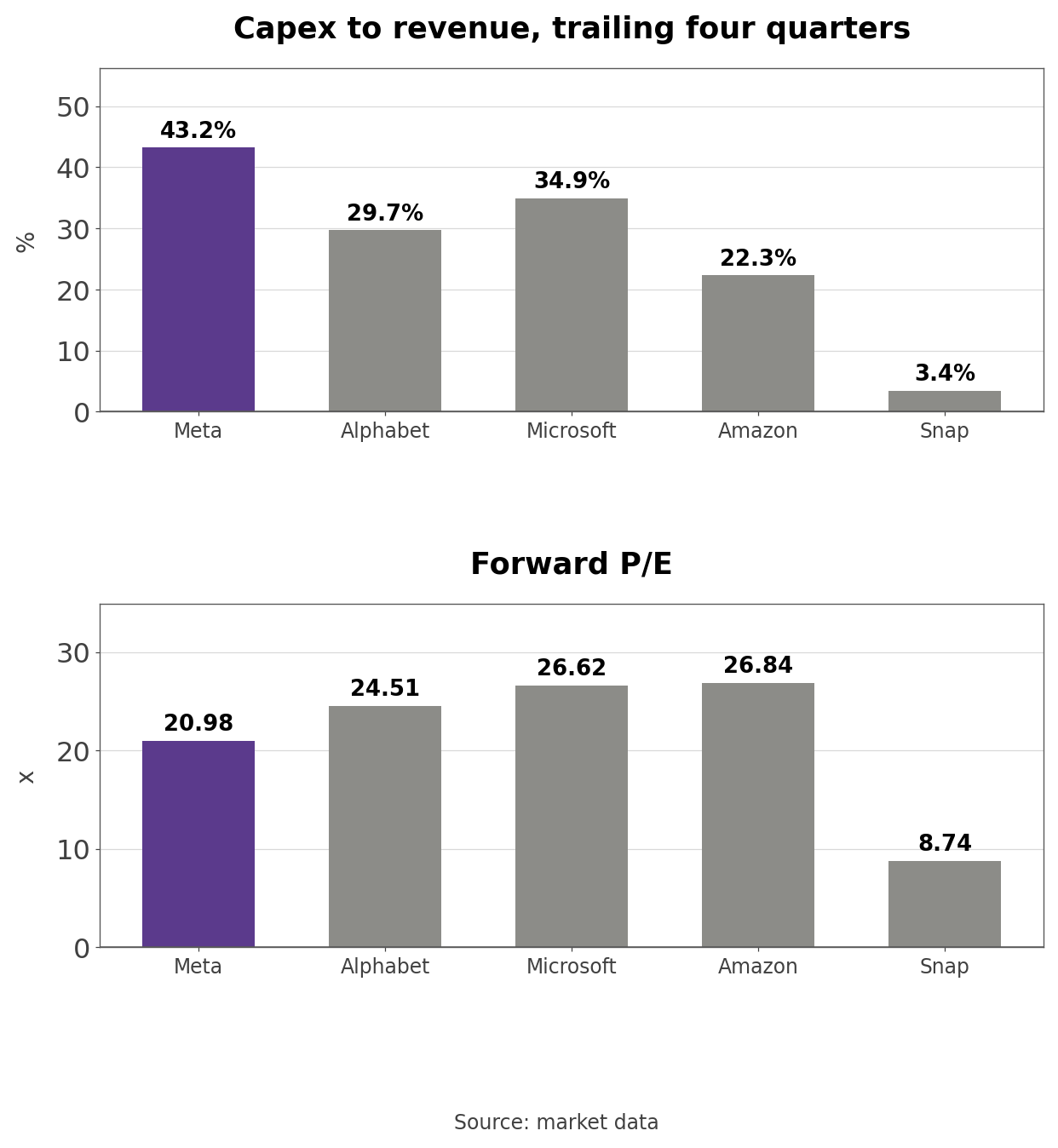
- Meta has the highest capex intensity of the five yet a forward P/E below Alphabet, Microsoft, and Amazon.
P/E on EPS Excluding One-Offs Over 61 Months
- On trailing EPS of $29.77 excluding disclosed one-offs, Meta trades at 23.43 times, the 54th percentile of the 61 months since October 2021, against a median of 23.16. The low was 8.88 in October 2022 and the high 31.95 in February 2024. Price to sales is 7.43, at the 47th percentile, against a median of 7.54.
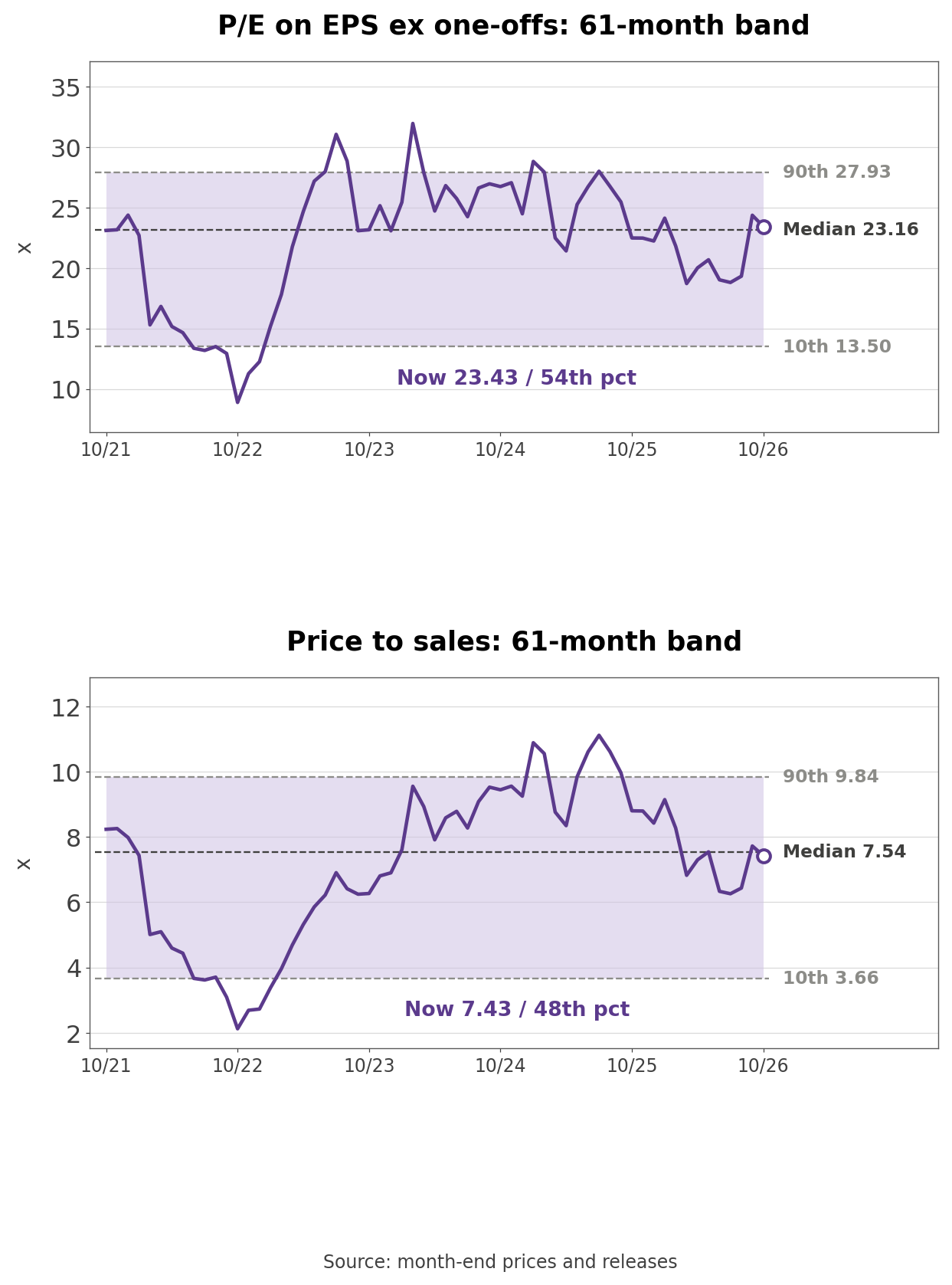
- On the 2027 estimate of $33.82 the multiple is 20.62. At $653.00 a share it would be 21.93 on EPS excluding one-offs, the 36th percentile. Meta's own trailing free cash flow including finance-lease principal, $25.13 billion, is 1.41% of market value, and the dividend yields 0.30%.
Three Conditions That Move the Stock
- Price per ad grew 14% in the third quarter while impressions growth slowed to 10%. Fourth-quarter revenue near the $76 billion top of the outlook with price growth holding in double digits would support the argument that revenue keeps pace with capex; price growth falling back to single digits, as in the fourth quarter of 2025, would leave slowing impressions to carry growth alone.
- Capex consumed 106.5% of operating cash flow in the third quarter. A 2027 capex outlook within trailing operating cash flow of $133.1 billion would bring free cash flow back above zero and reopen room for buybacks; a figure above it, on top of $121.4 billion of commitments due in 2027, would mean outside financing.
- Class C issuance is still zero. If the first issuance is limited to employee compensation, dilution stays close to today's RSU pace; if tens of billions of dollars come through offerings or acquisitions, per-share figures fall accordingly. Selling $100 billion of Class C against a $1.783 trillion market value would add about 5.6% to the share count.
The 2027 Capex Outlook and the First Class C Issuance
- The numbers to watch are the first 2027 expense and capex outlook in the fourth-quarter report, the record and payment dates for the Class C dividend after the January 19 charter change, and the appeal and any bond in the $25 billion New Mexico judgment. The company expects Class C trading to begin in late January 2027.
- One question this piece cannot settle: how much of the hundreds of billions of dollars in the board's forecasts will come through Class C rather than debt, and how close will that come to the 2027 capex outlook?
Related Analysis
- NVIDIA (NVDA) Stock Analysis: Guarantees and Cash Flow: the supplier side of AI infrastructure orders, where commitments and lease guarantees land on the vendor's books, useful next to Meta's $454.5 billion of non-cancelable commitments.
- Oracle (ORCL) Stock Analysis: Cash Flow and Capex Gap: another company whose AI capex outran free cash flow, a frame for how Meta funds 2026 capex of $135 billion to $145 billion.
- AMD Stock Analysis: Q2 2026 Earnings and the Debt Raise: an AI chip supplier that turned to the debt market, useful for comparing how different parts of the AI build-out are being financed.
#Meta #METAStock #Facebook #Instagram #AIInfrastructure #BigTech #USStocks #StockAnalysis #EquityResearch #GlobalStockBrief
'US Stock Analysis' 카테고리의 다른 글
| Schlumberger (SLB) Stock: Organic Sales Fall and a $4.1B Bet (0) | 2026.10.23 |
|---|---|
| Tesla (TSLA) Stock: 62% of Q3 Operating Income Was a Refund (0) | 2026.10.22 |
| Raytheon (RTX) Stock: EPS Growth Is 18% Without the Refund (0) | 2026.10.22 |
| Sanofi (SNY) Stock: Dupixent at 44% and Pipeline Write-Offs (0) | 2026.10.22 |
| Delta Air Lines (DAL) Stock: 23.6% EPS Guidance Cut on Fuel (0) | 2026.10.21 |


