
- SpaceX (Nasdaq: SPCX) earned its first operating profit as a public company in the third quarter: $2.79 billion on revenue of $14.58 billion, up +161.4%. The third-quarter 10-Q shows where much of that revenue came from. One unnamed customer accounted for 34.5% of it, and the cloud contracts behind that business run "typically three years and terminable by either party upon 90 days’ notice." The question is how much of a $2 trillion valuation rests on contracts that either side can end within a quarter.
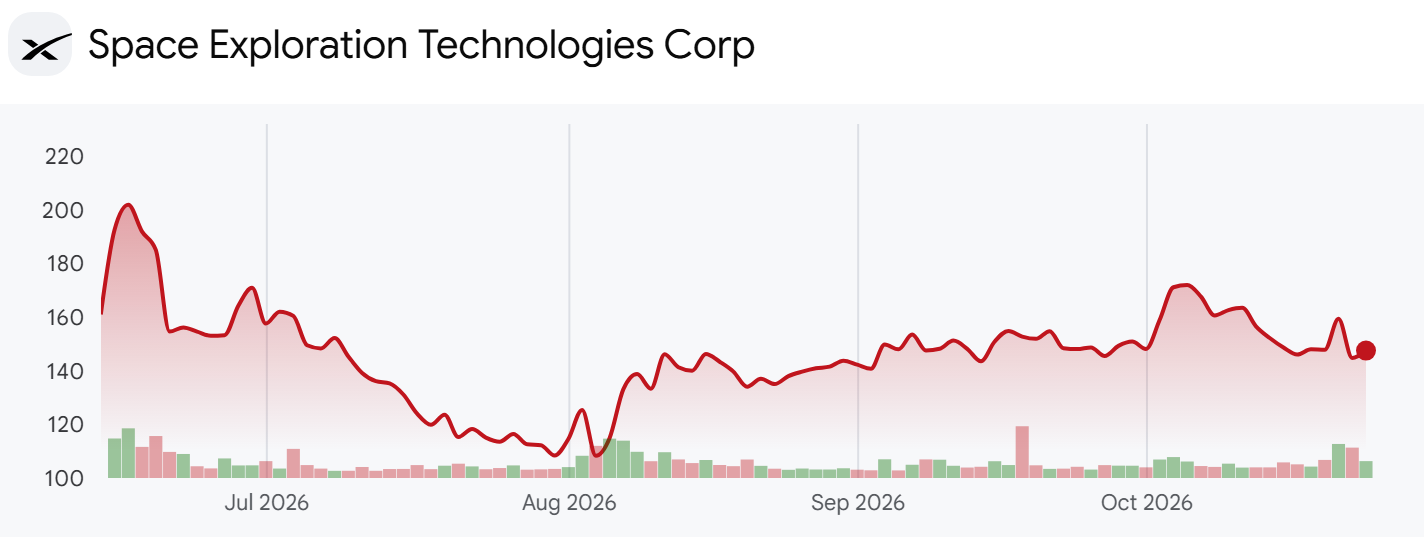
- SpaceX sells launches on Falcon 9 and Starship (the Space segment), Starlink satellite internet (Connectivity), and, since it merged with xAI in February 2026, GPU data center capacity, Grok subscriptions, and X advertising (the SI segment, which the company names Super Intelligence). The shares trade at $147.49, +9.3% above the June IPO price of $135 and -20.3% below the first weekly close of $185.00, for a market value of $2.003 trillion on the 13.58 billion shares listed on the 10-Q cover. Fourth-quarter 2025 segment figures are backed out of prospectus full-year totals, and Customer B revenue is the 10-Q percentage applied to quarterly revenue.
Compute Contracts in the Q3 Release and IPO Roadshow
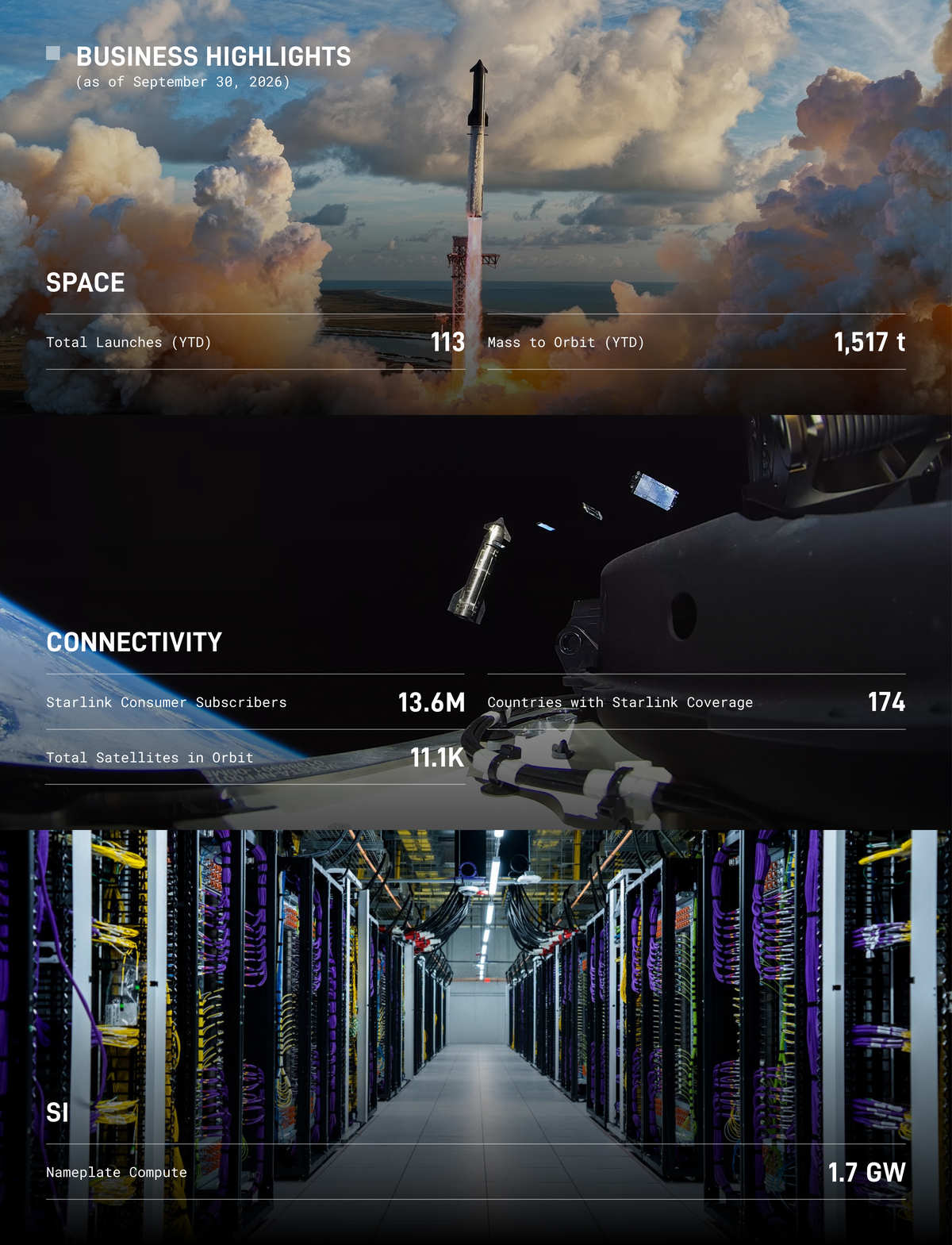
- The business highlights page of the third-quarter release puts one number on each segment: 113 launches and 1,517 metric tons to orbit so far this year in Space; 13.6 million Starlink consumer subscribers, 174 countries, and 11.1 thousand satellites in orbit in Connectivity; and 1.7 GW of nameplate compute in SI.
- The first page of the release lists revenue of $14.6 billion, up 161%, operating income of $2.8 billion, net income of $4.4 billion, and adjusted EBITDA of $8.8 billion, up 306%. It highlights the first revenue-generating Starship flight, which carried 26 Starlink V3 satellites, and explains $6.7 billion of added SI solutions and infrastructure revenue as "driven by cloud services agreements, the acquisition of Cursor, and our growing SI models and software applications, including Grok Bot." The CFO commentary describes a build-out "focused on capital efficiency, strong returns on invested capital, and maintaining a robust, investment-grade balance sheet" in a period when nine-month free cash flow was negative $34.97 billion.
- The SI segment table shows revenue of $7.56 billion, up +195.2% from the second quarter, operating income of $431 million after $1.22 billion of stock compensation tied to the Cursor deal, and segment adjusted EBITDA of $4.95 billion. Cursor, acquired on August 14, added $608 million of revenue; without it, solutions and infrastructure revenue still rose 192% from the second quarter.
- Page 40 of the roadshow presentation used for the June IPO names the buyers of compute. Anthropic pays a $1.25 billion monthly fee for capacity across the COLOSSUS and COLOSSUS II data centers through May 2029. Google pays $920 million a month for access to 110,000 NVIDIA GPUs from October 2026 through June 2029. Both fees are "subject to certain conditions."
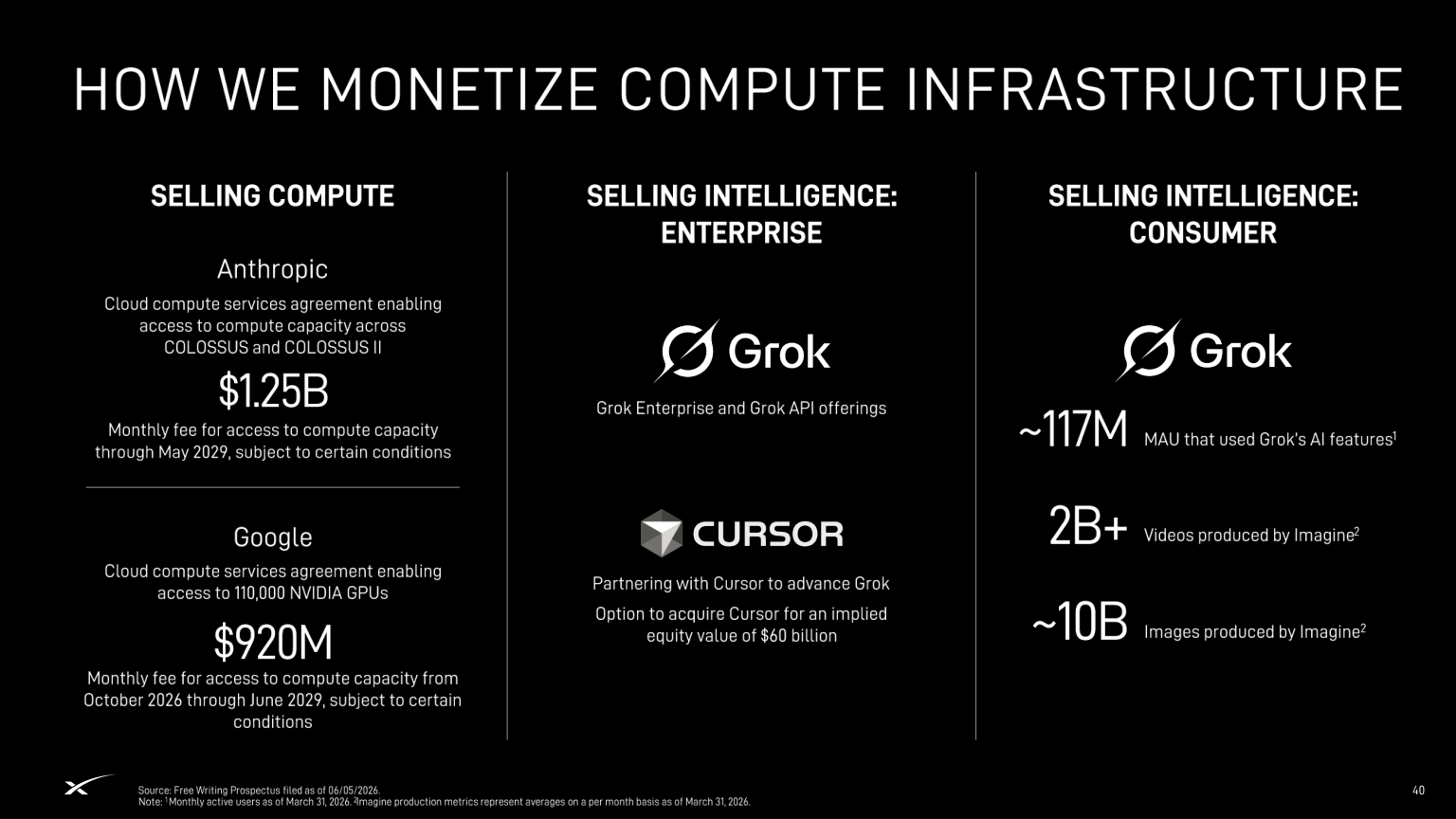
- The prospectus spells out the main condition for Anthropic: after an initial three-month period, either party can end the agreements on 90 days' notice. The company presented this as flexibility, saying the structure lets it sell capacity "while still permitting reallocation of that capacity for our own internal initiatives if needed in the future." On the third-quarter call, the chief financial officer said: "At current pricing, new compute deployments are generating a payback of less than a year." Pricing, he added, is running slightly above the top of the $30 to $50 per watt range discussed a quarter earlier.
- Elon Musk defended the contract length when an analyst asked about it: "I think the smart move is to do short-term contracts". He argued that better models raise the value of each watt and that short contracts have been renewing at higher prices per watt.
The December ARR Goal and the Q4 Capex Guide
- Company disclosure (Q3 call, Q4 and Q1 2027 outlook): The company remains on track for $100 billion of annual recurring revenue, defined as annualized December revenue. Nameplate compute should reach nearly 2 GW at the end of October and 2.5 to 3 GW by year end, fourth-quarter capital spending is guided at $35 billion to $40 billion, and first-quarter 2027 revenue is guided at $33 billion to $37 billion.
- The ARR goal is not new. On the second-quarter call Musk said of it: "That’s what we’d achieve if we basically did nothing." This quarter the company added the first-quarter 2027 range, citing better visibility into its compute contract pipeline over the next six months. Musk said he would be surprised not to have more than 13 GW online by the end of 2027, with 20 GW of power and cooling targeted, and that a six-month payback on compute next year is not impossible.
- The finance chief also warned on margins: "We also expect total company gross margins in Q4 to be more consistent with the second quarter, given some one-time benefits and customer mix that we highlighted in Q3." One of those benefits sits in Connectivity, where the 55% gross margin included roughly 3 points from tariff refunds.
- One metric did not come back. The second-quarter release reported $14.1 billion of contracted sales from cloud services agreements and defined the term narrowly: "It does not include any estimated revenue amounts for the future periods that are cancellable either by us or the customer." Neither the third-quarter release nor the call repeated the figure.
- Own calculation (what the guidance requires): A $100 billion December run rate means December revenue of $8.33 billion, 1.72 times the third-quarter monthly average of $4.86 billion. The first-quarter 2027 range equals 2.26 to 2.54 times third-quarter revenue, and moving from 1.7 GW to 13 GW is a 7.6-fold increase in roughly 15 months.
The Bull and Bear Case for SpaceX Shares
- The bullish case starts with how fast profit is arriving. SI segment adjusted EBITDA went from negative $428 million a year ago to $4.95 billion, Connectivity runs at a 45.1% operating margin, and backlog stands at $62.96 billion. If first-quarter 2027 revenue lands inside guidance, four times that quarter puts the stock at 13.5 to 15.2 times sales.
- The bearish case is about contract length and cash. A third of quarterly revenue came from one customer on contracts that can end on 90 days' notice, and the part of backlog due beyond one year did not grow in the quarter. Nine-month free cash flow was -$34.97 billion, and 36.6% of third-quarter net income came from outside operations.
- Outside view (sell-side research aggregate, October 2026): Of 21 analysts, 17 rate the stock Buy, with an average price target of $209, 41.7% above the share price, and a range from $75 to $450. The day after the results, Cantor raised its target from $246 to $345, UBS from $230 to $300, and Goldman Sachs from $205 to $245.
From a 2002 Rocket Startup to an AI Merger and IPO
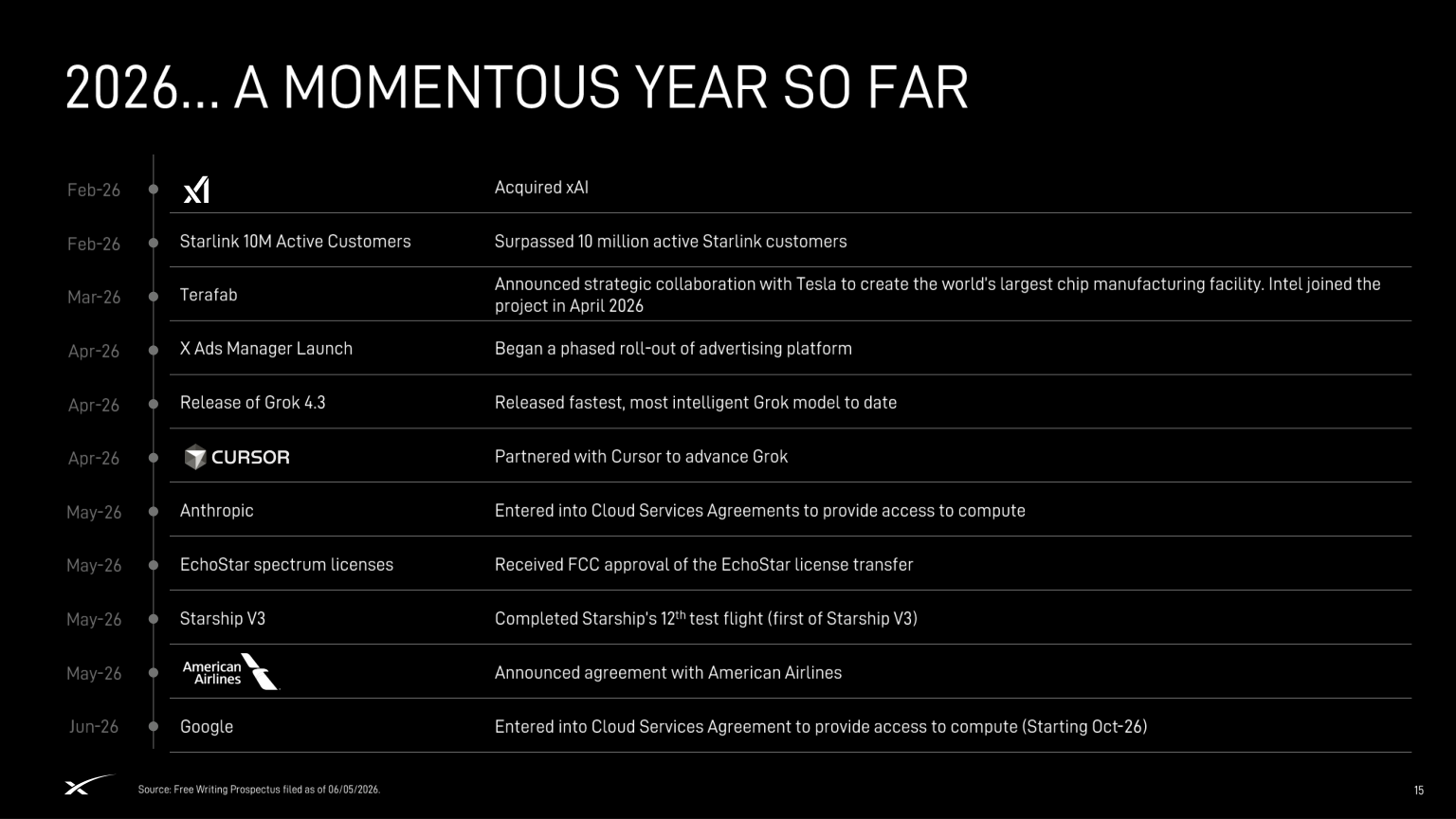
- Musk founded SpaceX in 2002. Reusable Falcon 9 boosters cut the cost of each launch, and the roadshow says the company has carried more than 80% of global mass to orbit since 2023; Starlink service began in 2020. In February 2026 SpaceX absorbed xAI, which had bought X in March 2025, in a merger of companies under Musk's common control, so earlier periods are restated on a combined basis. Page 15 of the roadshow runs the first half of 2026 from the xAI deal to the Anthropic and Google cloud agreements.
- The June 12 IPO sold 638.9 million Class A shares at $135 for net proceeds of $85.7 billion, and a $25 billion investment-grade bond followed on June 26. Cursor, the AI coding tool, closed on August 14 at an implied equity value of $60 billion. GAAP purchase consideration was $42.5 billion, and $23.4 billion of equity awards for post-deal service will be expensed over about three years.
- On weekly closes the stock fell -41.4% from $185.00 in its first week to $108.37 in the week of July 31, recovered after the August second-quarter report, and rose +1.0% in the week of the third-quarter results.
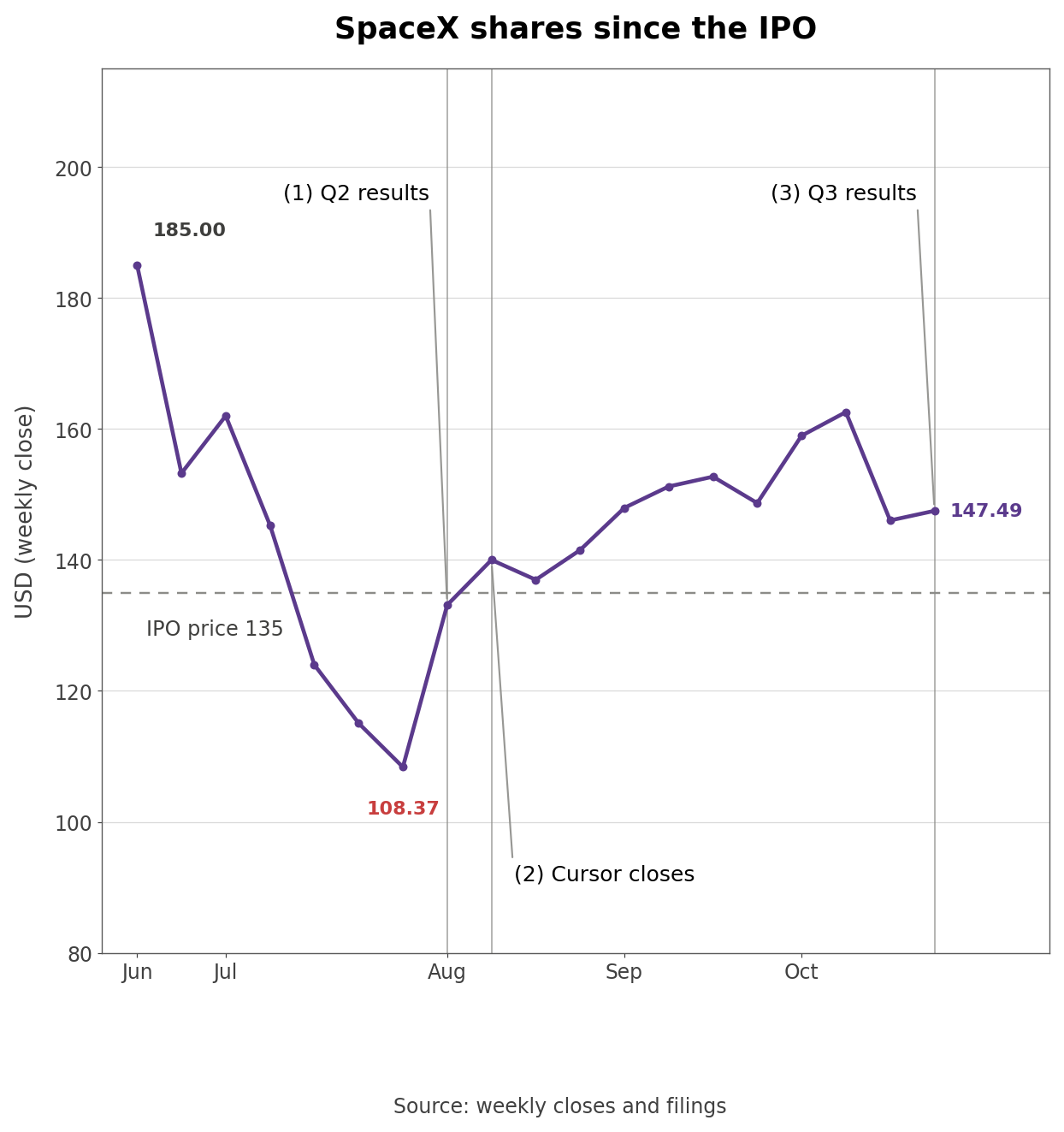
- Musk is locked up for 366 days; other holders unlock in stages through 180 days after the IPO, and some investors and officers between the fourth-quarter 2026 and second-quarter 2027 reports.
How Much Revenue Rests on One Customer?
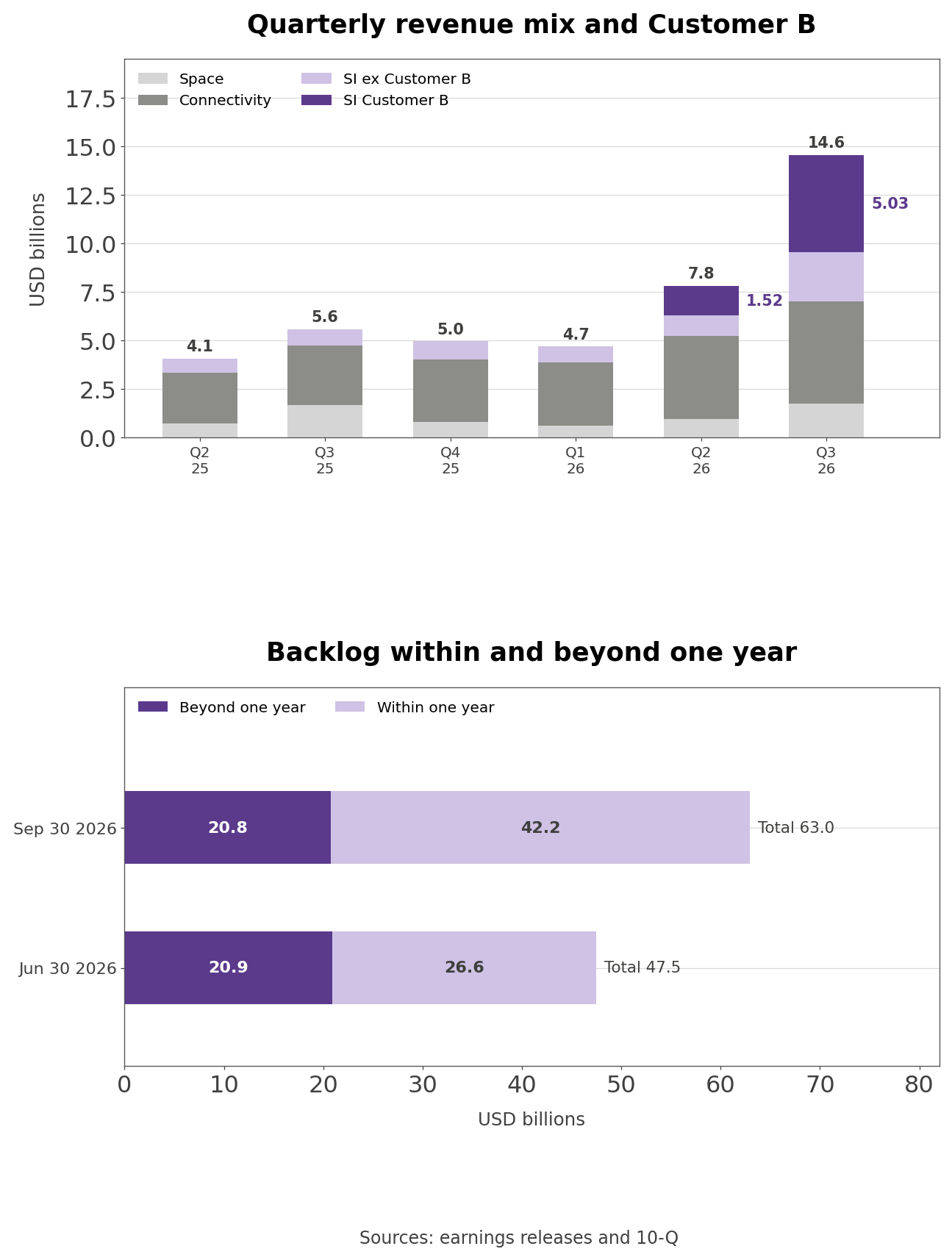
- Note 3 of the 10-Q lists two customers above 10% of revenue. Customer A buys across all three segments and was 16.6% of third-quarter revenue, down from 23.9% a year earlier. Customer B is an SI customer that rose from 19.5% in the second quarter to 34.5% in the third, after staying below 10% in the first. The filing names neither.
- Own calculation (Customer B in dollars): Applying those percentages, Customer B brought in $1.52 billion in the second quarter and $5.03 billion in the third, 66.5% of SI revenue and 71.6% of SI solutions and infrastructure revenue. Of the $4.83 billion sequential increase in solutions and infrastructure revenue, $3.50 billion came from Customer B. Three months of Anthropic's published fee comes to $3.75 billion, $1.28 billion less than Customer B's third-quarter revenue.
- Anthropic ramped in May and June at a reduced fee, Google starts in October, and on the second-quarter call management said it had contracted another $6.7 billion of cloud revenue over six months starting in October. Whether Customer B's revenue above the Anthropic fee reflects added contracts with the same customer is not disclosed.
- The 10-Q treats cloud services as a stand-ready obligation to provide reserved compute and recognizes fixed monthly fees over the contract term. Backlog rose from $47.46 billion at the end of June to $62.96 billion at the end of September, and the share expected within one year rose from 56% to 67%. "Contracts are included in backlog when an enforceable agreement has been reached," the filing says.
- Own calculation (backlog by duration): Backlog due within one year rose from $26.58 billion to $42.18 billion, an increase of $15.61 billion, while backlog due beyond one year slipped from $20.88 billion to $20.78 billion. All of the $15.50 billion of added backlog falls within a year.
- In Musk's telling the short backlog is a choice: he expects the compute shortage to last and prefers repricing at renewal. For the customer, the same clause is an option to move workloads after 90 days.
Non-Operating Gains Inside Q3 Net Income
- Third-quarter net income of $4.40 billion equals operating income of $2.79 billion, less $675 million of interest expense, plus $873 million of interest income, $1.03 billion of other income, and a $390 million tax benefit. The interest income comes from investing the IPO proceeds, and $561 million of the other income is an unrealized gain on SpaceX's stake in The Boring Company.
- Musk controls The Boring Company, so the stake is a related-party item, marked up after a September financing round. Of the interest expense, $351 million came from AI equipment leases with Valor Equity Partners, founded by SpaceX director Antonio Gracias; the leases were judged a failed sale-leaseback and sit on the balance sheet as $12.90 billion of debt.
- Own calculation (profit quality): The $1.61 billion of non-operating items equals 36.6% of third-quarter net income. Without the Boring Company gain and the tax benefit, net income would have been $3.45 billion.
- Gross margin rose from 55.3% to 62.4% on more low-cost cloud revenue and the tariff refunds, and the fourth quarter is guided back to the second-quarter level. For nine months SpaceX still shows a net loss of $413 million after a $1.55 billion first-quarter loss on early debt repayment.
How the IPO and Debt Fund the Capex Gap
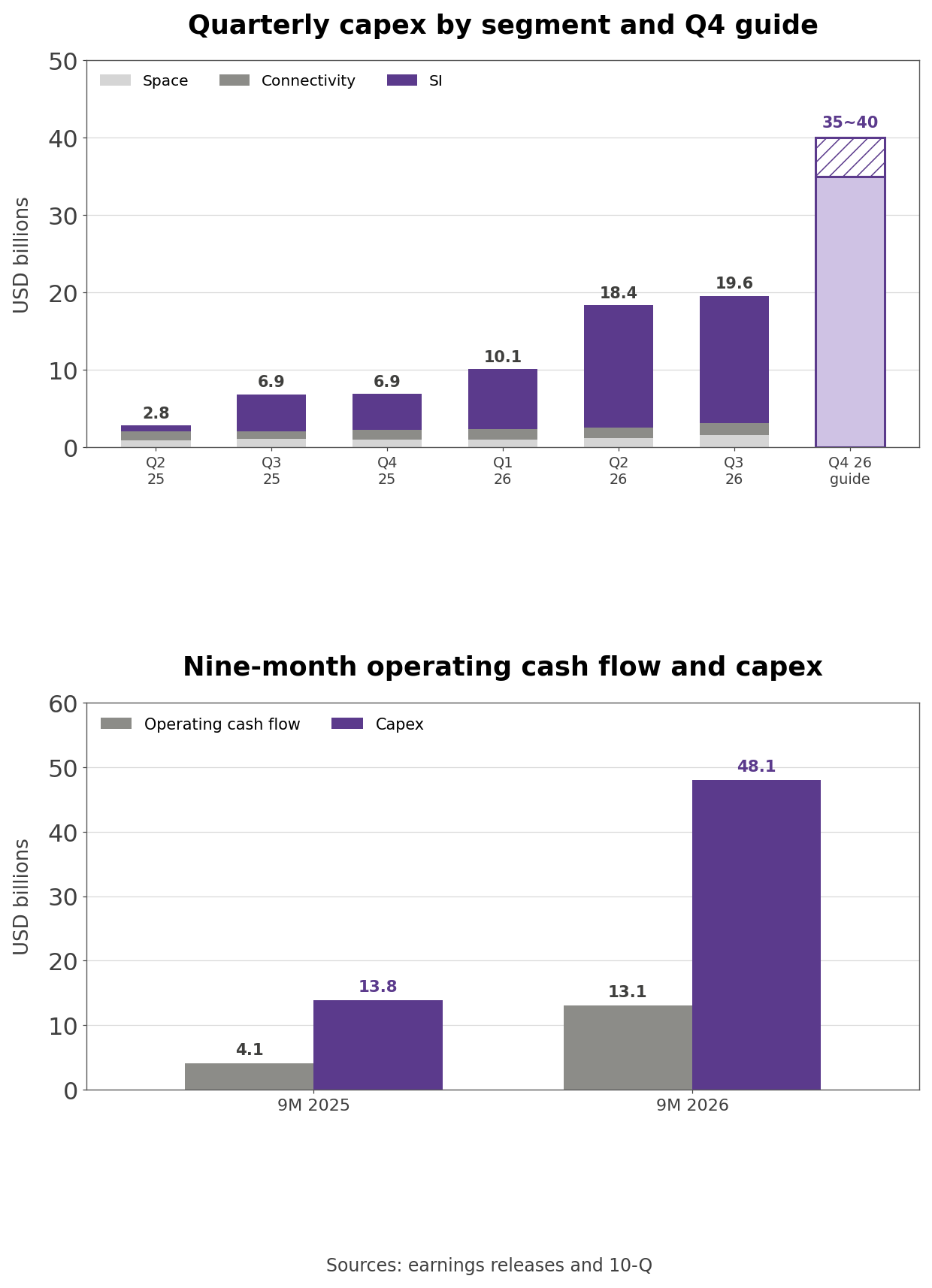
- Nine-month capital spending reached $48.07 billion, 3.5 times a year earlier, and 83.2% of it went to SI. The third quarter alone was $19.59 billion, and with fourth-quarter guidance of $35 billion to $40 billion, 2026 capex comes to $83 billion to $88 billion. Nine-month operating cash flow was $13.10 billion, leaving free cash flow of negative $34.97 billion; the third quarter alone produced operating cash flow of $9.63 billion and free cash flow of -$9.96 billion.
- The IPO and borrowing filled the gap. Nine-month financing cash flow was $99.82 billion, including $85.68 billion of IPO proceeds, and the quarter ended with $89.86 billion of cash and marketable securities against $38.99 billion of debt. When the EchoStar spectrum purchase closes, SpaceX will issue 261.8 million Class A shares worth $11.1 billion and pay up to $8.5 billion toward EchoStar debt.
- Own calculation (payback at the fleet level): SI capex over the last four quarters totals $44.65 billion. Divided by four times third-quarter SI adjusted EBITDA, or $19.81 billion, that is 2.25 years. The company's sub-one-year figure refers to new deployments rented at current prices, while this fleet-level number also carries unfinished data centers and the compute used to train Grok.
Three Segments From Launch to Compute Rentals
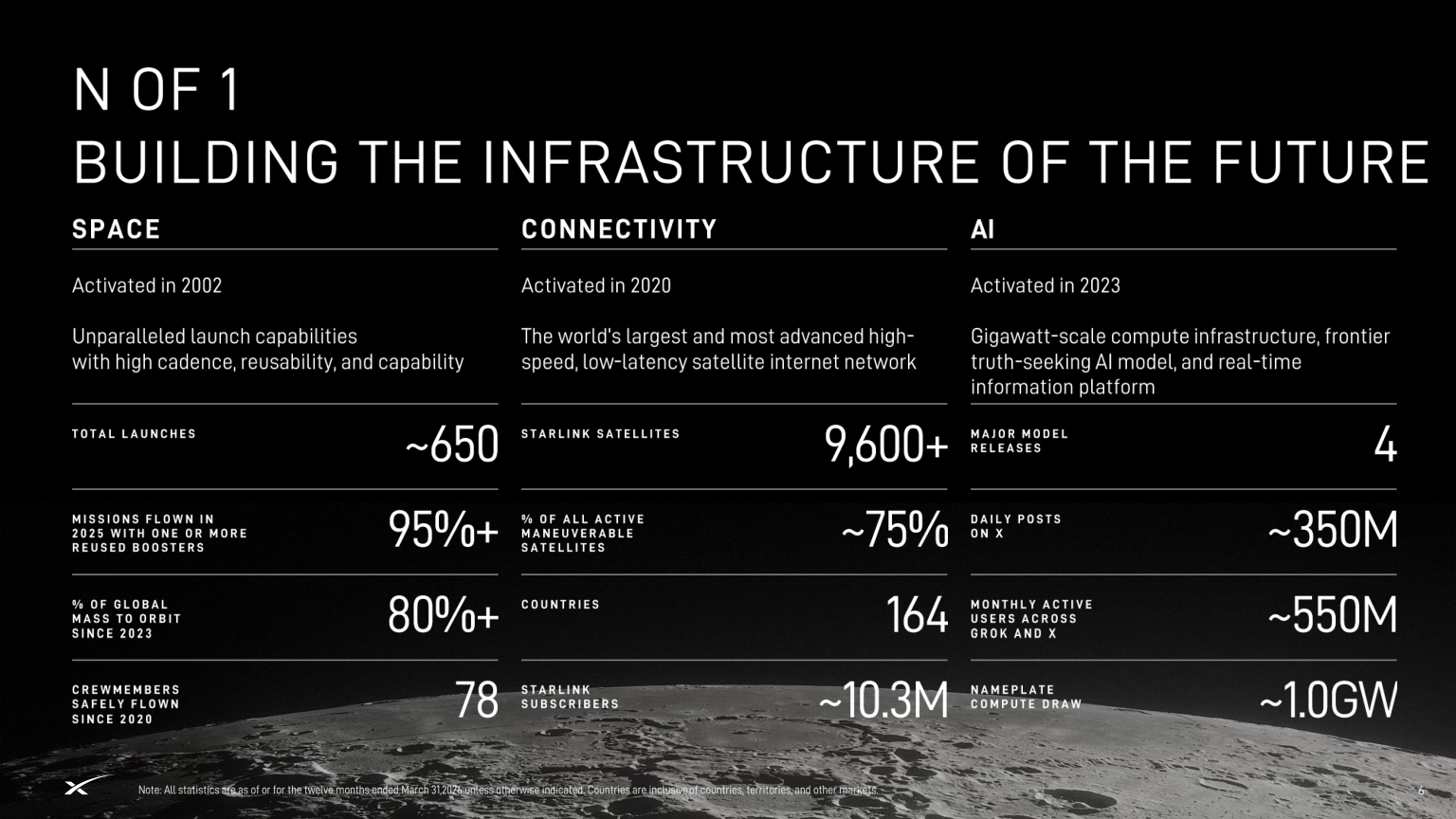
- Page 6 of the roadshow dates the three businesses to 2002, 2020, and 2023 and counts about 650 launches, more than 9,600 Starlink satellites, and about 550 million monthly users across Grok and X.
- Space revenue was $1.77 billion in the third quarter, up +6.1%, with an operating loss of $7 million. Only customer launches produce segment revenue: of 35 launches, 12 were for customers and 23 put up SpaceX's own Starlink satellites. Year-to-date launches total 113. Research and development, mostly Starship, was $1.23 billion, 69% of segment revenue. New awards included three NASA crew missions and 18 national security launches.
- Launch services revenue of $1.13 billion is booked at launch, and launch and development revenue of $637 million, such as NASA's Dragon programs, is booked over time. Customer launches fell from 15 to 12 while launch services revenue rose +13.0%, lifting the simple average per customer launch from $66.7 million to $94.2 million. Internal launches earn no Space revenue; their cost is capitalized in Connectivity, and 83.5% of the 1,517 tons sent to orbit this year was SpaceX's own payload.
- Connectivity revenue was $5.25 billion, up +69.5%, with operating income of $2.37 billion, a 45.1% margin. Consumer revenue of $3.12 billion, up 57.2%, comes from kit sales and monthly subscriptions; consumer subscribers reached 13.6 million, up 1.6 million in the quarter, while monthly ARPU of $69 was below $83 a year earlier as international users and lower-priced plans grew. Enterprise and government revenue, which includes the Starshield defense network, reached $2.13 billion, up +91.4%. Starlink Mobile reached 22 million monthly users, and U.S. mobile service on the EchoStar and 800 MHz spectrum is planned for early 2028.
- SI splits into advertising of $538 million, up 18.5%, and solutions and infrastructure of $7.02 billion, which covers compute rentals, Grok subscriptions and API usage, and Cursor. Nameplate compute, installed GPUs times their all-in power draw, rose from 0.6 GW to 1.7 GW as COLOSSUS II in Memphis and a site in Southaven, Mississippi came online. Grok Bot had 800,000 paid weekly users in early October, and SI depreciation reached $2.47 billion, 2.7 times a year earlier.
- SI now makes up 51.9% of revenue, Connectivity 36.0%, and Space 12.1%; a year ago Connectivity was 55.5% and SI 14.6%. SpaceX also bought $480 million of Tesla Megapacks for its data centers over nine months, and both companies' boards have formed special committees to evaluate a combination.
SpaceX Versus Five Compute and Space Peers
- Trailing twelve-month revenue is $71.78 billion at Oracle, $32.04 billion at SpaceX, $7.59 billion at CoreWeave, $1.36 billion at Nebius, $903 million at Iridium, and $769 million at Rocket Lab. Growth runs from Nebius at 506.9% and SpaceX at +128.6% to CoreWeave at 115.3%, Rocket Lab at 52.5%, Oracle at 21.6%, and Iridium at 3.6%.
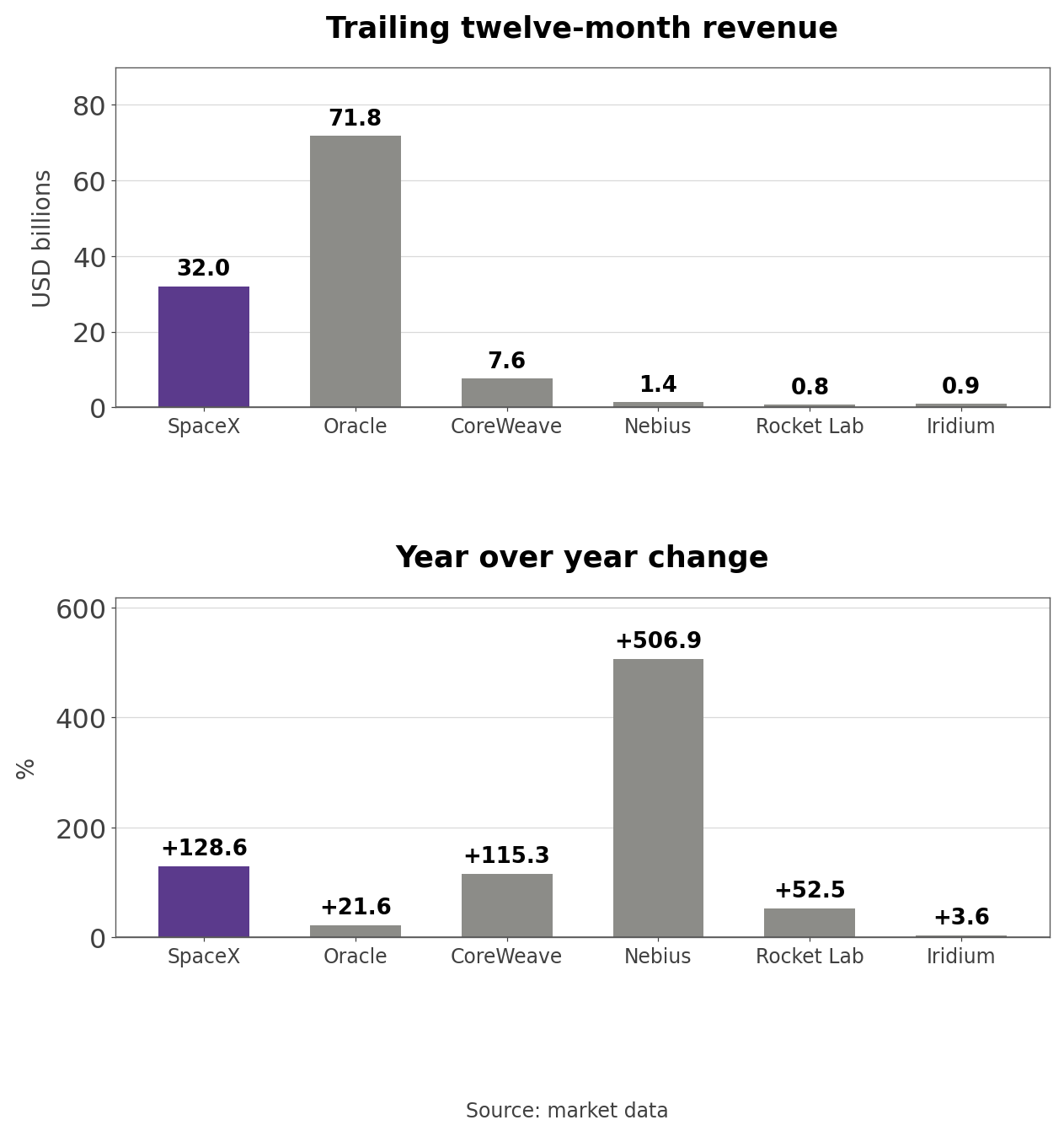
- CoreWeave and Nebius rent GPU capacity as their core business, and Oracle sells data center compute under long-term cloud contracts. Rocket Lab overlaps with the Space segment, and Iridium with the handheld satellite market Starlink Mobile is entering.
- On price to trailing sales (P/S), SpaceX trades at 62.5 times, Rocket Lab at 40.9, Nebius at 32.0, Oracle at 5.3, Iridium at 5.2, and CoreWeave at 3.9. Latest-quarter operating margins are 35.6% at Oracle, 19.1% at SpaceX, 12.9% at Iridium, negative 0.2% at Nebius, negative 1.9% at CoreWeave, and negative 24.6% at Rocket Lab. Over the past year CoreWeave shares fell -59.4% and Oracle shares fell -52.0%.
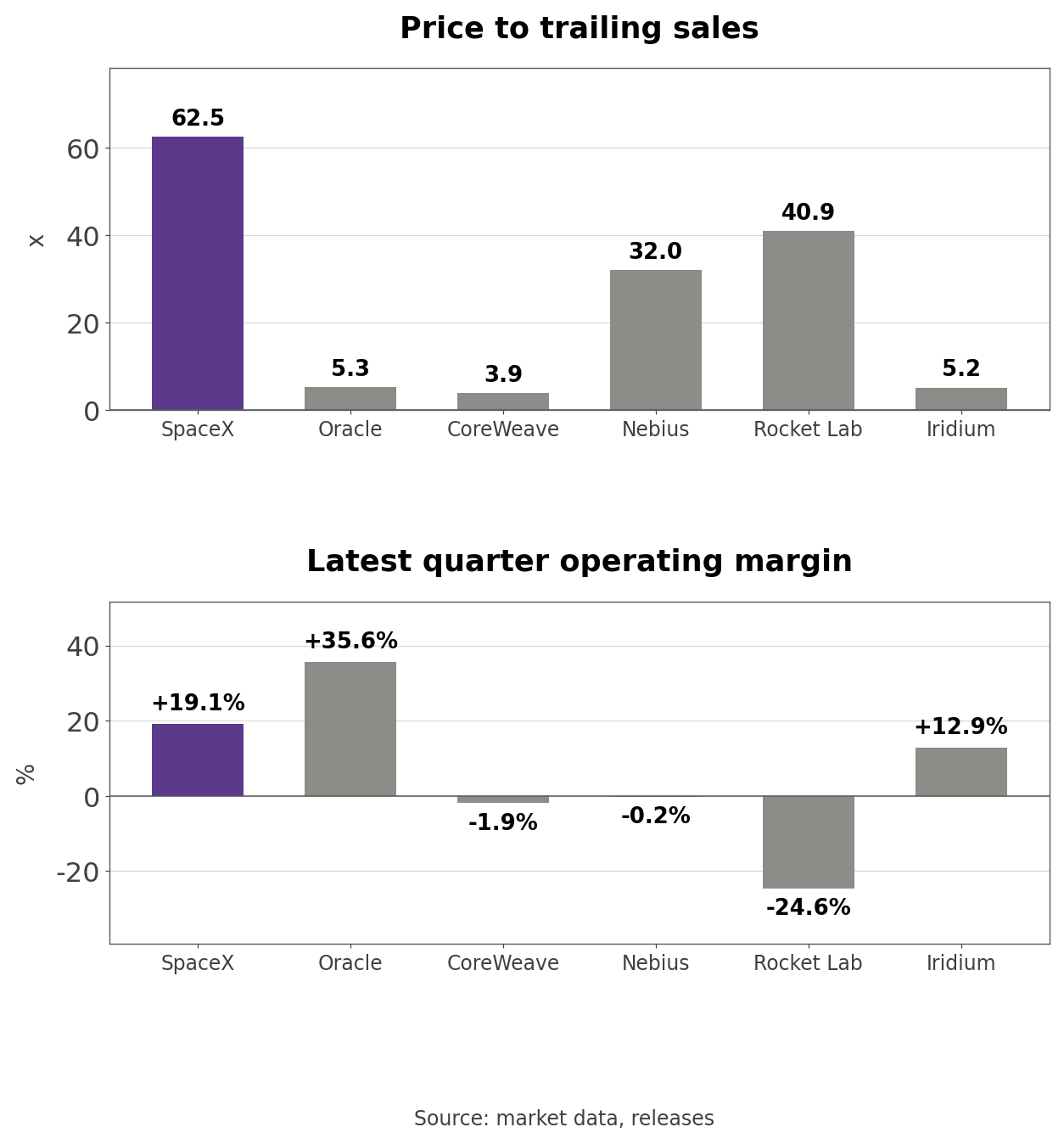
- SpaceX's P/S is 16.0 times CoreWeave's, even though both rent GPUs. Oracle earns a higher margin and trades at 5.3 times sales, and the companies closest to SpaceX's multiple are Rocket Lab and Nebius, each with about $1 billion of revenue or less.
Price to Sales on Six Revenue Bases
- Nineteen weeks of trading give four month-end prices, too few for a valuation band. Dividing the $2.003 trillion market value by six revenue bases instead gives 62.5 times trailing revenue, 44.3 times the 2026 consensus of $45.2 billion, 34.4 times third-quarter revenue annualized, 20.0 times the December ARR goal, 17.3 times the 2027 consensus of $116.0 billion, and 13.5 to 15.2 times first-quarter 2027 guidance annualized.
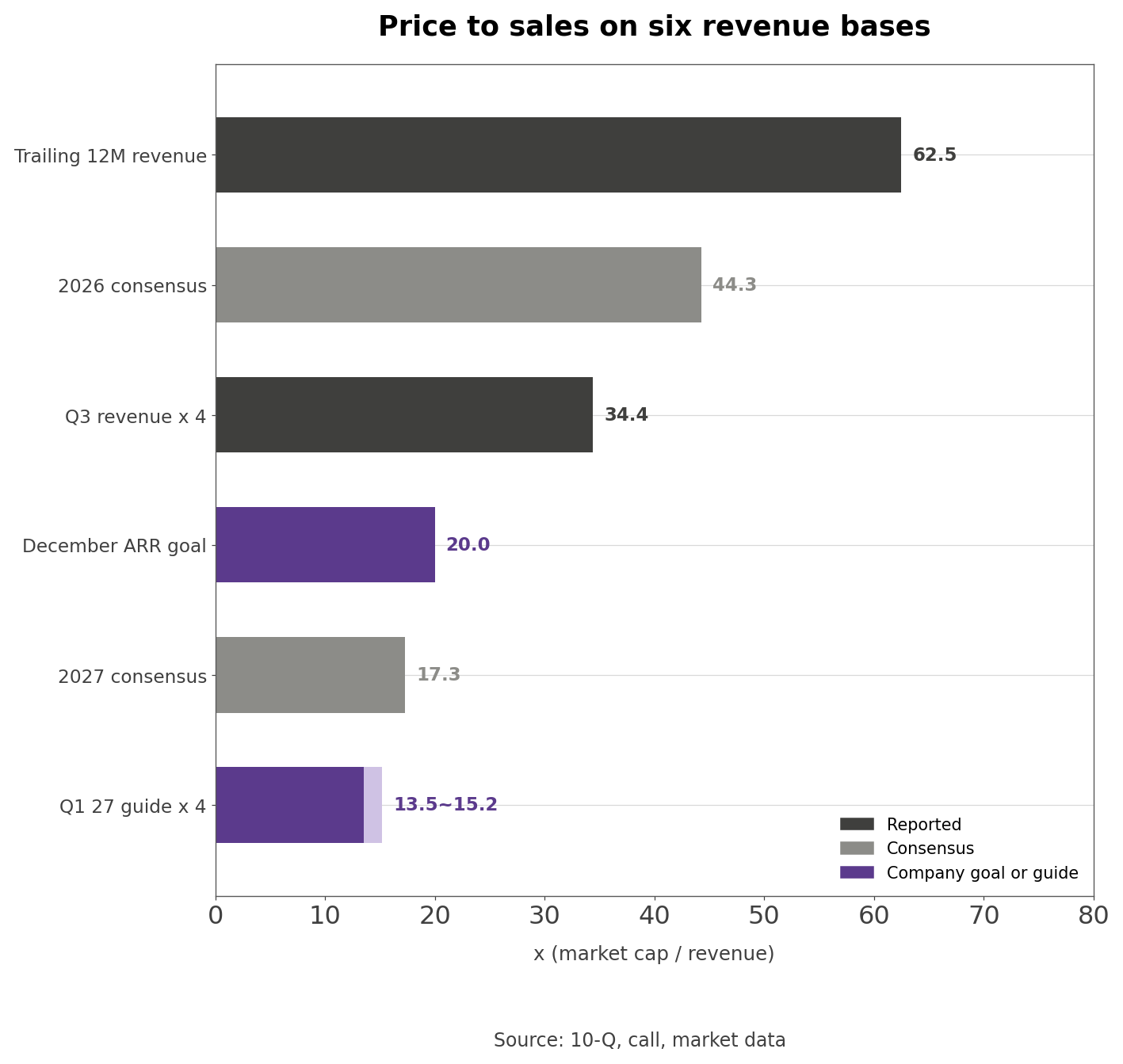
- The multiple on trailing results is 4.1 to 4.6 times the multiple on company guidance. The 2026 consensus implies fourth-quarter revenue of $18.12 billion, 24.3% above the third quarter.
Three Conditions That Move the Stock
- Customer B's share of revenue went from 19.5% to 34.5% between the second and third quarters. If the Google contract adds a second SI customer above 10% in the fourth quarter and Customer B's share falls, a single 90-day notice matters less to quarterly revenue; a share above 40% would tie that much of revenue to one customer's decision.
- Backlog due beyond one year was $20.88 billion in June and $20.78 billion in September. Growth in that figure in the annual report would show short contracts lengthening at renewal; a flat figure would mean new backlog is mostly near-term revenue booked early.
- The gap between capex and operating cash flow was negative $34.97 billion over nine months. If operating cash flow tops $10 billion a quarter while the $35 billion to $40 billion of fourth-quarter capex goes out, the $89.86 billion cash pile lasts longer; if not, more borrowing or equity becomes likely in 2027.
The Google Contract and the Tesla Review
- The numbers to watch in the fourth-quarter report are the December ARR, Customer B's share, backlog beyond one year, and fourth-quarter gross margin. The Google contract at $920 million a month and the six-month $6.7 billion contract both start in October, so the fourth quarter is the first to include them in full, and the review of a Tesla combination waits on the two companies' special committees.
- One question this piece cannot settle: short contracts let SpaceX reprice at every renewal while compute is scarce, but if GPU supply loosens and Customer B gives 90 days' notice, how much of the $20.78 billion of longer-dated backlog still stands behind the revenue?
Related Analysis
- Tesla (TSLA) Stock: 62% of Q3 Operating Income Was a Refund: the other side of the special committee review, and another third quarter where tariff refunds lifted margins, useful for comparing profit quality at the two Musk companies.
- Oracle (ORCL) Stock Analysis: Cash Flow and Capex Gap: a cloud provider funding data centers with customer prepayments, a contrast with SpaceX's short contracts and IPO-funded capex.
- NVIDIA (NVDA) Stock Analysis: Guarantees and Cash Flow: the GPU supplier behind COLOSSUS, useful for seeing how rental contract risk shows up on the supplier's balance sheet.
#SpaceX #SPCXStock #Starlink #AIInfrastructure #SpaceStocks #CloudComputing #USStocks #StockAnalysis #EquityResearch #GlobalStockBrief
'US Stock Analysis' 카테고리의 다른 글
| IBM (IBM) Stock: Organic Software Growth Is Just Over 4% (0) | 2026.10.24 |
|---|---|
| GE Aerospace (GE) Stock: Allowances Behind the Cash Flow (0) | 2026.10.24 |
| Schlumberger (SLB) Stock: Organic Sales Fall and a $4.1B Bet (0) | 2026.10.23 |
| Meta (META) Stock: Negative FCF Meets Non-Voting Class C (0) | 2026.10.23 |
| Tesla (TSLA) Stock: 62% of Q3 Operating Income Was a Refund (0) | 2026.10.22 |


