
- International Business Machines Corporation (NYSE: IBM) grew third-quarter software revenue +8.3% to $7.80 billion, or 9% at constant currency, but the company's own prepared remarks put organic growth at just over four points of that, with the rest coming from deals such as the $11.6 billion purchase of Confluent in March. Total revenue rose 4.7% to $17.10 billion, and IBM kept its full-year revenue outlook of 4% to 5% while raising only its free cash flow target. The question is how much growth is left in a company that trades at 20 times operating earnings once acquisitions are stripped out.
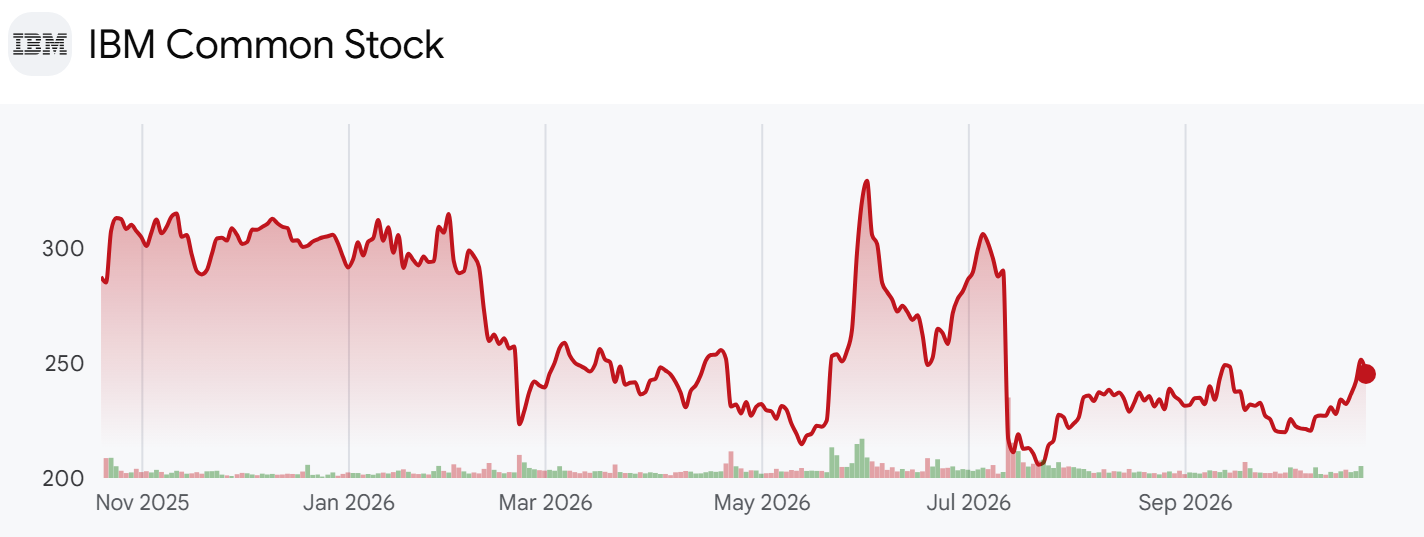
- IBM sells software such as Red Hat Enterprise Linux and OpenShift, IT consulting, and mainframes (IBM Z), servers, and storage. The shares trade at $251.46 for a market value of $237.66 billion on 945.1 million shares outstanding, -17.0% below the weekly high of $303.06 set in the week of December 12, 2025. EPS here is IBM's operating (non-GAAP) measure, which excludes acquisition-related amortization and retirement-related costs; third-quarter GAAP EPS was $2.31. IBM does not disclose how much acquisitions add to software growth, so the acquired share below is a range backed out from the organic figure the company gave.
What the Third-Quarter Presentation Says About Software
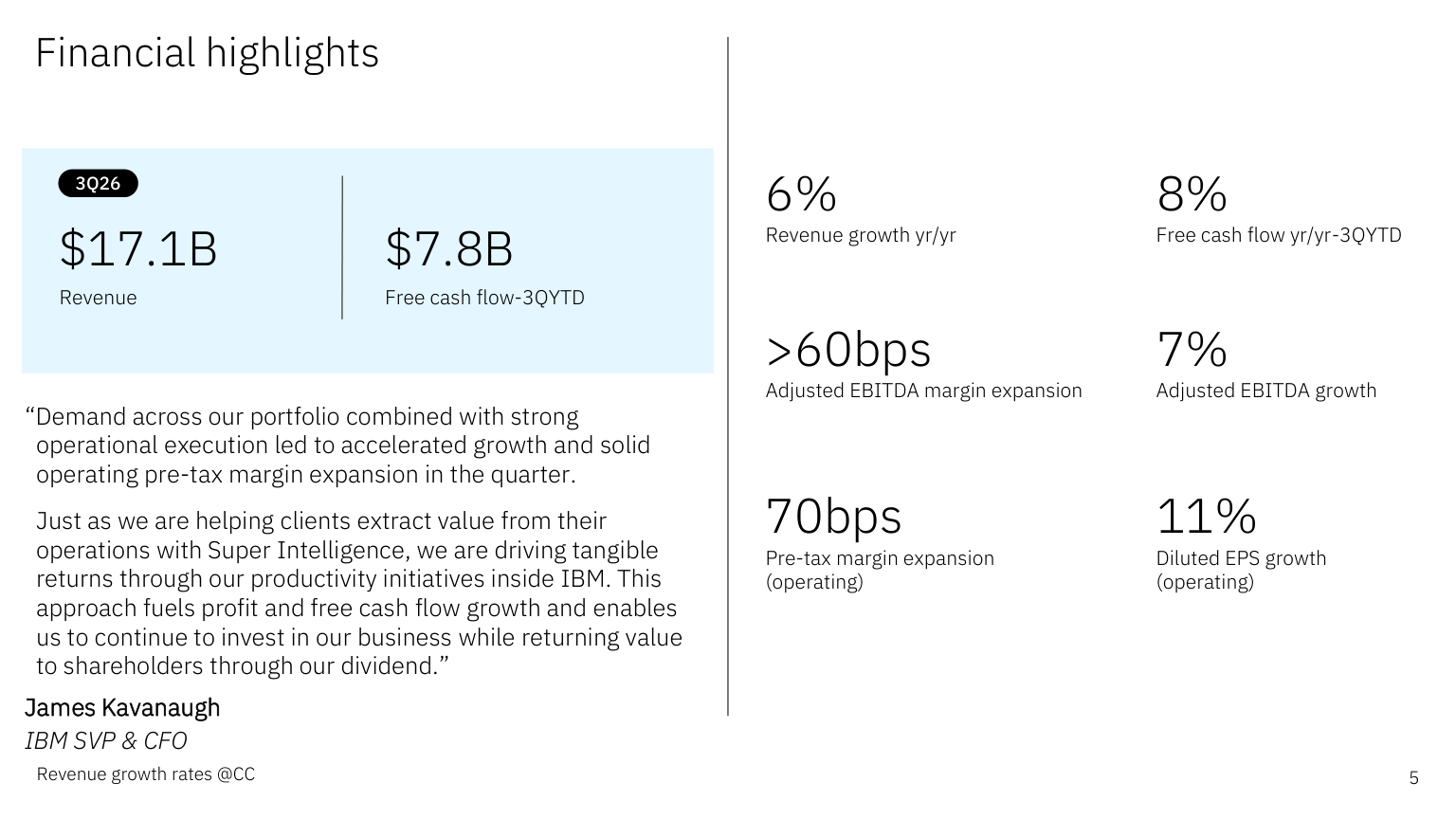
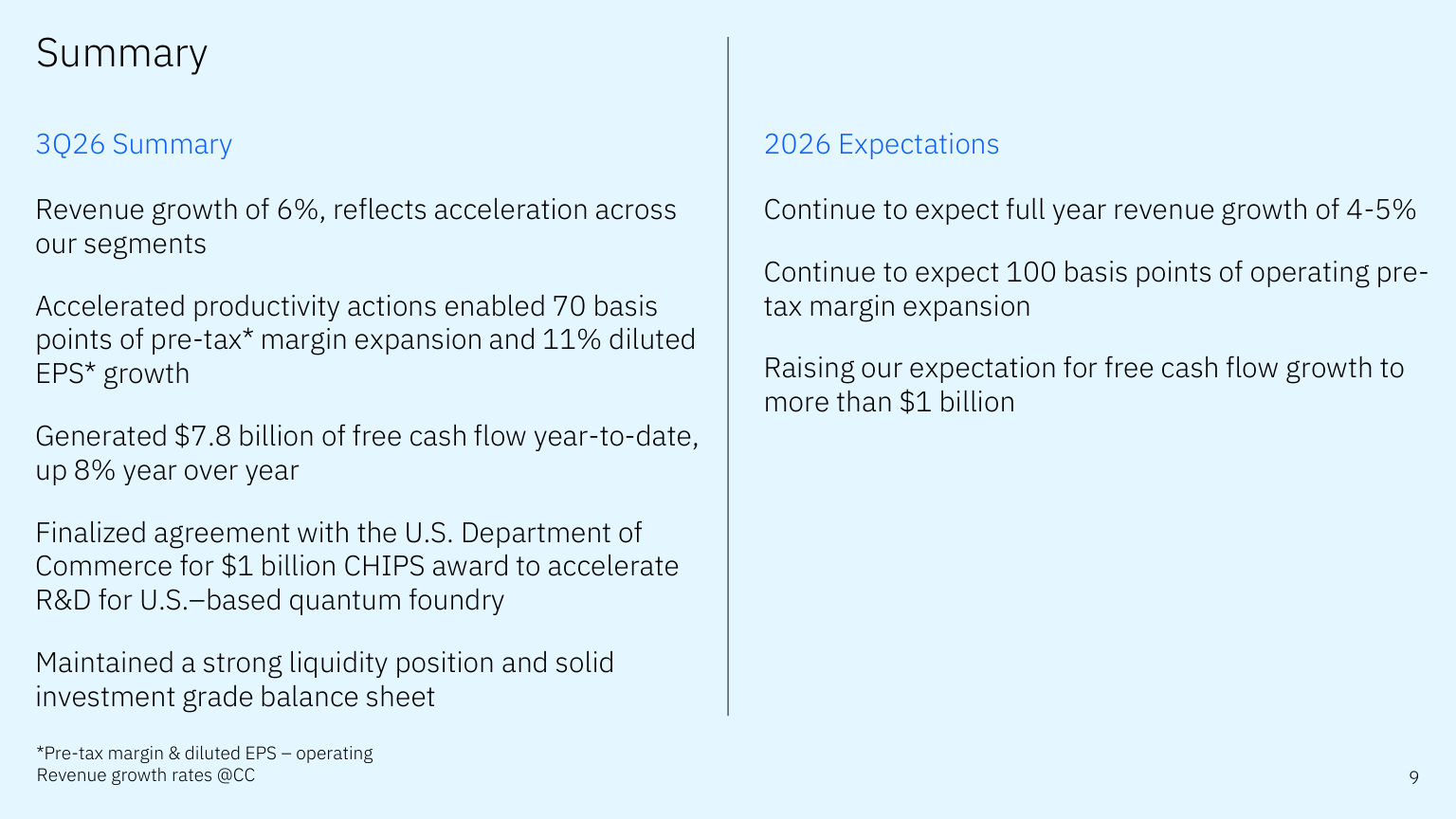
- Page 5 of the third-quarter presentation shows revenue of $17.1 billion (up 6% at constant currency), nine-month free cash flow of $7.8 billion (up 8%), adjusted EBITDA up 7%, operating pre-tax margin up 70 basis points, and operating EPS up 11%. The growth rates on that page are at constant currency; on a reported basis the release shows revenue up 4.7% and operating EPS up 11.3%.
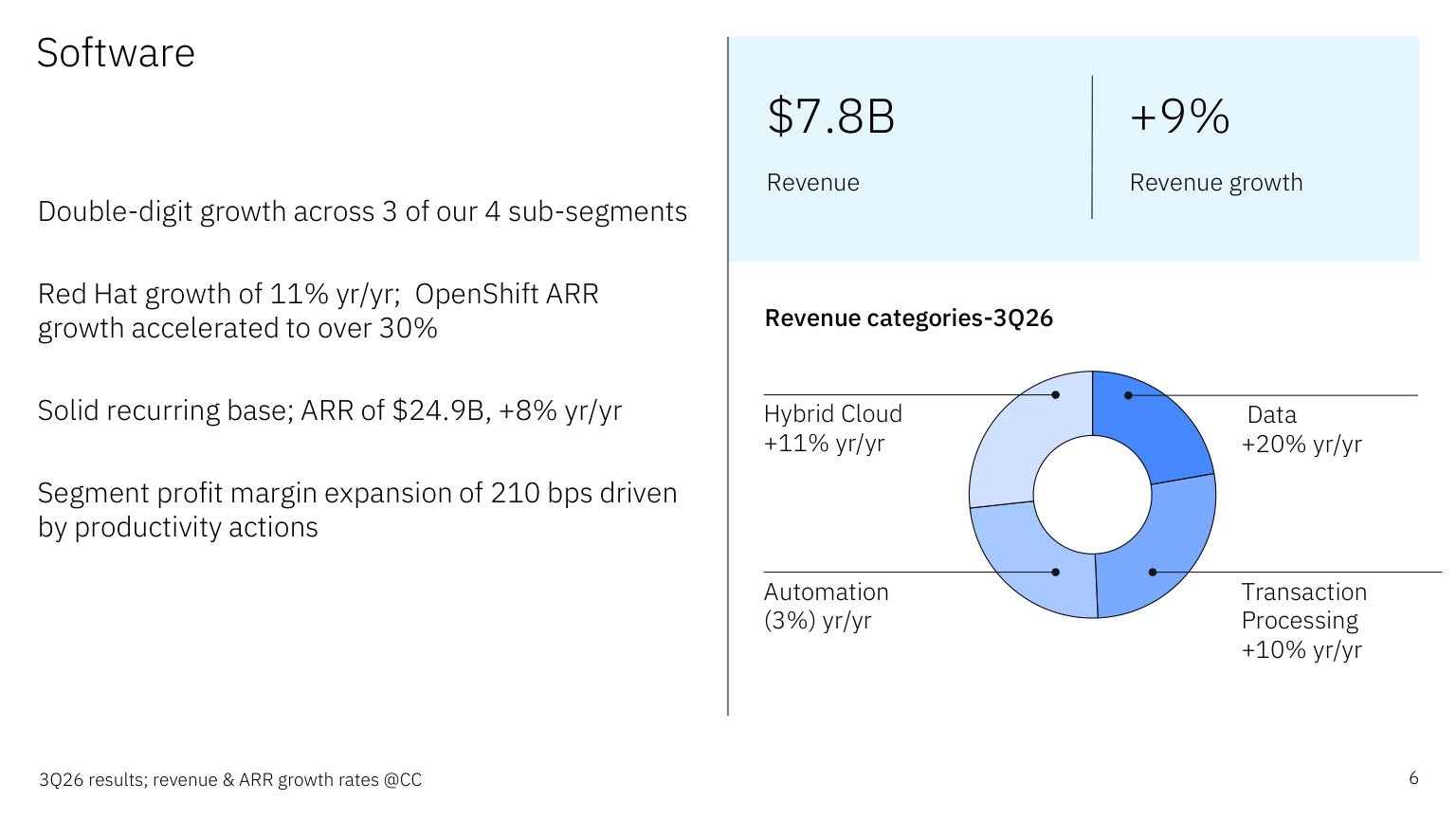
- Page 6 puts software revenue at $7.8 billion, up 9% at constant currency, with double-digit growth in three of four sub-segments: Hybrid Cloud (Red Hat) up 11%, Data up 20%, and Transaction Processing up 10%, while Automation fell -3%. Annual recurring revenue reached $24.9 billion, up 8%, OpenShift ARR growth accelerated to over 30%, and segment margin expanded 210 basis points on productivity actions.
- The prepared remarks add the number that matters for this piece: "Software revenue growth accelerated four points sequentially to 9% this quarter, including over four points of organic growth." They credit the Data increase to "another strong performance from Confluent." On the call, the finance chief said Transaction Processing fell by double digits in the second quarter and cost software growth four to five points, and that the third-quarter acceleration was organic.
- Own calculation (acquired growth): With a little over four points of the 9% organic, acquisitions contributed a little under five points. Reported software growth was 11.3% in the first quarter, 5.1% in the second, and 8.3% in the third, and both quarters since Confluent closed on March 17 include an acquired contribution.
- Page 8 shows consulting revenue of $5.3 billion, up 2% at constant currency, with cybersecurity growing nearly double digits. The detail on page 17 shows Strategy and Technology up 4%, Intelligent Operations flat, signings of $5.0 billion down 2%, a trailing book-to-bill of 1.04, and segment margin of 12.2%, down 0.6 points. While software margins rose, consulting held still on both revenue and margin.
The Mainframe Cycle and the 2026 Outlook
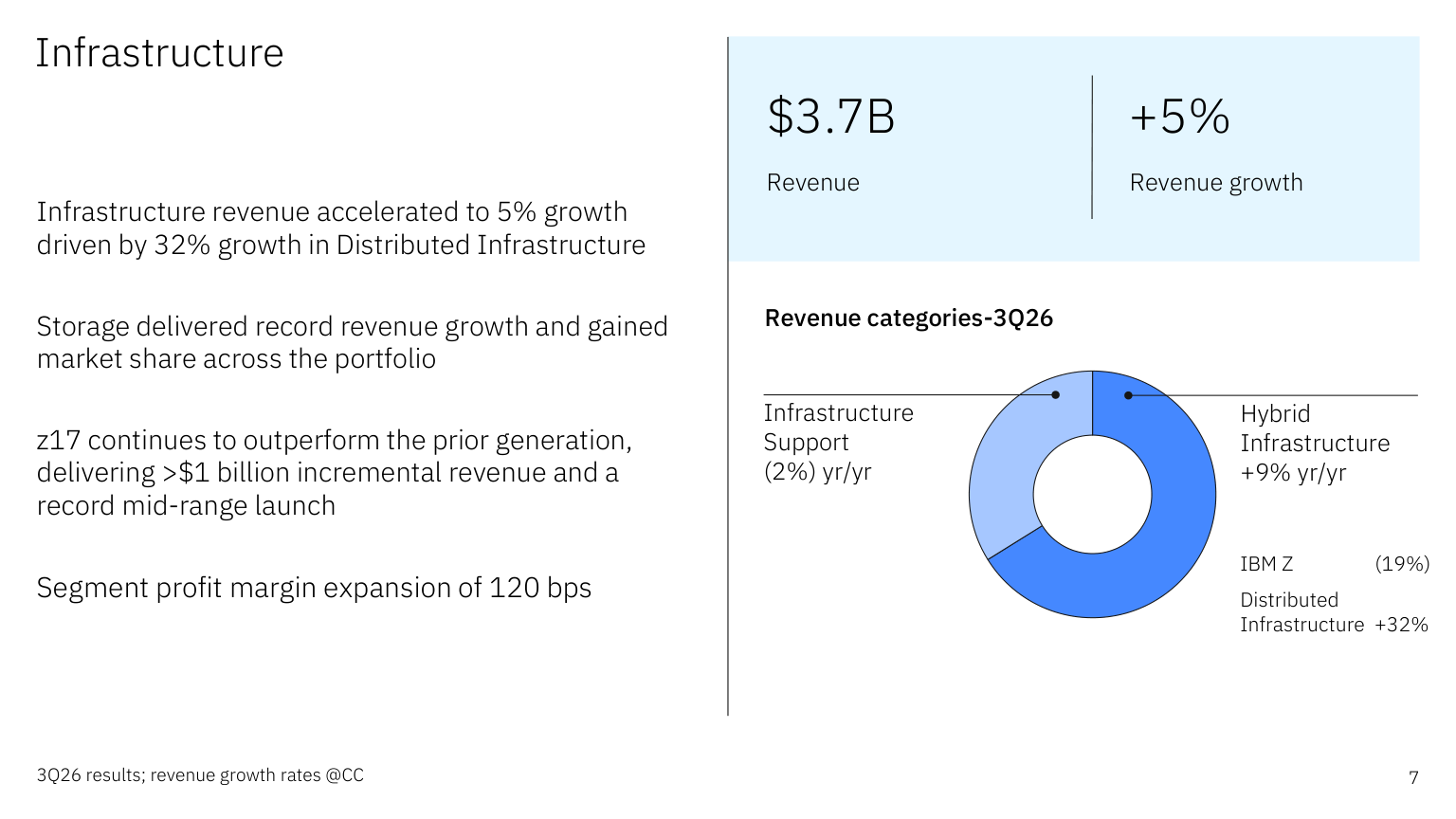
- Page 7 shows infrastructure revenue of $3.7 billion, up 5% at constant currency. Distributed Infrastructure (Power servers and storage) grew 32%, lifting Hybrid Infrastructure 9%, while IBM Z fell -19% and Infrastructure Support fell 2%. The slide says z17 has delivered more than $1 billion of incremental revenue over the prior generation and a record mid-range launch, and storage gained share with record revenue growth. The July 14 letter from chief executive Arvind Krishna had warned that "What played out was worse than our expectations, driven by a shortfall in our Z performance and the associated software stack, primarily in Transaction Processing."
- Page 9 keeps 2026 revenue growth at 4% to 5% and operating pre-tax margin expansion at 100 basis points, and raises the free cash flow growth target to more than $1 billion. The remarks put it this way: "We continue to expect revenue growth for 2026 in the range of four-to-five percent and are raising our expectation for free cash flow growth to more than $1 billion." The same page notes a finalized $1 billion CHIPS award from the Department of Commerce for a U.S. quantum foundry.
- Company disclosure (Q3 prepared remarks, full-year view): Software growth of about 7% to 8%, with about 7% as the base case; double-digit growth in Hybrid Cloud, mid-teens in Data, low single digits in Automation, and flat Transaction Processing after a raised view. Infrastructure revenue growth in the low single digits and an operating tax rate in the mid-teens.
- Own calculation (fourth-quarter math): If currency is neutral for the year, as IBM assumes, 4% to 5% growth implies fourth-quarter revenue of $20.05 billion to $20.73 billion, up 1.9% to 5.3% from $19.69 billion. The 4% base case implies 1.9%, and the analyst average of $20.47 billion (up 4.0%) sits in the upper half of the range.
- Page 14 lists $11.4 billion of acquisitions and $4.8 billion of dividends in the first nine months and shows debt outside IBM Financing rising from $46.2 billion at the end of 2025 to $51.2 billion. Page 18 shows operating expense up 2%, with acquisitions and divestitures adding five points and the base business down 1%; R&D rose 8% even excluding acquisitions, while SG&A fell 8% on the same basis.
The Bull and Bear Case for IBM Shares
- The bullish case starts with cash and recurring revenue. Nine-month free cash flow rose 8.5% to $7.79 billion, and the remarks say "Our free cash flow margin for the first nine months of the year is the highest in reported history." Red Hat grew 11% and ARR is $24.9 billion. The quarterly dividend of $1.69 yields 2.69%, and the release notes IBM has paid consecutive quarterly dividends every year since 1916.
- The bearish case looks at where growth comes from. Roughly half of software growth is acquired, consulting revenue rose only 0.2% with signings down 2%, last year's fourth quarter grew 12.2% (infrastructure 20.6%), and total debt reached $63.8 billion against $54.2 billion in the first quarter of 2022.
- Outside view (sell-side research aggregate, October 2026): Of 25 analysts, 9 rate the stock Strong Buy, 3 Buy, 11 Hold, 1 Sell, and 1 Strong Sell, with an average price target of $242.65. The average 2026 operating EPS estimate is $12.31 and the 2027 estimate is $13.15, 6.8% higher.
- That average target is 3.5% below the share price, and Hold is the most common rating. Third-quarter operating EPS of $2.95 beat the $2.87 average estimate by 2.8%.
From C-T-R in 1911 to Red Hat and Confluent
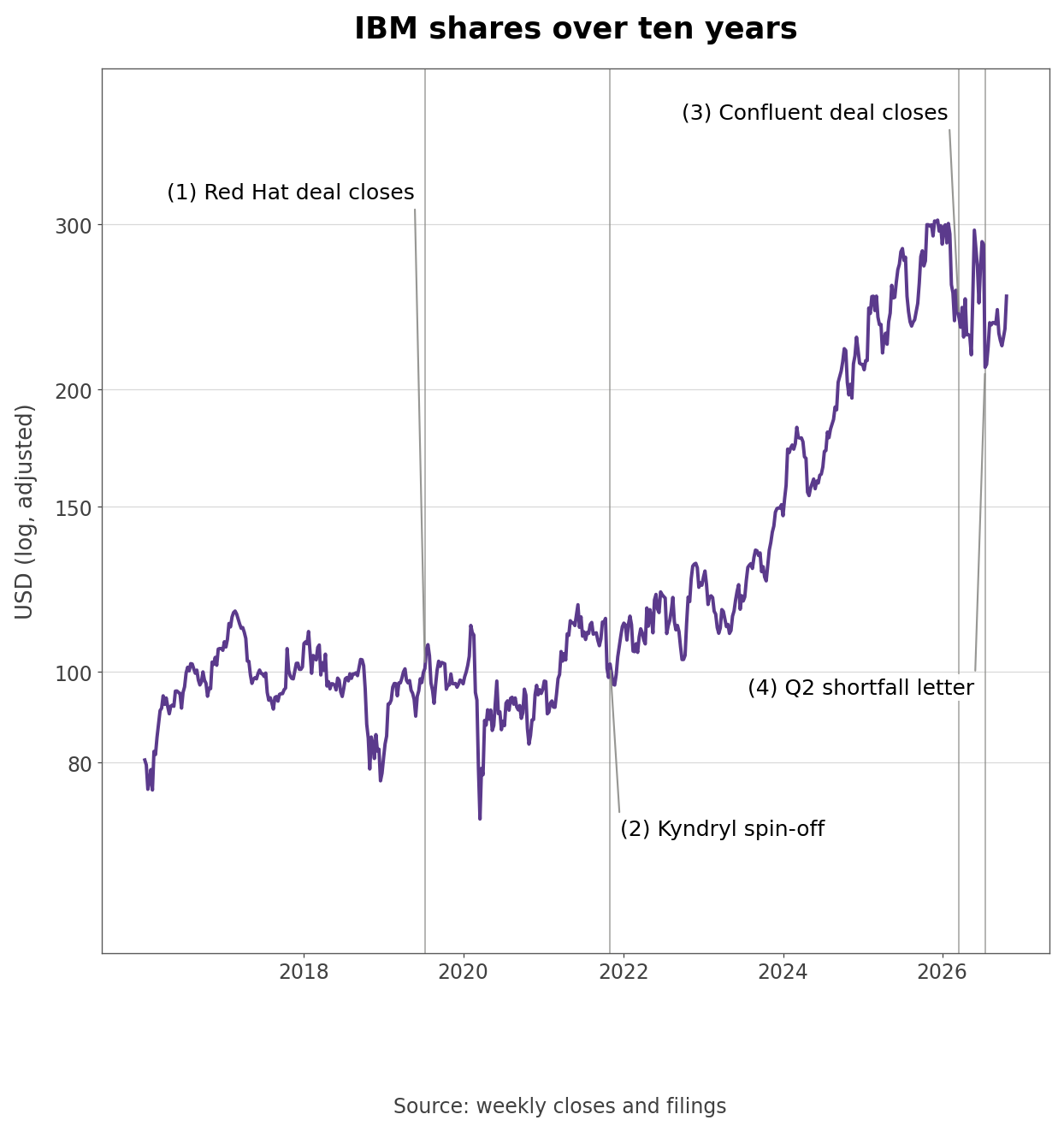
- IBM was incorporated in New York on June 16, 1911, as the Computing-Tabulating-Recording Co., a merger of three companies making scales, tabulators, and time recorders, and took its current name in 1924. On an adjusted basis the stock has gone from $80.55 in the first week of 2016 to $251.46, a multiple of 3.12.
- The modern IBM was shaped by two deals. On October 28, 2018, IBM agreed to buy Red Hat for $190.00 a share in cash and closed on July 9, 2019. On November 3, 2021, it spun off its managed infrastructure services business as Kyndryl, distributing 80.1% of Kyndryl to shareholders at one Kyndryl share for every five IBM shares, after which revenue was reorganized into software, consulting, and infrastructure.
- The shares gained +21.9% in 2023, +41.1% in 2024, and +40.5% in 2025. IBM bought HashiCorp in 2025 and Confluent on March 17, 2026, for $31 a share in cash and $11.60 billion in total consideration. The July 14 letter flagged second-quarter revenue up 1%, software up 5%, and infrastructure down 7%, and said "These conditions require our teams to execute perfectly, and this quarter we faltered." The stock has fallen 15.9% in 2026.
How Fast Is Software Growing Without Acquisitions?

- Software revenue rose from $5.14 billion in the first quarter of 2021 to $7.80 billion in the third quarter of 2026 and is now 45.6% of revenue. Year-over-year growth ran between 7% and 14% from late 2024 through the end of 2025, then 11.3%, 5.1%, and 8.3% in the first three quarters of 2026, with HashiCorp and then Confluent adding acquired revenue in turn.
- Infrastructure follows the mainframe cycle. It peaked at 19.0% growth in the second quarter of 2022 with z16 and at 20.6% in the fourth quarter of 2025 with z17, then fell -7.3% in the second quarter of 2026 as the launch effect faded. The third quarter recovered to 4.2% on Distributed Infrastructure, but IBM Z itself was still down 19% at constant currency.
- Segment margins moved apart. Software rose from 32.9% to 35.0% and infrastructure from 18.1% to 19.3%, while consulting fell from 12.9% to 12.2%, and the company credited the software gain to productivity.
How Much of the EPS Gain Came From a Lower Tax Rate?
- Operating pre-tax income rose 8.6% to $3.30 billion, while operating EPS rose 11.3% to $2.95. The gap is the tax rate, which fell from 17.0% to 14.7% on an operating basis.
- Own calculation (tax effect): Applying last year's 17.0% rate to this quarter's operating pre-tax income gives operating EPS of $2.87, up 8.3%. About 8 cents of the 30-cent increase came from the lower tax rate.
- GAAP EPS rose 25.5% to $2.31 because the prior-year GAAP figure carried a 33-cent tax charge. The fourth quarter of 2025 went the other way: its GAAP EPS of $5.86 included a $1.54 benefit from resolving tax audits, which lifts trailing GAAP EPS to $11.72, close to operating EPS of $12.31.
Free Cash Flow Against Dividends and Deals
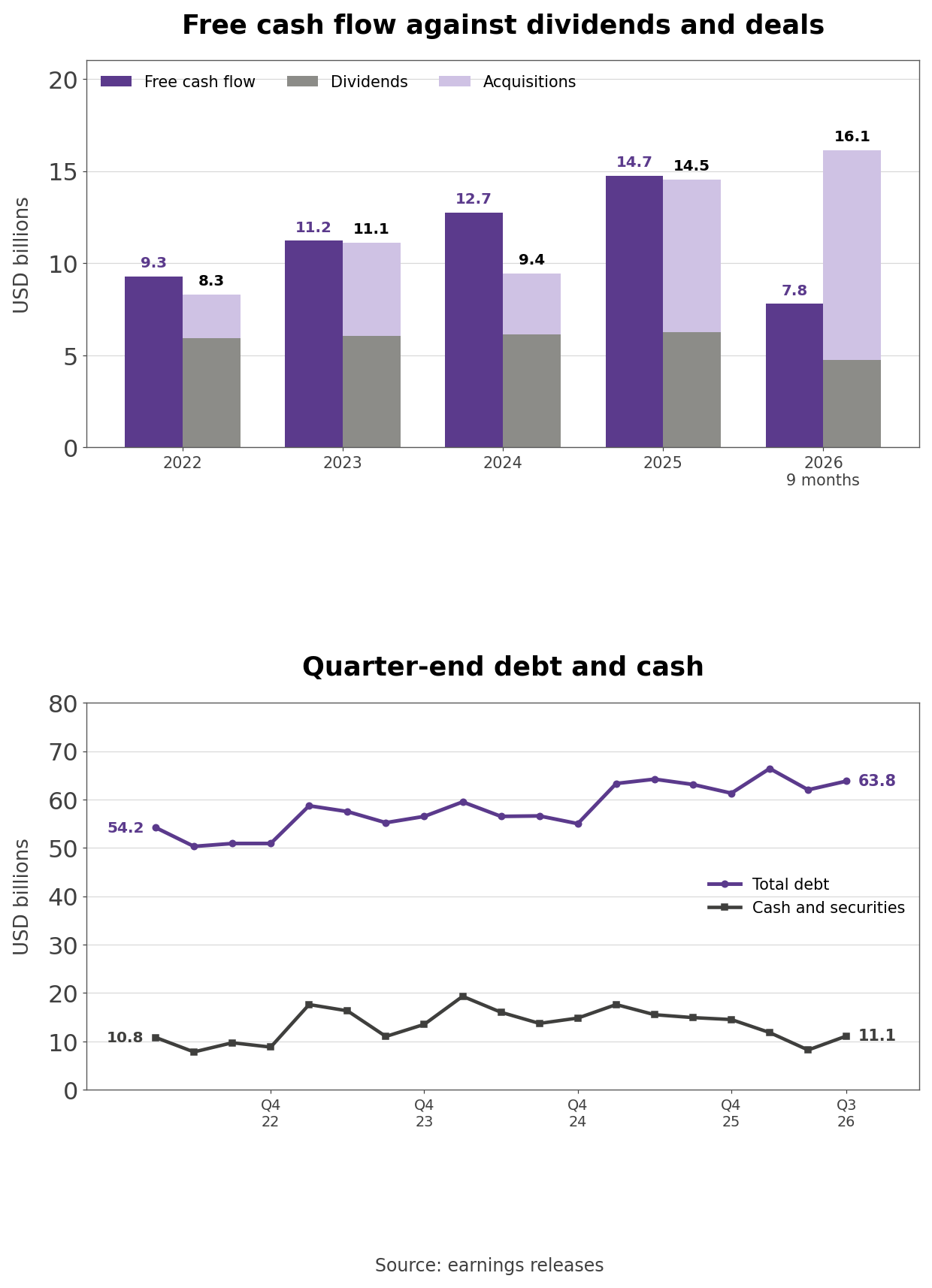
- Free cash flow climbed from $9.29 billion in 2022 to $14.73 billion in 2025. Dividends edged up from $5.95 billion to $6.25 billion, while acquisitions rose to $5.08 billion in 2023, $8.29 billion in 2025, and $11.36 billion in the first nine months of 2026. In 2026 so far, dividends absorbed 61.2% of free cash flow and acquisitions exceeded free cash flow outright.
- Own calculation (cash uses since 2022): From 2022 through the third quarter of 2026, IBM generated $55.77 billion of free cash flow, paid $29.15 billion in dividends, and spent $30.38 billion on acquisitions, so dividends plus deals exceeded free cash flow by $3.76 billion. Total debt rose from $54.2 billion to $63.8 billion while cash and securities stayed near $11 billion.
- The third-quarter 10-Q allocates $7.25 billion of the $11.60 billion Confluent price to goodwill and $3.83 billion to client relationships, technology, and trademarks. Goodwill rose from $67.72 billion at the end of 2025 to $74.92 billion, 2.11 times stockholders' equity of $35.54 billion. To lift free cash flow by more than $1 billion for the year, IBM needs at least $7.95 billion in the fourth quarter, 5.2% more than a year ago.
How IBM Makes Money Across Three Segments
- Revenue of $67.54 billion in 2025 grew 7.6%: software 10.6%, infrastructure 12.1%, and consulting 1.8%. Software was 44.4% of the total, consulting 31.2%, infrastructure 23.3%, and financing 1.1%. In the third quarter the Americas brought in $8.6 billion (up 5% at constant currency), Europe, the Middle East and Africa $5.4 billion (up 4%), and Asia Pacific $3.1 billion (up 10%). Revenue clusters at year end: the fourth quarter of 2025 was 29.1% of annual revenue and 30.1% of annual software revenue.
- Software has four parts. Hybrid Cloud covers RHEL, OpenShift, Ansible, and Red Hat AI; Automation covers HashiCorp, Apptio, security, observability, and IT financial management; Data covers AI assistants and agents, databases, data integration, and Confluent; and Transaction Processing covers CICS and storage and security software for the mainframe. In the third quarter Hybrid Cloud and Transaction Processing brought in $2.1 billion each, Automation $1.9 billion, and Data $1.7 billion. Management describes ARR of $24.9 billion as the high-value recurring core, with OpenShift at $2.4 billion of it.
- The mainframe anchors that model. On the call, management said mainframes handle 70% of industry transactions by value and run core systems at 45 of the top 50 banks, and the remarks say clients representing about 85% of installed MIPS capacity are maintaining or growing it. The finance chief said each dollar that lands on the mainframe brings three to five dollars of software.
- Consulting splits into Strategy and Technology ($3.0 billion) and Intelligent Operations ($2.4 billion), and works alongside partners including Adobe, AWS, Microsoft, Oracle, Palo Alto Networks, Salesforce, and SAP; generative AI is part of 35% of its backlog. Infrastructure covers IBM Z, Distributed Infrastructure (Power, storage, IBM Cloud), and maintenance. IBM Financing lends to clients buying IBM products and carries $12.7 billion of the $63.8 billion of debt.
Four Peers From Consulting to Infrastructure
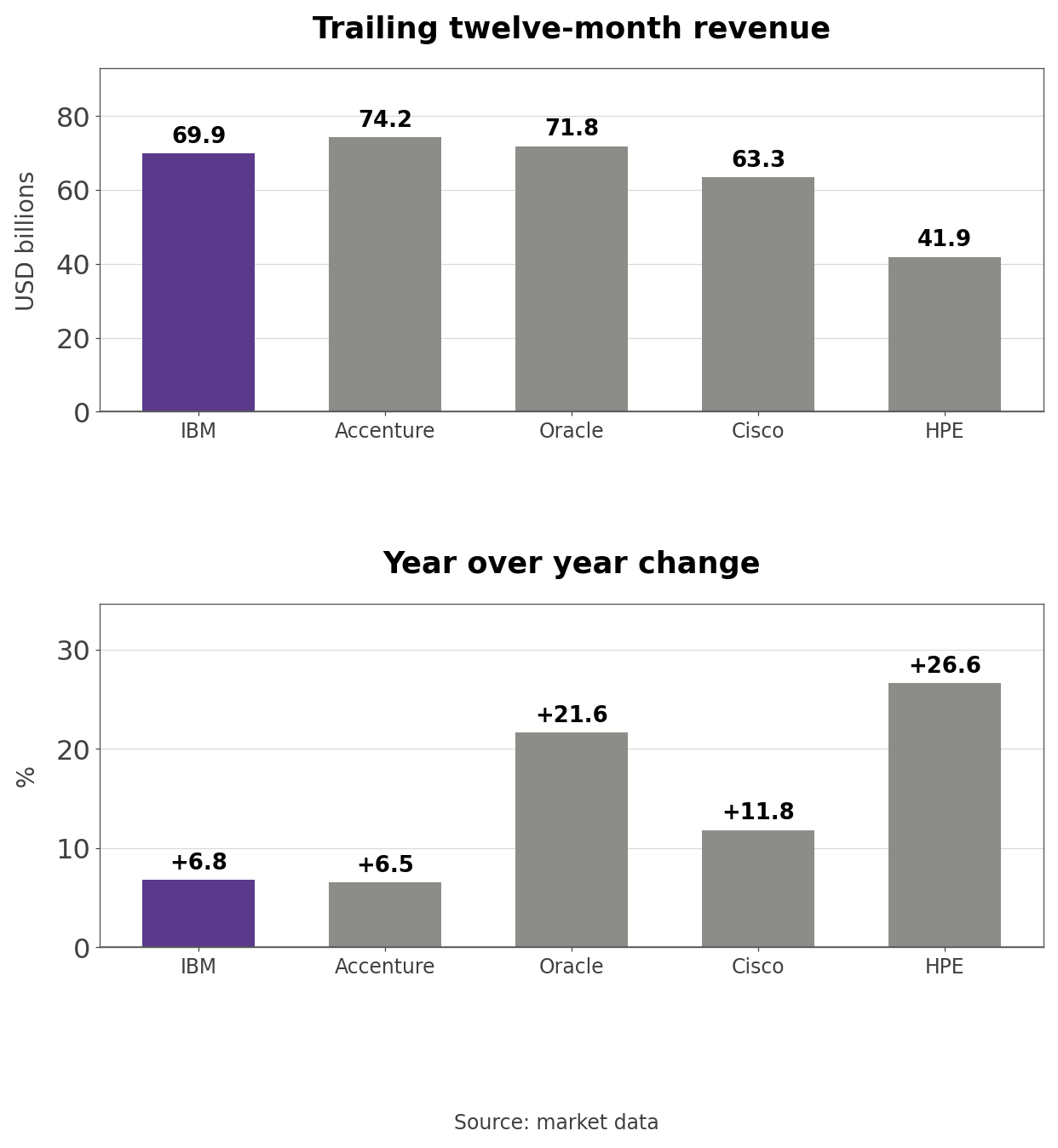
- Trailing twelve-month revenue was $74.2 billion at Accenture, $71.8 billion at Oracle, $69.9 billion at IBM, $63.3 billion at Cisco, and $41.9 billion at HPE. Growth was 26.6% at HPE, 21.6% at Oracle, 11.8% at Cisco, +6.8% at IBM, and 6.5% at Accenture, which puts IBM next to the consulting peer.
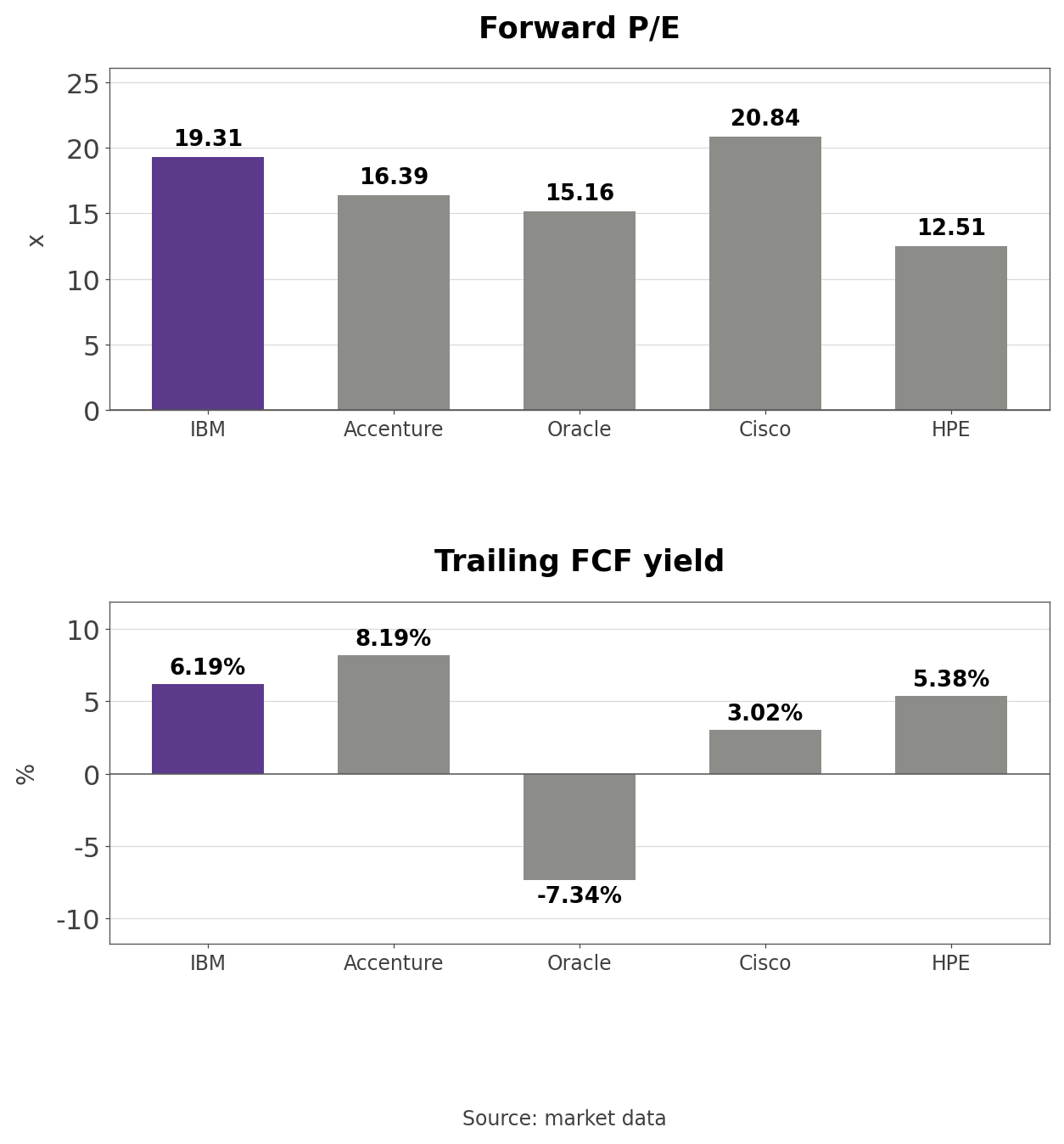
- Forward P/E is 20.84 for Cisco, 19.31 for IBM, 16.39 for Accenture, 15.16 for Oracle, and 12.51 for HPE, while trailing FCF yield is 8.19% at Accenture, 6.19% at IBM, 5.38% at HPE, and 3.02% at Cisco, with Oracle at -7.34%. Dividend yield is 2.85% at Accenture and 2.69% at IBM. Over one year HPE gained 138.2% and Cisco 46.7%, while IBM fell -18.2% and Oracle 50.8%.
- This piece pairs forward P/E with FCF yield because a mature company growing in single digits earns its multiple through the cash it returns. Accenture competes in consulting, Oracle in databases and cloud while also partnering with IBM Consulting, and Cisco and HPE in servers, storage, and networking.
- Own calculation (FCF yield): IBM's own trailing free cash flow of $15.34 billion is 6.45% of its market value, close to the aggregator's 6.19%. On the aggregator basis IBM yields 2.0 points less than Accenture yet trades at 19.31 times forward earnings against Accenture's 16.39.
P/E on Operating EPS Over 58 Months
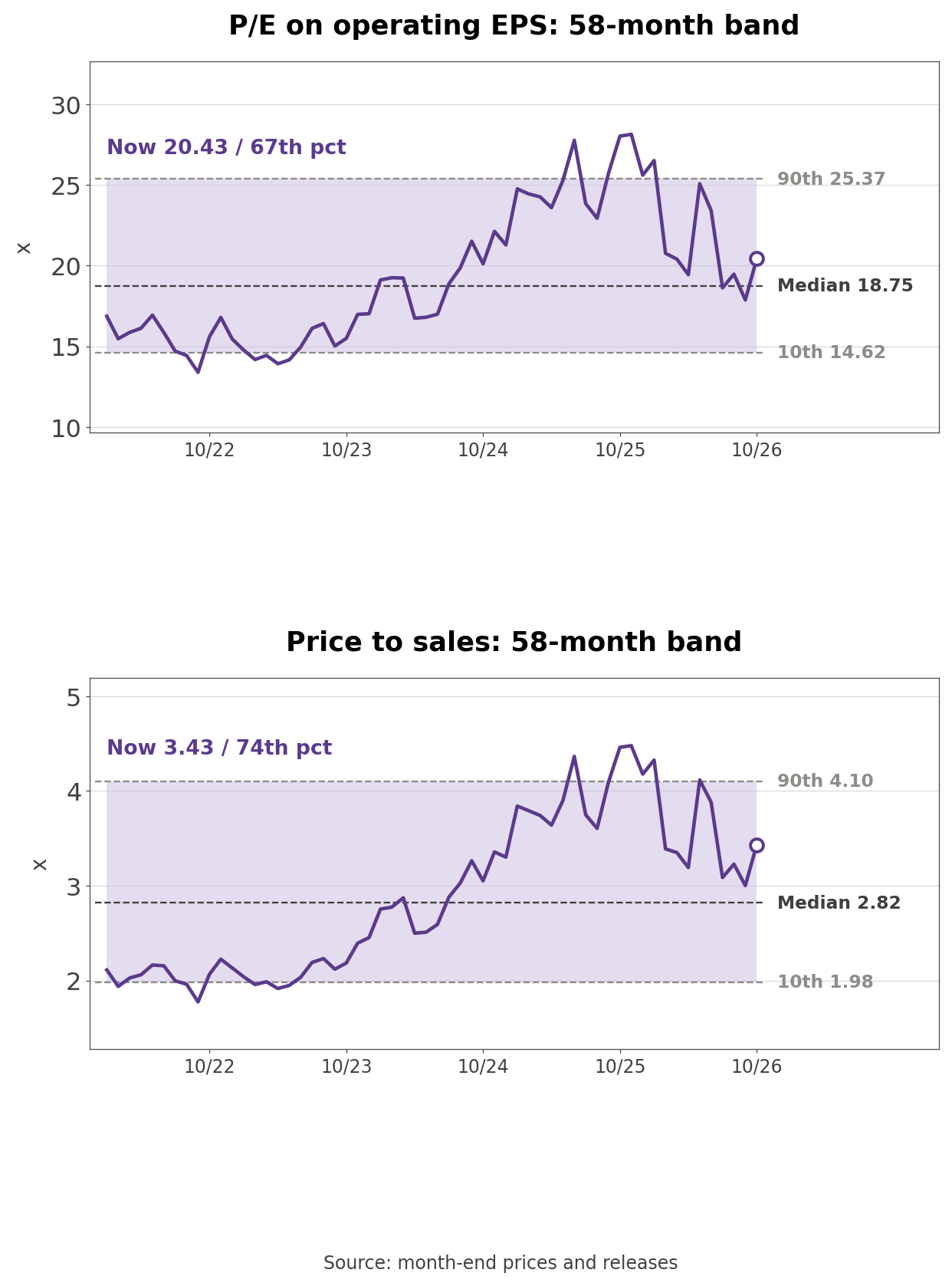
- On trailing operating EPS of $12.31, IBM trades at 20.43 times, the 67th percentile of the 58 months since January 2022, against a median of 18.75. The low was 13.39 times in September 2022 and the high 28.13 times in November 2025. Price to sales is 3.43, at the 74th percentile, against a median of 2.82.
- The band uses weighted diluted shares, 953.5 million in the third quarter, as EPS does. On the 2027 estimate of $13.15 the stock trades at 19.12 times, and on trailing GAAP EPS of $11.72 at 21.46 times. The 28 times reached in late 2025 was paid on operating EPS lower than today's.
Three Conditions That Move the Stock
- Organic software growth was a little over four points in the third quarter, and the chief executive said on the call he is confident Red Hat will grow double digits in the fourth quarter. If software still grows around 7% after Confluent's anniversary in 2027, organic strength is confirmed; if it settles near 4%, the case for a forward multiple above 19 weakens.
- Fourth-quarter revenue growth implied by the outlook is 1.9% to 5.3%, against a quarter last year when z17 lifted infrastructure 20.6%. Beating the 4.0% consensus on the Distributed Infrastructure backlog and a steadier Transaction Processing would put the top of the 4% to 5% range in reach; landing near the 1.9% base case would make the software acceleration a one-quarter event.
- Free cash flow of at least $7.95 billion in the fourth quarter is needed to meet the raised target. If cash covers a dividend of about $6.3 billion a year plus quantum and deal spending, debt stops rising; another large debt-funded acquisition would push goodwill further past twice equity.
The 2027 Outlook and Confluent Synergies
- The fourth-quarter report in late January will show revenue growth, fourth-quarter free cash flow, and the first 2027 outlook. On the call, the finance chief described 2026 as the year of integrating Confluent and 2027 as the year of growth synergies, and said IBM is planning its investment and capital structure strategy through 2027.
- One question this piece cannot settle: once Confluent's revenue becomes organic in the second quarter of 2027, can IBM software keep growing around 7% on its own, or will the next acquisition have to fill the gap again?
Related Analysis
- Oracle (ORCL) Stock Analysis: Cash Flow and Capex Gap: a peer in databases and cloud whose spending outran free cash flow, useful for comparing how two mature software companies fund growth.
- Adobe (ADBE) Stock Analysis: Valuation After the CEO Change: another large software company priced on recurring revenue, a frame for IBM's ARR of $24.9 billion and its 19 times forward multiple.
- CrowdStrike (CRWD) Stock Analysis: GAAP vs Non-GAAP Results: a case study in adjustments, helpful for reading IBM's operating EPS next to acquisition amortization and tax items.
#IBM #IBMStock #RedHat #Mainframe #SoftwareStocks #Dividends #USStocks #StockAnalysis #EquityResearch #GlobalStockBrief
'US Stock Analysis' 카테고리의 다른 글
| GE Aerospace (GE) Stock: Allowances Behind the Cash Flow (0) | 2026.10.24 |
|---|---|
| Schlumberger (SLB) Stock: Organic Sales Fall and a $4.1B Bet (0) | 2026.10.23 |
| Meta (META) Stock: Negative FCF Meets Non-Voting Class C (0) | 2026.10.23 |
| Tesla (TSLA) Stock: 62% of Q3 Operating Income Was a Refund (0) | 2026.10.22 |
| Raytheon (RTX) Stock: EPS Growth Is 18% Without the Refund (0) | 2026.10.22 |


