Tempus AI, Inc. (NASDAQ: TEM) narrowed its third-quarter GAAP net loss to $14.9 million from $80.0 million a year earlier, and the CEO and CFO wrote in their shareholder letter that “This quarter we made the turn.” Of the $65.1 million improvement, $42.7 million came from marking up equity stakes the company holds, mostly in Personalis, the diagnostics company Tempus has agreed to buy. Operating loss improved by $4.1 million. The quarter still contains real progress in testing volume and third-party data revenue, but the profit line owes most of its change to two companies that sit very close to Tempus.
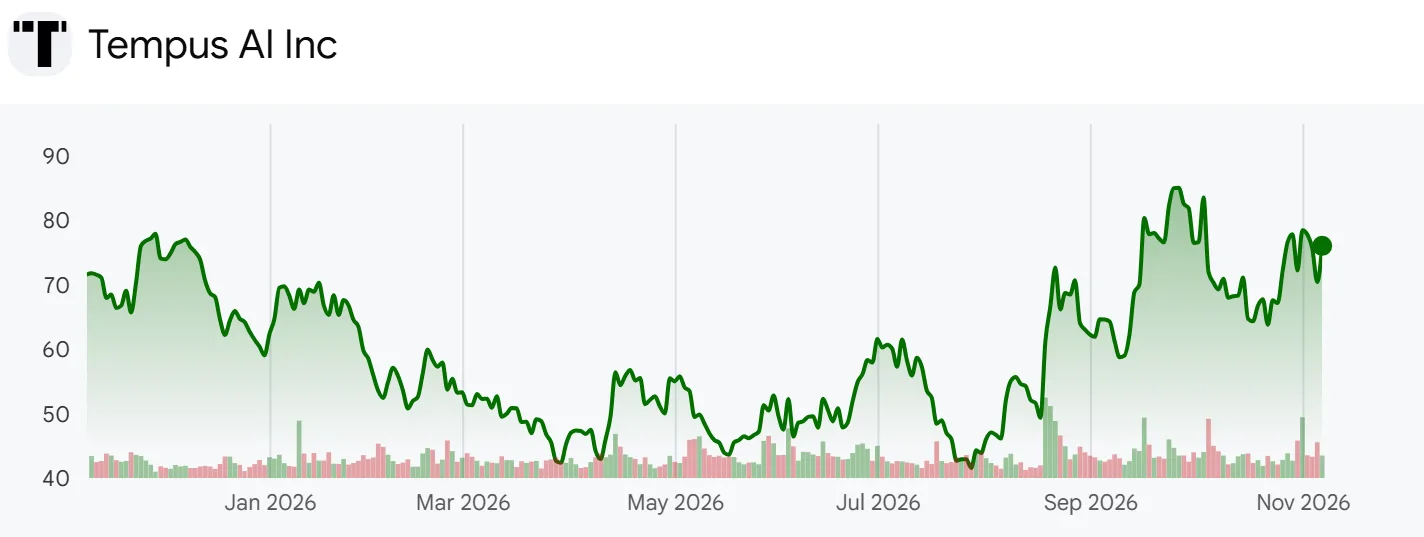
Tempus AI one-year share price chart ending near 76 dollars
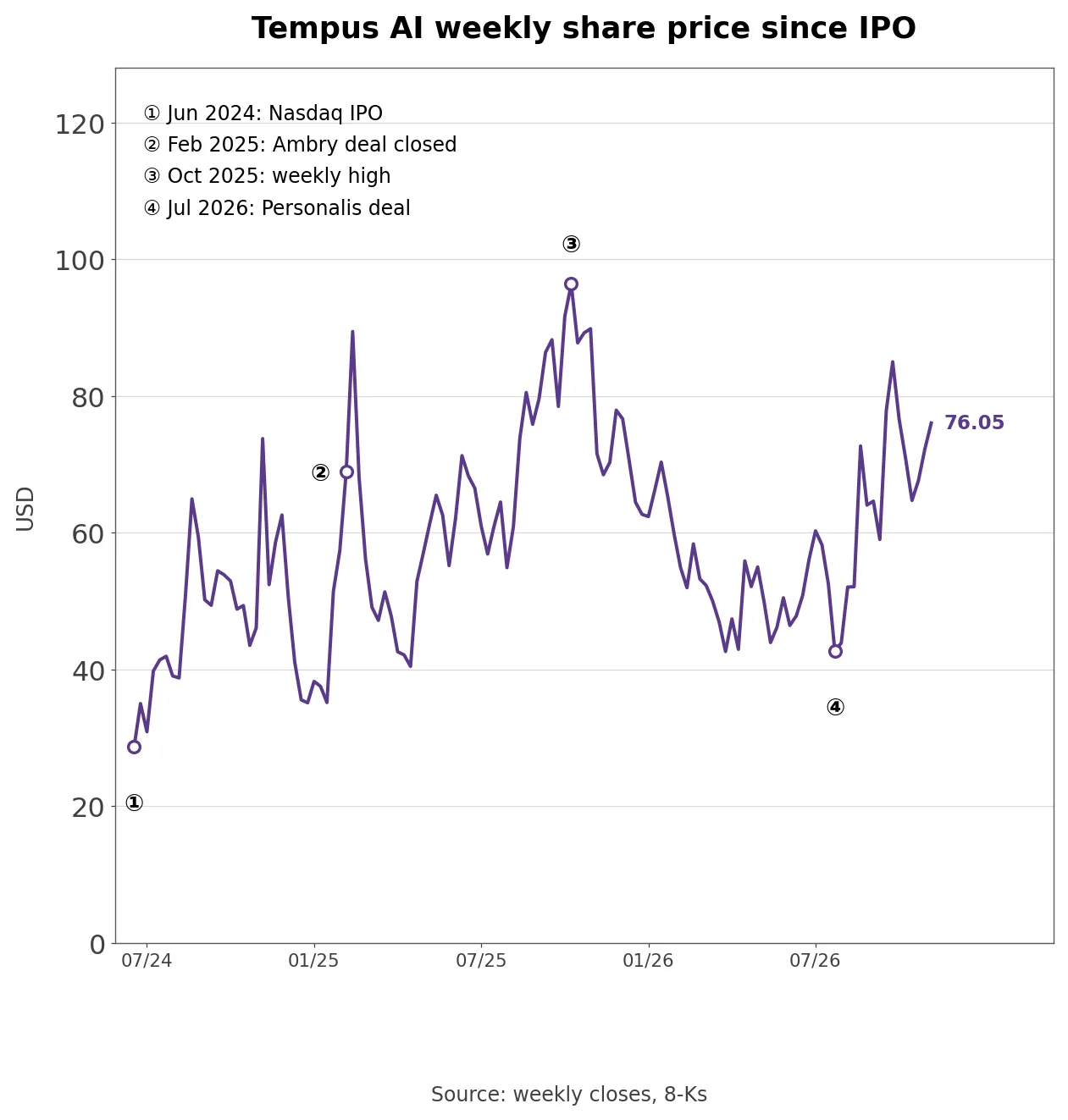
Tempus sells genomic tests to oncologists and licenses the de-identified clinical and molecular data those tests generate to drug companies. Eric Lefkofsky founded it in Chicago in August 2015, and it listed on Nasdaq in June 2024. Revenue comes from two lines: Diagnostics, which runs oncology, hereditary cancer and MRD tests, and Data and Applications, which licenses data, supports clinical trials and sells software. At $76.05 a share and 182.4 million Class A and Class B shares on the latest 10-Q cover, the market value is about $13.9 billion.
I compared the Q3 2026 10-Q, the earnings release, the 24-page Q3 presentation, the 14-page CEO and CFO letter and the November 2 call with all 10 earnings releases and all 10 quarterly and annual reports since the IPO. Related-party revenue comes from footnotes, so the Q4 2025 figure is full-year minus nine months, and the valuation band starts in March 2025 because the Ambry acquisition changed the equity base.
MRD Volume and the Path to Higher Test Prices
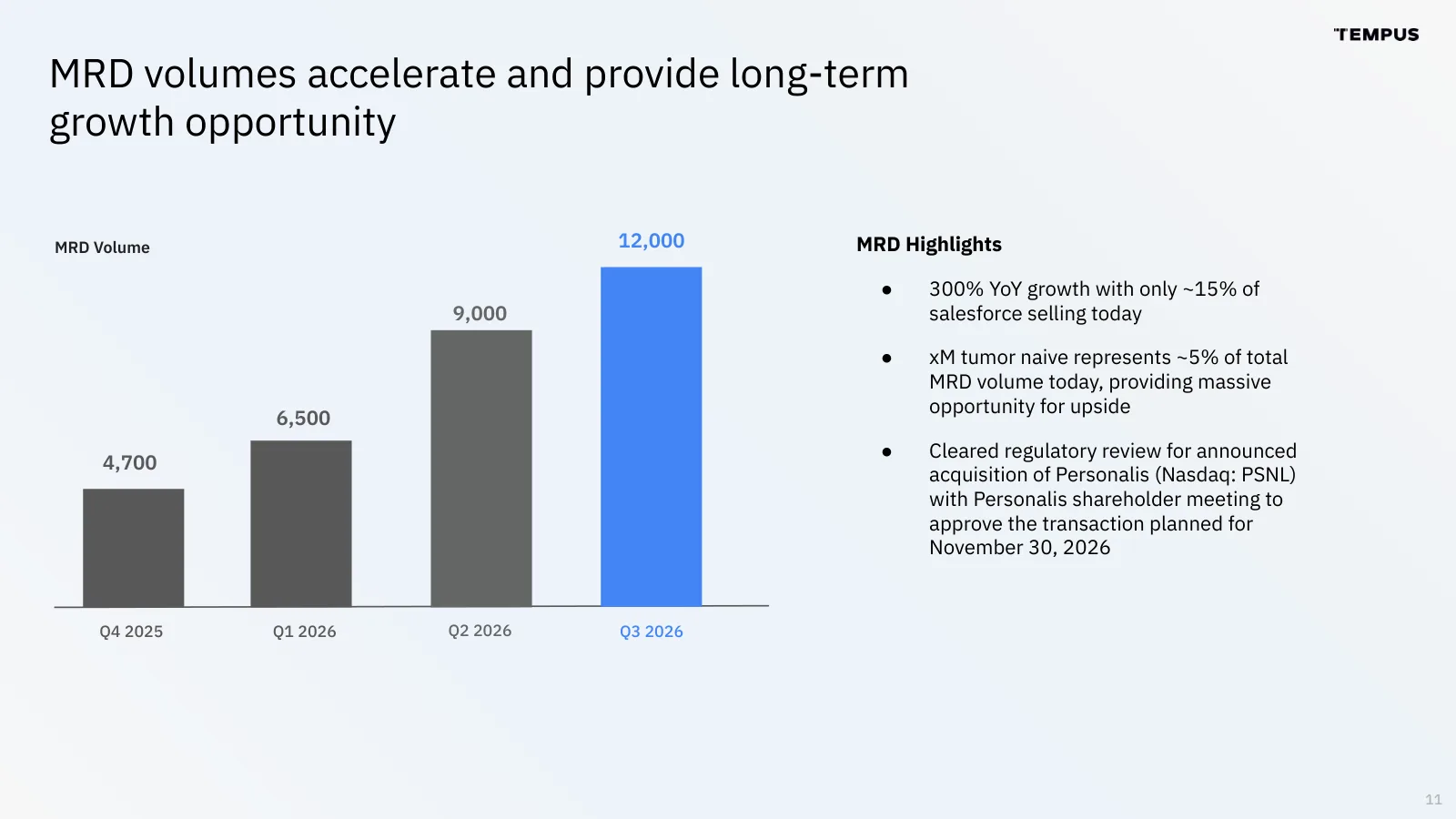
Q3 2026 presentation page 11 with MRD volume rising to about 12000 tests
Page 11 of the presentation plots MRD (minimal residual disease, a blood test that looks for cancer left behind after treatment) volume at 4,700 tests in Q4 2025, 6,500 in Q1 2026, 9,000 in Q2 and 12,000 in Q3. The slide calls that +300% growth “with only ~15% of salesforce selling today” and notes that xM, the tumor-naive test Tempus built itself, is about 5% of MRD volume. Most of the volume is NeXT, a tumor-informed assay that Personalis makes and Tempus has distributed exclusively since 2023.
The steep bars come with a cost. Lefkofsky said on the call that Personalis loses money every time it runs these tests and that Tempus will too once it owns them. He expects more coverage decisions, colorectal cancer in particular, to make the test gross-profit positive per unit around mid-2027. The letter adds that oncology average reimbursement slipped to about $1,700 in Q3 as MRD volume grew, while the price excluding MRD rose from $1,850 in Q2 to $1,880.
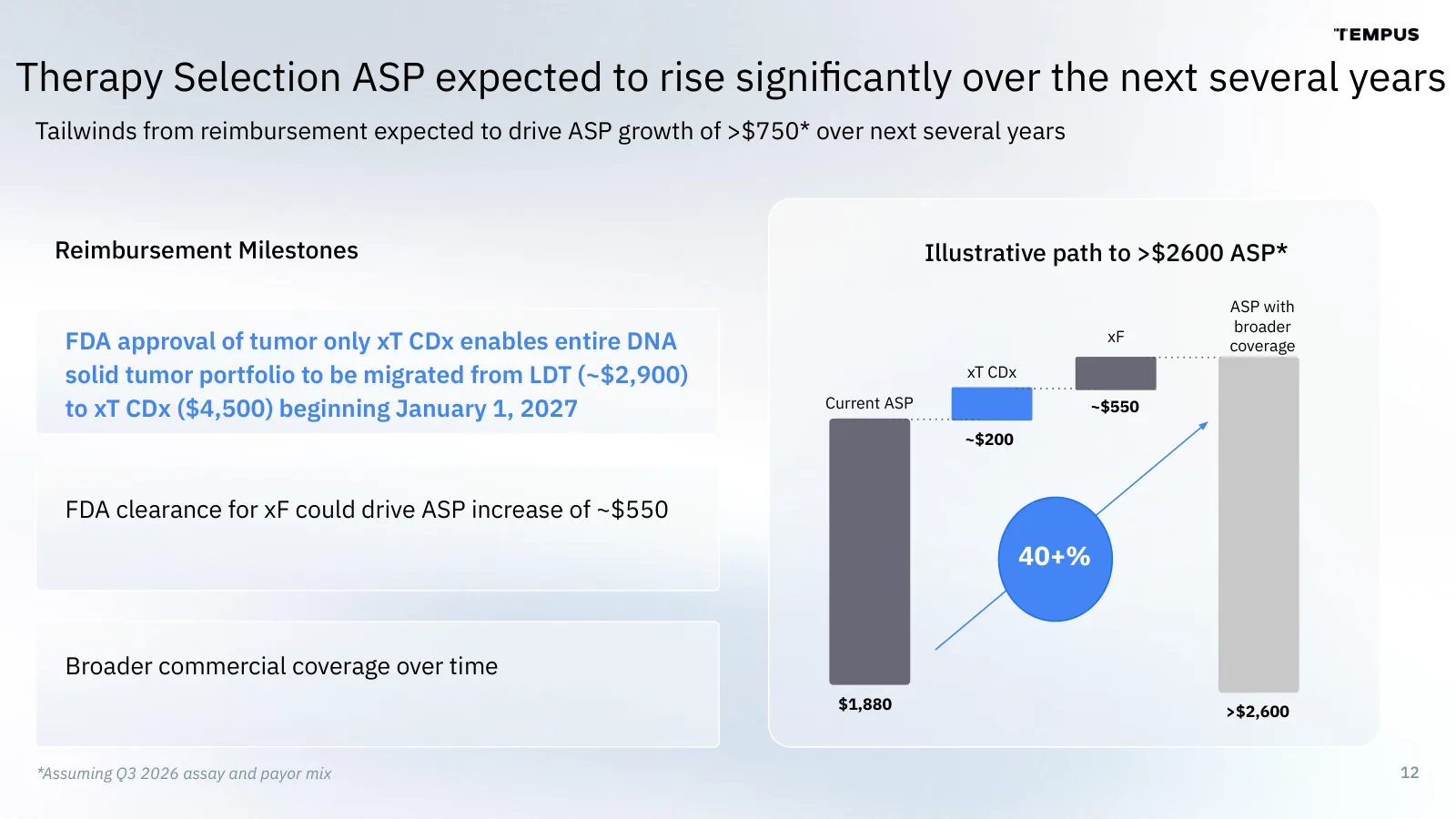
Q3 2026 presentation page 12 with the path from a 1880 dollar ASP to above 2600 dollars
Page 12 stacks the path from that $1,880 to more than $2,600, a rise of over 40% in the average price of therapy-selection tests. Starting January 1, 2027, the whole solid tumor DNA portfolio moves from a lab-developed test priced at about $2,900 to the FDA-approved xT CDx at $4,500, worth about $200 on the blended average. FDA clearance for the liquid biopsy xF would add about $550, and broader commercial coverage the rest. The letter puts the xT shift alone at about $80 million of ASP benefit in 2027. A footnote on the slide says the path assumes the Q3 assay and payor mix, and xF is still under FDA review.
Own calculation (Q3 presentation page 12 and letter): A $1,600 rise per converted test that adds only about $200 to the blended average implies the conversion covers roughly one-eighth of therapy-selection volume. Dividing $80 million by $200 gives 400,000 tests a year. Q3 oncology volume of about 101,500 minus 12,000 MRD tests leaves 89,500, or about 358,000 a year, so the $80 million figure needs therapy-selection volume to grow by a little over 10% in 2027.
Data Licensing Bookings and the Fourth-Quarter Guide
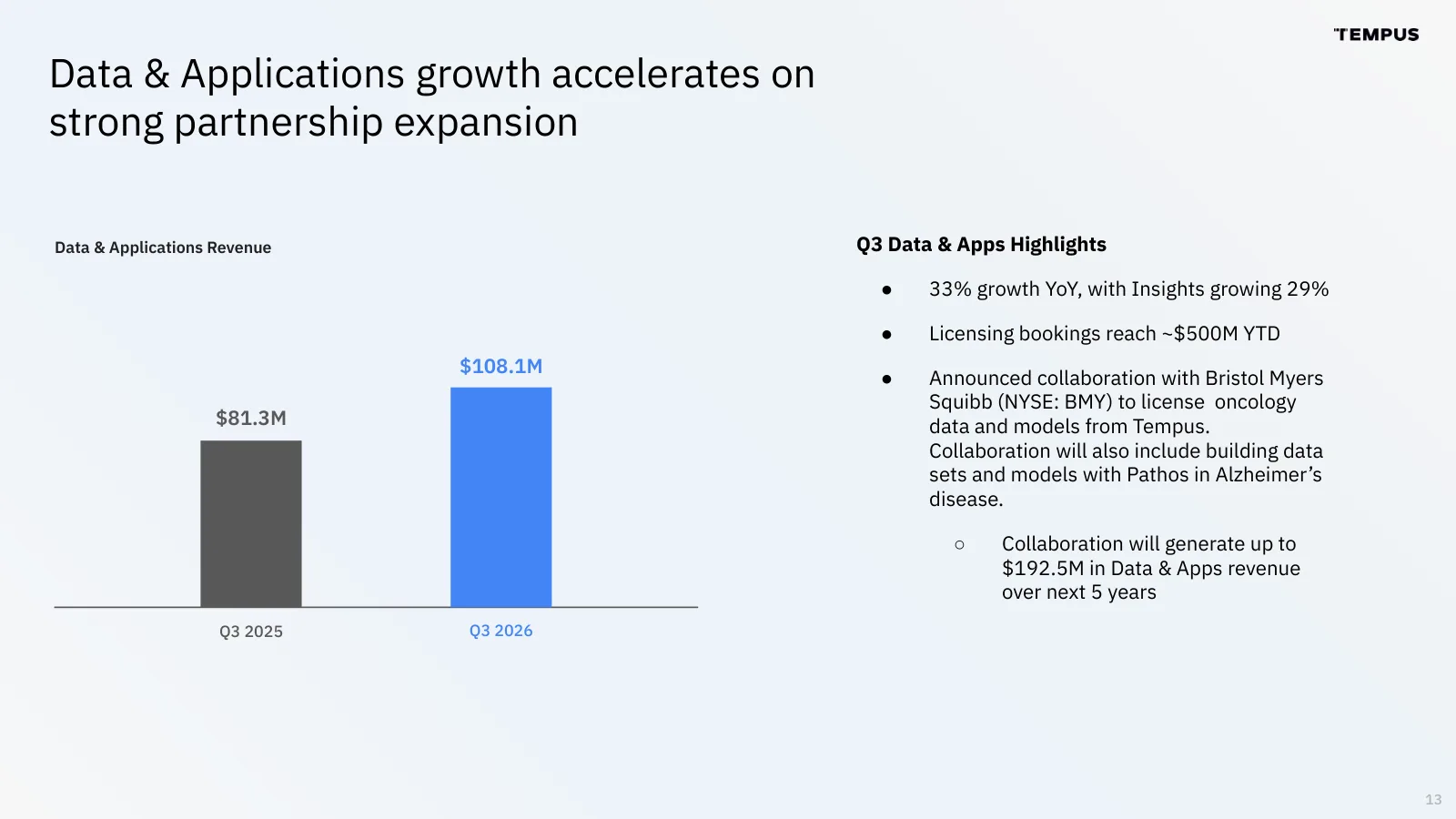
Q3 2026 presentation page 13 with data and applications revenue of 108.1 million dollars
Page 13 shows Data and Applications revenue rising from $81.3 million to $108.1 million, +33%, with Insights, the data licensing and modeling business, up +29%. The highlights box reads “Licensing bookings reach ~$500M YTD” and says the Bristol Myers Squibb collaboration will generate up to $192.5 million over five years.
The letter and the release, published the same day, describe the same bookings differently: “we now have >$550 million in data licensing bookings this year.” The gap of about $50 million is close to the $55 million cap on the neurology data agreement Tempus signed with Pathos AI on October 22. The $192.5 million is also a sum of two contracts: $137.5 million of fixed payments from BMS for oncology data and up to $55 million from Pathos. The 10-Q subsequent events note shows the Pathos contract pays $100 per delivered patient record, which is why “up to” is attached.
Q3 2026 presentation page 15 with 2026 revenue and adjusted EBITDA guidance
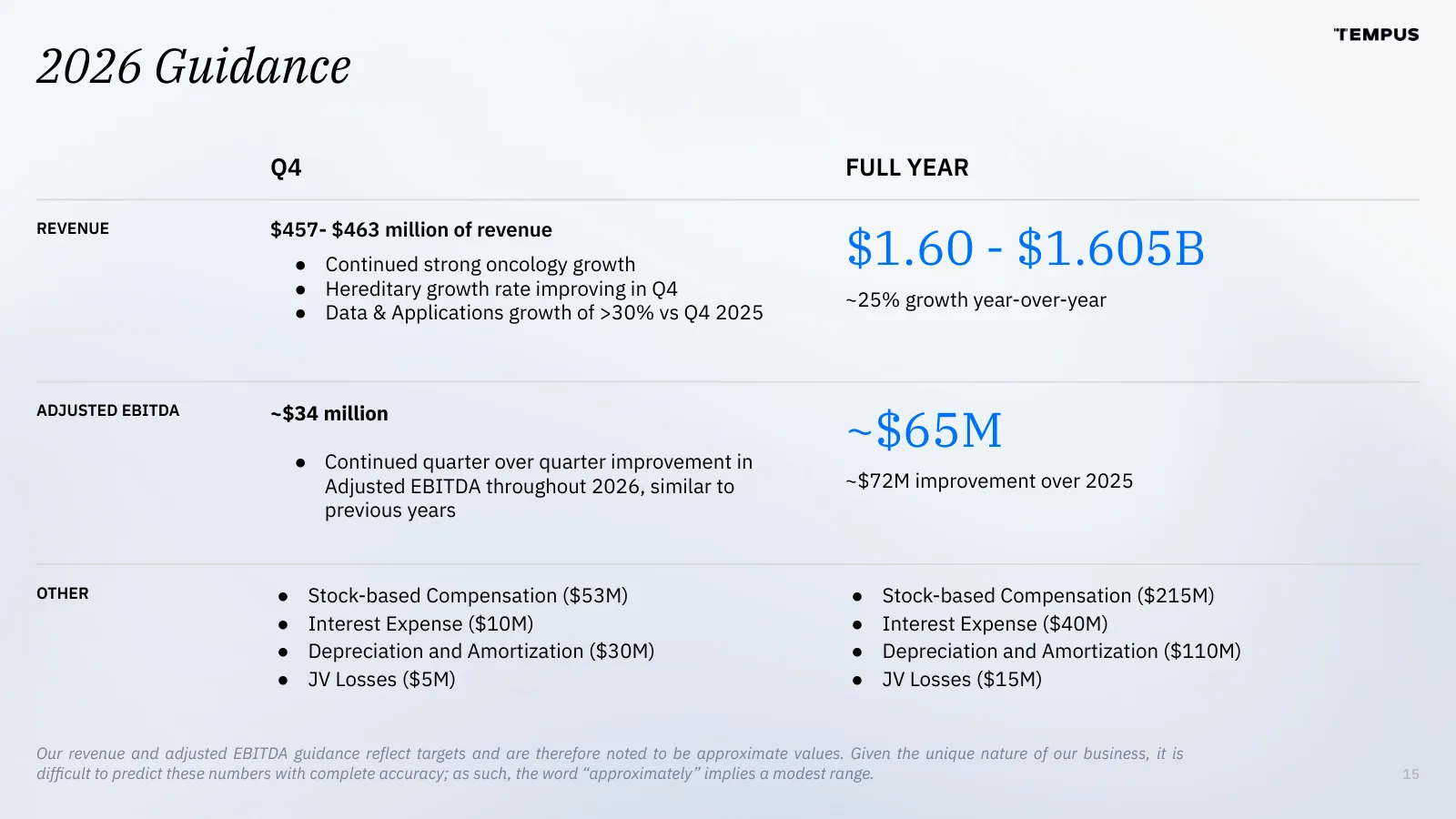
Page 15 raises full-year revenue guidance to $1.60 billion to $1.605 billion, about 25% growth, and sets fourth-quarter revenue at $457 million to $463 million. Adjusted EBITDA guidance stays at about $65 million for the year and about $34 million for the fourth quarter. The “Other” column lists full-year stock-based compensation of about $215 million, interest expense of $40 million, depreciation and amortization of $110 million and joint venture losses of $15 million.
Own calculation (Q3 release and presentation page 15): Nine-month revenue of $1,142.1 million implies fourth-quarter revenue of $457.9 million to $462.9 million, the same as the slide, and growth of +24.5% to +26.1% against $367.2 million in Q4 2025. Nine-month adjusted EBITDA of $30.8 million implies $34.2 million in the fourth quarter, a 7.4% margin. If Data and Applications grows the guided 30% from $100.4 million, it reaches $130.5 million, leaving $326.5 million to $332.5 million for Diagnostics, up 22.4% to 24.6% from $266.9 million.
Page 15 also promises “Continued quarter over quarter improvement in Adjusted EBITDA throughout 2026, similar to previous years.” The releases show that the improvement resets each January. Adjusted EBITDA went from -$7.8 million in Q4 2024 to -$16.2 million in Q1 2025, and from $12.9 million in Q4 2025 to -$2.8 million in Q1 2026. Whether that seasonal drop repeats after a $34 million fourth quarter is the first thing 2027 will test.
The Bull and Bear Case for Tempus AI Stock
The bull case is that volume and price are rising together. Oncology test volume grew +32%, the fastest in years, and the 2027 price increase for solid tumor tests is already set. Data and Applications revenue grew +33%, and adjusted EBITDA has been positive for two straight quarters.
The bear case is the distance between the adjusted figures and GAAP. Third-quarter GAAP operating loss was $56.9 million, only $4.1 million better than a year earlier, and of the $71.3 million gap between that loss and non-GAAP operating income of $14.4 million, $50.8 million is stock-based compensation and related payroll tax. Annual stock-based pay is more than three times guided adjusted EBITDA, a fifth of data revenue comes from a related party, and a loss-making MRD business arrives with Personalis in December. TD Cowen analyst Daniel Brennan said on the call that consensus has the adjusted EBITDA margin at 7% in 2027 and 11% in 2028.
From a 2015 Startup to the Personalis Deal
Tempus AI weekly share price since the June 2024 IPO with four dates
Tempus was incorporated as Bioin, LLC in August 2015. It grew by selling tumor sequencing and stitching test results to hospital records, and the letter now counts connections to about 8,000 providers and more than 600 petabytes of data. The June 2024 IPO raised $382.0 million.
The company changed shape in 2025. Closing the Ambry Genetics acquisition in February added a large hereditary cancer testing business, and Diagnostics revenue growth jumped to +115.3% in Q2 2025. In April, Tempus signed the foundation model agreements with AstraZeneca and Pathos that first put a large number on its data business. The weekly share price climbed from $28.64 in the first week after listing to $96.39 in October 2025.
In 2026 the balance sheet and the business moved again. In May, Tempus sold $460 million of 0% convertible notes due 2032 and used part of the money to repay $317.9 million of term loan and revolver borrowings. In July it agreed to buy Personalis for $16.25 a share, an enterprise value of $1.5 billion. The stock is 2.66 times its first-week level and -21.1% below the October 2025 high.
Where the Q3 Net Loss Improvement Came From
Bridge of the Q3 net loss improvement and share of added gross profit kept as adjusted EBITDA
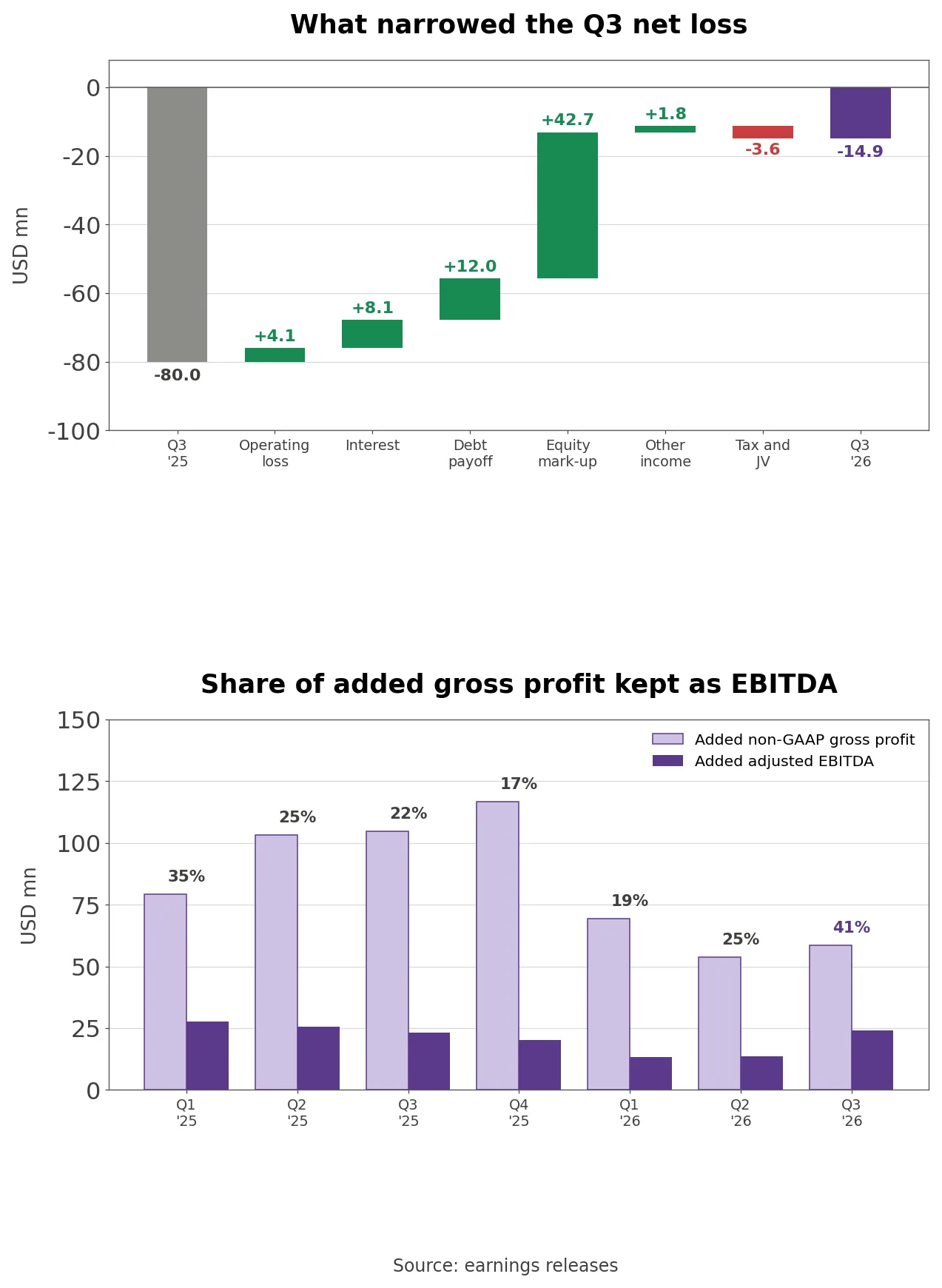
Of the $65.1 million improvement in third-quarter net loss, $42.7 million (65.6%) came from fair value changes on equity stakes and $4.1 million (6.3%) from a smaller operating loss.
Own calculation (Q3 release income statement and reconciliations): A year ago the quarter carried a $12.0 million loss on debt extinguishment, which did not recur, and interest expense fell from $15.4 million to $6.7 million, so net interest improved by $8.1 million. Fair value changes moved from a $1.3 million loss to a $41.5 million gain. Those two sources explain 84.0% of the improvement.
At the operating level, gross profit rose $56.8 million and operating expenses rose $52.6 million. Selling, general and administrative expense grew from $187.9 million to $231.9 million, +23.4%, and stock-based compensation inside that line rose from $22.7 million to $30.4 million. Almost all the added gross profit went into higher costs.
Excluding the fair value gain, the Q3 net loss was $56.3 million, against $78.7 million a year earlier. Over nine months, fair value gains reached $107.8 million, and the nine-month net loss of $135.1 million becomes $242.9 million without them. The letter says the $42.8 million unrealized gain in Q3 was “a majority of which is associated with our ownership stakes in Personalis.”
Did the One-Third Rule Hold in 2026?
Rogers said on the call that Tempus reinvests roughly two-thirds of each new dollar of gross profit and lets the other third reach the bottom line. Personalis losses will be absorbed from the reinvested share, and in about two years he expects to flip the ratio.
Of the added non-GAAP gross profit, the share that reached adjusted EBITDA was 41.1% in the third quarter but 28.1% over the first nine months of 2026. For full-year 2025 it was 24.0%. Quarter by quarter, the share fell from 35.0% in Q1 2025 to 17.4% in Q4 2025 before passing 40% for the first time in Q3 2026, so the one-third rule shows up in a single quarter so far.
The largest item adjusted EBITDA removes is stock-based compensation. Q3 stock-based pay was $48.1 million, +41.5% on the year, and the nine-month total reached $154.9 million, +95.1%. The roughly $215 million on page 15 is 3.3 times guided adjusted EBITDA, and the fourth quarter alone shows $53 million of stock-based pay against $34 million of adjusted EBITDA. Because the expense is non-cash, operating cash flow turned positive at $9.2 million in Q3 after -$7.5 million in Q2. Shareholders pay for it in share count instead: the weighted average rose from 174.9 million to 181.3 million shares, +3.6%.
The Personalis Stake and the Deal Terms
Filing footnote (Q3 10-Q note 15): Personalis granted Tempus warrants for 9,218,800 shares as consideration for the November 2023 commercialization agreement, and Tempus exercised them in August 2024 for $18.4 million. At the same time it bought 3,500,000 more shares for $17.7 million, bringing the stake to 12,718,800 shares at a cost of $36.1 million.
At the end of September the stake was carried at $212.3 million, or $16.69 a share. That is above the $16.25 offer price Tempus set in July and 5.9 times what it paid. Marketable equity securities are marked to market every quarter through other income. Once the deal closes, the stake becomes part of the purchase consideration and drops out of the quarterly fair value line.
Company disclosure (Q3 CEO and CFO letter, Nov 2 2026): Consideration is Tempus Class A stock by default, with an option to pay up to 50% in cash. Rogers wrote that Tempus has begun talks on a debt facility and intends to pay a large portion in cash to limit dilution. The Personalis vote is set for November 30, with closing expected in December.
Some revenue disappears too. Personalis paid Tempus about $400 per NeXT test in Q3, recognized as Tempus revenue. At about 12,000 tests that is roughly $4.8 million a quarter, 1.2% of Q3 revenue, which becomes an intercompany transaction after closing.
How Tempus Makes Money From Tests and Data
Diagnostics brought in $303.5 million in Q3, +20.0%, and Data and Applications $108.1 million, +32.9%, so testing is 73.7% of revenue. Within Diagnostics, oncology contributed $172.6 million (+28%) and hereditary cancer testing $111.3 million (+3%), with the remaining $19.6 million from research and other testing.
The oncology menu covers tissue sequencing with xT, liquid biopsy with xF, whole-transcriptome RNA with xR and MRD monitoring. Tempus ran about 101,500 oncology tests in Q3, +32%. Therapy-selection volume across tissue and blood grew about 22%, and September requisitions for xF were up 25%. Lefkofsky said on the call that late-stage patients increasingly get tissue and blood tests together, which is lifting liquid biopsy volume across the industry.
Hereditary testing came with Ambry in February 2025. Volume grew 2% to about 143,000 tests, with an average price of about $780. Lefkofsky said a large competitor’s financial trouble pushed growth to about 30% in 2025 instead of the usual 15%, and this year laps that surge. Daily requisitions rose about 13% in September and 12% in October, and the company expects low-to-mid double-digit growth by year-end.
Data and Applications combines data licensing and modeling (Insights), trial matching (Trials) and clinical software (Applications). Drug companies query de-identified records through the Lens platform, and the newer contracts attach dedicated GPU clusters so clients can train their own models inside Tempus’s environment. Applications revenue was $9.7 million, three times the $3.2 million of a year earlier.
Data carries the higher margin. Q3 GAAP gross margin was 62.4% in Diagnostics (61.0% a year earlier), 71.5% in Data and Applications (68.5%) and 64.8% overall. Non-GAAP gross margin, which excludes stock-based pay, was 65.9%, and management expects full-year Data and Applications non-GAAP margin in the mid-70s.
Related Party Pathos and Data Revenue
Data and applications revenue split between related party Pathos and other customers
Pathos AI is a drug development company co-founded by Lefkofsky, who serves as its executive chairman. Under a 2021 master agreement Tempus holds a warrant to buy 23,456,790 Pathos shares at $0.0125 each, about 11% of Pathos after its Series E round according to the letter.
The April 2025 agreement made Pathos responsible for building an oncology foundation model for AstraZeneca and committed it to $200 million of data license fees to Tempus over three years. Tempus in turn paid Pathos $35.0 million “in consideration of Pathos’ commitments,” the last $10.0 million in October 2026. The 10-Q adds that “Pathos, in its sole discretion, may pay up to 50% of the data license fees owed to us in shares of Pathos’ Series D Preferred Stock,” and Pathos used that option in June and August, paying $8.8 million each time.
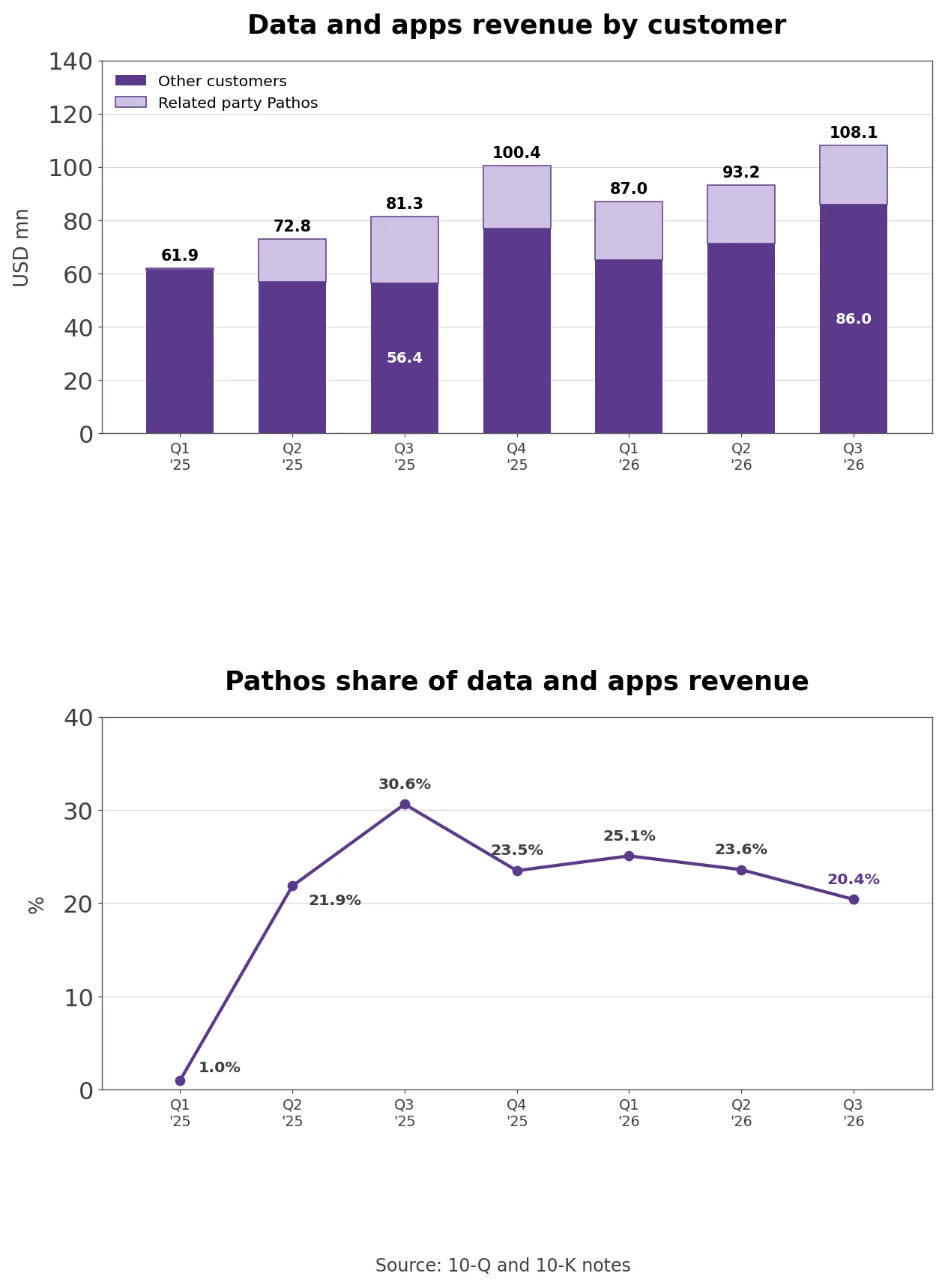
Pathos contributed $22.1 million of Data and Applications revenue in Q3, 20.4% of the line, compared with $24.9 million and 30.6% a year earlier. Excluding Pathos, Data and Applications revenue grew 52.4% in the third quarter, faster than the 32.9% for the line as a whole. Over nine months Pathos was $65.7 million, 22.8% of the line, and growth excluding Pathos was 27.4%. The base shifts quarter by quarter: the Pathos contract started in Q2 2025, and growth excluding Pathos was only +6.4% in Q1 2026.
The relationship widened in October. Tempus will deliver up to 500,000 Alzheimer’s and dementia records to Pathos over five years for up to $55 million in cash, and Pathos may sublicense them to BMS. In February, Pathos CEO Iker Huerga signed an independent contractor agreement with Tempus, and on October 22, the same day as the neurology order form, a special committee of independent directors approved his 175,000 performance share units tied to milestones that include minimum purchase commitments.
Growth and Multiples Against Guardant Natera and Caris
Latest-quarter revenue growth and GAAP operating margin at Tempus AI Guardant Natera and Caris
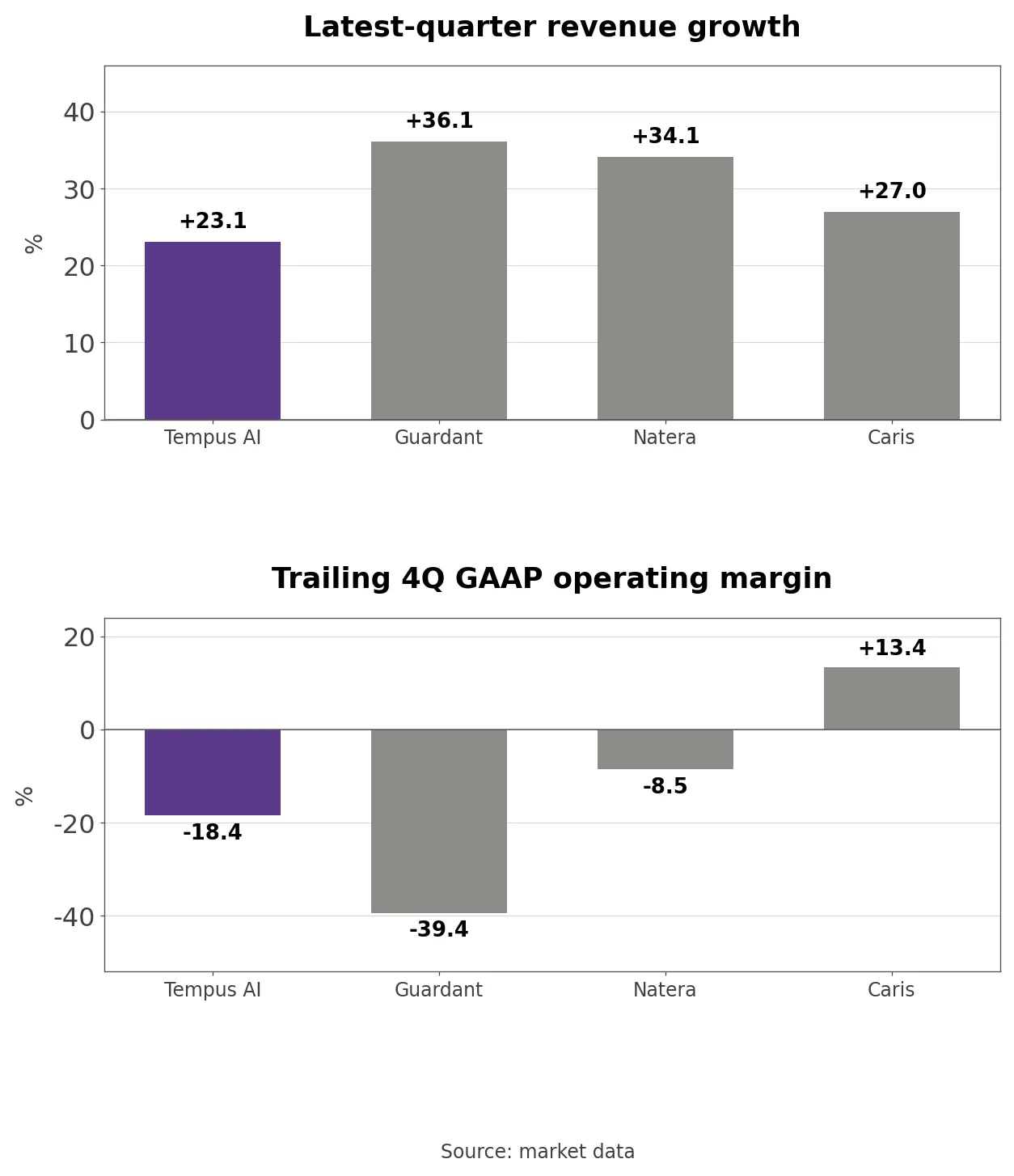
On market data, latest-quarter revenue growth was +36.1% at Guardant Health, +34.1% at Natera, +27.0% at Caris Life Sciences and +23.1% at Tempus. With Ambry now in both periods, Tempus has the slowest growth of the four.
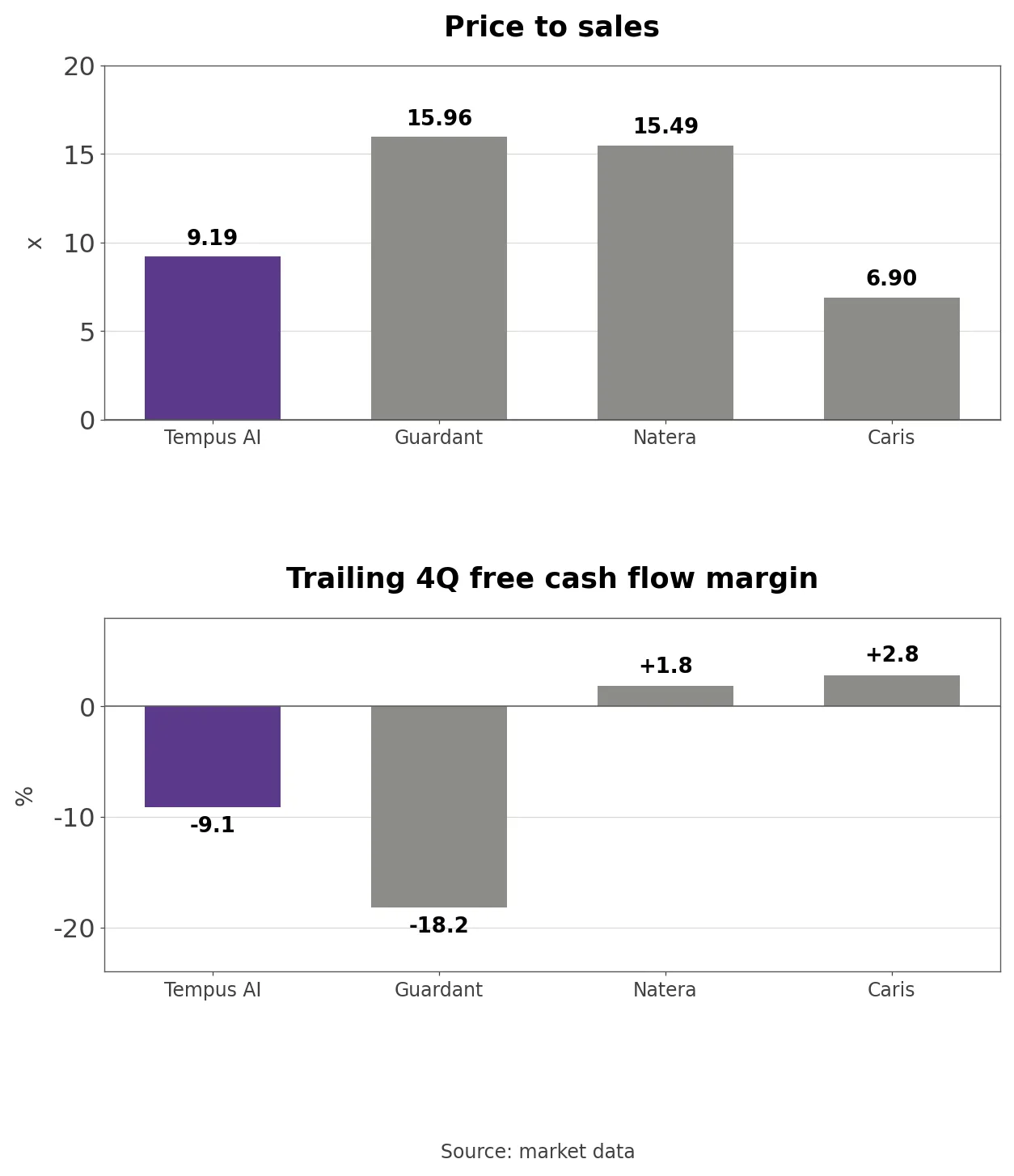
Trailing GAAP operating margin runs from 13.4% at Caris to -8.5% at Natera, -18.4% at Tempus and -39.4% at Guardant. Free cash flow margin is positive at Caris (2.8%) and Natera (1.8%) and negative at Tempus (-9.1%) and Guardant (-18.2%).
Price to sales and free cash flow margin at Tempus AI Guardant Natera and Caris
Price to sales is 15.96 for Guardant, 15.49 for Natera, 9.19 for Tempus and 6.90 for Caris. Tempus trades at about 60% of the two MRD leaders’ multiple and 1.33 times Caris, the peer with the same test-plus-data model. Lefkofsky said on the call that Foundation Medicine was as dominant in solid tumors when Tempus entered as Natera is in MRD today. Natera’s -8.5% margin, earned while scaling MRD, is the benchmark that claim invites.
The Price-to-Sales and Price-to-Book Band
Tempus AI price-to-sales and price-to-book bands over 21 months
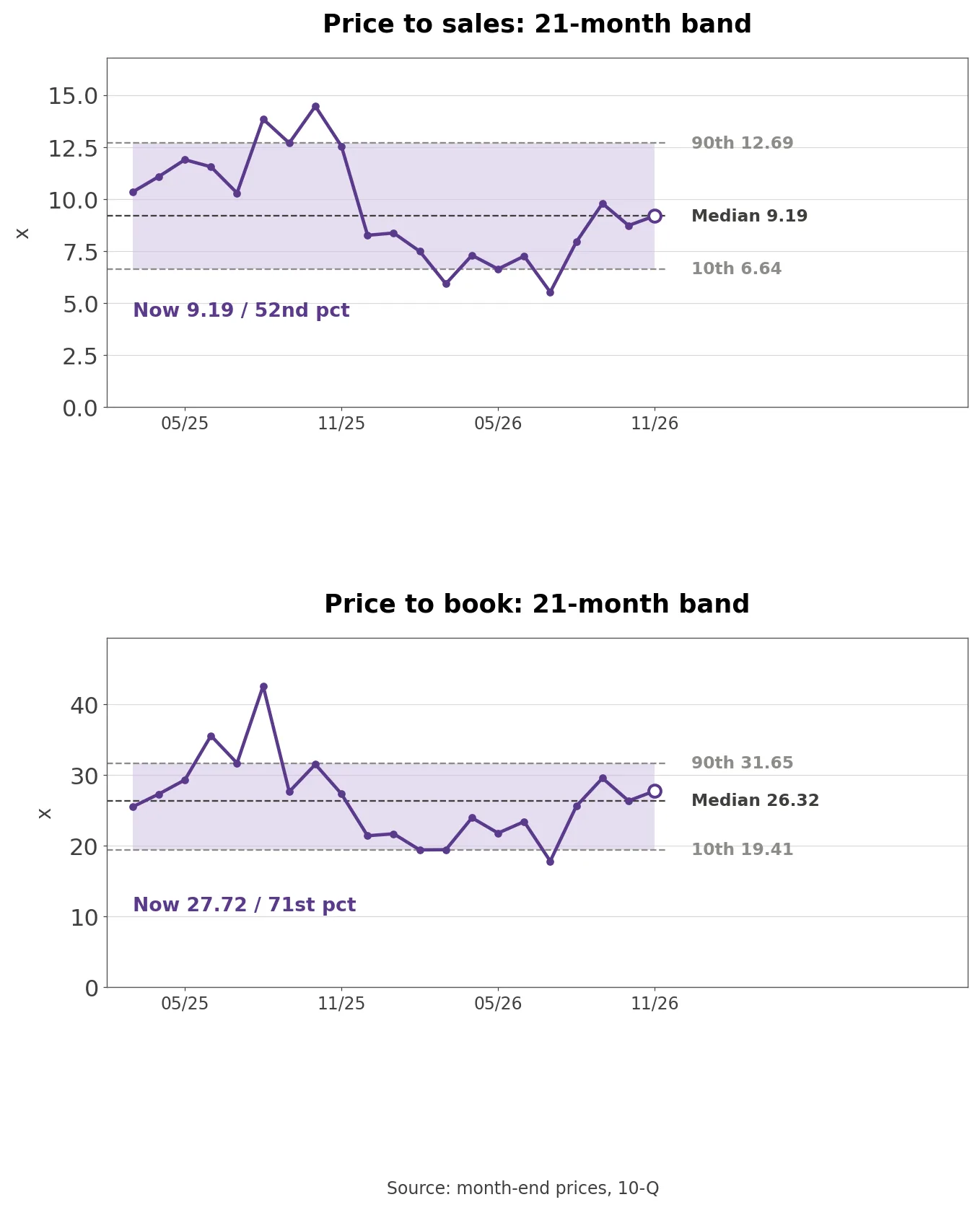
With a GAAP net loss there is no usable P/E, so I calculated price to sales and price to book for 21 months from March 2025, using trailing four-quarter revenue and the Class A and B share count from each filing cover.
Price to sales of 9.19 equals the 21-month median and sits at the 52nd percentile; the range ran from 14.46 in October 2025 to 5.53 in July 2026. Price to book of 27.72 is slightly above the 26.32 median, at the 71st percentile, because equity of $500.4 million is just 3.6% of market value.
Own calculation (Q3 release balance sheet): Convertible senior notes of $1,174.9 million and a convertible promissory note of $176.0 million, less $854.4 million of cash and marketable securities, leave net debt of $496.4 million. Enterprise value of $14.37 billion is 8.97 times the midpoint of 2026 revenue guidance and about 221 times guided adjusted EBITDA.
Three Conditions That Move the Stock
Data revenue growth excluding Pathos comes first. The company guided Q4 Data and Applications growth above 30%; holding that pace without the related party would support the stock, while growth that leans on Pathos and the new neurology order would weigh on it.
The share of added gross profit that reaches adjusted EBITDA is the second. Delivering about $34 million in Q4 and showing the one-third rule again would support the stock. A Q1 2027 figure that falls back below the rule once Personalis losses are consolidated would weigh on it; for full-year 2025 the share was 24.0%.
The cash portion of the Personalis consideration is the third. Paying close to the 50% cap in cash would limit new shares and support the stock, while paying mostly in stock would raise the share count and weigh on it. Cash funded by new debt would also lift the $10 million quarterly interest line again, so the borrowing cost matters as much as the mix.
2027 ADLT Pricing and the Personalis Losses
From January 2027, xT is reimbursed at its ADLT (Advanced Diagnostic Laboratory Test) rate, worth about $80 million by the company’s estimate. In the same year Personalis’s per-test losses are consolidated and Tempus plans to add MRD sales reps. If two-thirds of new gross profit is reinvested, one-third of $80 million is about $27 million, less than a single quarter of 2026 adjusted EBITDA. The open question is how much of that $80 million the February 2027 guidance will carry down to adjusted EBITDA.