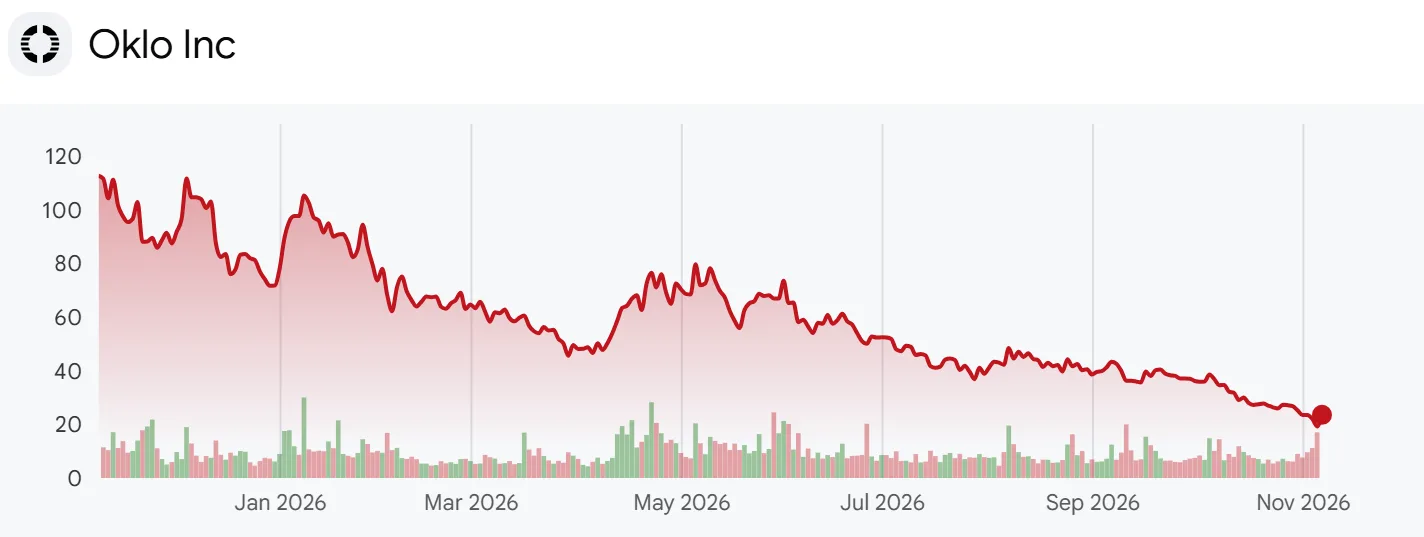
Oklo Inc. (NYSE: OKLO) pushed the target for its first Aurora powerhouse to “2028-2029” in its third-quarter 10-Q, the third time the date has slipped since it listed in 2024. The shares trade at $23.55, a market value of $4.60 billion against $3.13 billion of cash and marketable securities, or 1.26 times book value. The question for investors is what the remaining $1.47 billion is paying for.
Oklo one-year share price chart ending near 24 dollars
Oklo is building a 75-megawatt sodium-cooled fast reactor called Aurora and plans to own and operate it, selling electricity and heat under long-term contracts. It is also developing nuclear fuel recycling and medical isotope production. Third-quarter revenue was $1.86 million, all from engineering and fabrication services, so the company still reports a GAAP net loss. The stock sits -82.3% below its October 2025 month-end close of $132.77.
I compared the Q3 2026 10-Q, the 31-page Q3 company update, the November 6 call and the plan-of-operations paragraph in all 10 filings since the SPAC merger. Market value uses the 195.29 million shares on the November 4 10-Q cover; four quarterly decks from Q2 2025 to Q1 2026 could not be downloaded, so wording changes are traced through the filings.
Execution Gates and the Missing Start Year in the Q3 Deck
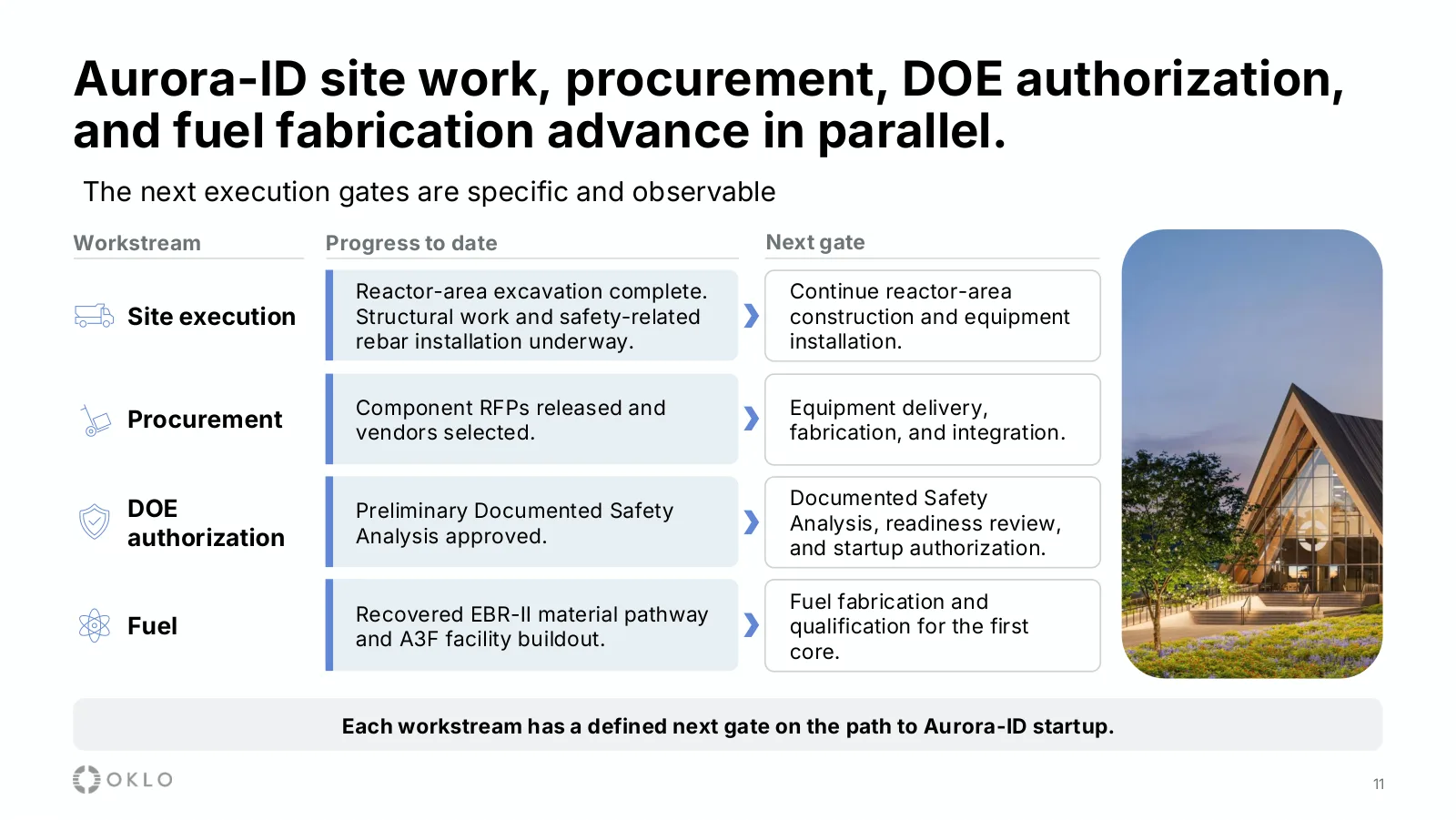
Page 11 of the Q3 company update splits the Aurora-Idaho project at Idaho National Laboratory into four workstreams. Site work has finished reactor-area excavation and moved into structural and safety-related rebar. Procurement has released component requests for proposal and selected vendors. On the regulatory side, the Department of Energy (DOE) approved the Preliminary Documented Safety Analysis (PDSA), and on fuel the company is building the A3F fabrication facility around recovered material from EBR-II, a retired experimental fast reactor.
Q3 2026 company update page 11 with four Aurora-Idaho workstreams and next gates
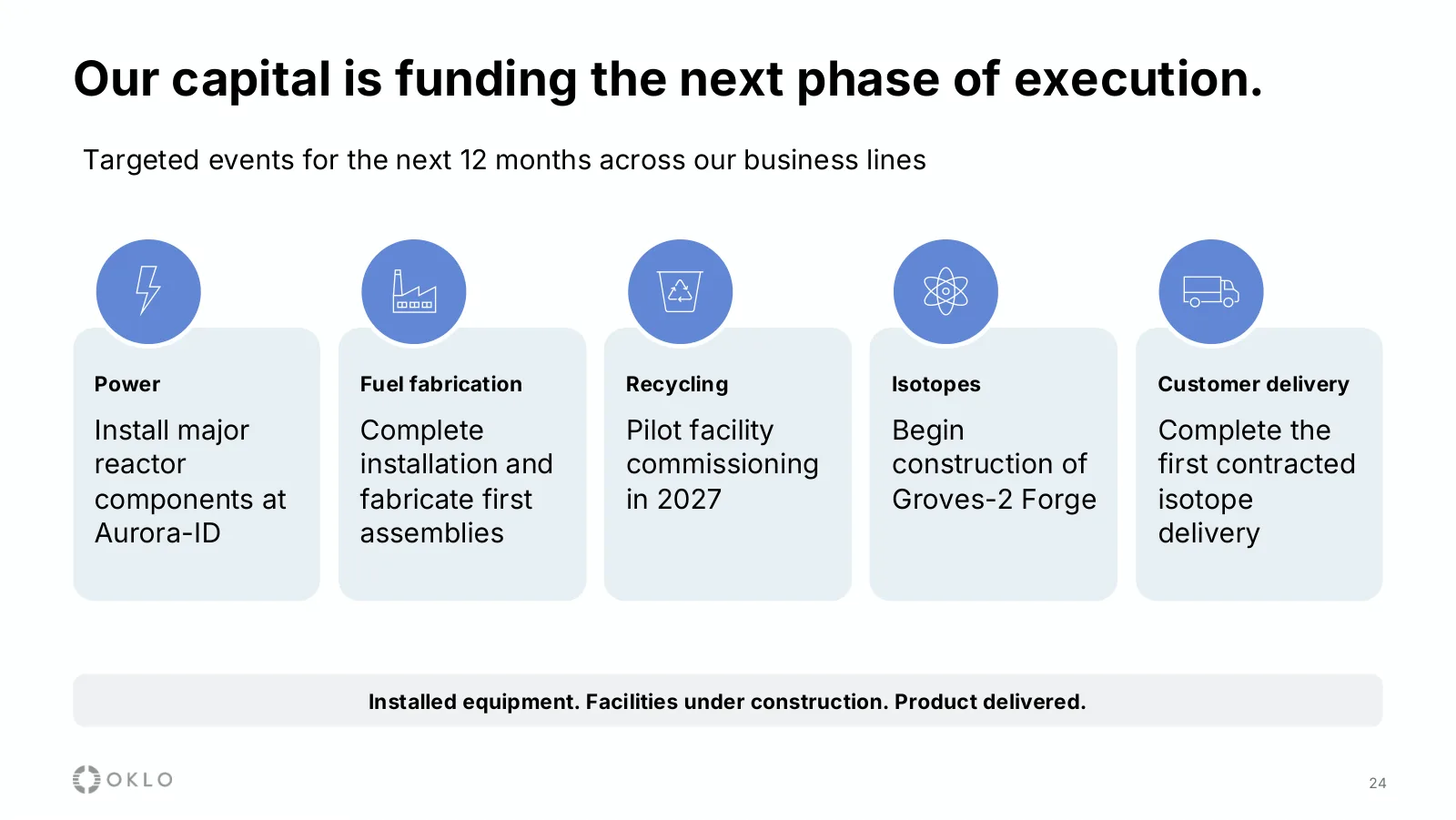
The next gates listed are equipment installation, equipment delivery and integration, the full Documented Safety Analysis (DSA) with a readiness review and startup authorization, and fabrication and qualification of the first core. Page 24 lists five targets for the next 12 months: installing major reactor components at Aurora-Idaho, completing fuel fabrication equipment and producing the first assemblies, commissioning a recycling pilot facility in 2027, starting construction of the Groves-2 isotope plant and completing the first contracted isotope delivery. Page 17 targets the first full fuel assembly for 2027.
Q3 2026 company update page 24 with five targets for the next 12 months
None of the 31 pages gives a year for Aurora-Idaho to produce power. The 10-Q released the same day does: its plan of operations now refers to an “ambitious target of deploying our first powerhouse in 2028-2029”, where the second-quarter 10-Q said 2028. When Needham analyst Drew Scott asked on the call whether this meant a slip to 2029, CEO Jacob DeWitte said Groves-1 had taught the team how long instrument noise isolation and recalibration take, and that he wanted schedule buffer for commissioning. He added that the DSA would come much closer to the end of construction, which leaves all three remaining approvals bunched near completion.
The emphasis has moved across the decks. The Q4 2024 deck put the customer backlog above 14 GW after the Switch deal, and the Q1 2025 deck aimed for operations in late 2027 or early 2028. The Q2 and Q3 2026 decks give neither a start year nor a gigawatt pipeline; construction photos and the list of next gates fill that space. Page 12 presents PJM’s rejection of one Virginia interconnection request, and FERC’s denial of Oklo’s complaint, as evidence that filing at many sites was the right strategy, and says the Ohio project is not affected.
Groves-1 Build Cost and the USFR Capacity Deal
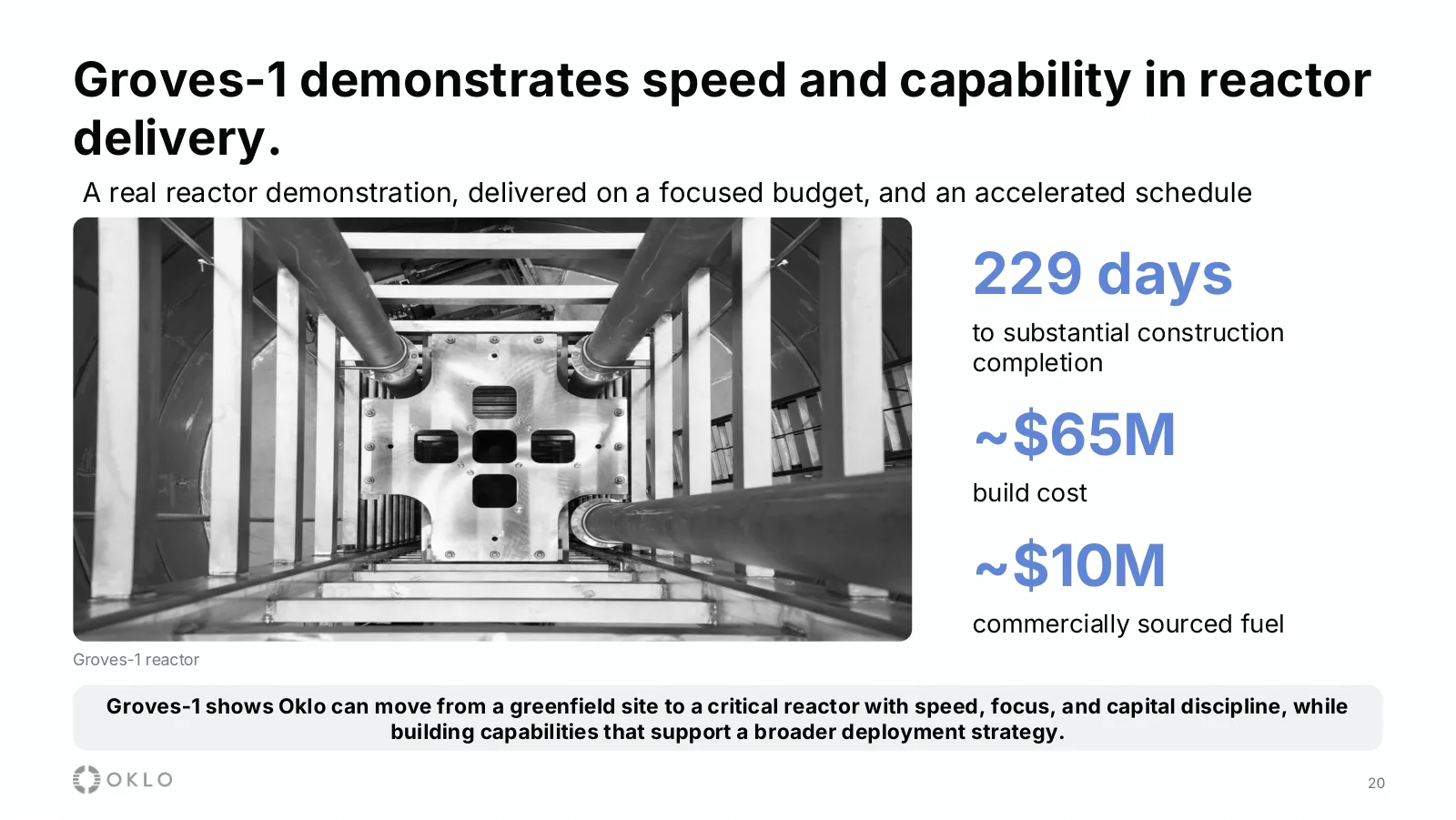
Page 20 says the Groves-1 isotope test reactor reached substantial construction completion in 229 days at a build cost of about $65 million plus about $10 million of commercially sourced fuel. It was built with private money on private land in Texas, authorized by DOE and reached first criticality on August 5, 2026. DeWitte said on the call that the lowest figures he remembered for isotope reactors 15 years ago were $300 million to $500 million, against about $75 million all-in for Groves-1.
Q3 2026 company update page 20 with Groves-1 built in 229 days for about 65 million dollars
The September Groves teach-in deck argues for new isotope supply by pointing to aging Western research reactors such as HFIR (1965) and BR2 (1961). Page 13 of the Q3 deck says ARMEC, a precision machining firm, and CEI, a sodium engineering firm, both acquired in 2026, are already writing component specifications, reviewing supplier bids and building sodium loops and pumps for Aurora-Idaho. The 10-Q puts the purchase prices at $20.5 million and $12.9 million.
Groves-1 makes no electricity; Aurora is a 75 MW power plant. The 10-Q says the first INL powerhouse will carry “additional, unique costs” because of extra fuel and core testing capability. Starting with the Q3 2025 10-Q, the filings also say third-party cost estimates for building and fueling Aurora powerhouses “include increases to the estimates we previously prepared in connection with the Recapitalization”. No filing gives a total cost for Aurora-Idaho. For scale, the roughly $75 million spent on Groves-1 equals 29.3% of the $256.1 million of property, plant and equipment on the September balance sheet.
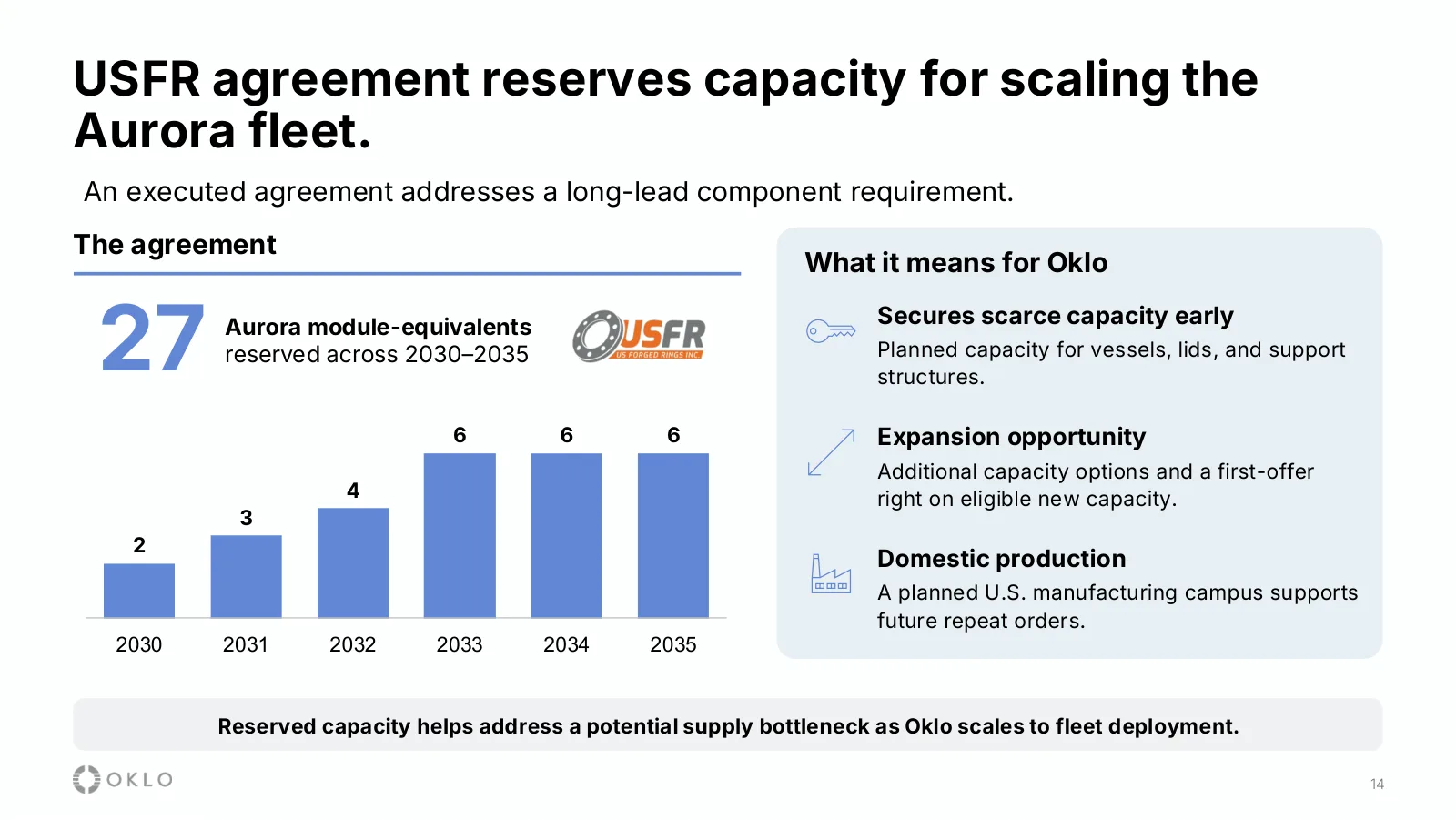
Page 14 covers the October manufacturing agreement with U.S. Forged Rings (USFR). It reserves planned USFR capacity for reactor vessels, lids and support structures equal to 27 Aurora modules from 2030 to 2035, phased 2, 3, 4, 6, 6 and 6 a year, with a first-offer right on new capacity.
Q3 2026 company update page 14 with 27 Aurora modules reserved at USFR for 2030 to 2035
Own calculation (Q3 deck page 14, 10-Q): 27 modules at 75 MW each is 2,025 MW, 1.69 times the 1,200 MW Ohio campus planned with Meta. The 2030 to 2032 reservations alone cover nine modules, which assumes large-component demand for nine units within three years of a first powerhouse now targeted for 2028-2029. The capacity being reserved is a plant USFR still has to build, and Oklo has no binding power purchase agreement yet.
Page 25 shows $965.1 million of nine-month investing outflows went into marketable securities against $280.9 million of capital spending, so most of this year’s raise still sits in bonds.
The Bull and Bear Case for Oklo Stock
The bull case rests on cash and execution. The $3.13 billion of cash and securities covers 4.8 to 6.0 years of the 2026 guidance for operating cash use plus capital spending ($520 million to $650 million combined), and Groves-1 went from an empty field to a critical reactor in under a year. Policy has helped too: the NRC finalized a rule letting applicants use DOE demonstration data in commercial license applications.
The bear case is schedule, contracts and dilution. The first powerhouse target has slipped three times, the Meta and Switch power deals are not binding, and selling the $911.2 million left on the current at-the-market program at $23.55 would add +19.8% to the share count. Aggregated sell-side estimates put the average price target at $65.25. TD Cowen’s Marc Bianchi started coverage in late October with a Hold rating and a $26 target, which is roughly $16.03 of cash per share plus about $10 for the business.
From an NRC Denial to the DOE Pilot Program
Oklo was founded in 2013 and is run by co-founder Jacob DeWitte. In March 2020 it became the first advanced fission company to file a custom combined license application with the NRC, which was denied without prejudice in 2022. It agreed to merge with the SPAC AltC in July 2023 and listed in May 2024; Sam Altman, then chair, left the board chair role in April 2025.
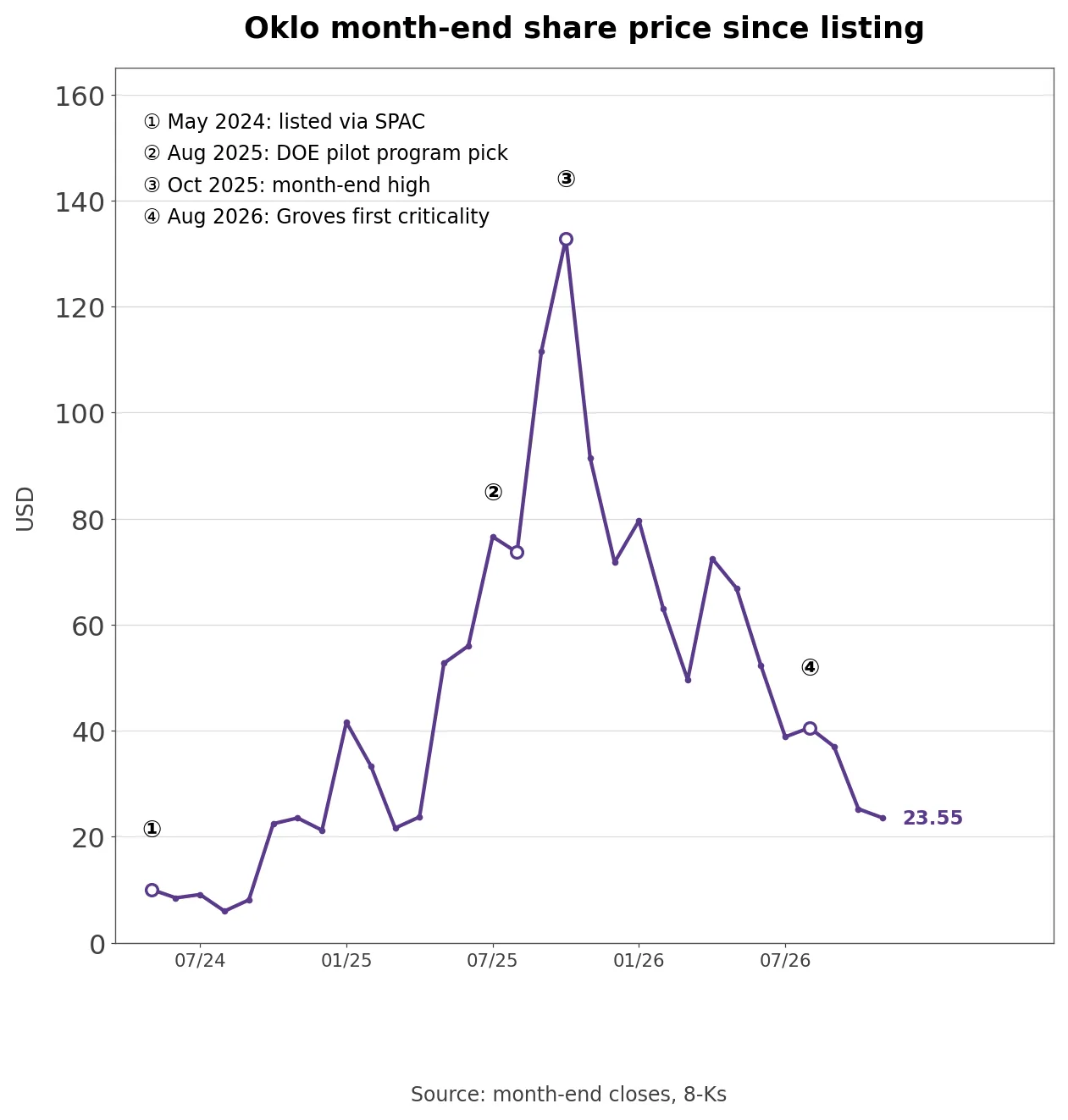
The licensing path changed on August 13, 2025, when DOE selected two Oklo projects and one from its Atomic Alchemy subsidiary among 11 in its new Reactor Pilot Program, moving the Aurora-INL powerhouse under DOE authorization rather than NRC licensing. Month-end prices rose from $5.97 in August 2024 to $132.77 in October 2025 and fell afterward, including after Groves-1 reached criticality in August 2026.
Oklo month-end share price over 31 months since listing with four dates
How Has the First Powerhouse Target Moved Across 10 Filings?
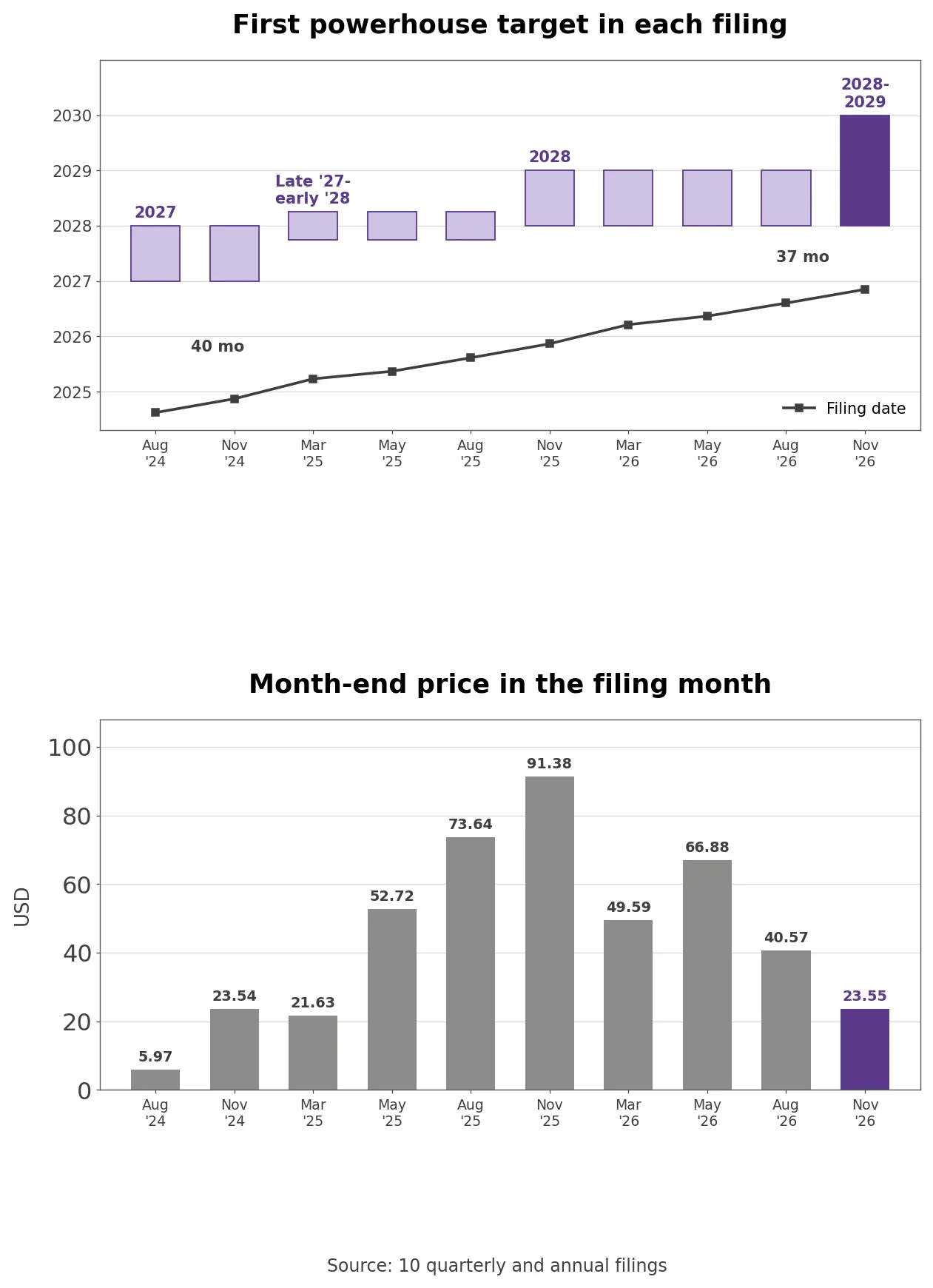
The first Aurora powerhouse target read 2027 in the August 2024 10-Q, late 2027 or early 2028 in the March 2025 10-K, 2028 in the November 2025 10-Q and 2028-2029 in the latest 10-Q. I pulled the plan-of-operations paragraph from all 10 filings since the merger and compared them line by line. The August 2024 version reads: “Our first Aurora powerhouse is targeted for deployment in 2027.” The March 2025 10-K reads: “The deployment of our first Aurora powerhouse is targeted for completion in late 2027 or early 2028.”
First powerhouse target in 10 filings from 2027 to 2028-2029 and the month-end price
The Q3 2025 10-Qmoved the date to 2028 and added the word “ambitious” for the first time, and the sentence about higher third-party cost estimates first appeared in the same filing. The stock closed that month at $91.38. The filings were pushing the date out through the second half of 2025 while the share price was setting its high.
Own calculation (10 filings, August 2024 to November 2026): Over the 27 months since August 2024, the far end of the target moved out 24 months, so the time left shrank from 40 months to 37. The target window also widened from one year to two.
The company explains the change with lessons from Groves-1. DeWitte said on the call that neutron detectors have to register single reactions, so electrical noise isolation and calibration take time, and some of that work can only be done once the whole plant is assembled. He said there is room to pull the schedule in, but across 10 filings the target sentence has never moved earlier. Moving Aurora under DOE authorization in August 2025 has not brought the date forward so far.
ATM Dilution and Book Value per Share
Filing footnote (Q3 10-Q equity note): Oklo sold 32.61 million shares through three at-the-market programs in the first nine months of 2026: the rest of the 2025 program at $96.95, 17.97 million shares under the first 2026 program at $55.64 and 2.26 million shares under the second at $39.30. Net proceeds were $2.254 billion.
The $70.19 average in the 10-Q table is gross proceeds of $2.289 billion divided by the shares sold, so buyers in this year’s offerings are underwater on average, with the stock at 33.6% of that price.
The share count rose +59.9%, from 122.10 million at the end of June 2024 to 195.29 million on the November 4 cover, while cash and securities per share went from $2.41 to $16.03.
Own calculation (month-end prices, 10-Q equity): The price-to-book ratio fell from 17.20 at the end of October 2025 to 1.26, a 13.65-fold drop that combines a 5.64-fold fall in the share price with a 2.42-fold rise in book value per share. On a log basis, 66.2% of the decline came from the price and 33.8% from the larger denominator created by the equity sales.
Operating Expenses vs Interest Income
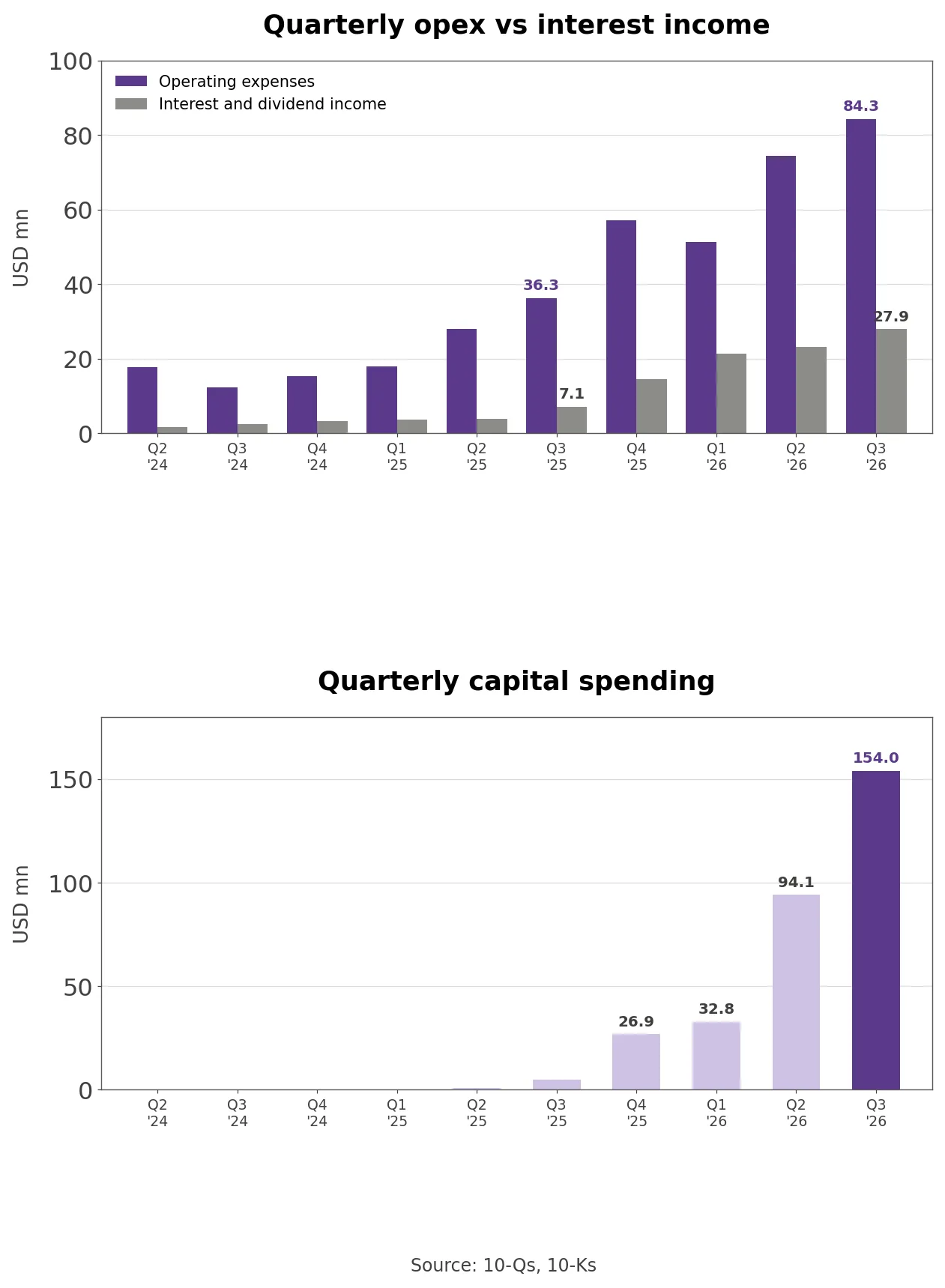
Third-quarter operating expenses were $84.3 million, +132.2% from $36.3 million a year earlier, with research and development up +178.7% and general and administrative up +94.6%. The 10-Q attributes the increase mainly to headcount, with average R&D staff up about 155 and G&A staff up about 85. Stock compensation was $19.2 million, 2.1 times the prior-year level.
Oklo quarterly operating expenses and interest income and capital spending over 10 quarters
Interest and dividend income of $27.9 million covered 33.1% of operating expenses, up from 19.6% a year earlier. The cash raised in equity offerings is earning enough on bonds to pay for a third of the cost base.
The third-quarter operating loss was -$71.0 million, or -$82.4 million without an $11.4 million gain on a land sale. The nine-month GAAP net loss of $123.3 million is a $195.2 million operating loss partly offset by $72.0 million of other income.
Company disclosure (Q3 earnings call, Nov 6 2026): CFO Craig Bealmear kept guidance for 2026 operating cash use of $120 million to $150 million and cash spending on property, plant and equipment of $400 million to $500 million. Through nine months the figures were $110.9 million and $280.9 million. That implies fourth-quarter capital spending of $119.1 million to $219.1 million, in line with the third quarter’s $154.0 million, but operating cash use of only $9.1 million to $39.1 million against $45.5 million in the third quarter.
What the Company Sells Before Its First Powerhouse Runs
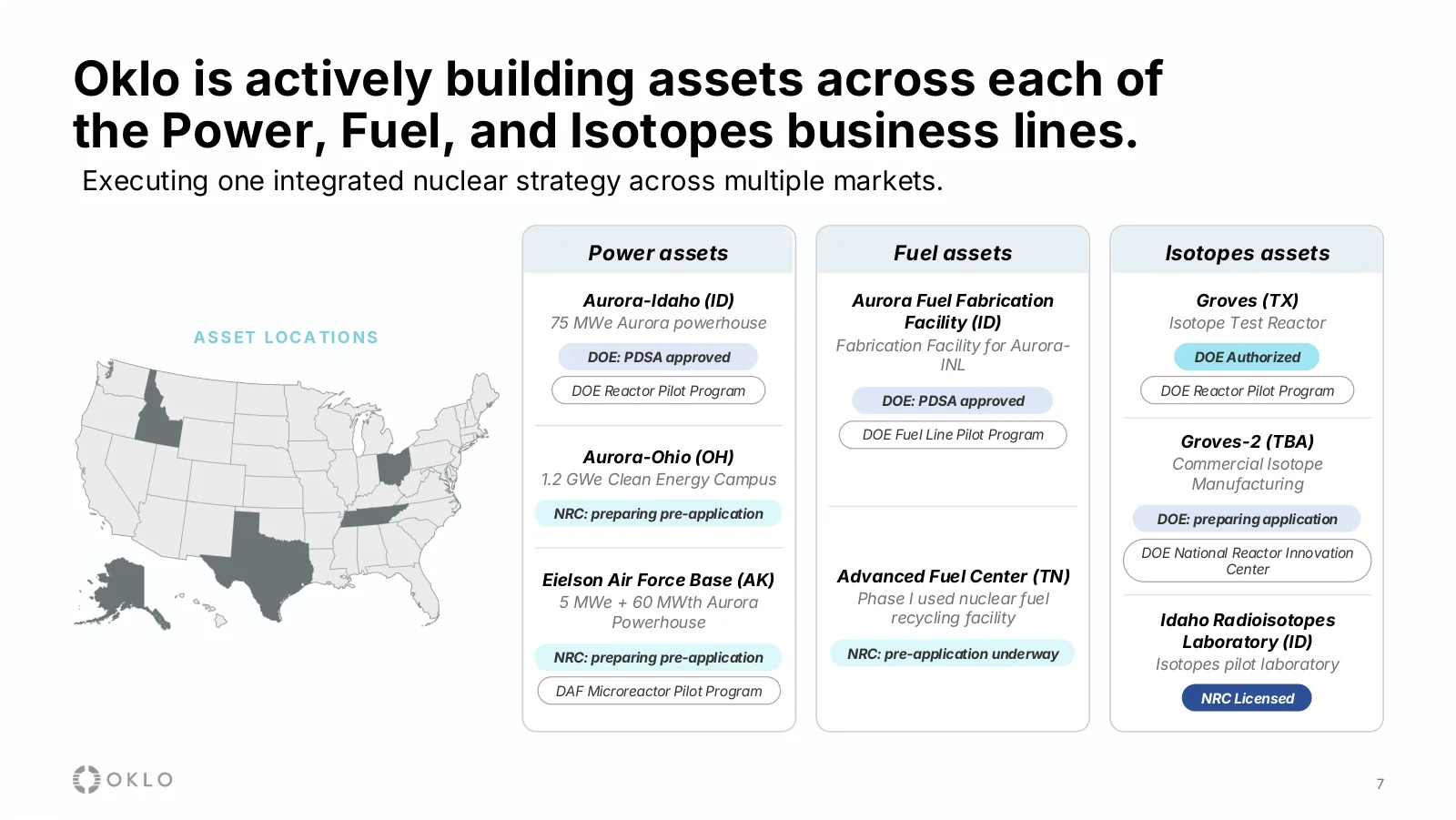
Oklo describes three businesses. Power means owning and operating Aurora plants and selling electricity and heat, plus fast-neutron irradiation services for testing fuels and materials. Fuel covers fabrication services and recycling of used nuclear fuel. Isotopes covers radioisotopes such as lutetium-177 for cancer therapy.
Q3 2026 company update page 7 with power and fuel and isotope assets
The asset map on page 7 lists three power sites: Aurora-Idaho (75 MWe, DOE PDSA approved), Aurora-Ohio (a 1.2 GWe campus, preparing an NRC pre-application) and Eielson Air Force Base in Alaska (5 MWe plus 60 MWth, also preparing an NRC pre-application). Fuel assets are A3F in Idaho and a recycling facility in Tennessee, and isotope assets are Groves in Texas and a radioisotope lab in Idaho.
Third-quarter revenue of $1.86 million split into $1.56 million of engineering and consulting and $0.30 million of manufacturing services. Revenue was zero a year earlier, and the ARMEC and CEI acquisitions came in between. Electricity revenue starts only when the first plant runs.
Groves-2 Forge, a lutetium-177 pilot that combines irradiation and processing, was selected for DOE’s Nuclear Energy Launch Pad. On fuel, DeWitte said on the call that Oklo will not make TRISO fuel but will cover metal and oxide fuels below 20% enrichment, with some service revenue possible within two years and real growth only after other developers deploy reactors. ARPA-E selected Oklo for $6.8 million to develop recycled metal fuel.
The Meta Prepayment and Non-Binding Power Deals
Oklo signed a prepayment agreement with Meta on January 5, 2026, setting a framework for Meta to prepay for power and fund development of a campus of up to 1.2 GW in Pike County, Ohio, on land Oklo bought in December 2025. On September 30 it signed a HALEU supply agreement with Centrus tied to that deal, and on November 2 “an initial funding amount from Meta was released from escrow and paid directly to Centrus as a credit towards fuel orders.”
That money did not pass through Oklo’s income statement or cash balance. At September 30 the company carried contract liabilities of $2 thousand and contract assets of $1.66 million.
TD Cowen’s Bianchi asked on the call whether the Meta agreement binds Meta to the reactor build, and DeWitte said it does not. Bealmear added that there are binding elements: Meta put up capital to reserve capacity, and Oklo has milestones to meet with it, starting with securing fuel.
The rest of the pipeline looks similar. The 10-Q says Oklo has “signed non-binding letters of intent” with Equinix, Diamondback Energy and Prometheus Hyperscale, and the 12 GW Switch deal from December 2024 is a master power agreement. Negotiating binding power purchase agreements is still on the list of planned initiatives. Eielson is at the notice-of-intent-to-award stage from June 2025.
Asked by Goldman Sachs analyst Brian Lee about state moratoriums on data centers, DeWitte said the 75 MW size has always suited industrial and defense customers too. In PJM’s 2026 cluster study, 900 MW is under active consideration.
Oklo vs NuScale NANO Nuclear and Centrus
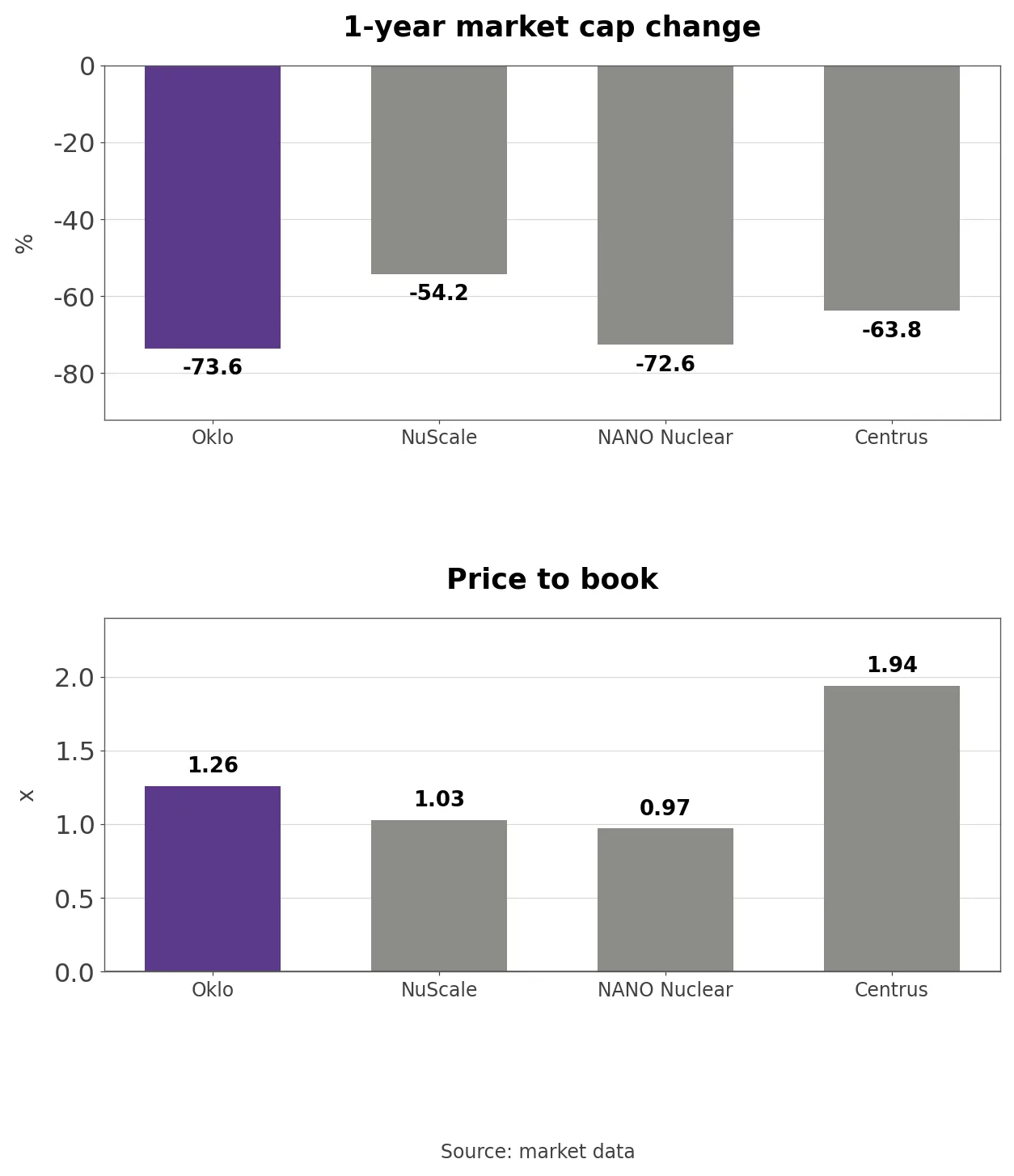
On market data, one-year market value changes were -73.6% for Oklo, -72.6% for NANO Nuclear, -63.8% for Centrus and -54.2% for NuScale, so the decline is sector-wide. Price to book is 1.03 for NuScale and 0.97 for NANO Nuclear, close to book value, against 1.26 for Oklo and 1.94 for Centrus.
One-year market cap change and price to book at Oklo NuScale NANO Nuclear and Centrus
NuScale is a small modular reactor company with an NRC design approval whose trailing revenue fell -95.7%; NANO Nuclear is a pre-revenue microreactor developer; Centrus is Oklo’s HALEU supplier. Since year-end 2025, price to book fell most at NANO Nuclear (7.20 to 0.97) and Oklo (7.60 to 1.26).
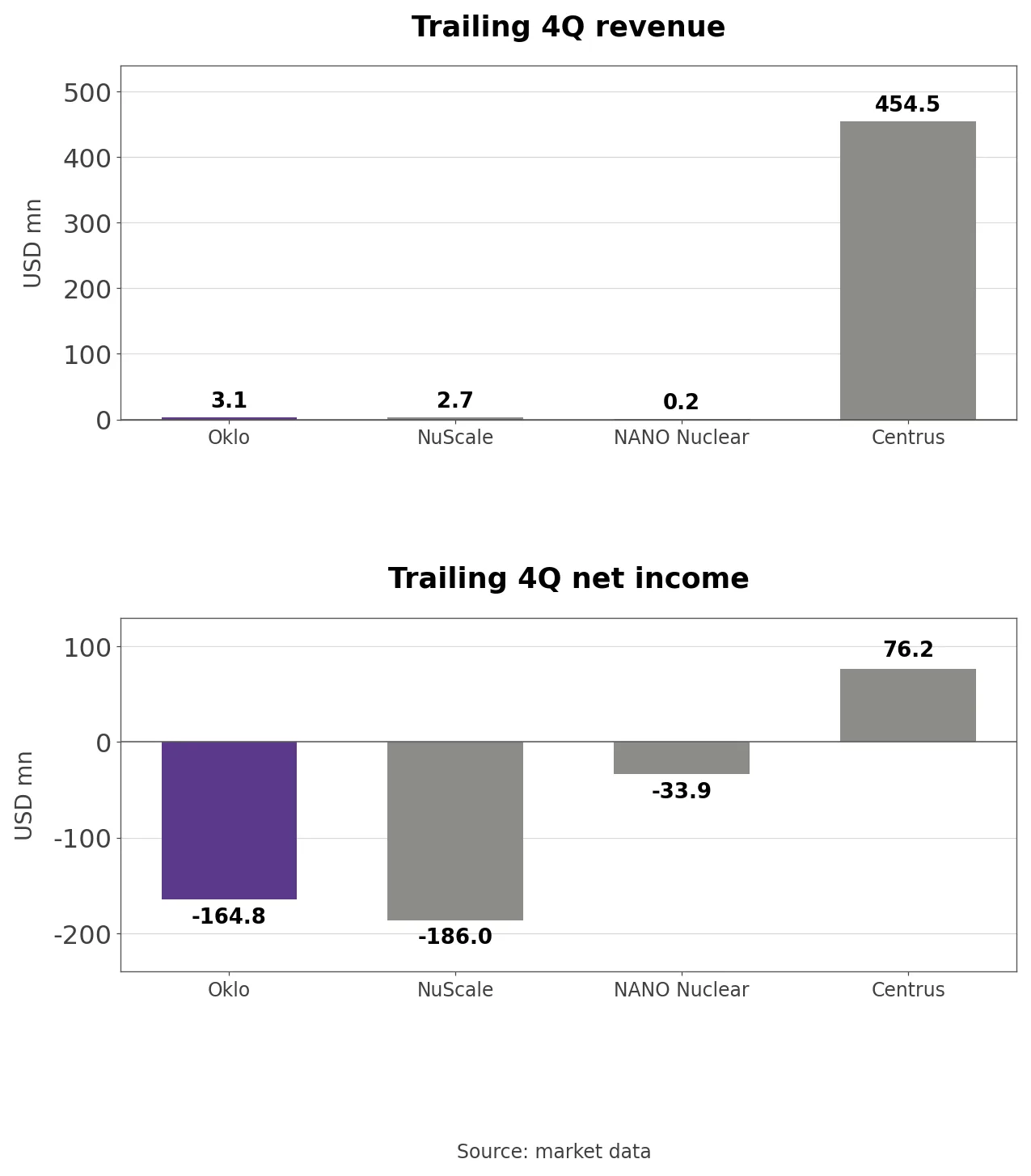
Trailing four-quarter revenue was $454.5 million at Centrus, $3.07 million at Oklo, $2.73 million at NuScale and $0.21 million at NANO Nuclear. Only Centrus was profitable, with net income of $76.2 million, against losses of -$164.8 million at Oklo, -$186.0 million at NuScale and -$33.9 million at NANO Nuclear.
Trailing revenue and net income at Oklo NuScale NANO Nuclear and Centrus
The profitable supplier trades at 1.94 times book and a P/S of 4.75, while NuScale’s P/S of 799.92 mostly shows how little revenue it has left; the three pre-revenue developers sit between 0.97 and 1.26 times book. With no debt, Oklo’s $3.13 billion of cash and securities is all net cash, equal to 68.1% of its market value.
In the session after the results, Oklo rose +22.66%, while Centrus rose +17.49%, NuScale +16.25% and NANO Nuclear +15.25%. Against the peer average of +16.33%, Oklo’s own move was about 6.33 points.
The Price-to-Book Band and Market Cap to Cash
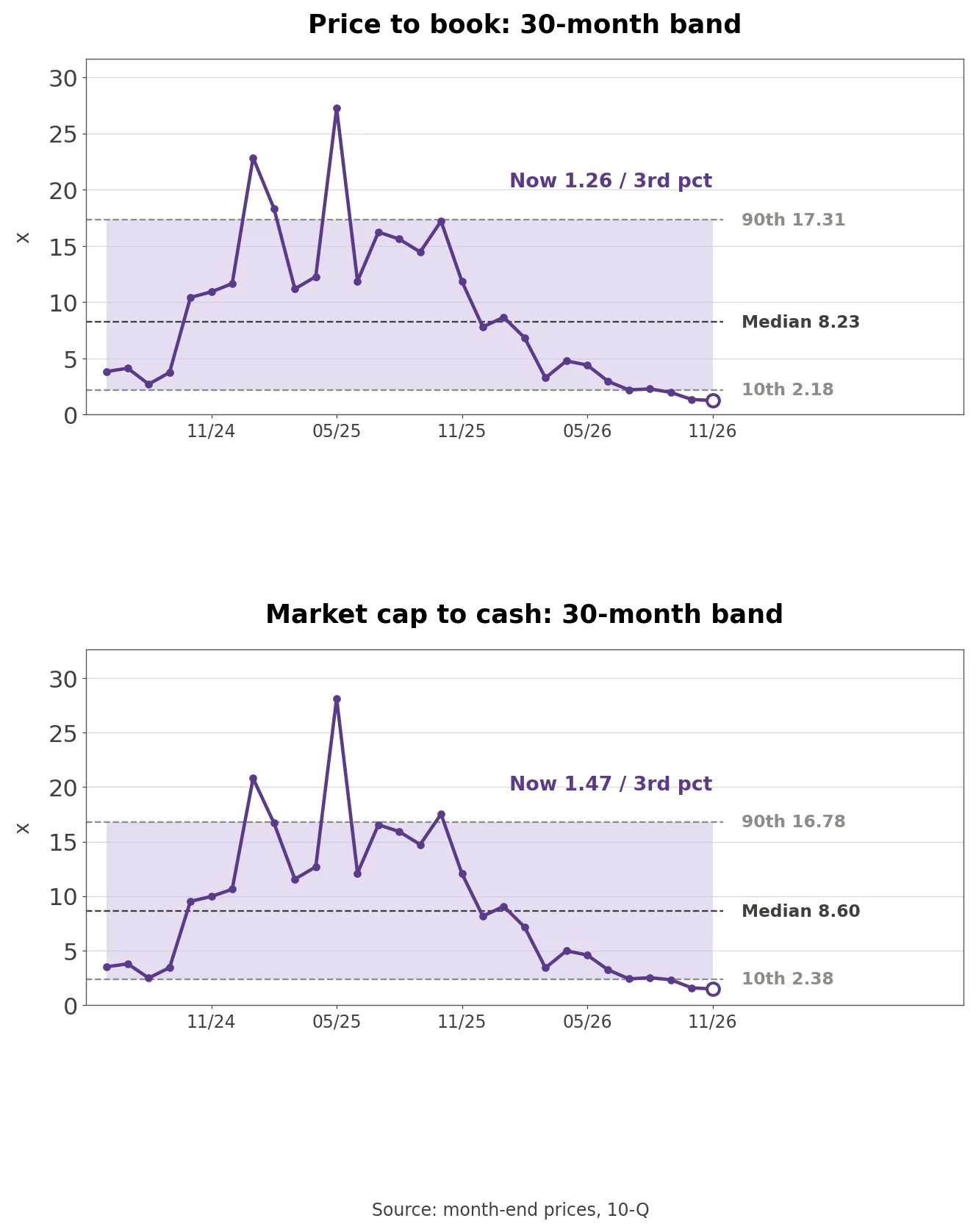
With nine-month revenue of $3.07 million and continuing GAAP losses, price-to-earnings and price-to-sales bands cannot be drawn. I calculated price to book from month-end closes and quarterly equity, and market value divided by cash and securities, over the 30 months since June 2024.
Oklo price to book and market cap to cash over 30 months
Price to book of 1.26 is the lowest of the 30 months, against a median of 8.23 and a high of 27.25 in May 2025. Market value to cash and securities is also at its low of 1.47, against 28.15 in the same month.
Subtracting $3.13 billion of cash and marketable securities from the $4.60 billion market value leaves $1.47 billion for the business, 2.84 times the $517.5 million of non-cash net assets on the balance sheet. Those net assets include $256.1 million of property and equipment and $158.1 million of prepaid expenses and other current assets. Per share, $16.03 of the $23.55 price is cash and securities and $7.52 is the business.
Three Conditions That Move the Stock
The DOE approval schedule for Aurora-Idaho comes first. If the next 10-Q keeps 2028-2029 and puts a date on the DSA submission, that supports the stock; another slip past 2029 would weigh on it.
A binding power contract is the second. Converting any part of the Meta Ohio campus or the Switch volume into a binding PPA would give the $1.47 billion business value something to stand on. More letters of intent and framework deals would not.
Dilution is the third. Using the remaining $911.2 million of at-the-market capacity at prices in the low $20s would raise the share count by about a fifth and weigh on the stock. Interest income that keeps covering a third of operating costs, with cash use inside guidance, would support it.
Sourcing Fuel for the First Aurora Core
The first core will be made at A3F from EBR-II material DOE has already allocated, and page 17 targets the first full fuel assembly for 2027. Fuel for the Meta Ohio units would come from Centrus HALEU starting in 2029, and the only firm, conditional contract so far is the September 30 agreement tied to Meta. No U.S. plant makes HALEU at commercial scale yet, so every unit after Aurora-Idaho is tied to the fuel supply schedule as well as to licensing.
The open question is whether the first fuel assembly moves into the completed column in the next quarterly deck while A3F equipment is still being installed.