Cameco (CCJ) Stock: Spot Uranium $89.63 vs Realized $65.78
Contents
- Cameco (NYSE: CCJ) sold uranium at an average of $65.78 per pound in the third quarter of 2026. At the end of that quarter the spot price was $89.63 and the long-term contract price was $96.50, approaching its highest level since 2011 in constant dollars, so the company collected 73.4% of spot. Over nine months the average spot price rose +22% from a year earlier while Cameco’s US dollar realized price rose +10%, and the MD&A puts the gap down to “the impact of ceiling prices on market-priced contracts”. Third-quarter adjusted EBITDA fell -13.9% to C$267 million, and operating cash flow was C$3 million against C$156 million a year earlier.
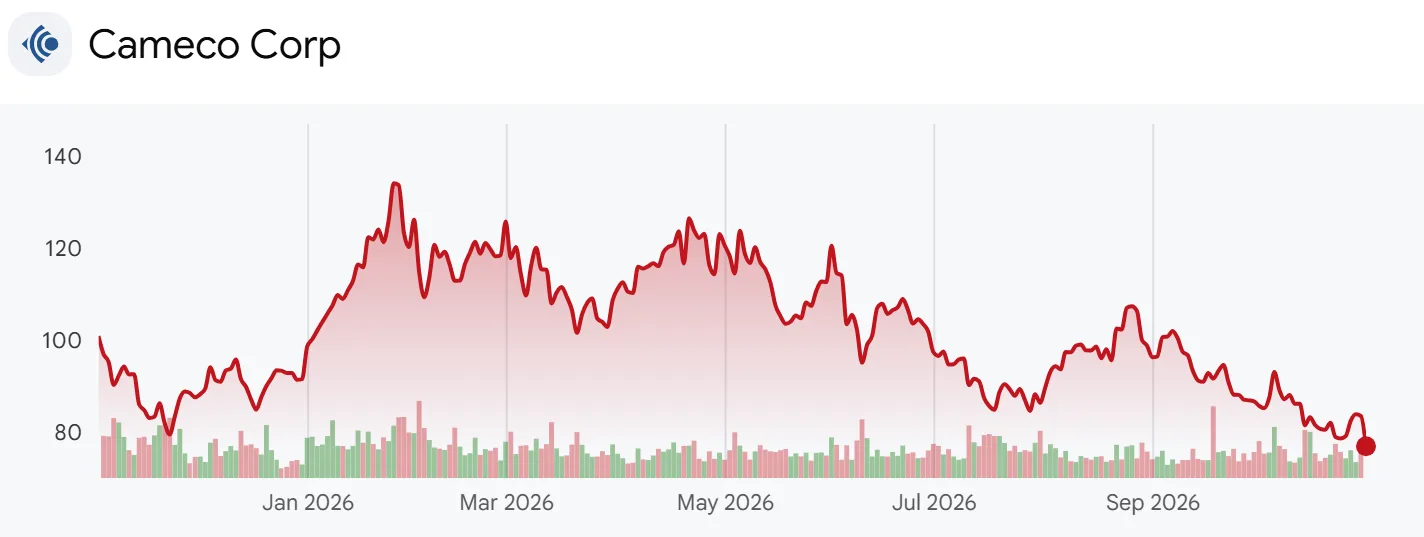
- Cameco is a uranium company based in Saskatoon, Saskatchewan. It mines at McArthur River and Cigar Lake and through the JV Inkai joint venture in Kazakhstan, refines and converts uranium and makes fuel bundles in its fuel services segment, and owns 49% of Westinghouse, the reactor technology company. At a $76.91 close it is worth about $33.5 billion on market data.
- The question here is how slowly, and by how much, Cameco’s contract book passes rising uranium prices through to earnings while reactor demand and market prices climb together. The analysis lines up the Q3 2026 earnings release and Q3 2026 MD&A, the Q3 conference call slides and the 53-page investor presentation on the IR site, 16 quarterly earnings releases since Q4 2022, and the industry price tables in four third-quarter MD&As.
- Two caveats apply. Cameco reports under IFRS in Canadian dollars and files quarterly results on Form 6-K rather than a 10-Q, so financial figures below are in Canadian dollars unless marked, while uranium prices are in US dollars. Adjusted EBITDA and adjusted net earnings are non-IFRS measures, and quarter-end spot and long-term prices are the industry averages Cameco reproduces in its MD&A.
What the Q3 Slides Say About Deliveries and Output
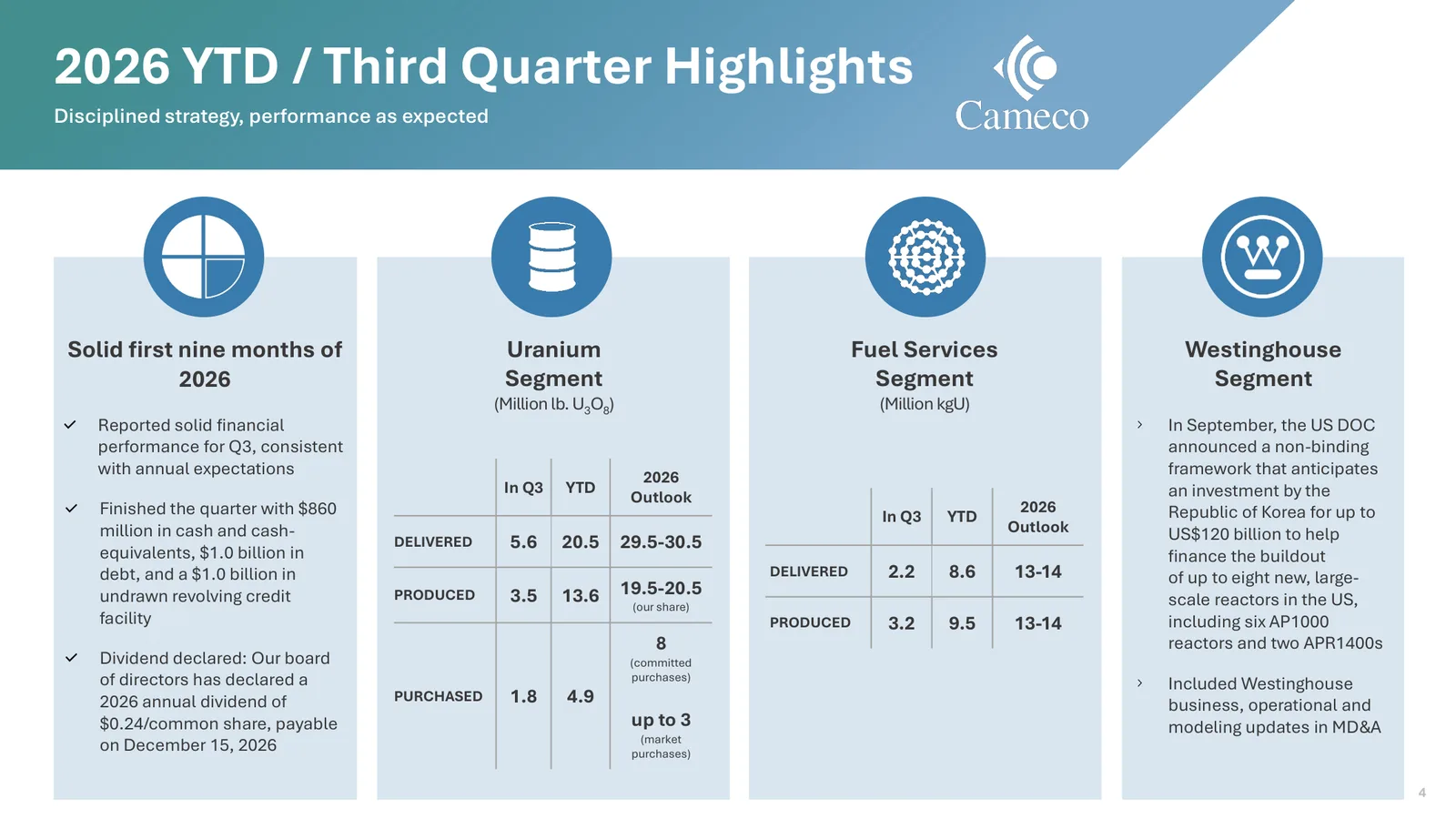
- The Q3 call deck runs 14 pages. The page 4 summary, subtitled disciplined strategy and performance as expected, sets the uranium, fuel services and Westinghouse segments side by side. Uranium delivered 5.6 million pounds, produced 3.5 million and purchased 1.8 million in Q3, and the 2026 outlook calls for deliveries of 29.5 million to 30.5 million pounds against production of 19.5 million to 20.5 million pounds (Cameco’s share), with 8 million pounds of committed purchases and up to 3 million pounds of market purchases. The fuel services column shows Q3 deliveries of 2.2 million kgU and output of 3.2 million kgU, with both guided to 13 million to 14 million kgU for 2026. The Westinghouse column cites the US-Korea reactor framework of up to $120 billion announced in September. Page 11 maps the AP1000 pipeline, with three reactors in Poland and two in Bulgaria in long-lead procurement and EPC negotiations and FEED-stage units in the Netherlands, Slovenia and Slovakia.
- Company disclosure (Q3 2026 earnings release, October 30, 2026): Cameco narrowed 2026 production guidance to 19.5 million to 20.5 million pounds from 19.5 million to 21.5 million, and sales guidance to 29.5 million to 30.5 million pounds from 29 million to 32 million. CEO Tim Gitzel blamed the weaker quarter on a planned longer maintenance outage at the Key Lake mill and a large Westinghouse payment from the Dukovany project in the prior year, adding that “it is important to distinguish between changes in market sentiment and changes in underlying fundamentals”.
- Checked against the filings, the gap between sales and output stands out first. Subtracting the low end of production from the top of the sales range leaves 11 million pounds to source elsewhere, which is exactly what the 8 million committed and up to 3 million market purchases cover. The 1.8 million pounds bought in Q3 cost C$83.78 per pound (US$60.15), only C$7.98 below the quarter’s realized price of C$91.76. With 20.5 million pounds delivered through September, the fourth quarter alone has to deliver 9 million to 10 million pounds.
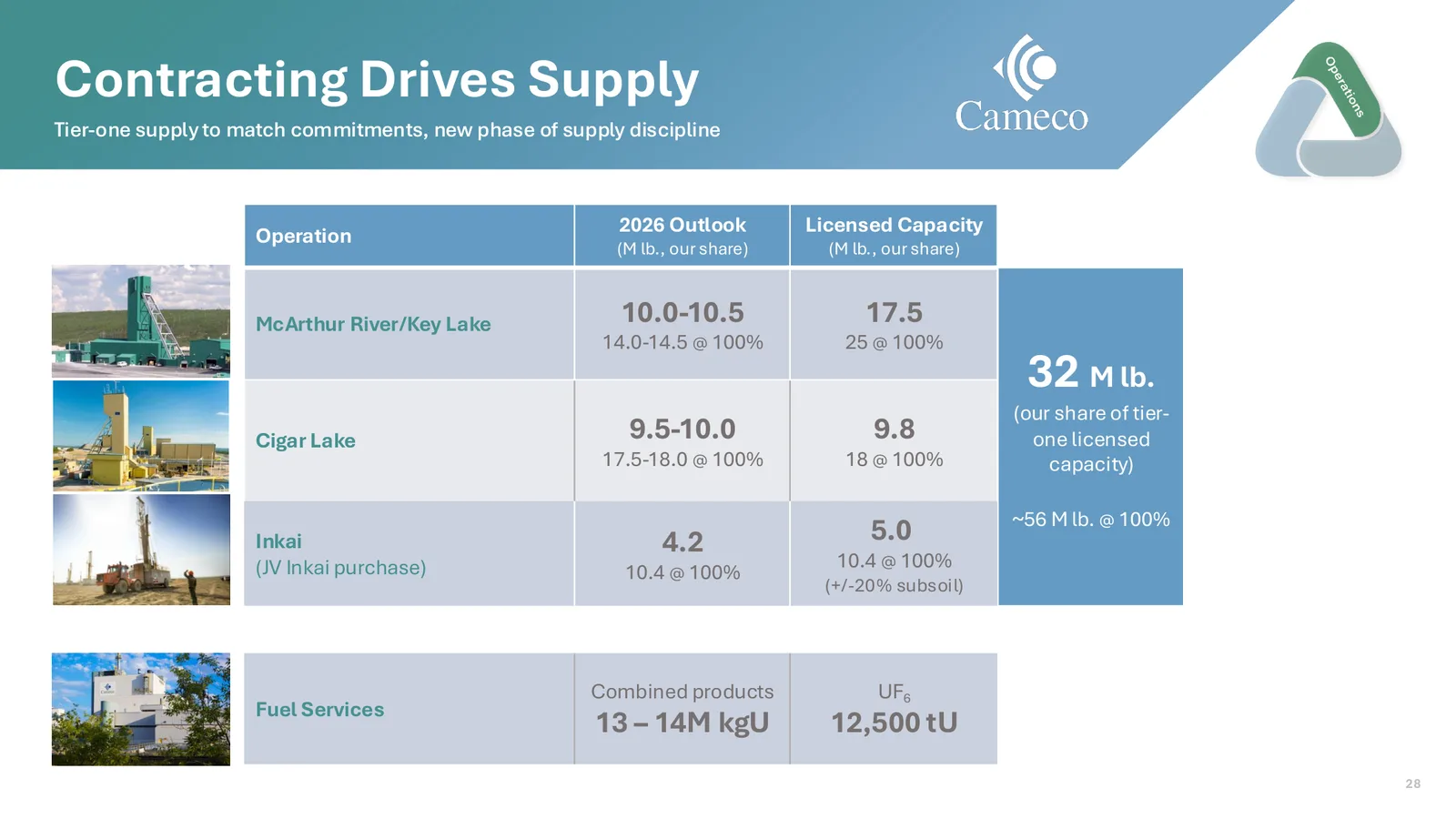
- Page 28 of the investor presentation sets each mine’s 2026 outlook against licensed capacity. McArthur River/Key Lake is guided to 10.0 million to 10.5 million pounds for Cameco’s share against 17.5 million of licensed capacity, Cigar Lake to 9.5 million to 10.0 million against 9.8 million, and Inkai to 4.2 million against 5.0 million. McArthur River/Key Lake is running at 57.1% to 60.0% of its licence, and the slide is titled Contracting Drives Supply.
Long-Term Contracts and Uncovered Demand in the Deck
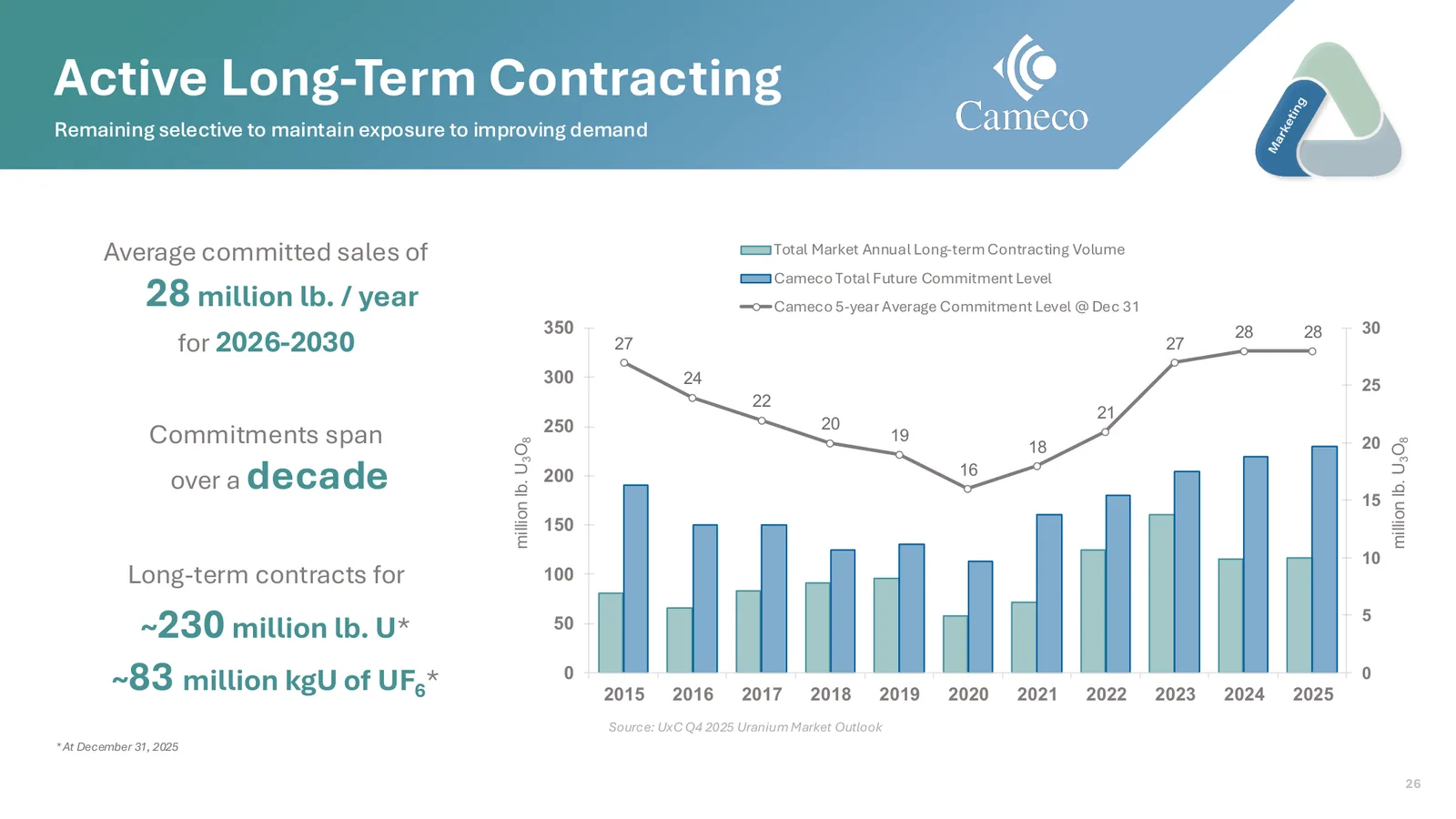
- Page 26 covers the contract book: about 230 million pounds under long-term contracts at the end of 2025 and average committed sales of 28 million pounds a year for 2026 to 2030, with commitments spanning more than a decade. The MD&A adds that commitments are above that average in 2026 to 2028 and below it in 2029 and 2030, and the release repeats that “As the market continues to improve, we expect to continue layering in volumes that capture greater future upside using market-related pricing mechanisms”.
- The same chart shows the five-year average commitment level at 28 million pounds at the end of both 2024 and 2025, so new contracts over the year only replaced deliveries that rolled off. Thin coverage in 2029 and 2030 leaves room to sign higher-priced volume, but how high the new ceilings are set has not yet shown up in the numbers. Page 10 of the call deck lists the principles behind that book: layering, price optimization, diversification and an over-contracted position.
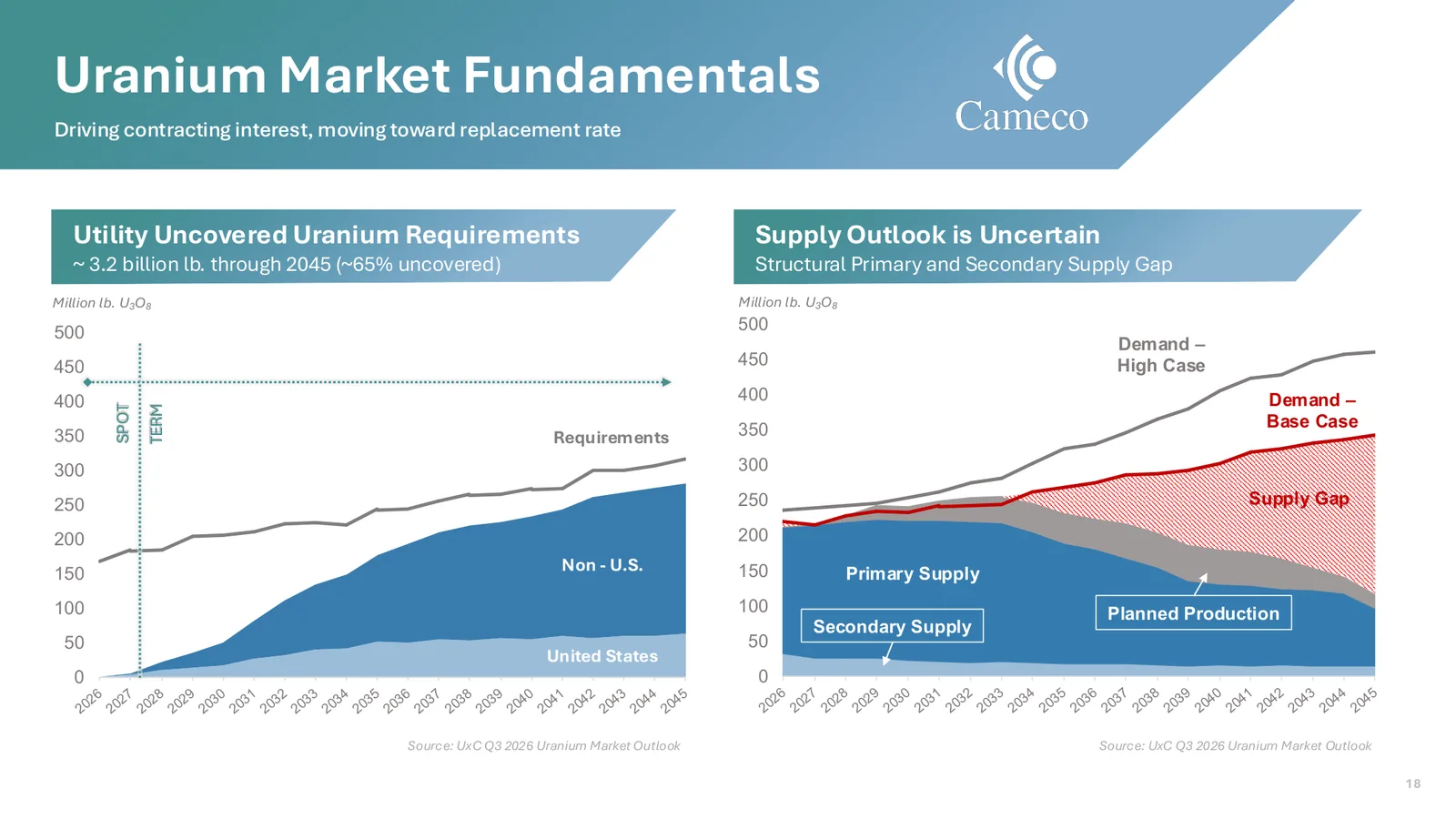
- Page 18 is the demand case. Utilities have about 3.2 billion pounds of uranium requirements still uncovered through 2045, roughly 65% of the total, and the right-hand chart shades a structural supply gap opening in the mid-2030s against base-case demand. The MD&A adds that spot market volume was about 9 million pounds in Q3 against 15 million a year earlier, and that long-term contracts generally start delivering more than two years after they are signed. It also notes requests for proposals from utilities, several due before year-end, and more off-market negotiations. Uncovered demand reaches the realized price only after those contracts are signed and deliveries begin.
The Bull and Bear Case for Cameco Shares
- The bull case is market prices and Westinghouse. The long-term price of $96.50 is $13.50 higher than a year ago, and at a $100 spot assumption the expected realized price climbs from $68 in 2026 to $88 in 2030. Westinghouse holds an AP1000 pipeline of up to 91 reactors backed by the US Commerce Department partnership and the US-Korea framework, and Cameco’s share of its Q3 adjusted EBITDA rose +15.3%.
- The bear case is contract ceilings and costs. Even at $140 spot, the 2027 expected realized price is only $76, and Q3 cash production cost rose +61.6% per pound. Nine-month operating cash flow fell -84.7%, and after a -37.7% drop from the peak the price-to-sales ratio still sits above its 34-month median.
From the Westinghouse Deal to the US-Korea Framework
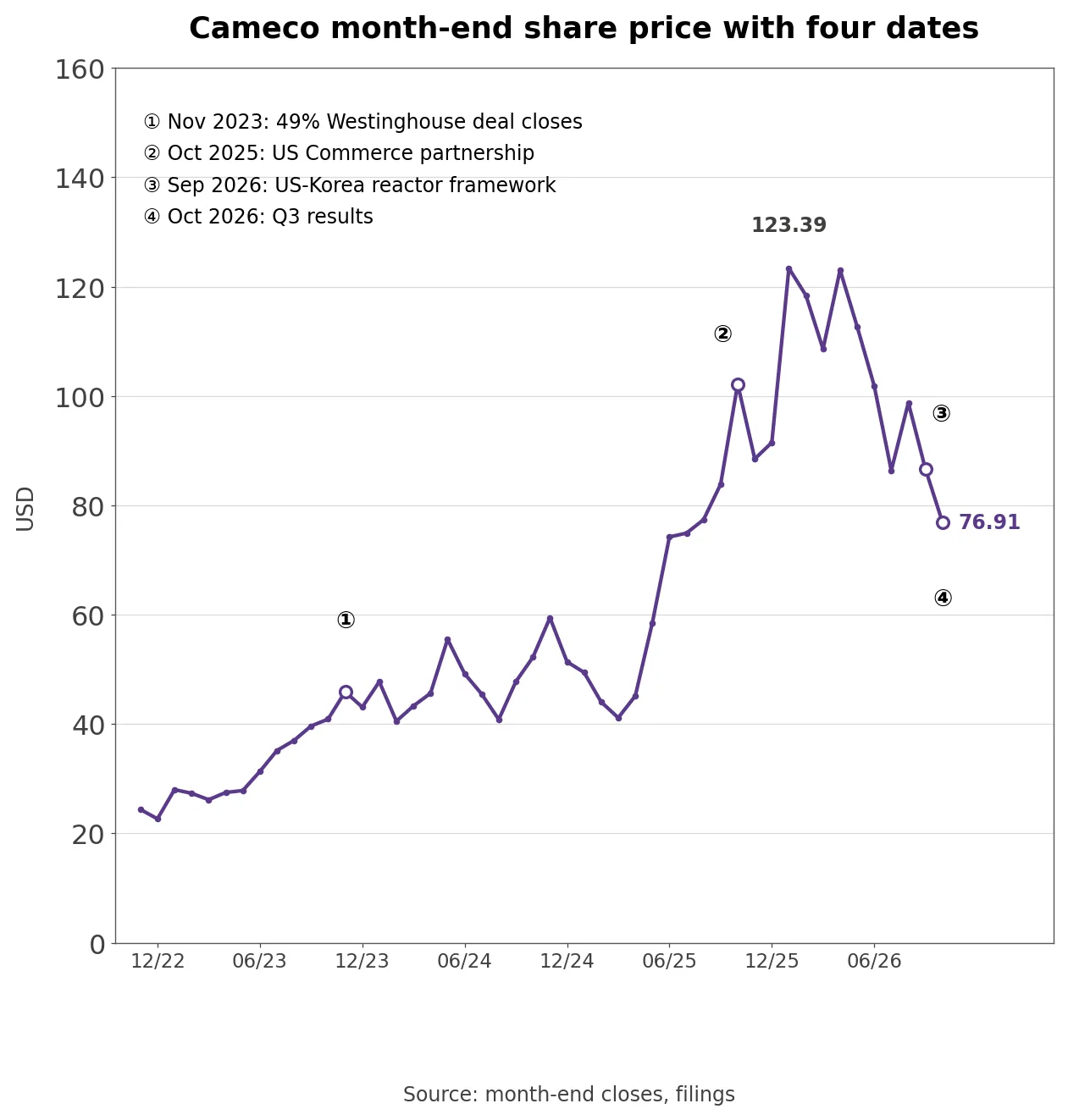
- Today’s Cameco took shape on November 7, 2023, when it closed the purchase of Westinghouse with Brookfield and took a 49% stake. The shares closed November 2022 at $24.38 and November 2023 at $45.92, and from then on a uranium miner also owned a reactor designer, fuel maker and service provider.
- Uranium prices wobbled first. The quarter-end spot price went from $91.00 at the end of 2023 to $64.23 at the end of March 2025, the month the shares closed at a low of $41.16. Reactor policy changed the direction after that. In October 2025, when Westinghouse and its two owners announced a partnership with the US Commerce Department to build new AP1000 reactors, the month-end close rose +21.9% to $102.21, and January 2026 brought the month-end high of $123.39.
- The shares fell back in 2026. Cameco bought TEPCO’s stake in Cigar Lake jointly with Orano in July, and in September the Commerce Department and South Korea announced a non-binding framework for Korean investment of up to $120 billion to build up to eight large reactors in the US, yet the September close of $86.67 was -12.2% below August. The stock fell -7.88% the day after the Q3 report, and the October close of $76.91 is -37.7% below the high and 3.15 times the November 2022 level.
Why Does Cameco Earn Less Than the Spot Price?
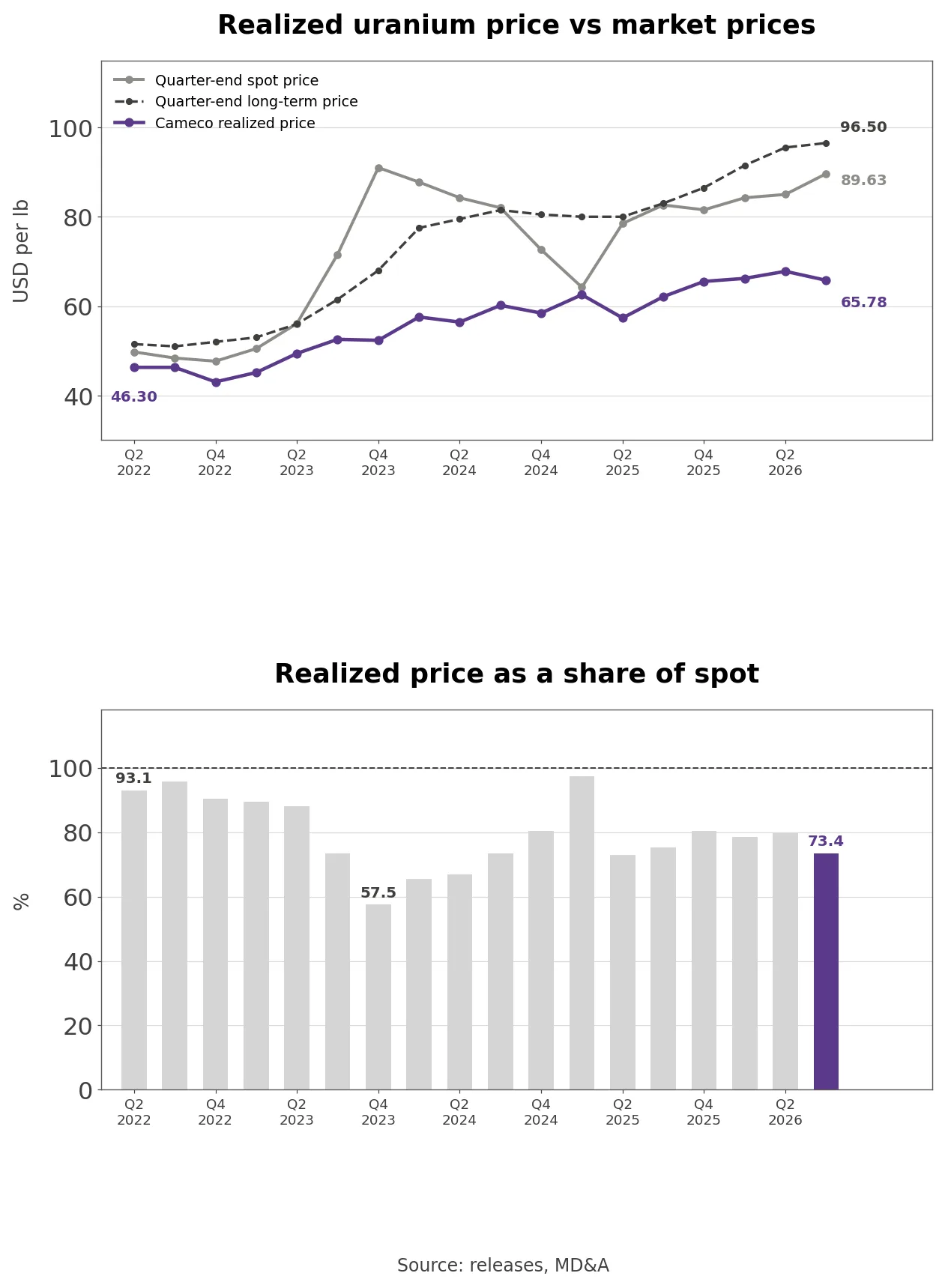
- Cameco’s realized price is uranium revenue, including transport and storage fees, divided by pounds delivered in the quarter. Against 18 quarter-end spot prices, the Q2 2022 realized price of $46.30 was 93.1% of spot at $49.75, but when spot jumped to $91.00 in Q4 2023 the realized price of $52.35 was only 57.5% of it. With spot down at $64.23 in Q1 2025, the realized $62.55 caught up to 97.4%, and Q3 2026 stands at 73.4%.
- Own calculation (16 earnings releases and four MD&As): From Q2 2022 to Q3 2026 the spot price rose $39.88 to $89.63 while the realized price rose $19.48 to $65.78. Only 48.8% of the rise in spot reached the realized price, and the long-term price rose $45.00 to $96.50 over the same span.
- The company’s explanation is the contract mix. The MD&A ties the nine-month gap to “the impact of ceiling prices on market-priced contracts, which limited the average realized price”. Cameco’s long-term book mixes base-escalated contracts, priced at signing and escalated with inflation, with market-related contracts that carry floors and ceilings, so floors cushion falling markets and ceilings cap rising ones. Slide 10 describes the goal as pricing that gives exposure to rising markets and protection when prices decline.
- Costs moved the other way. Q3 cash production cost was C$40.73 per pound, +61.6% from C$25.20, and the MD&A says “The increase was due to the impact of fixed costs on lower production as well as the effects of inflation”. Produced and purchased cost combined was C$66.36, so the margin against the C$91.76 realized price narrowed to C$25.40 per pound from C$37.72, and uranium adjusted EBITDA fell -18.6% to C$179 million.
- Cash followed. Quarterly operating cash flow went from C$677 million in Q4 2025 to negative C$22 million, C$131 million and C$3 million in the first three quarters of 2026, and the MD&A blames lower earnings, higher income taxes paid and higher working capital. Cash at the end of September was C$860 million, 29% below the end of 2025, after also paying for the extra Cigar Lake stake.
The Price Sensitivity Table a Year Later
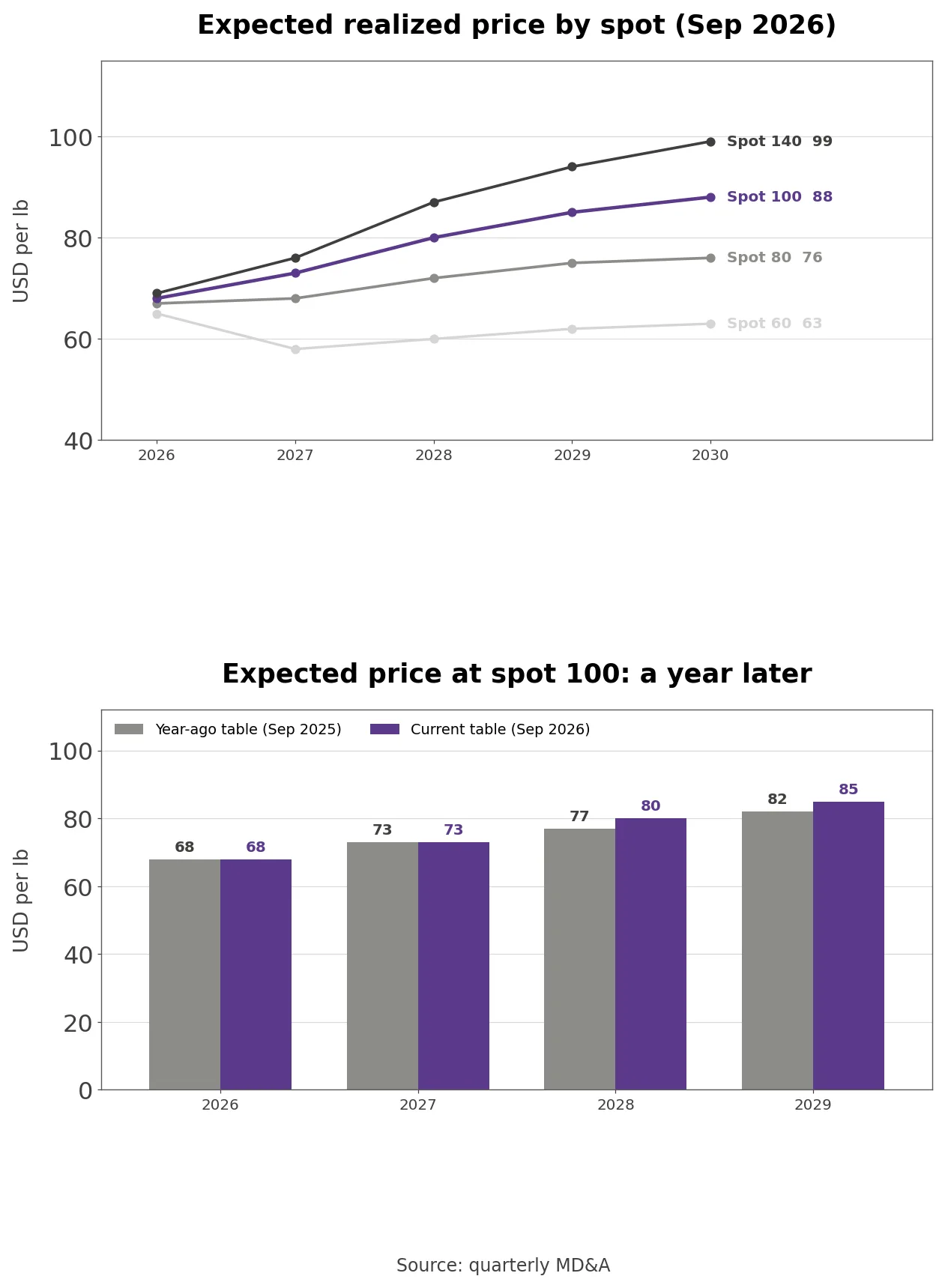
- Every quarter Cameco publishes the average realized price its finalized contracts would deliver if spot held at a fixed level. In the September 2026 table, a $100 spot price yields $68 in 2026, $73 in 2027, $80 in 2028, $85 in 2029 and $88 in 2030. At $140 spot the 2027 figure is $76 and 2030 reaches $99, while $60 spot gives $58 in 2027. The company stresses that “It is important to note that the table is not a forecast of prices we expect to receive”.
- Own calculation (Q3 2025 and Q3 2026 MD&As): At a spot price of $100, the expected realized price for 2027 is $73 in both the year-ago table and the current one. The 2028 figure moved from $77 to $80 and 2029 from $82 to $85. A year ago the table pointed to $68 for 2026 at $100 spot, and the realized price through nine months was $66.64.
- A year of new contracting barely moved what Cameco would collect in a high-price world. With spot at $89.63, between the $80 and $100 columns, averaging the two gives roughly $70.50 for 2027 and $76.00 for 2028. A footnote also explains that the high-price figures for later years fell from the Q2 table because of a methodology correction under one contract; at $160 spot, 2030 went from $106 to $104.
How Cameco Makes Money
- Cameco has three tier-one mines. McArthur River (69.8%), which the company calls the world’s largest high-grade uranium mine, sends ore to the Key Lake mill (83.3%) and holds 241.9 million pounds of proven and probable reserves for Cameco’s share at an average grade of 6.48%, with mine life to 2044. Cigar Lake (57.4%) holds 94.1 million pounds at 16.33% with life to 2036, and JV Inkai (40%) in Kazakhstan runs to 2045. Idle tier-two assets at Rabbit Lake, Millennium (69.9%), Yeelirrie and Kintyre give the company supply it can restart if prices justify it.
- Inkai is equity-accounted, so Cameco records its share of output as a purchase and captures the benefit through dividends that reflect Inkai’s low cost. Its life-of-mine operating cost is C$12.94 per pound, against C$21.72 at McArthur River/Key Lake and C$23.94 at Cigar Lake, and Cameco says the McArthur River figure will be revised in an updated technical report.
- Uranium dominates the top line. Of C$2.278 billion of nine-month revenue, the uranium segment contributed C$1.888 billion, or 82.9%, and fuel services C$381 million, or 16.7%. Fuel services covers Blind River, which the company calls the world’s largest commercial uranium refinery, UF6 and UO2 conversion at Port Hope, whose operating licence expires in February 2027, and heavy water reactor fuel bundles. Its Q3 realized price was C$42.90 per kgU, down -12.6%, and adjusted EBITDA was C$24 million.
- Westinghouse, owned 49% by Cameco and 51% by Brookfield, services about 63% of the world’s roughly 417 operating reactors and fuels about 40%. Its Operating Plants business (fuel, outage services and long-term operations) carried a $13.2 billion backlog at the end of 2025, and the New Plants business, which designs and procures AP1000 reactors, carried $0.8 billion. Purchase accounting amortization keeps its net result weak, so Cameco’s Q3 share was a net loss of C$24 million against adjusted EBITDA of C$143 million.
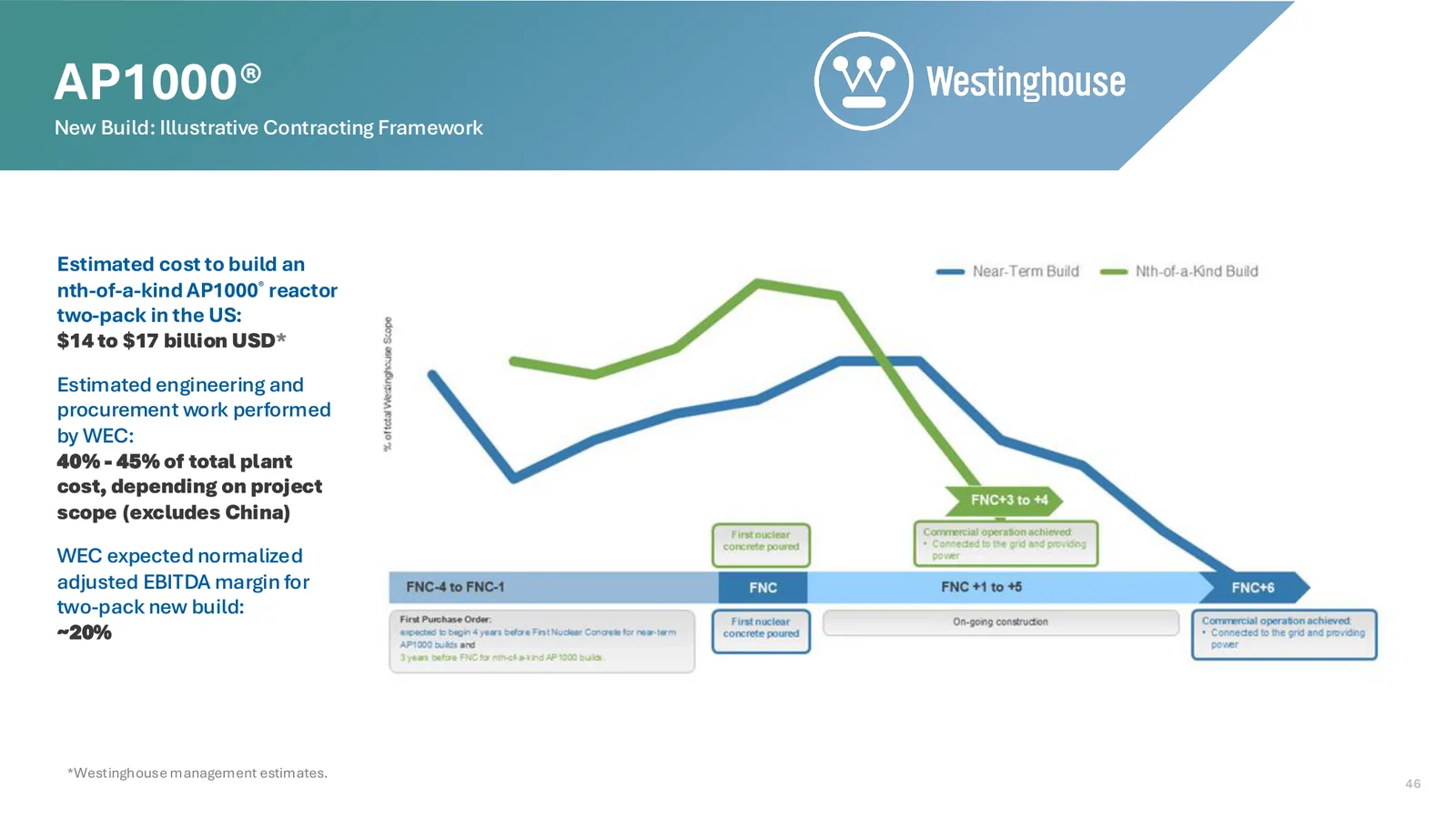
- Page 46 shows the AP1000 math. An nth-of-a-kind two-unit plant in the US is estimated at $14 billion to $17 billion, Westinghouse performs 40% to 45% of total plant cost in engineering and procurement, and the target normalized adjusted EBITDA margin is about 20%. The MD&A puts Westinghouse’s share of a near-term two-unit project at $8 billion to $11 billion. Multiplied by Cameco’s 49% stake, that is $3.9 billion to $5.4 billion per project. Once running, each two-unit plant adds $45 million to $60 million a year of fuel and service revenue for more than 80 years.
- Korea runs through the story too. The US-Korea framework covers six AP1000s and two Korean APR1400s, with Westinghouse’s scope on each APR1400 put at about $2 billion, and about $7.5 billion of a planned $10 billion advance payment by year-end would buy long-lead AP1000 equipment. The Dukovany project in the Czech Republic that paid Westinghouse in 2025 is led by Korea Hydro & Nuclear Power, and Cameco also owns 49% of laser enrichment developer GLE, with an option to reach 75%.
Cameco vs BWX Technologies Centrus and Energy Fuels
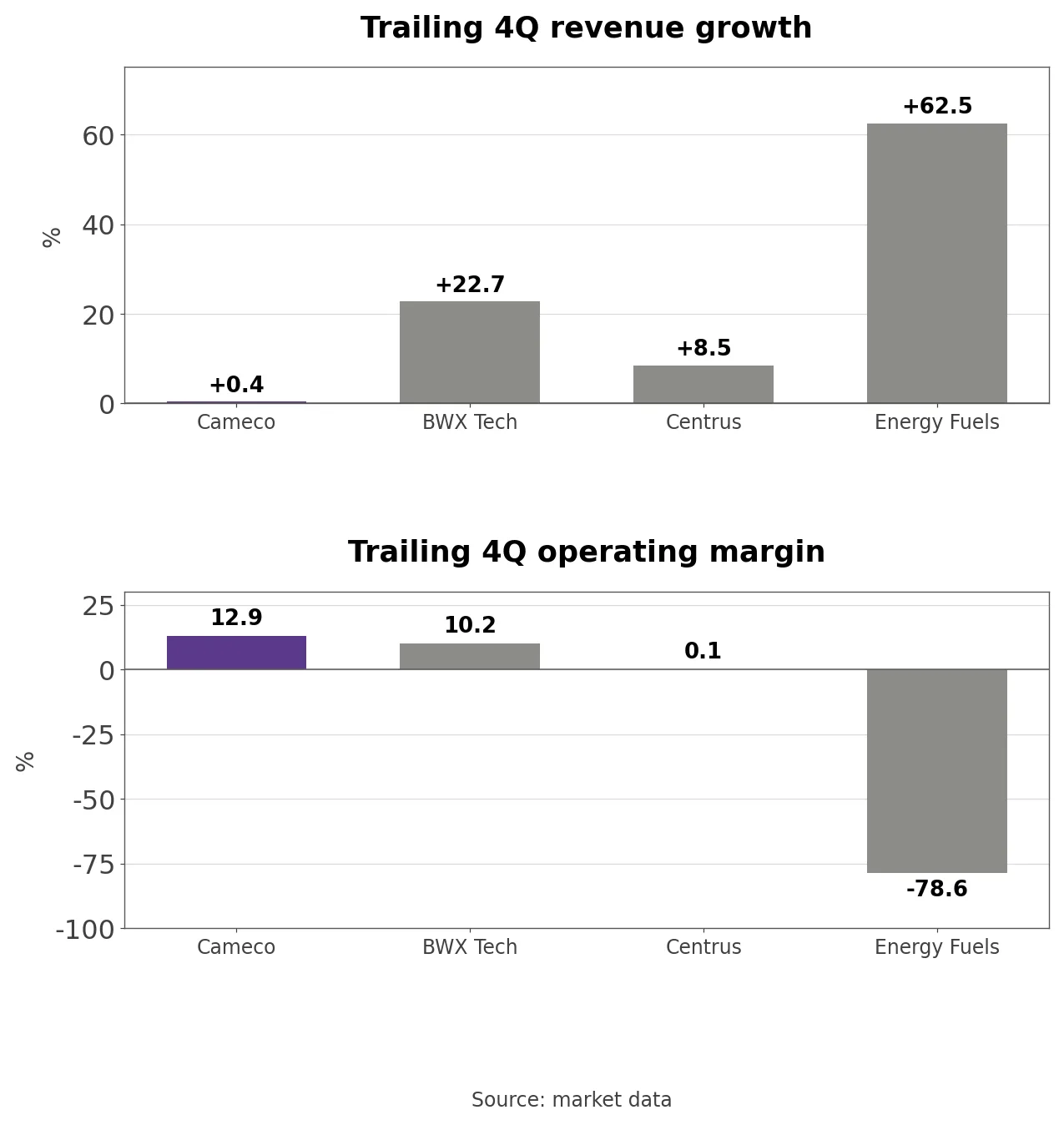
- The comparison uses three US-listed nuclear fuel and component companies: BWX Technologies (naval reactors and nuclear components), Centrus (enrichment) and Energy Fuels (US uranium and rare earths). On market data, TTM revenue growth was +0.4% at Cameco, +22.7% at BWX Technologies, +8.5% at Centrus and +62.5% at Energy Fuels (the last three through June). Operating margins were 12.9%, 10.2%, 0.1% and -78.6%, so Cameco grew slowest and earned the widest margin.
- Over a year, market value changed -27.7% at Cameco, -38.7% at BWX Technologies, -70.3% at Centrus and -59.0% at Energy Fuels. Uranium producer UEC is left off the charts: $3.82 billion of market value, a price-to-sales ratio of 102.58 and no earnings. Only Cameco and Energy Fuels mine uranium; BWX Technologies and Centrus process it or build components, so their revenue tracks reactor construction and government contracts more than uranium prices.
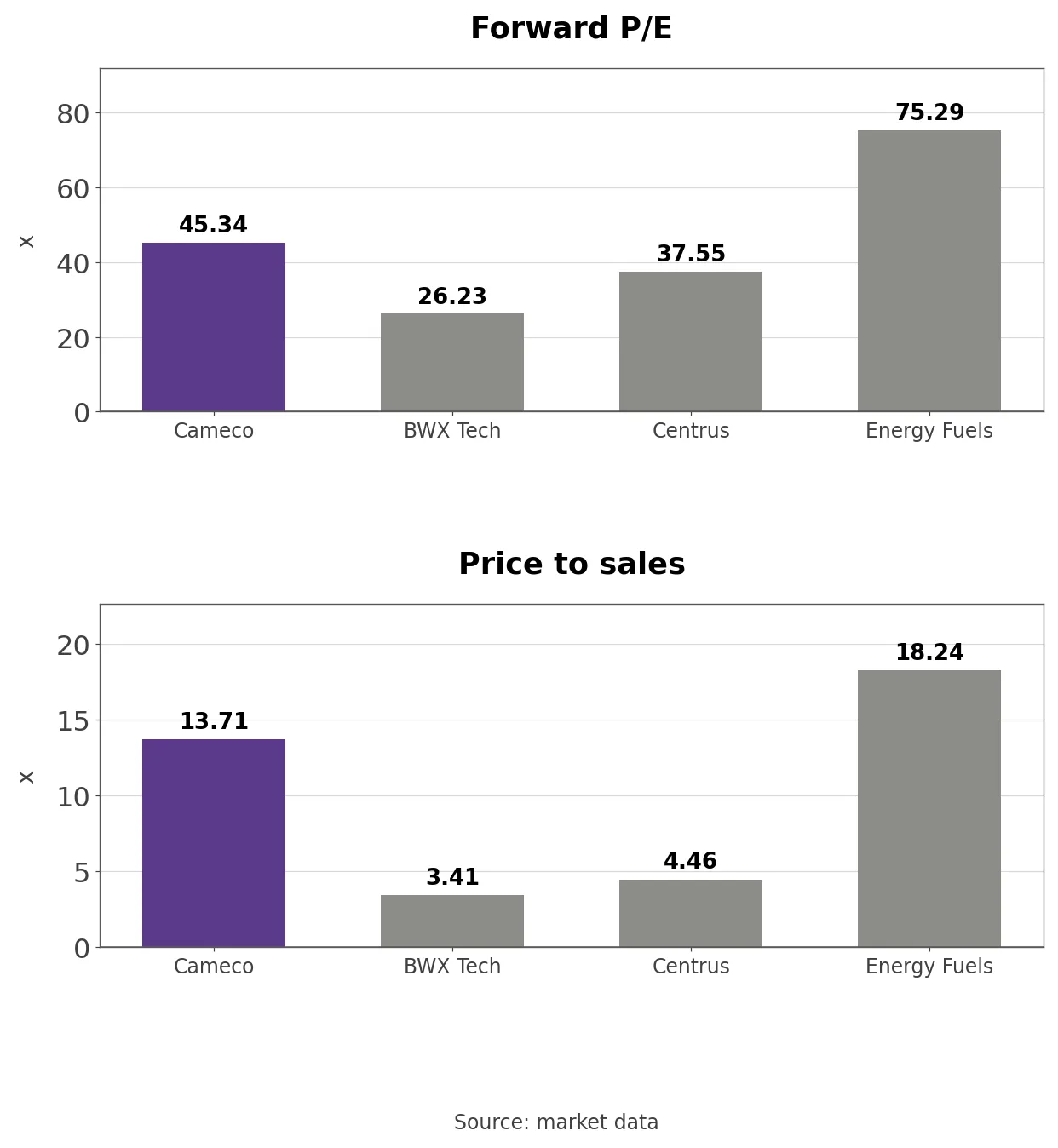
- Cameco’s forward P/E of 45.34 is above BWX Technologies’ 26.23 and Centrus’ 37.55 and below Energy Fuels’ 75.29. Its price to sales of 13.71 is 3.1 to 4.0 times BWX Technologies’ 3.41 and Centrus’ 4.46. Paying 13 times sales for flat revenue means the multiple prices Westinghouse and new reactor builds more than uranium sales. The payout is limited to an annual dividend of C$0.24 per share, and while Cameco is not in a net cash position, net debt of C$140 million is small.
Cameco’s Price-to-Sales and EV-to-EBITDA Band
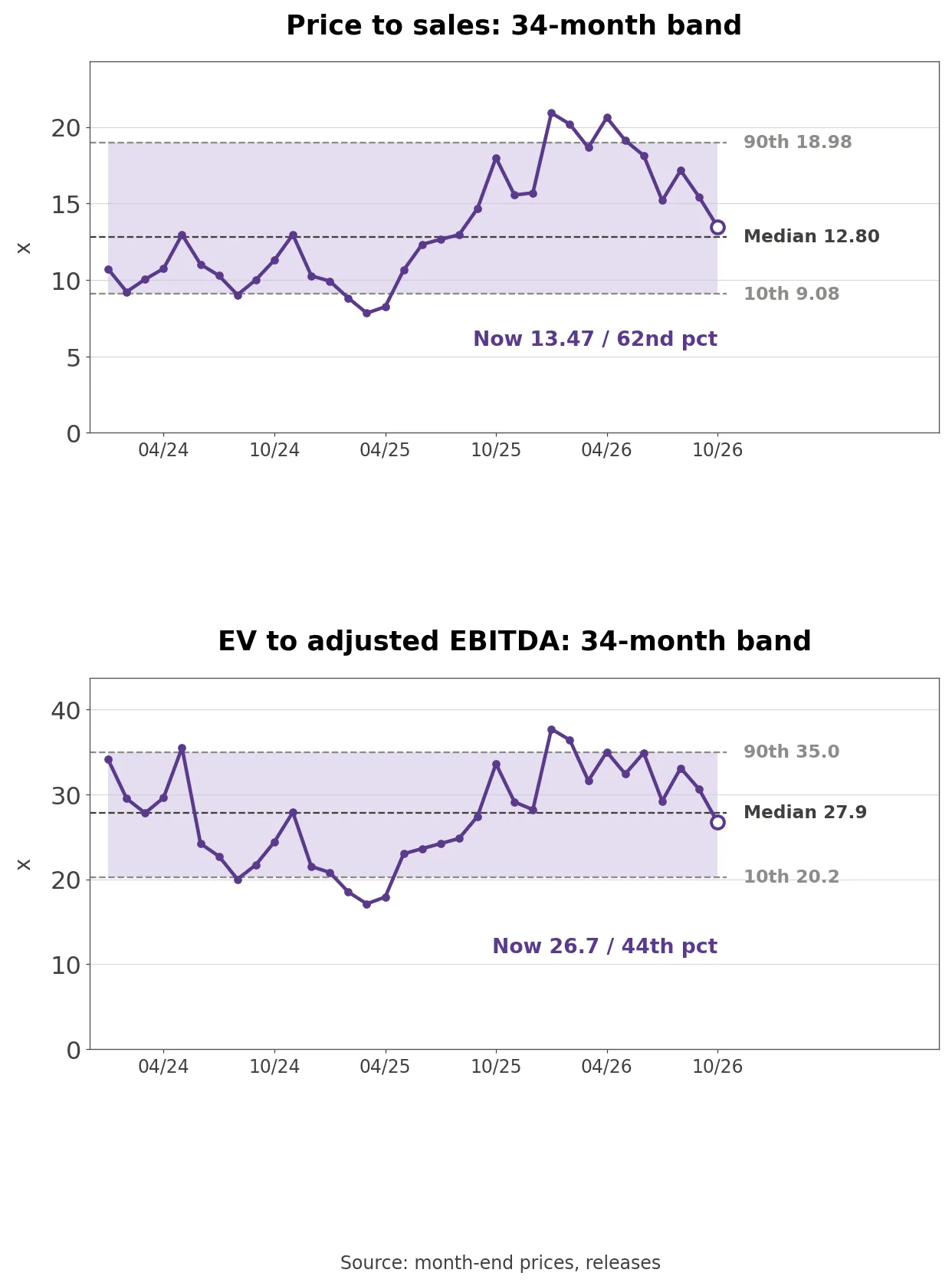
- The band covers 34 months from January 2024, the first month with four quarters of adjusted EBITDA including Westinghouse. Because financials are in Canadian dollars and the stock trades in US dollars, market value is converted at FRED month-end exchange rates. P/E is left out: the trailing figure of 117.77 and forward 45.34 swing too much on a small earnings base.
- Own calculation (month-end prices and 16 earnings releases): Price to sales of 13.47 sits in the 62nd percentile of 34 months (median 12.80, high 20.92). Enterprise value of C$47.01 billion, including C$140 million of net debt, is 26.7 times TTM adjusted EBITDA of C$1.758 billion, in the 44th percentile (median 27.85, high 37.7).
- Even after a -37.7% fall from the peak, both multiples sit mid-band. At the March 2025 low, price to sales was 7.83 and EV to adjusted EBITDA 17.1. Westinghouse’s C$639 million share of TTM adjusted EBITDA equals 36.3% of the C$1.758 billion total, so much of the multiple rests on Westinghouse rather than uranium.
Three Conditions That Move the Stock
- The price sensitivity table shows whether contract ceilings are loosening. If the $100 spot column for 2028 to 2030 moves above $80, $85 and $88 in the next table, new contracts are starting to capture market upside, which would support the stock. Another year of roughly $3 changes would mean earnings keep trailing spot.
- Cash production cost shows the earning power of the tier-one mines. A return toward the 2025 nine-month level of C$24.39 per pound after the Key Lake outage would rebuild the per-pound margin. Staying above C$30, or a McArthur River technical report that lifts life-of-mine cost above C$21.72, would weigh on the shares.
- Westinghouse adjusted EBITDA and firm AP1000 orders hold up the multiple. Turning the US-Korea framework into definitive contracts, moving the $10 billion advance payment and reaching a final investment decision on a first US AP1000 project would support the stock. A framework that stays non-binding, or a fourth-quarter Westinghouse share below the C$211 million of Q4 2025, would undercut it.
What to Watch in the December Quarter
- The Q4 report, likely in early February 2027, should show whether Cameco delivered the 9 million to 10 million pounds the full-year guidance implies, what share of spot the realized price reached and whether cash production cost came down after the Key Lake work. The December sensitivity table and the status of the US-Korea framework will arrive at the same time.
- One question stays open. Cameco has accepted slower participation in rising prices in exchange for protection when prices fall, under what it calls contracting discipline. With the long-term price at $96.50, will the next contracts carry much higher ceilings, or will the company keep choosing stability?
Related Analysis
- Linde (LIN) Stock Analysis: Price, Volume and Margin Trends: another company whose results split into contracted price and volume, useful for comparing how pricing terms set the pace of margin change.
- Dell (DELL) Stock Analysis: Q2 FY2027 Earnings and Guidance: the AI data center buildout seen from the server side, the same power demand that utilities cite when they look at new reactors.