- Philip Morris International (NYSE: PM) reported record third-quarter adjusted EPS of $2.36, but cigarette pricing did the heavy lifting. Over nine months, adjusted operating income rose $1.35 billion while the price variance alone added $1.89 billion, and $1.61 billion of that came from international combustibles. The U.S. business built around ZYN, which PMI bought with Swedish Match, moved the other way: nine-month adjusted operating companies income (OCI) fell to $550 million from $958 million, and management guided fourth-quarter U.S. adjusted OCI to around zero as it moves ZYN from 15-pouch to 20-pouch cans. The question is whether smoke-free products can take over as the profit engine once the U.S. investment phase ends, while cigarettes are still paying for it.
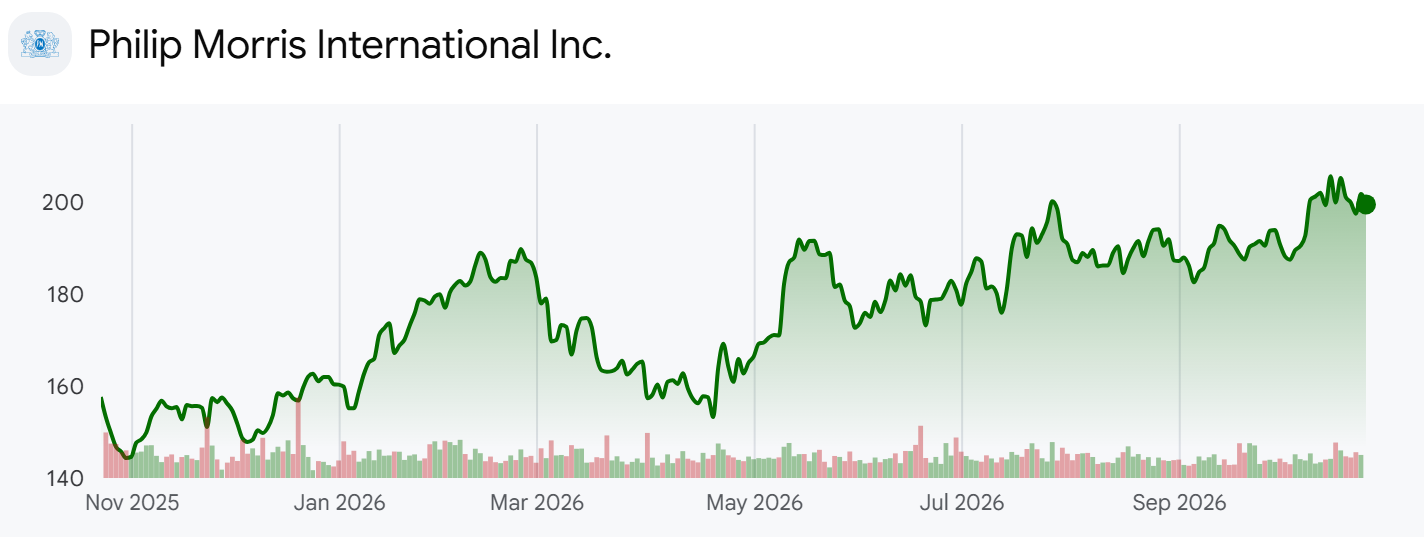
- PMI sells Marlboro cigarettes, IQOS heated tobacco, ZYN nicotine pouches and VEEV e-vapor products outside the U.S. and, increasingly, inside it. At $199.47 a share the company is worth $310.9 billion, and the stock is +24.4% in 2026 and +38.2% over one year, though it fell -2.8% from the prior week's high of $205.20 in results week. The analysis parses 32 quarterly releases since the fourth quarter of 2018 and checks them against the third-quarter earnings release, its supplemental schedules, the third-quarter deck and prepared remarks, the 10-Q and the 2025 10-K. Adjusted EPS and adjusted OCI are non-GAAP measures that exclude acquired intangible amortization and one-off items; the P/E band sums adjusted EPS over the trailing four quarters (TTM). Stockholders' equity is negative, so there is no price-to-book band.
The Investor Deck on ZYN's 20-Pouch Can
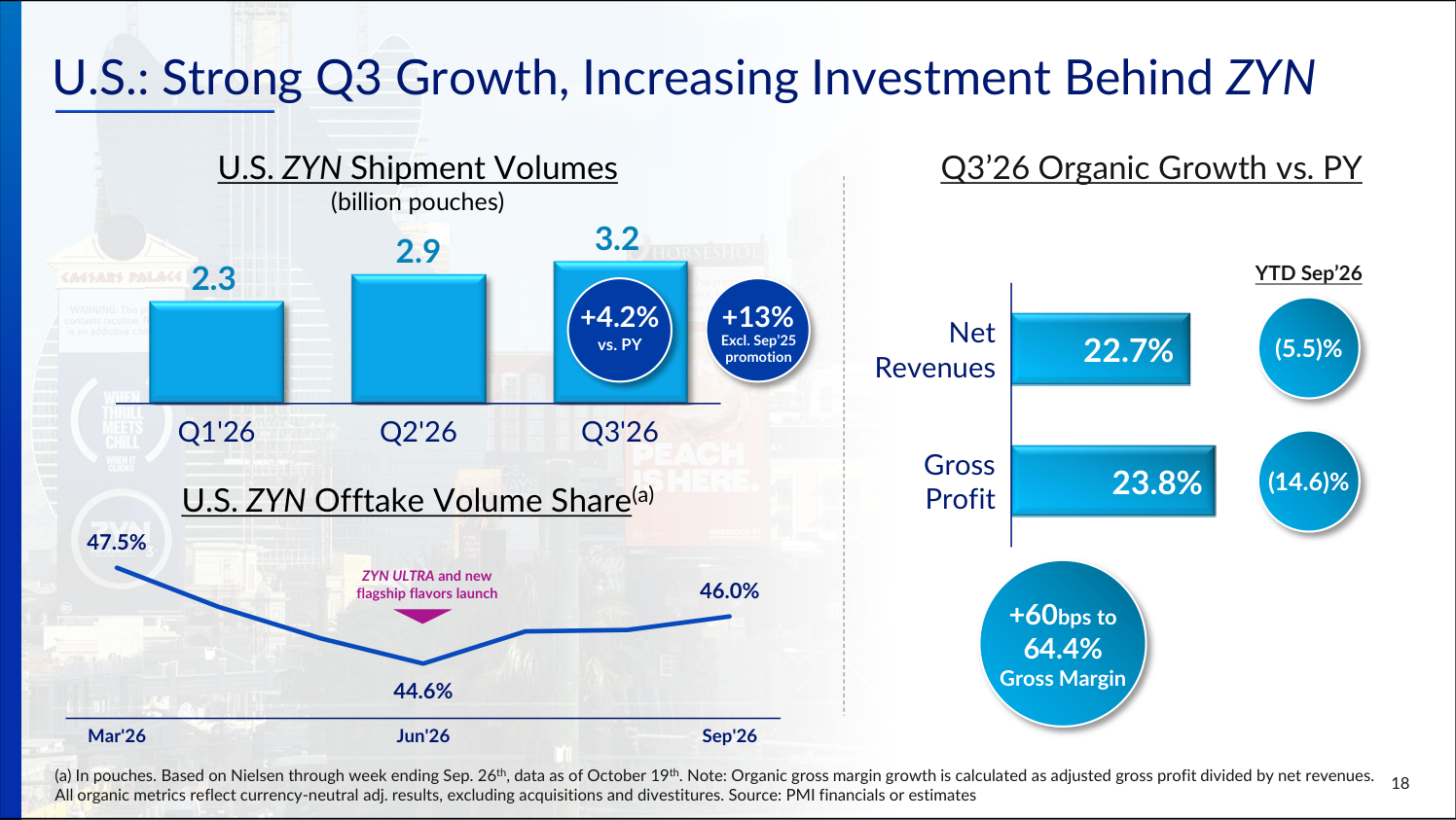
- Slide 18 of the third-quarter deck shows U.S. ZYN shipments of 2.3 billion pouches in the first quarter, 2.9 billion in the second and 3.2 billion in the third, up 4.2% from a year earlier and 13% excluding a September 2025 promotion. The line below it tracks ZYN's Nielsen offtake share falling from 47.5% in March to 44.6% in June, then recovering to 46.0% in September after the launch of ZYN ULTRA and new flavors.
- Company disclosure (third-quarter prepared remarks): Starting in October, PMI is moving its 1.5mg, 3mg and 6mg flagship variants from 15 to 20 pouches per can, which "translates into approximately 25% less revenue-per-pouch" all else equal. U.S. segment SG&A rose to about $370 million in the third quarter and will rise about 10% more in the fourth. Management added: "We expect an abnormally low level of U.S. profitability in the fourth quarter, with adjusted OCI around zero or slightly negative."
- The release frames the move as pricing strategy: "The change to 20-pouch cans is designed to align the value proposition across the portfolio and optimize ZYN's price premium." The remarks also say the step-up was flagged at second-quarter earnings, that fourth-quarter shipments should be broadly in line with or modestly above the third quarter, and that "Looking beyond Q4, we view the Q3 level of spend to be sufficient to support the brand." On the call, CFO Massimo Andolina said consumers who had left ZYN for higher-nicotine competitors were returning after the 9mg and 11mg ZYN ULTRA launch.
- Slide 19 lists the rest of the plan: ZYN ULTRA and new dry flavors approaching full distribution, 1.5mg and 8mg flagship variants rolling out, and a fourth-quarter ramp of the "When It Clicks" campaign. The FDA authorized 11 ZYN ULTRA variants on August 21, bringing ZYN to 31 authorized variants.
- The filings show what the investment costs. U.S. net revenue over nine months was $2.32 billion, 7.1% of the group and -5.2% from a year earlier, and the U.S. nine-month adjusted gross margin was 64.1% against 71.2%. Third-quarter U.S. adjusted OCI of $171 million adds back $205 million of adjusting items; before them the segment's OCI was -$34 million. The 10-Q notes that "Non-amortizable intangible assets substantially consist of the ZYN trademarks," which carry $4.59 billion on the balance sheet and are tested for impairment each second quarter.
Cigarette Pricing and the Margin Bridge
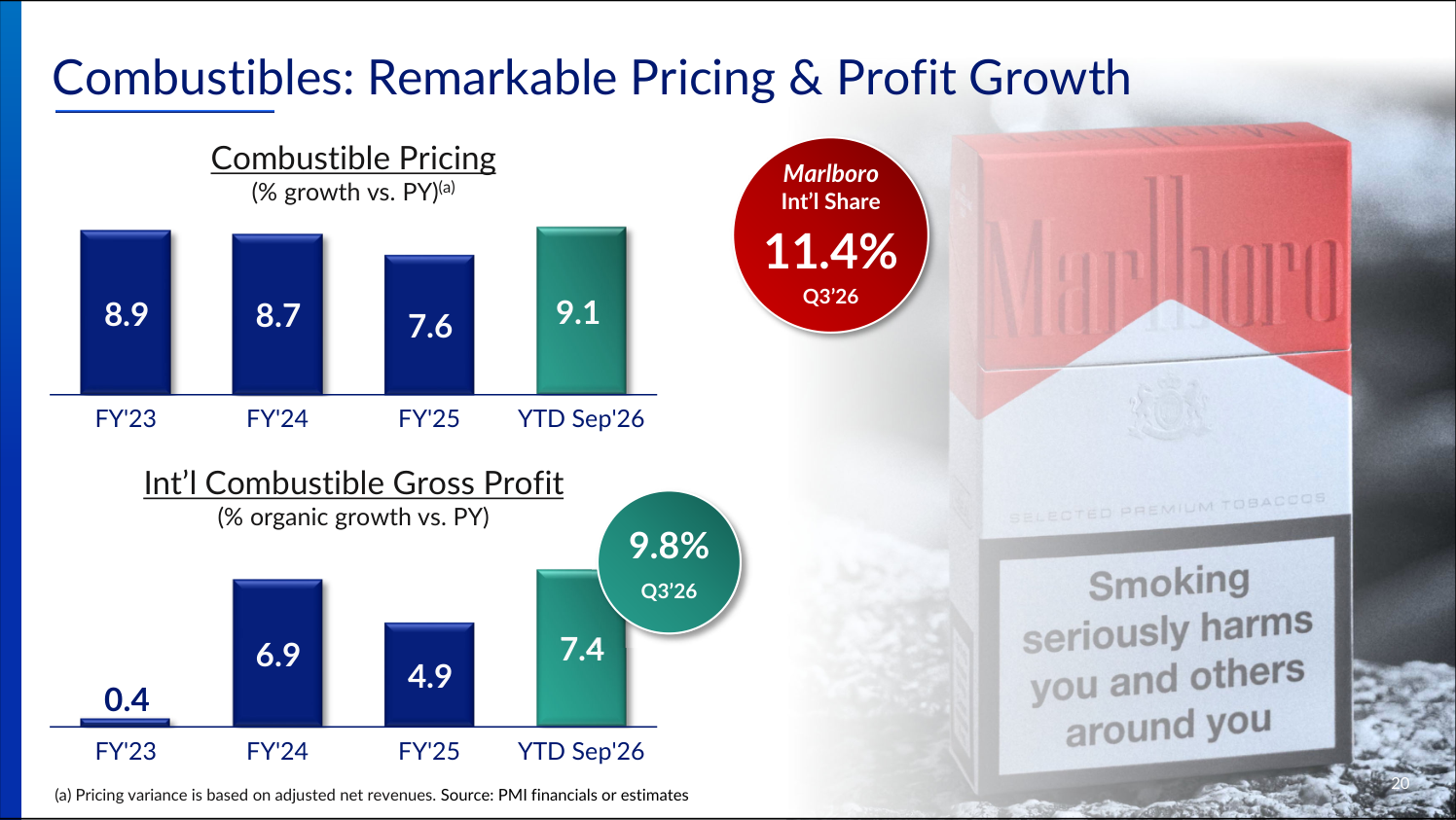
- Slide 20 shows combustible pricing of 8.9% in 2023, 8.7% in 2024 and 7.6% in 2025, rising again to 9.1% for the first nine months of 2026. International combustible gross profit grew 0.4% organically in 2023, 7.4% over nine months of 2026 and 9.8% in the third quarter. Marlboro's international share hit a record 11.4%.
- Company disclosure (third-quarter earnings release): Combustibles net revenue grew 7.8% organically on 8.9% pricing, and the quarter also benefited from restructured distribution terms in certain markets, "which is not expected to recur at the same level in future quarters." Full-year combustible pricing is expected above 8%.
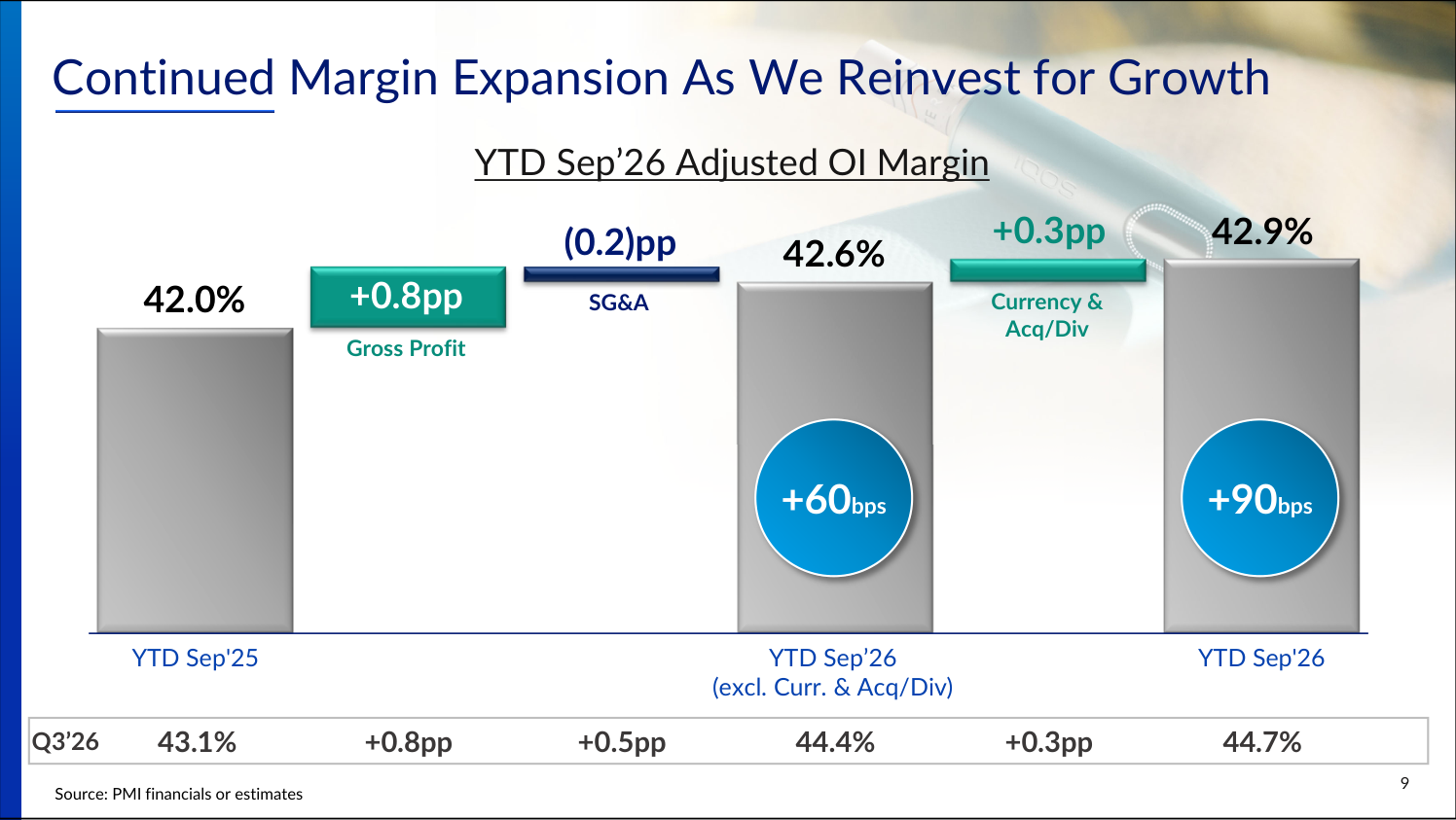
- Slide 9's bridge takes the nine-month adjusted operating margin from 42.0% to 42.9%: gross profit added 0.8 points, SG&A cost 0.2 points and currency plus acquisitions added 0.3 points. In the third quarter alone the margin rose from 43.1% to 44.7%, and SG&A helped by 0.5 points, which the remarks attribute to G&A savings and a prior-year comparison that included certain combustible charges. Cumulative gross savings since 2024 have passed $2 billion, ahead of the three-year goal.
- Slide 10 strips out the U.S.: international organic revenue grew 7.0% over nine months, gross profit 9.1% and OCI 11.4%. International smoke-free revenue grew 9.9% and gross profit 11.8%, reaching a 70.0% gross margin, but in the third quarter those rates slowed to 3.4% and 3.3%, while international combustibles grew revenue 7.8% and gross profit 9.8%. PMI blames shipment timing in Japan and expects smoke-free to reaccelerate in the fourth quarter.
- Own calculation (profit bridge): Nine-month adjusted operating income rose from $12.71 billion to $14.06 billion, an increase of $1.35 billion, while the price variance was $1.89 billion, or 139.7% of the increase. International combustibles supplied $1.61 billion, 85.1% of the price variance; volume and mix cost $261 million and costs $650 million.
The Bull and Bear Case for PMI Shares
- The bull case rests on smoke-free momentum and cash. Smoke-free shipments grew +2.7% in the third quarter, international smoke-free revenue rose 9.9% organically over nine months at a 70.0% gross margin, operating cash flow is guided to a record of about $13.5 billion, and the dividend was raised for the 19th straight year to $6.40.
- The bear case rests on where profit growth comes from and what the market pays for it. Pricing explained more than all of the nine-month profit increase, mostly from cigarettes, and U.S. ZYN is entering a lower revenue-per-pouch phase. The P/E on TTM adjusted EPS of 24.27 sits in the 92nd percentile of 47 months, and the 3.01% dividend yield is in the 6th percentile, near the low end of its range.
- Outside view (sell-side research aggregate, October 2026): Of 25 analysts, 17 rate the stock Buy, 7 Hold and 1 Sell, with an average target of $212 and a range of $192 to $225. UBS moved to Neutral in September and raised its target from $192 to $201 the day after results; Barclays raised its target from $205 to $225 in July.
- The average target is +6.3% above the share price.
From Swedish Match to a 42% Smoke-Free Business
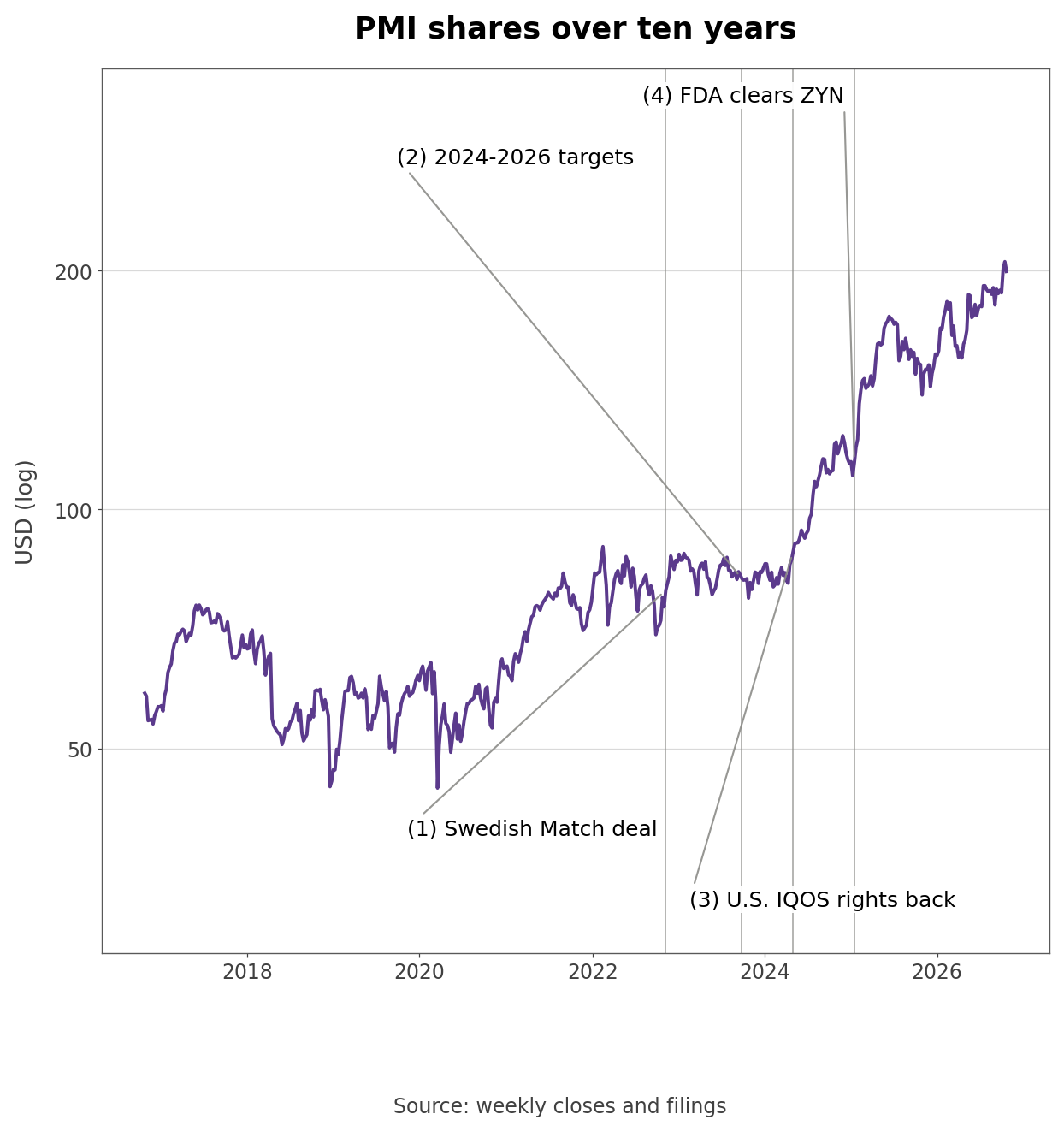
- The stock's trajectory changed around the November 2022 acquisition of Swedish Match, which the 10-K describes as "creating a global smoke-free combination led by the companies' IQOS and ZYN brands." Smoke-free products rose from about 32% of revenue in 2022 and about 37% in 2023 to 41.5% in 2025, when smoke-free revenue reached close to $17 billion.
- On September 28, 2023 PMI set 2024 to 2026 growth targets. Under a 2022 agreement with Altria, it regained full U.S. rights to IQOS on April 30, 2024, and the 10-Q still carries those reacquired rights at a gross $2.78 billion. In early 2025 the FDA authorized ZYN, which PMI's February 2025 release called "long-awaited."
- The stock fell -7.0% in 2023, then rose +27.9% in 2024 and +33.3% in 2025. The month-end P/E bottomed at 14.71 in October 2023 and peaked at 26.71 in May 2025. In February 2026 PMI said "we have delivered our three-year CAGR targets on operating income and EPS in just two years," and set new targets for 2026 to 2028.
Is ZYN's U.S. Recovery Showing Up in Profit?
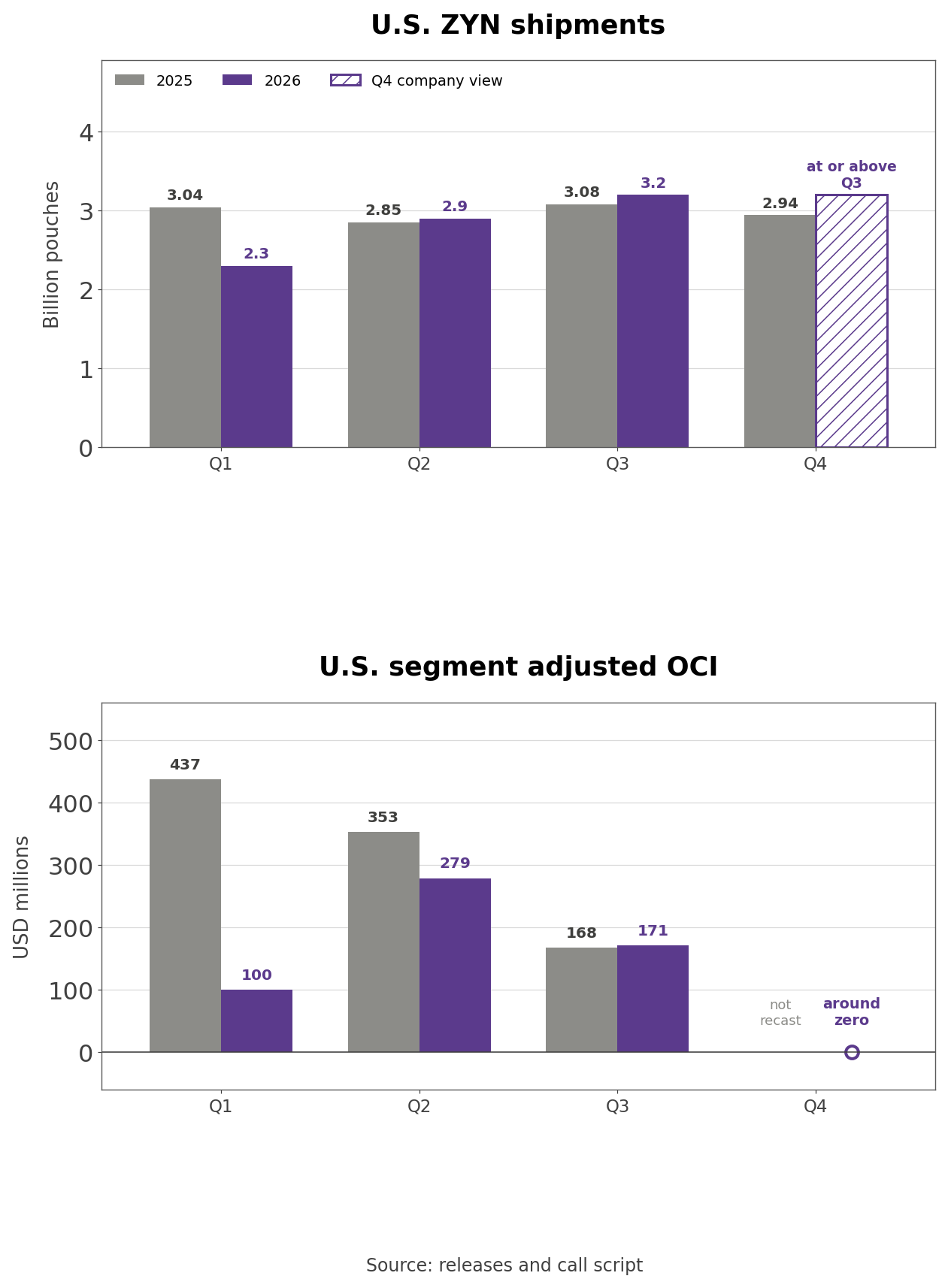
- U.S. ZYN shipments were 205 million cans in the third quarter of 2025, up 37%, and 196 million in the fourth, up more than 19%, for 794 million in 2025. Distributor destocking cut first-quarter 2026 shipments to 2.3 billion pouches, or 155 million cans, -23.5%, before a recovery to 2.9 billion (+1.8%) and 3.2 billion (+4.2%).
- Profit did not follow. U.S. adjusted OCI was $437 million, $353 million and $168 million in the first three quarters of 2025, and $100 million, $279 million and $171 million in 2026. Third-quarter U.S. revenue rose 22.7%, largely because last year's promotional discounts did not repeat.
- Own calculation (ZYN and U.S. profit): Backing out 2025 from the 2026 growth rates gives about 3.04 billion pouches in the first quarter and 2.85 billion in the second; with the reported third and fourth quarters, the total matches the 794 million cans reported for 2025 within one million cans. If fourth-quarter U.S. adjusted OCI lands near zero as guided, the 2026 total of about $550 million will fall short even of the $958 million earned in the first nine months of 2025.
Pricing and the Fourth-Quarter EPS Guide
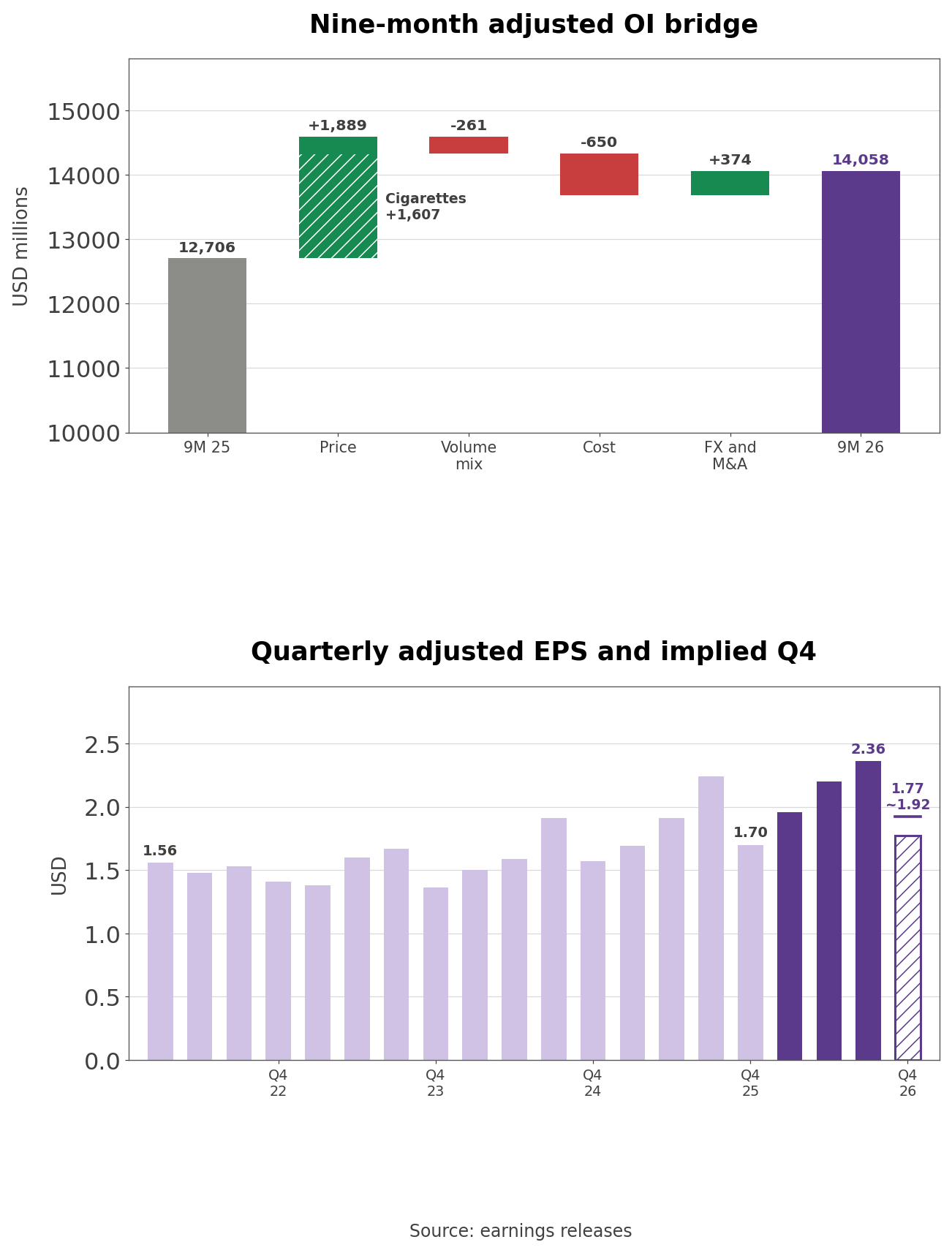
- Quarterly adjusted EPS climbed from $1.56 in the first quarter of 2022 to $2.36. The 2026 range of $8.29 to $8.44 is 9.9% to 11.9% above 2025's $7.54, including $0.18 of currency benefit, down from $0.27 in February and $0.24 in July. Reported diluted EPS fell -4.9% to $2.12 mainly on fair value losses on listed stakes in India and Sri Lanka. The remarks say a low prior-year tax rate cut third-quarter EPS growth by about 4 points, and Middle East energy costs plus Ukraine disruption together trim about 1 point of full-year growth.
- Company disclosure (third-quarter earnings release): Currency-neutral adjusted EPS growth is expected at 7.5% to 9.5%, more likely at the midpoint or lower half given U.S. investment and geopolitical costs. PMI targets net debt to adjusted EBITDA of close to 2.0x by year-end and plans no share repurchases.
- Subtracting nine-month adjusted EPS of $6.52 implies $1.77 to $1.92 for the fourth quarter, 4.1% to 12.9% above last year's $1.70. The February 2026 targets call for 9% to 11% annual currency-neutral EPS growth from 2026 to 2028, so the first year's 7.5% to 9.5% guide already sits below that range.
How Philip Morris Makes Money
- PMI now reports three segments: International Smoke-Free, International Combustibles and the U.S. Third-quarter revenue was $3.87 billion, $6.73 billion and $845 million respectively, and international businesses made up 93% of nine-month revenue. Nine-month adjusted gross margins were 70.0%, 68.0% and 64.1%. Nine-month revenue grew +12.3% in international smoke-free and +7.7% in combustibles, while the U.S. declined 5.2%.
- By volume, cigarettes still dominate: 452.2 billion units over nine months (-1.2%), against 124.5 billion heated tobacco units (+6.7%), 14.9 billion oral units (-5.3%) and 4.0 billion e-vapor units (+68.1%), for 595.6 billion in total (+0.5%).
- IQOS heats tobacco sticks (HTUs) in a device instead of burning them, so PMI sells the device once and the consumables repeatedly. Third-quarter HTU shipments were 41.5 billion, up 1.5%; IQOS took 9.9% of combined cigarette and HTU volume where it is sold, and PMI holds about three quarters of global heated-tobacco volume. Sticks come in tiers: premium TEREA and LEVIA, and mainstream DELIA and SENTIA. Japan is the largest market. Third-quarter adjusted in-market sales there grew 3.4%, or 1.3% excluding pantry-loading ahead of an October tax increase, IQOS holds about 68% of the heated category, and a further tax step in April 2027 will be the third change in 12 months.
- ZYN is a tobacco-leaf-free nicotine pouch. It now has 31 FDA marketing authorizations and 20 modified-risk orders in the U.S., and sells in 62 international markets, where nine-month shipments reached 1.5 billion pouches, up 6.3% like-for-like. VEEV shipments grew 61.6% in the third quarter, it leads Europe's closed-pod segment, and it launched in South Korea in August.
- International combustibles is a pricing business. Third-quarter cigarette shipments were flat at 158.0 billion, but 8.9% pricing, led by Turkey, the Philippines, Indonesia and Poland, lifted revenue, and volumes held up in markets such as Turkey, Indonesia and Egypt where smoke-free products are banned or scarce. PMI's cigarette and HTU share of the international market passed 30% for the first time.
- The U.S. segment holds ZYN, the reacquired IQOS rights, cigars and the Aspeya wellness unit. U.S. IQOS volumes remain below the 50 million units the release table reports. Smoke-free products are sold in 110 markets to an estimated 43 million adults, and PMI has spent more than $16 billion on them since 2008.
How Philip Morris Compares With Three Tobacco Peers
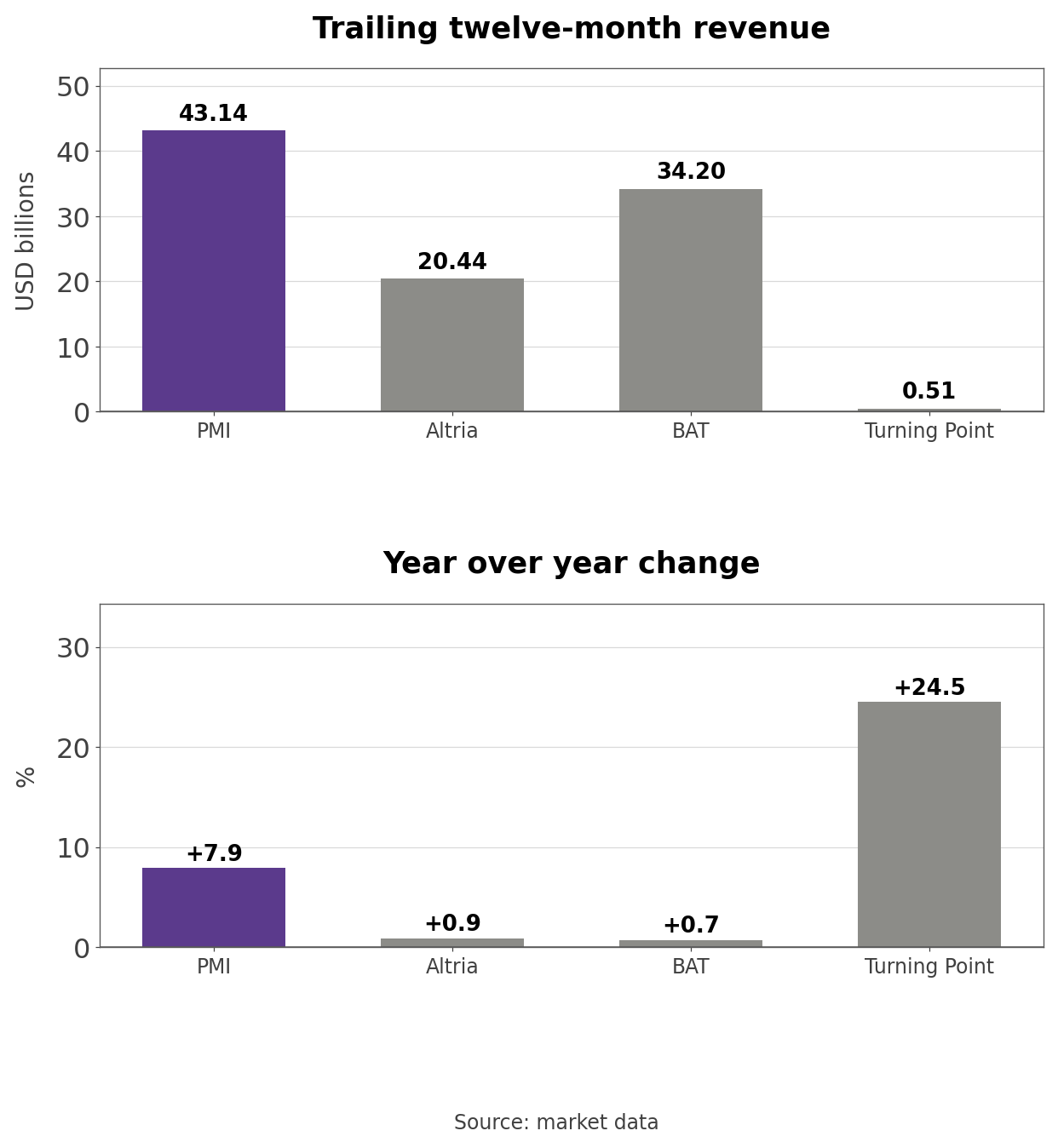
- TTM revenue is $43.14 billion at PMI, $34.20 billion at BAT, $20.44 billion at Altria and $507 million at Turning Point Brands, with growth of +24.5% at Turning Point, +7.9% at PMI, 0.9% at Altria and 0.7% at BAT. Altria sells Marlboro, on! pouches and NJOY vapes in the U.S.; BAT sells cigarettes, heated products, pouches and vapes in the U.S. and Europe; Turning Point sells Zig-Zag papers and Stoker's chewing tobacco in North America. Growth rates diverge, so EV/EBITDA and dividend yield are the yardsticks.
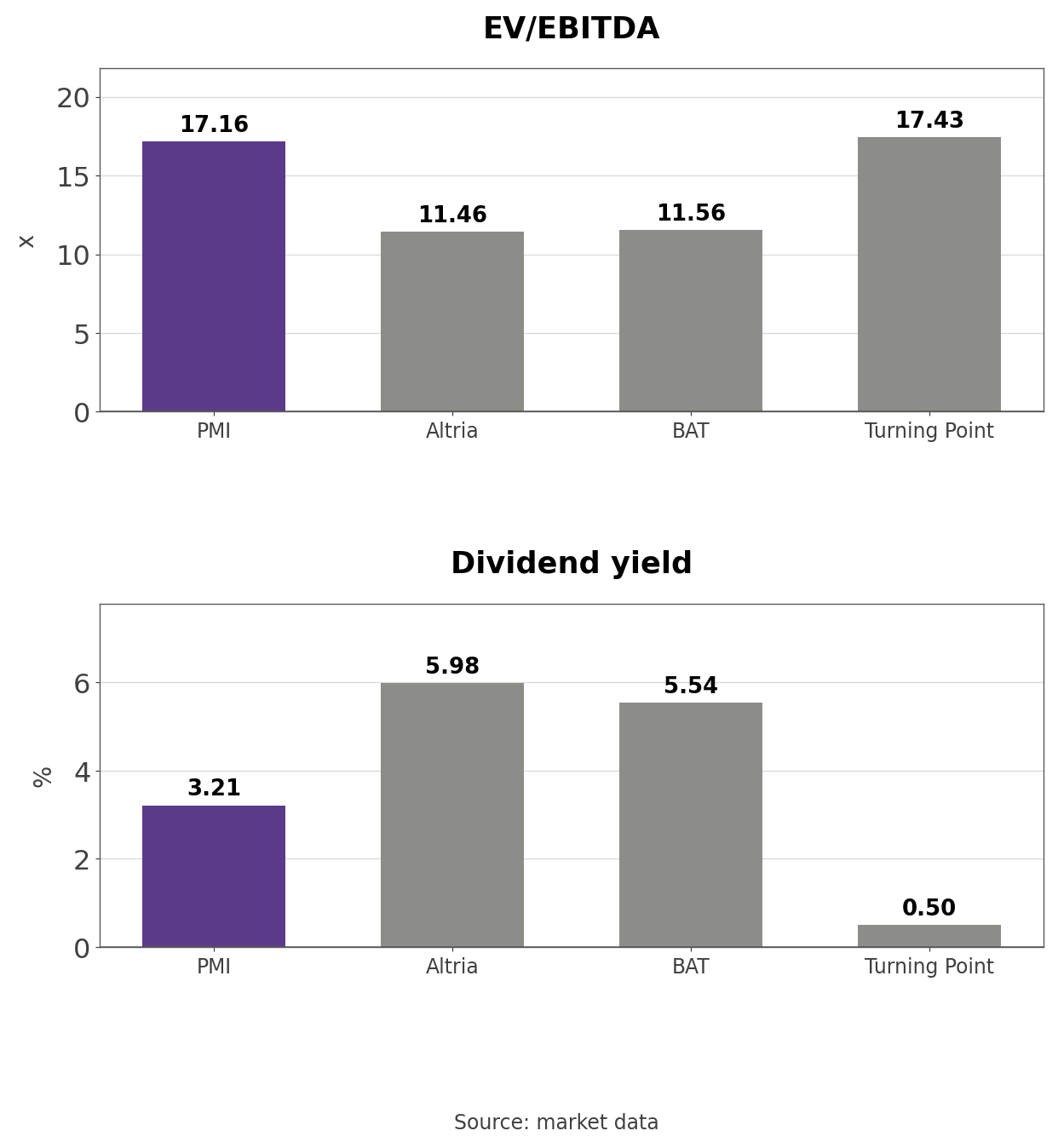
- EV/EBITDA is 17.43 at Turning Point, 17.16 at PMI, 11.56 at BAT and 11.46 at Altria. Dividend yields are 5.98% at Altria, 5.54% at BAT, 3.21% at PMI and 0.50% at Turning Point. Over one year PMI shares rose 38.2%, Altria 31.8% and BAT 16.2%, while Turning Point fell -28.8%. On forward P/E, PMI trades at 22.78 against 12.89 for Altria and 12.00 for BAT.
P/E on Adjusted EPS and Dividend Yield Over 47 Months
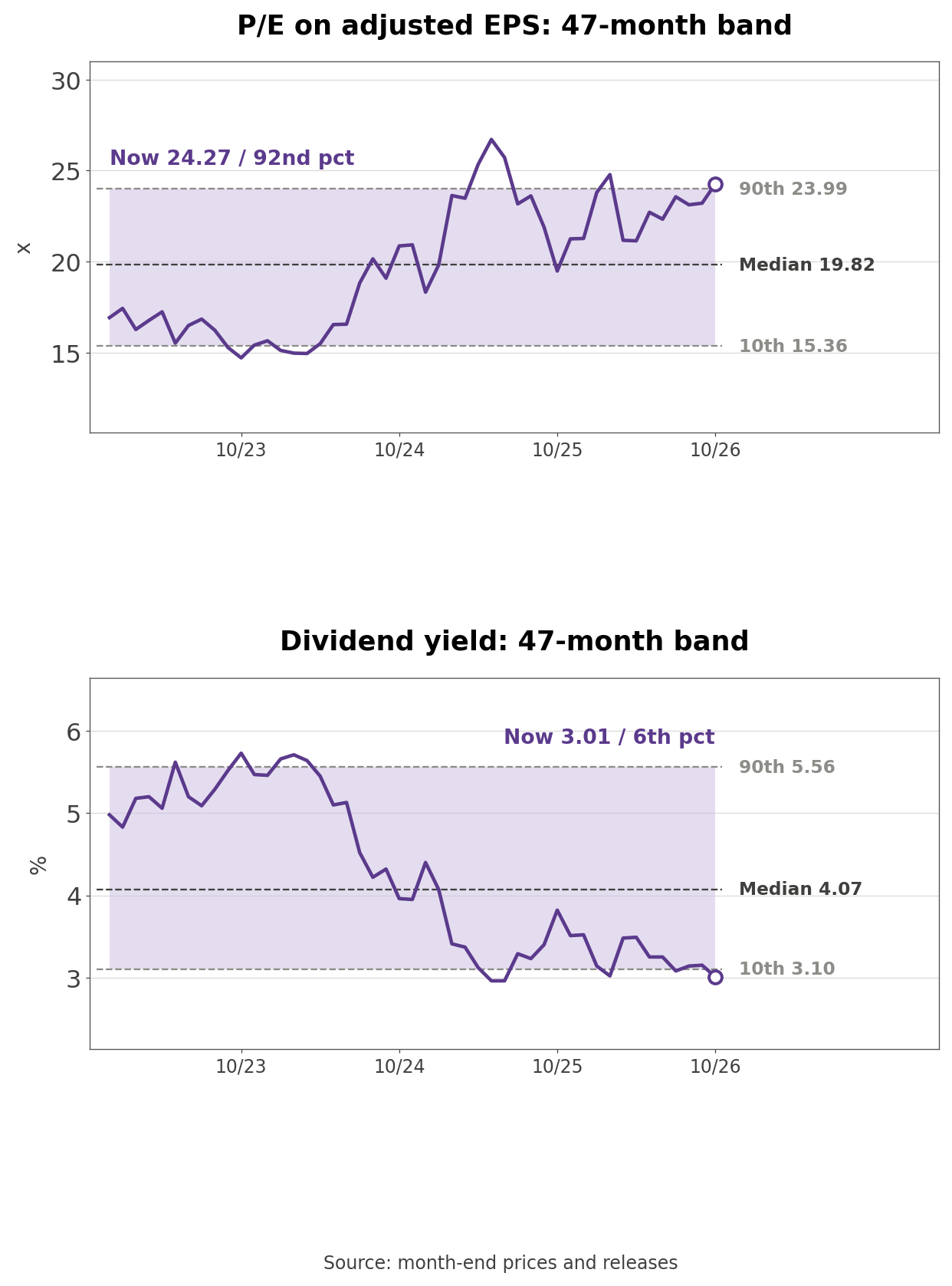
- On TTM adjusted EPS of $8.22 the stock trades at 24.27 times, in the 92nd percentile of the 47 months since December 2022, against a median of 19.82. The band starts there because adjusted EPS has added back acquired intangible amortization since 2022. The dividend yield on $6.01 of TTM declared dividends is 3.01%, in the 6th percentile, against a median of 4.07%.
- On the $8.365 midpoint of 2026 guidance the P/E is 23.85. Net debt of $40.88 billion is 2.17 times adjusted EBITDA, down from 2.53 at the end of 2025, and the stockholders' deficit narrowed to $5.95 billion from $8.03 billion. Shareholder returns come only through the dividend, and the $6.40 rate equals 76.5% of guided 2026 adjusted EPS.
- Own calculation (cash coverage): Guided operating cash flow of about $13.5 billion less the $1.5 billion capex midpoint leaves free cash flow of about $12.0 billion; $6.40 times 1.559 billion shares is about $9.98 billion, or 83.1% of it.
Three Conditions That Move the Stock
- U.S. adjusted OCI was $171 million in the third quarter and is guided near zero in the fourth. If third-quarter spending levels in 2027 bring enough extra 20-pouch volume to outrun the 25% lower revenue per pouch, U.S. profit can return toward 2025 levels; if shipments stall near third-quarter levels, the profit gap lasts longer.
- Combustible pricing was 9.1% over nine months. Price increases above 8% without volume losses let international combustibles keep funding smoke-free investment; if pricing fades once one-off distribution benefits are gone, the base of profit growth weakens.
- IQOS HTU shipments were 41.5 billion in the third quarter, with 39.5 to 40.5 billion guided for the fourth. If shipments catch up with in-market sales after Japan's third tax step, the smoke-free revenue share climbs again; if Japanese sales stay at about 1% growth, the promised smoke-free reacceleration slips.
What to Watch in the Fourth Quarter
- The next numbers are U.S. revenue and adjusted OCI after the 20-pouch transition, and the medium-term targets due at an investor day in the second quarter of 2027. The remarks put underlying third-quarter U.S. ZYN growth at 13% excluding promotions, and offtake share recovered 1.4 points from its June low.
- One question remains open. PMI chose to cut ZYN's revenue per pouch by about a quarter and run U.S. profit near zero for a quarter to protect the brand's price premium. Can ZYN grow volume fast enough to hand smoke-free products the job of driving profit before cigarette pricing slows?
Related Analysis
- Linde (LIN) Stock: 40% More Profit, No Volume Growth: another company whose profit grew on price rather than volume, a direct parallel to PMI's cigarette business.
- Shopify (SHOP) Stock Analysis: Net Income vs. Equity Gains: reported earnings moved by stakes in listed companies, as PMI's GAAP EPS was this quarter.
- AutoZone (AZO) Stock Analysis: ROIC Down 11 Quarters: a quality compounder whose multiple compressed, useful against PMI's P/E near the top of its band.
#PhilipMorris #PMStock #TobaccoStocks #ZYN #NicotinePouches #DividendStocks #USStocks #StockAnalysis #EquityResearch #GlobalStockBrief
'US Stock Analysis' 카테고리의 다른 글
| Intuitive Surgical (ISRG) Stock: The 3% to 5% Instrument Cut (0) | 2026.10.25 |
|---|---|
| Netflix (NFLX) Stock: A $2.8B Warner Fee and Record Buybacks (0) | 2026.10.25 |
| General Motors (GM) Stock: EV Add-Backs and a $20B Buyback (0) | 2026.10.25 |
| SpaceX (SPCX) Stock: One Customer and a 90-Day Exit Clause (0) | 2026.10.24 |
| IBM (IBM) Stock: Organic Software Growth Is Just Over 4% (0) | 2026.10.24 |


