Cloudflare (NYSE: NET) grew third-quarter revenue +39% to $782.5 million, its fastest pace since the fourth quarter of 2022, and posted a record non-GAAP operating margin of 17.5%. Its GAAP operating loss still widened to -$67.9 million from -$37.5 million a year earlier, because stock-based compensation including payroll taxes rose +45.5% to $174.1 million.
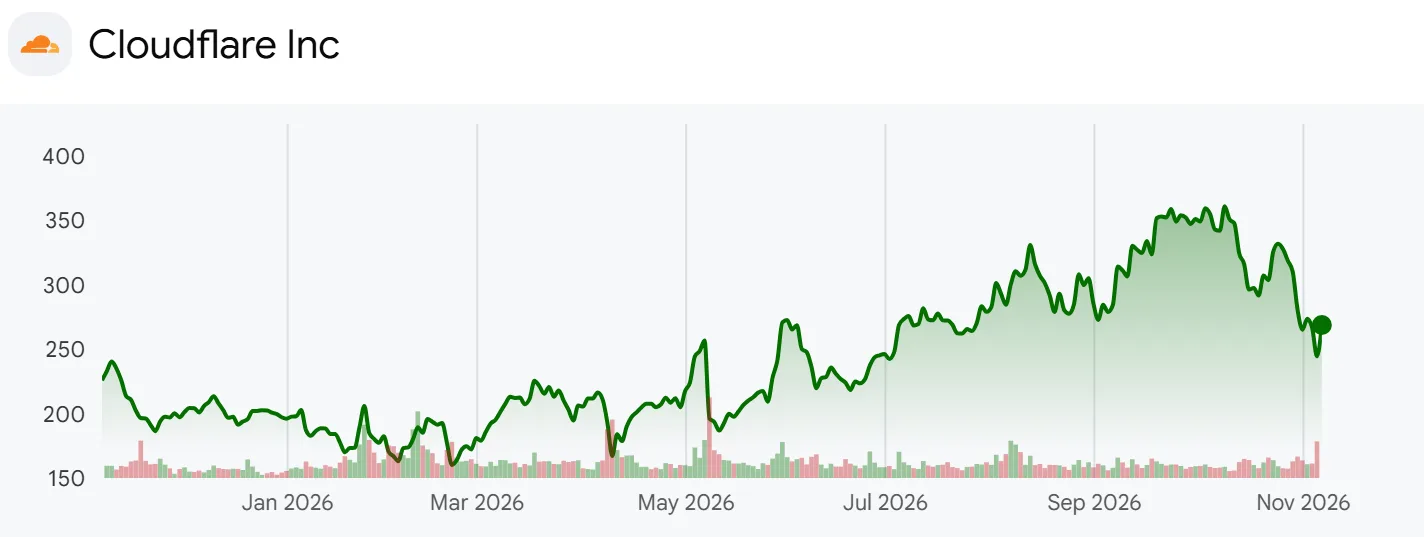
Cloudflare runs web security, zero trust remote access and a serverless developer platform on one network spread across more than 340 cities. Its fiscal year ends in December. At $268.75, multiplying by the 358.39 million Class A and Class B shares on the 10-Q cover (as of October 22) gives a market value of $96.32 billion, -22.6% below the September month-end close of $347.28.
Management now expects GAAP profitability in the fourth quarter, well ahead of the 2028 target it gave at its June Investor Day. To check whether that profit comes from operations, I lined up the Q3 2026 earnings release, the Q3 10-Q, the 47-page Q3 investor presentation, eight quarters of supplemental financial data, the November 5 call transcript and 29 earnings releases going back to 2019. If third-quarter adjustments stay the same, fourth-quarter GAAP profit comes from interest income, not operations. One limit: the company does not guide stock compensation, so the fourth-quarter GAAP estimate holds third-quarter adjustments constant.
Cloudflare one-year share price chart
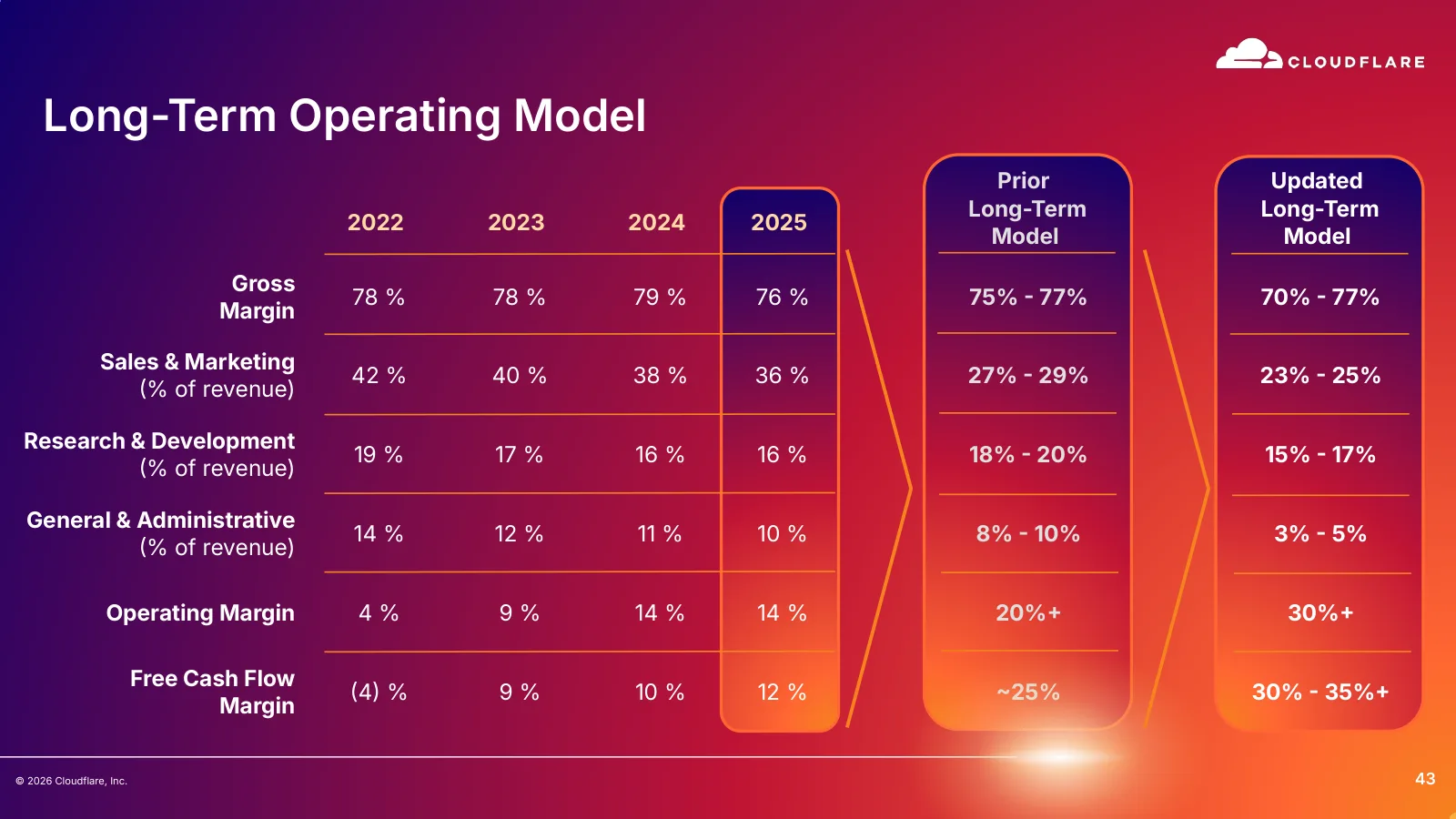
Long-Term Model and Cost Structure in the Investor Deck
Page 43 of the investor presentation shows the long-term operating model revised at the June Investor Day. Non-GAAP results for 2022 through 2025 were gross margin of 78%, 78%, 79% and 76%, operating margin of 4%, 9%, 14% and 14%, and free cash flow (FCF) margin of -4%, 9%, 10% and 12%. The prior long-term model called for gross margin of 75% to 77%, operating margin above 20% and FCF margin of about 25%. The updated model lowers the gross margin range to 70% to 77% and raises the targets to an operating margin above 30% and an FCF margin of 30% to 35% or more, with sales and marketing at 23% to 25%, R&D at 15% to 17% and G&A at 3% to 5% of revenue.
Investor presentation page 43 with the prior and updated long-term operating model
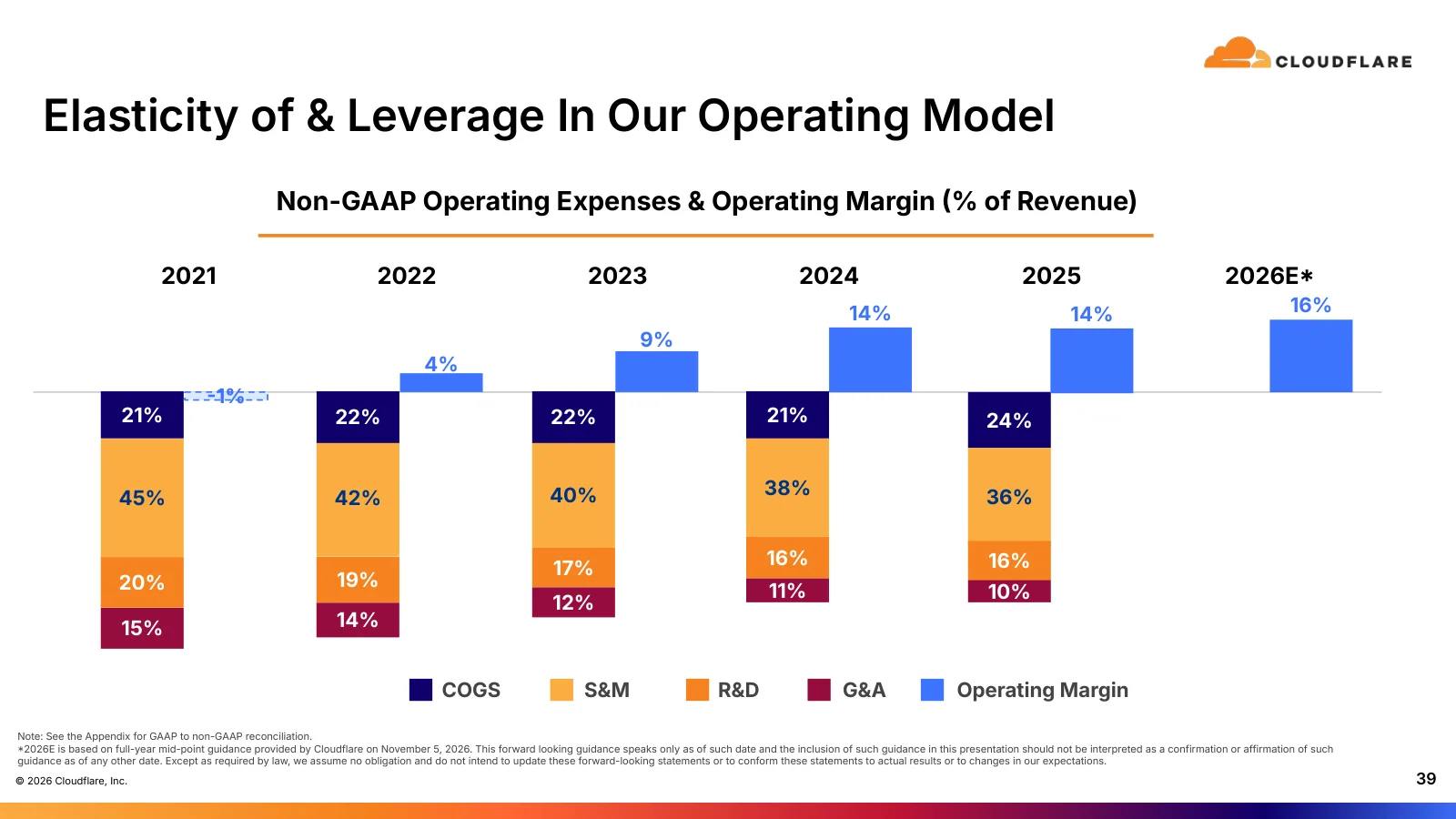
Page 39 stacks the same costs as a share of revenue by year. Cost of revenue rose from 21% in 2021 to 24% in 2025, while sales and marketing fell from 45% to 36%, and the company puts its 2026 non-GAAP operating margin at 16%. The slide’s argument is elasticity: rising delivery costs are offset by lower operating expenses.
Investor presentation page 39 with non-GAAP expenses and operating margin by year
Page 38 puts the unit economic margin, the lifetime revenue from $1 of annual recurring revenue minus the cost to book and the cost to serve it, at 44%, with a footnote that this is not operating margin. Page 41 guides 2026 revenue to $2.963 billion to $2.964 billion (+37%) and fourth-quarter revenue to $845 million to $846 million (+38%). Page 42 raises the “Rule of” target from 40% since the IPO to 50% in 2027. On the common definition of revenue growth plus FCF margin, the third quarter adds up to 49.7%, close to the 2027 target, but almost all of that sum is growth.
Own calculation (non-GAAP income statement in the release): Third-quarter non-GAAP sales and marketing was $270.2 million (34.5% of revenue), R&D $101.7 million (13.0%) and G&A $57.5 million (7.4%). R&D is already below the new 15% floor, while sales and marketing and G&A sit well above their new targets. The 72.4% gross margin is inside the new range but 2.6 points below the old 75% floor, and the 10.5% FCF margin is about a third of the new 30% to 35% target. The 76% gross margin for 2025 on page 43 matches the 75.8% from adding up 2025 quarterly non-GAAP gross profit of $1.6432 billion in the supplemental data.
Large Customers and AI Agent Requests
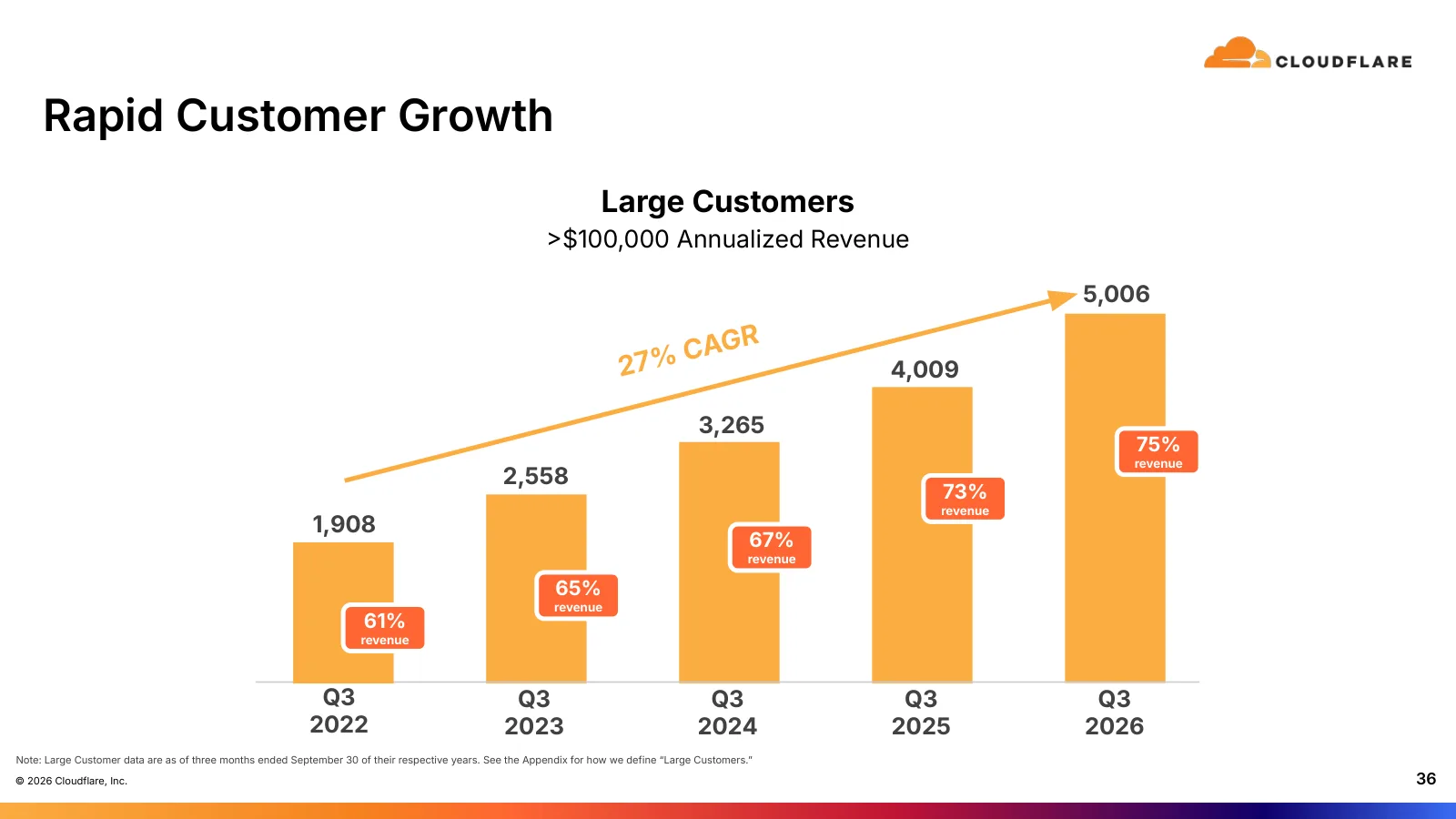
Page 35 shows annual revenue compounding at 38% from $431 million in 2020 to $2.168 billion in 2025. Page 36 tracks customers paying more than $100,000 a year, measured each third quarter: 1,908 in 2022, then 2,558, 3,265 and 4,009, and 5,006 in 2026, with their share of revenue rising from 61% to 75%. CFO Thomas Seifert said on the call that the company added 308 large customers in the quarter and nearly 1,000 over the year, both records, and that “the bigger the size of the customer’s annual spend with us, the faster they are growing with Cloudflare.” Dollar-based net retention reached 122% against 119% a year earlier, up from 111% in the fourth quarter of 2024 with a single dip to 118% in the first quarter of 2026.
Investor presentation page 36 with large customers and their share of revenue
Large customers grew 24.9% while revenue grew 39%, so much of the growth came from existing large customers spending more. Applying the 75% share to revenue gives about $586.9 million from large customers, roughly 43% more than the $410.3 million implied a year ago.
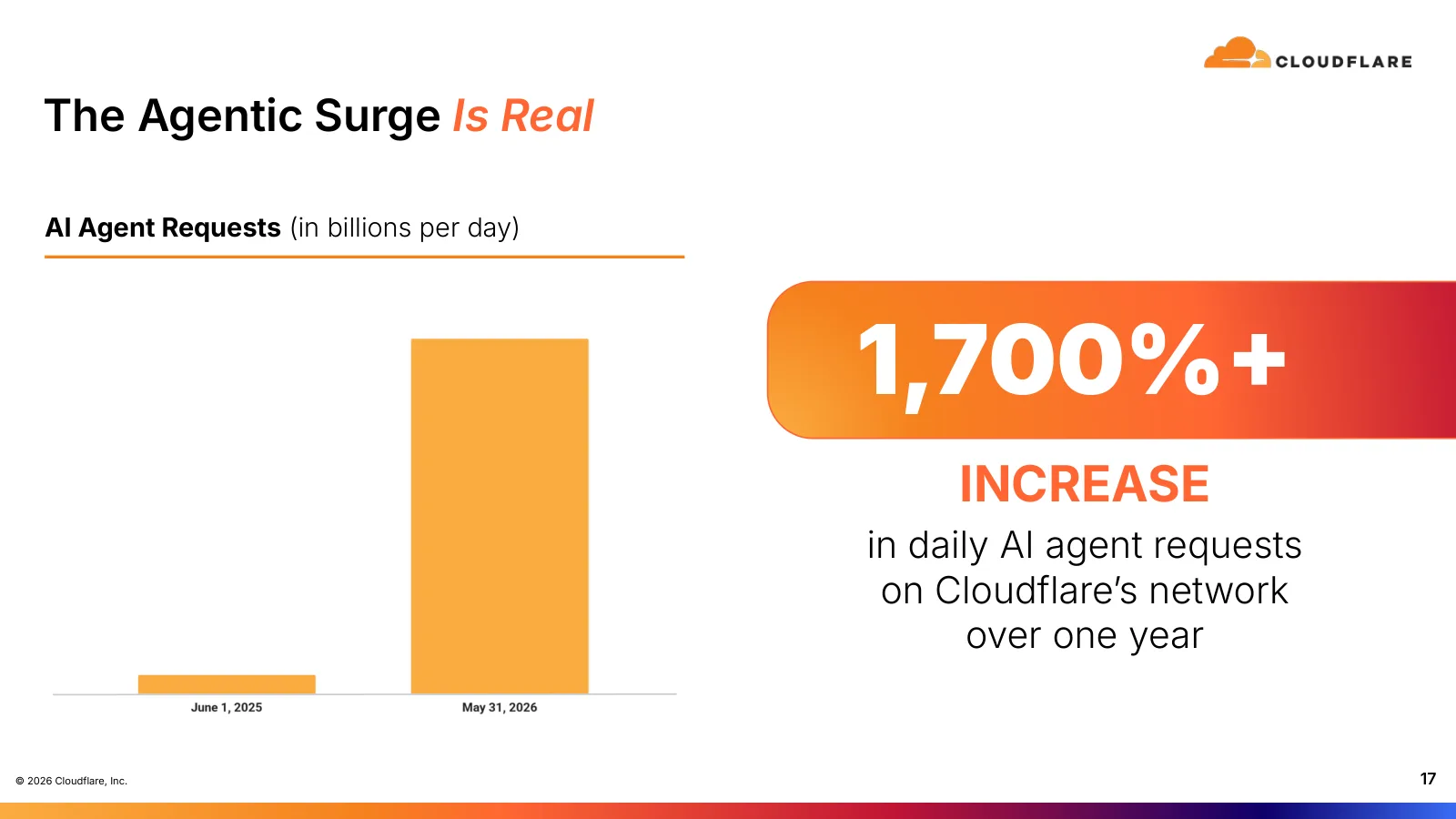
Page 17 says daily AI agent requests on Cloudflare’s network rose by more than 1,700% between June 1, 2025 and May 31, 2026, though the chart shows no absolute scale. Page 16 says half of the traffic on Cloudflare’s network is now non-human, and page 27 says 78% of the top 50 generative AI web products run on Cloudflare. CEO Matthew Prince named Meta’s Muse agent as a customer. The gap between eighteenfold agent traffic and 39% revenue growth shows most agent traffic is not yet paying.
Investor presentation page 17 with daily AI agent requests over one year
The company highlighted three third-quarter contracts: an AI company signing an $11 million one-year deal for the developer platform, a Fortune 100 infrastructure provider spending $15.5 million over 13 months on Magic Transit to replace DDoS hardware, and a U.S. federal department committing $10.3 million over five years to SASE.
The Bull and Bear Case for Cloudflare Stock
The bull case is reaccelerating growth and usage revenue. Growth has risen from 27% in the first quarter of 2025 to 39%, and current remaining performance obligations grew +37%. Seifert said variable, usage-based revenue was the main source of the third-quarter upside.
The bear case is stock compensation and gross margin. GAAP operating margin fell while non-GAAP margin rose, and gross margin is 7.1 points below its 2024 peak. The analyst consensus target in market data is $336, +25.0% above the price, within a range of $160 to $430.
Outside view (RBC Capital Markets, November 6): Raised its price target from $290 to $350 the day after earnings. Piper Sandler moved from $250 to $337, while Cantor Fitzgerald cut its target from $340 to $310.
From the 2022 Low to the 2026 Workforce Cut
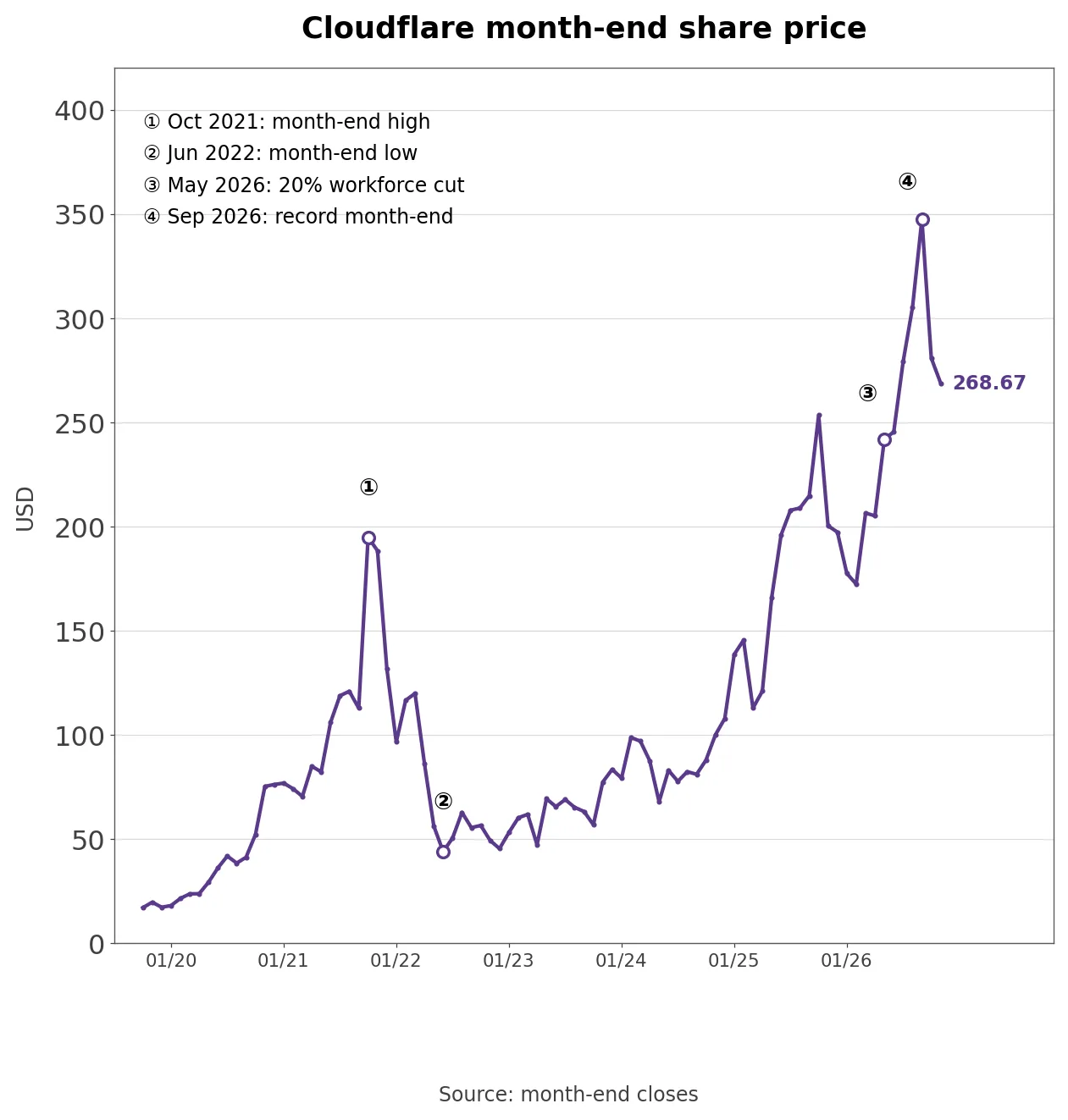
Cloudflare listed on the New York Stock Exchange in September 2019. Annual revenue grew from $287.0 million in 2019 to $975.2 million in 2022 and $2.168 billion in 2025, and the 2026 guide is $2.963 billion to $2.964 billion. The month-end price peaked at $194.72 in October 2021, when price to sales was 104.03, and fell to $43.75 in June 2022.
Cloudflare month-end share price over 86 months with four dates
From that low to the September 2026 month-end high of $347.28 the stock rose 7.9 times, while annual revenue rose 2.2 times between 2022 and 2025. The month-end price also fell -32.0% from $253.30 in October 2025 to $172.19 in February 2026 before recovering. On May 7, 2026 the company announced a plan to move to an agentic AI-first operating model that cut about 20% of the workforce, with charges of up to $165 million ($125 million in cash severance, $35 million in stock compensation and $5 million in other costs), of which $161.7 million was recognized through September. The stock rose +9.9% the day after third-quarter results.
Why Did Stock Comp Rise After a 20% Workforce Cut?
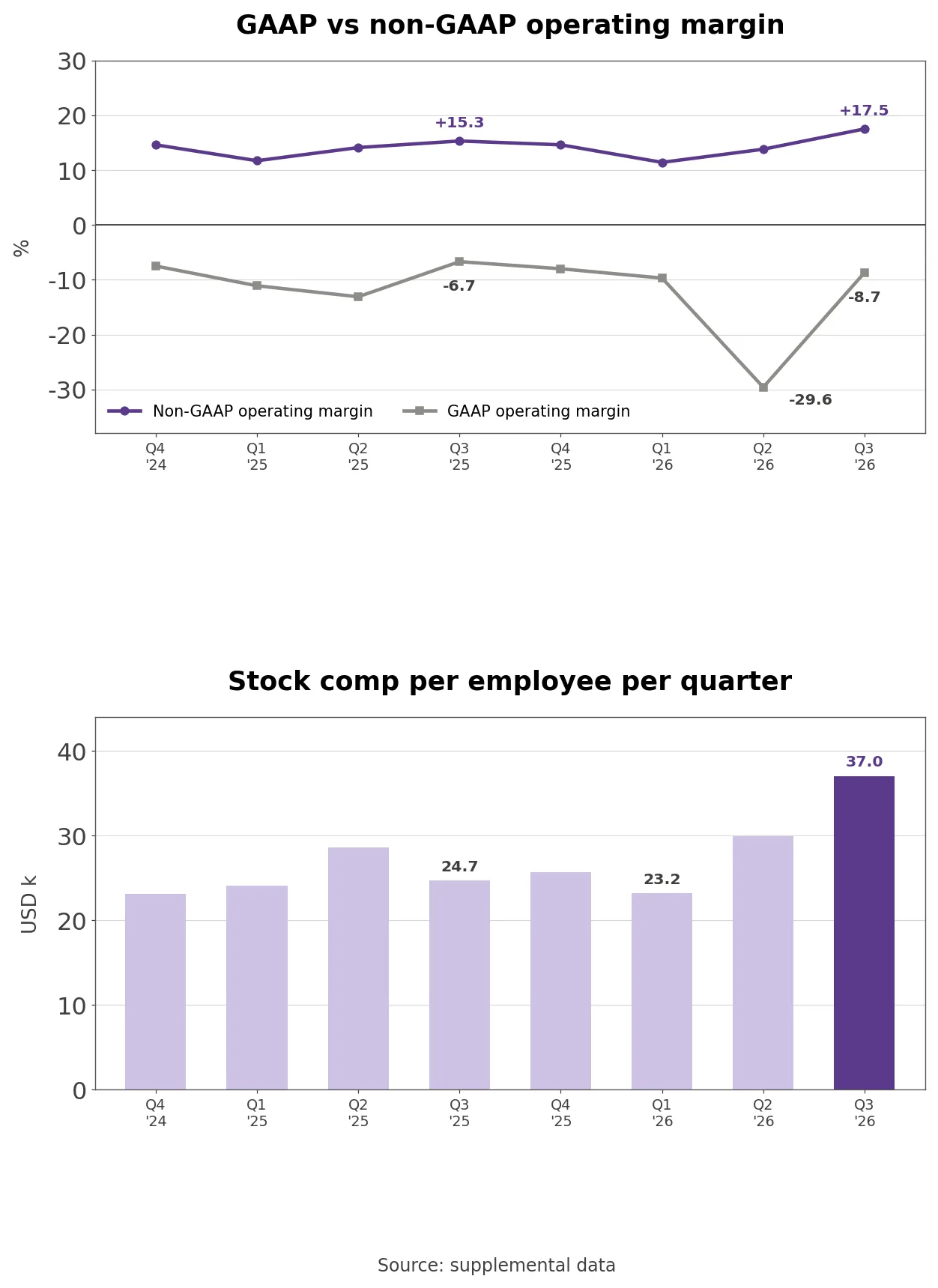
Headcount fell from 5,483 in the first quarter to 4,707 in the third quarter, while stock compensation including payroll taxes rose from $127.5 million to $174.1 million. Against the third quarter of 2025, headcount was -2.7% lower at 4,707 versus 4,838, yet stock compensation was +45.5% higher and its share of revenue rose from 21.3% to 22.2%. The 10-Q attributes $27.2 million of the increase to sales and marketing and $25.7 million to R&D.
Cloudflare GAAP and non-GAAP operating margin and stock comp per employee over 8 quarters
Own calculation (supplemental data, pages 3 and 10): Stock compensation per employee rose from $24,700 a quarter in the third quarter of 2025 to $37,000, an increase of 49.5%. The spread between the 17.5% non-GAAP operating margin and the GAAP operating margin of -8.7% widened to 26.2 points from 22.0 points. Third-quarter adjustments were $174.1 million of stock compensation, $9.2 million of acquired intangible amortization, $10.7 million of legal reserves and $11.0 million of restructuring.
Company disclosure (Q3 release and call): Fourth-quarter guidance is non-GAAP operating income of $156 million to $157 million and non-GAAP EPS of $0.43 on about 379 million shares, with a 20% tax rate. There is no GAAP guidance for the quarter.
Seifert said “We also expect to achieve GAAP profitability in the fourth quarter” and tied the improvement to developer platform growth. Subtracting third-quarter stock compensation and amortization from the $156.5 million guidance midpoint leaves a GAAP operating result of about -$26.8 million. Adding third-quarter non-operating income of $40.6 million, including $45.4 million of interest income, brings pretax income to about $13.8 million. A fourth-quarter GAAP profit therefore needs either lower stock compensation or the interest earned on $5.1 billion of cash.
Gross Margin Falling as Growth Reaccelerates
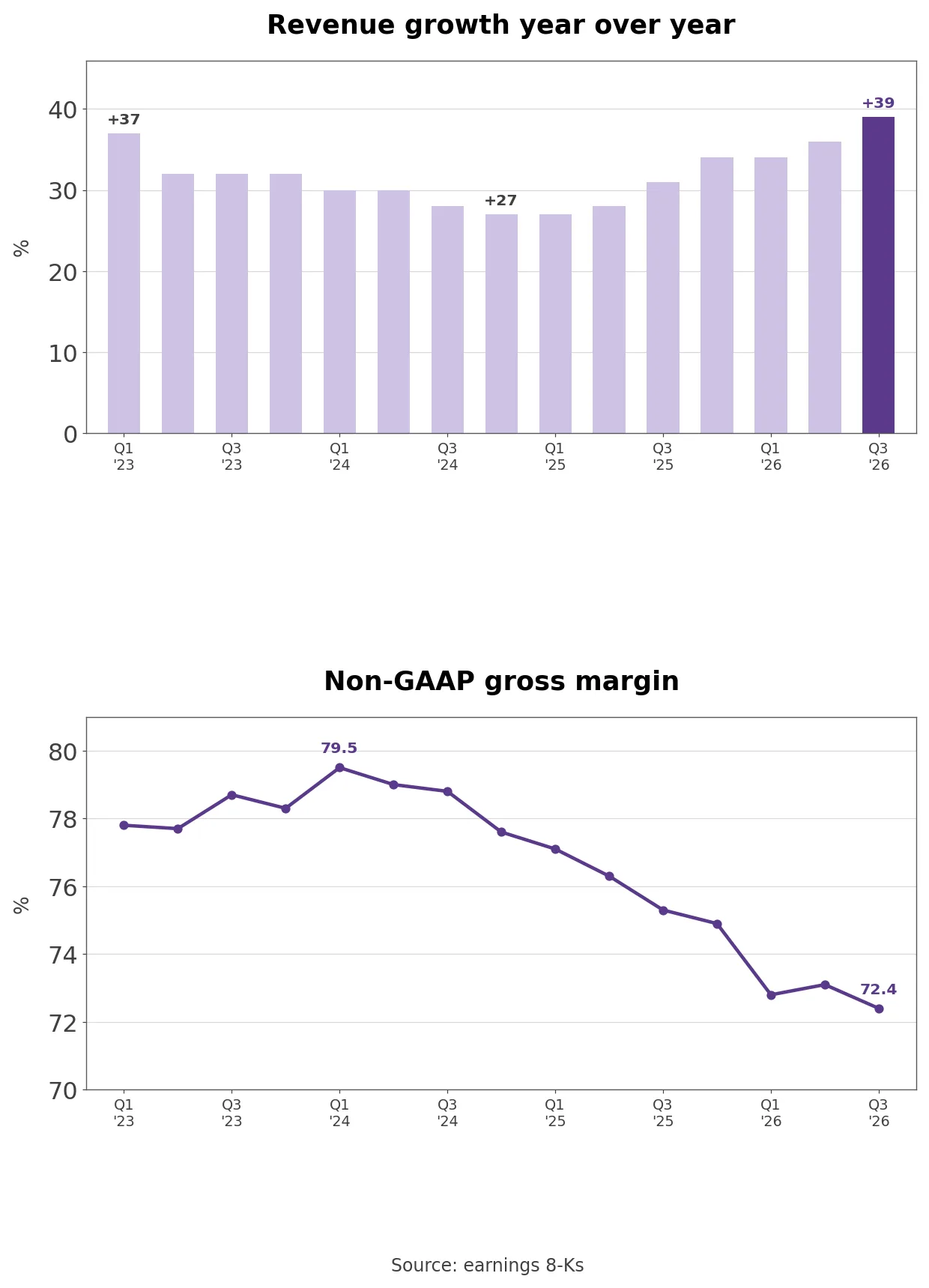
Across 29 releases, revenue growth bottomed at 27% in the fourth quarter of 2024 and first quarter of 2025, then rose to 28%, 31%, 34%, 34%, 36% and 39%. Over the same stretch non-GAAP gross margin fell from 77.6% to 72.4%, after a peak of 79.5% in the first quarter of 2024. GAAP gross margin fell from 74.0% to 71.2% over the year.
Cloudflare revenue growth and non-GAAP gross margin over 15 quarters
Of the $79.0 million increase in third-quarter cost of revenue, $43.0 million came from third-party technology services. The rest came from $19.4 million in co-location and bandwidth costs and $10.1 million of server depreciation. The 10-Q describes “an increase of $43.0 million in third-party technology services costs”, and those costs rose $104.0 million over nine months. Seifert said the Workers platform carries slightly lower gross margins but a much lower cost to book, which lifts operating margin, and that better use of compute infrastructure leaves room to expand gross margin again.
Capital spending also picked up. Third-quarter purchases of property and equipment were $121.8 million, or 15.6% of revenue, more than double the $50.0 million (7.2%) of the second quarter, and the company kept its full-year network capex target at 14% to 15% of revenue. Free cash flow rose to $82.1 million from $75.0 million, but FCF margin fell from 13.3% to 10.5%.
Conversion Terms of the 2031 Convertible
The 2026 convertible notes that matured in August were settled with $1.2934 billion of cash and about 2.2 million Class A shares. About 1.418 million shares came back from the 2026 capped calls and were retired, so the net increase was about 789,000 shares. In August the company also issued $2.5 billion of 2031 notes that carry no regular cash interest, with a conversion price of about $496.94 and capped calls up to about $854.12 that cost $259.5 million. That cost reduced equity from $1.62 billion in the second quarter to $1.4648 billion.
The 2030 notes convert at about $247.67, with a cap of $469.73, so the $268.75 share price is +8.5% above that conversion price. The 10-Q reserves 11.71 million shares for the 2030 notes and 8.05 million for the 2031 notes.
Own calculation (Q3 balance sheet): Cash, cash equivalents and available-for-sale securities of $5.1287 billion minus $4.4419 billion of convertible notes leaves net cash of $686.8 million, the source of the interest income behind the fourth-quarter GAAP profit.
How Cloudflare Makes Money on One Network
Every Cloudflare service runs on the same servers in more than 340 cities in over 130 countries. Application services that speed up websites and block DDoS attacks came first, followed by zero trust and SASE products that secure employee access, network services that replace corporate private networks, and the Workers developer platform that runs code without servers. The developer platform layers storage (R2), stateful Durable Objects, AI inference (Workers AI) and Workflows on top of Workers. Page 26 says 20% of the internet, 37% of the top 10,000 sites and 45% of the Fortune 500 use Cloudflare, and page 34 sizes the 2026 addressable market at $238 billion.
By region, third-quarter revenue was $407.9 million from the U.S. (+44.3%), $202.2 million from EMEA (+31.9%), $111.7 million from APAC (+31.9%) and $60.7 million from elsewhere. Revenue outside the U.S. was 47.9%, in line with the 48% on page 5. Most revenue is subscription, and customers move from free plans to paid plans and large contracts. The 5,006 large customers produce 75% of revenue.
Headcount is now 4,707, and Christian Smith, who ran sales at Cisco and Splunk, has replaced the retiring Mark Anderson as President of Revenue. Prince said Cloudflare has been asked repeatedly to do financially structured deals like the GPU neoclouds and declined, saying “We are not a financial engineering company.”
Channel Partners and Usage-Based Revenue
Revenue through channel partners was $247.4 million, +65.1% from a year earlier and 2.4 times the $101.4 million of the fourth quarter of 2024, lifting its share from 22.0% to 31.6%. Channel partners delivered $97.6 million, or 44.3%, of the $220.5 million revenue increase. Direct revenue was $535.1 million, +29.8%, and its share fell from 78.0% to 68.4%. Revenue share paid to partners added $18.1 million to sales and marketing, a cost that stays in non-GAAP operating expenses.
Revenue recognition is shifting too. Under pool-of-funds contracts customers commit a year of spending up front and draw it down across products, so the commitment sits in remaining performance obligations and usage shows up as revenue. In the third quarter RPO rose +5.3% sequentially to $2.8768 billion while revenue rose +12.4%. RPO grew +34.2% from a year earlier, and 65% of it will be recognized within a year, down from 70% in the fourth quarter of 2024. Seifert said the upside came from many customers joining pool-of-funds contracts or expanding them, not from a few large ones.
Cloudflare vs Akamai Fastly and Zscaler
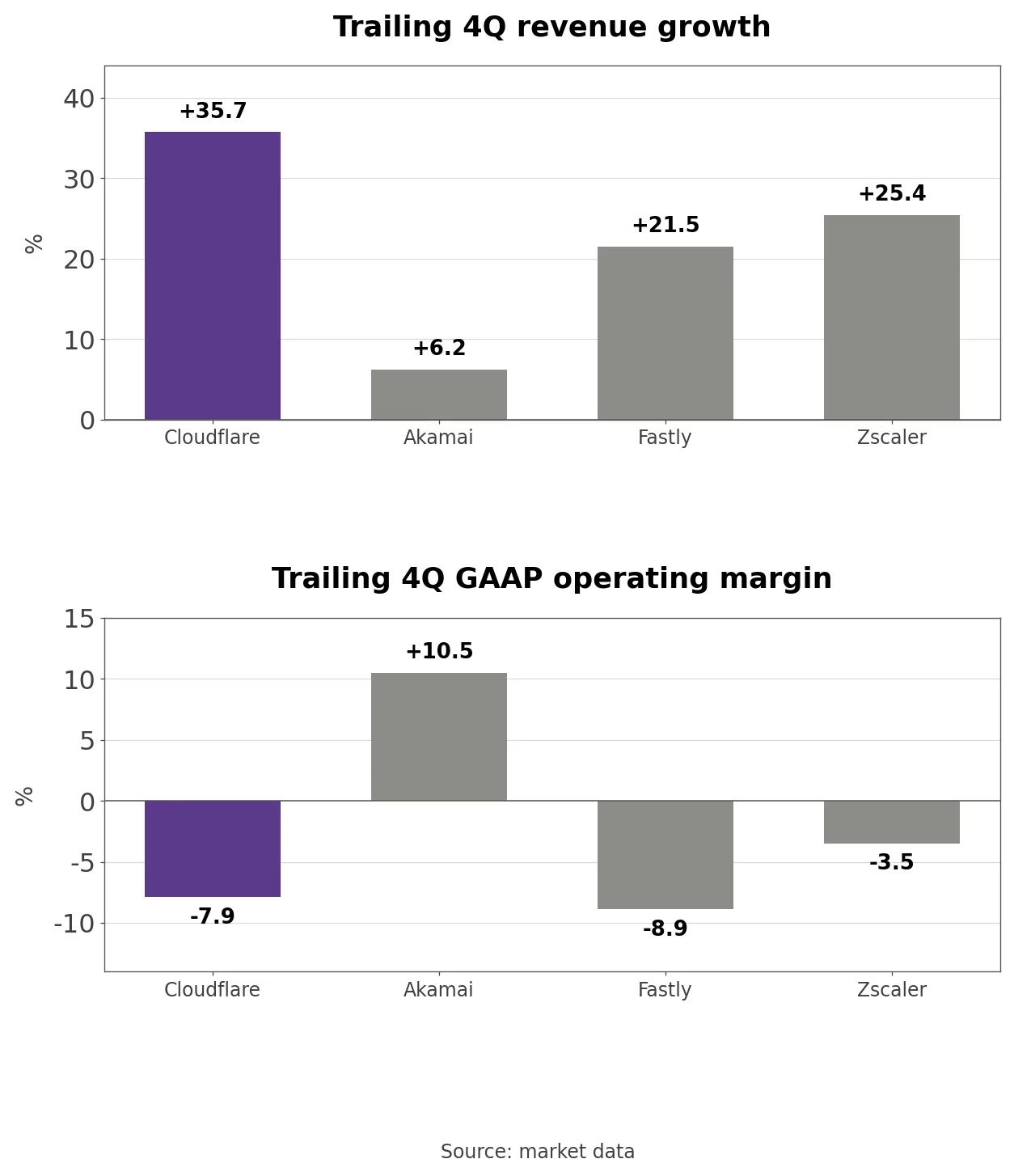
Akamai is the established content delivery and security provider, Fastly an edge cloud rival and Zscaler a zero trust security rival. Trailing four-quarter revenue growth is +35.7% at Cloudflare, +25.4% at Zscaler, +21.5% at Fastly and +6.2% at Akamai. Only Akamai has a positive trailing GAAP operating margin at 10.5%, against -7.9% at Cloudflare, -8.9% at Fastly and -3.5% at Zscaler.
Trailing revenue growth and GAAP operating margin at Cloudflare Akamai Fastly and Zscaler
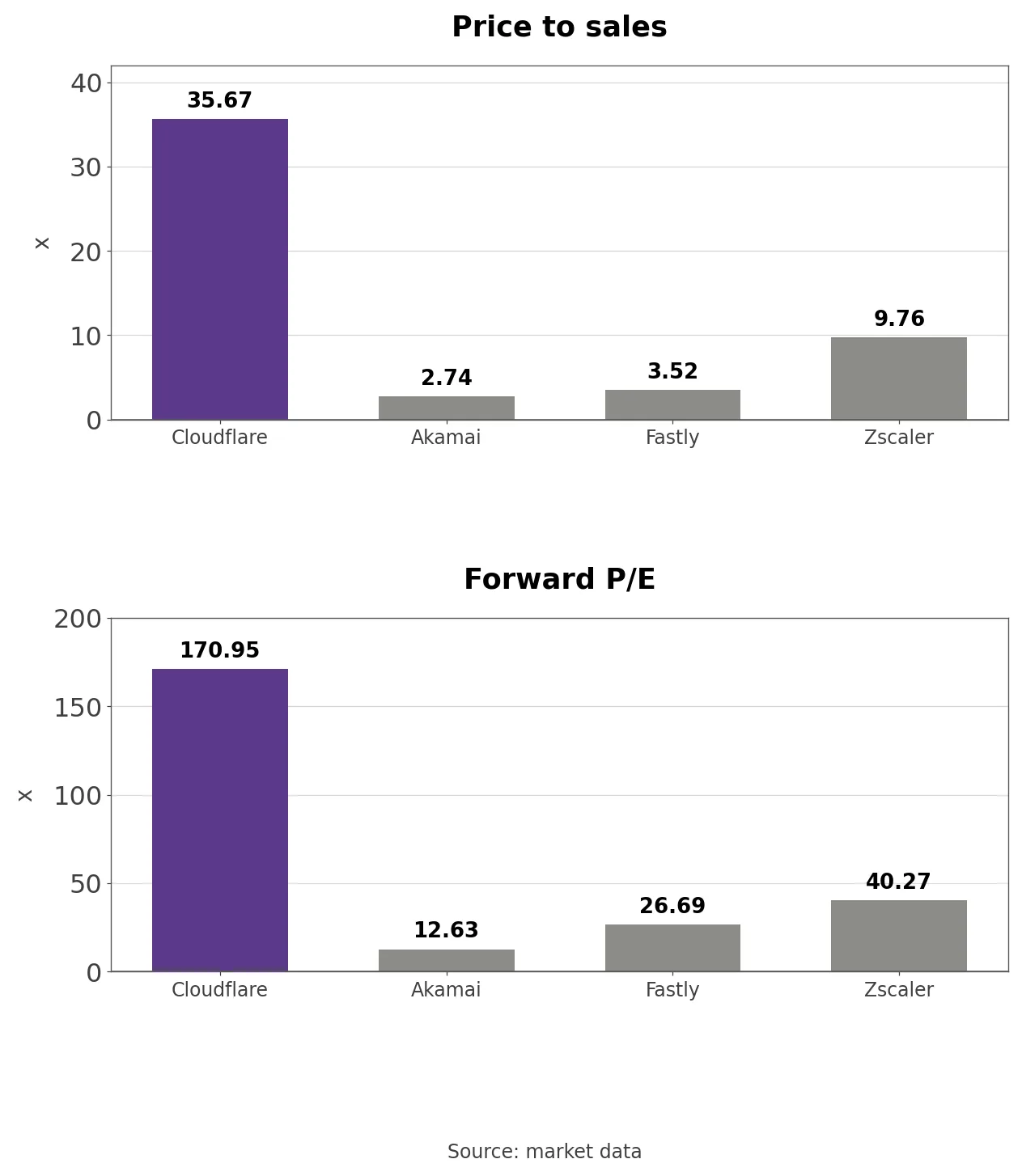
Price to sales is 35.67 at Cloudflare, 9.76 at Zscaler, 3.52 at Fastly and 2.74 at Akamai, so Cloudflare trades at 3.7 times Zscaler. Forward P/E is 170.95, 40.27, 26.69 and 12.63. Against Akamai, Cloudflare grows 5.8 times as fast but trades at 13.0 times the price to sales.
Price to sales and forward P/E at Cloudflare Akamai Fastly and Zscaler
Dividing price to sales by trailing growth gives 1.00 for Cloudflare, 0.44 for Akamai, 0.38 for Zscaler and 0.16 for Fastly, so Cloudflare is still the most expensive after adjusting for growth. Its $96.29 billion market value on market data is 2.1 times the $46.73 billion of the three peers combined. On market data, trailing FCF margin is 25.4% at Zscaler and 12.9% at Cloudflare. Zscaler’s fiscal year ends in July, so its figures run through July.
The Price-to-Sales and Price-to-Book Band
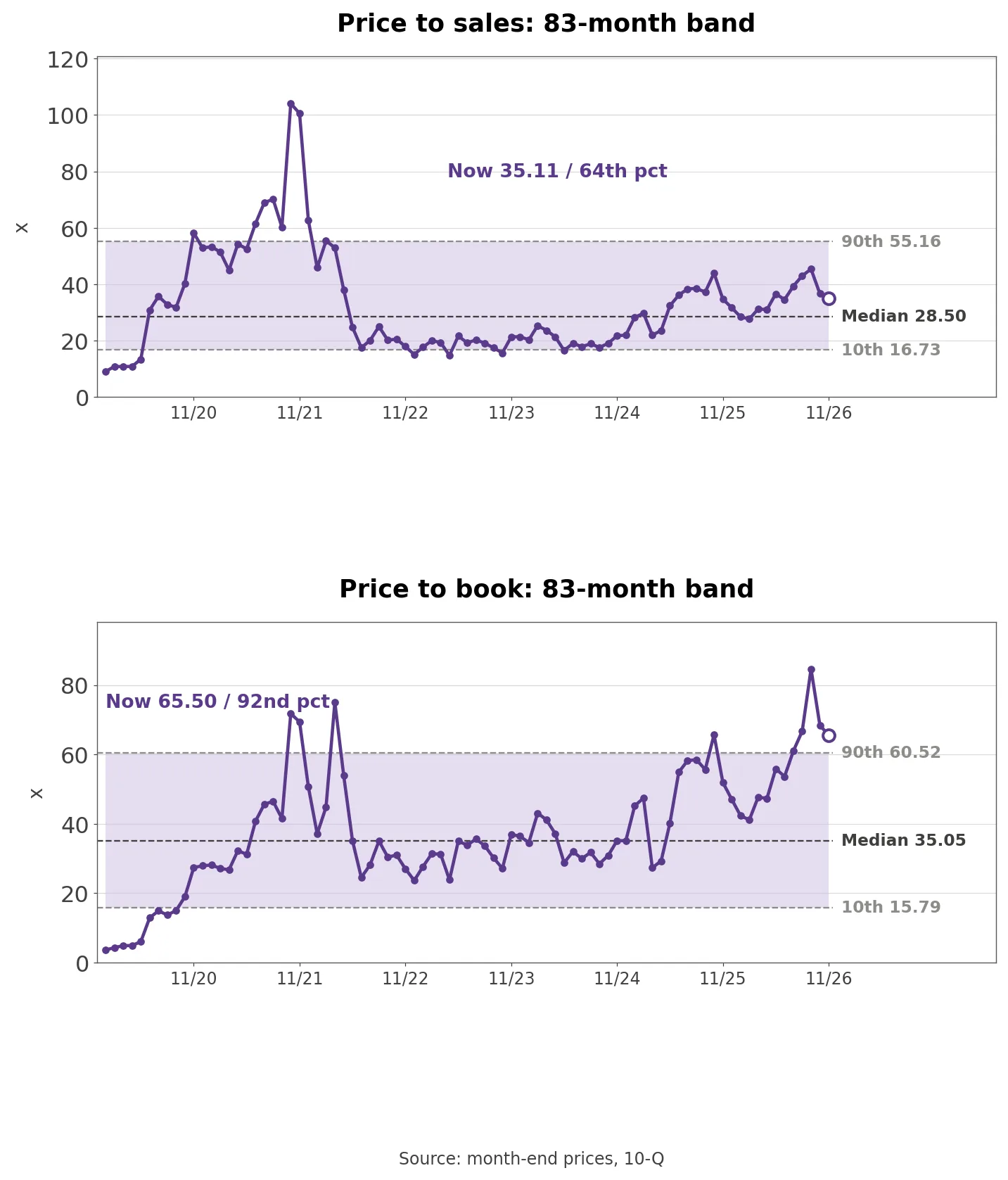
With a trailing GAAP net loss of $239.1 million there is no P/E band. I calculated price to sales and price to book from month-end closes and quarterly filings for 83 months starting in January 2020.
Cloudflare price to sales and price to book over 83 months
Price to sales of 35.11 sits above the 83-month median of 28.50, at the 63.9th percentile. The high was 104.03 in October 2021, and the September 2026 month-end reading was 45.38. Price to book of 65.50 uses 10-Q equity of $1.4648 billion; market data shows 59.80 because it still divides by second-quarter equity. Because the capped call cost shrank equity, price to book moves with capital transactions more than with the business.
Three Conditions That Move the Stock
Fourth-quarter GAAP results are the first. A GAAP operating profit would show stock compensation coming down and support the stock, while a profit that relies on interest income with an operating loss near the third quarter’s -$67.9 million would weigh on it.
Non-GAAP gross margin is the second. Holding at 72.4% or rising would confirm cost improvements in the developer platform and support the stock, while a drift toward the 70% bottom of the new range would weigh on it.
Current remaining performance obligations are the third. Growth at or above 37% would show the usage-driven acceleration carrying into contracts and support the stock, while growth below revenue growth would suggest the third-quarter upside was a burst of usage and weigh on it.
First Revenue From Charging AI Agents
Prince said the business Cloudflare calls Act 4 booked its first revenue. It provides the billing and payment layer that lets content owners charge AI agents for access, and page 29 lists access fees, verification, gateway routing and payment facilitation as revenue sources. Prince argued that if agents generate 1,000 times human traffic, someone has to pay for the extra bandwidth and servers, and that ten years out this could be Cloudflare’s largest business, but he did not disclose how much it has earned so far.
The open question is when agent billing will become large enough for Cloudflare to report it separately.