
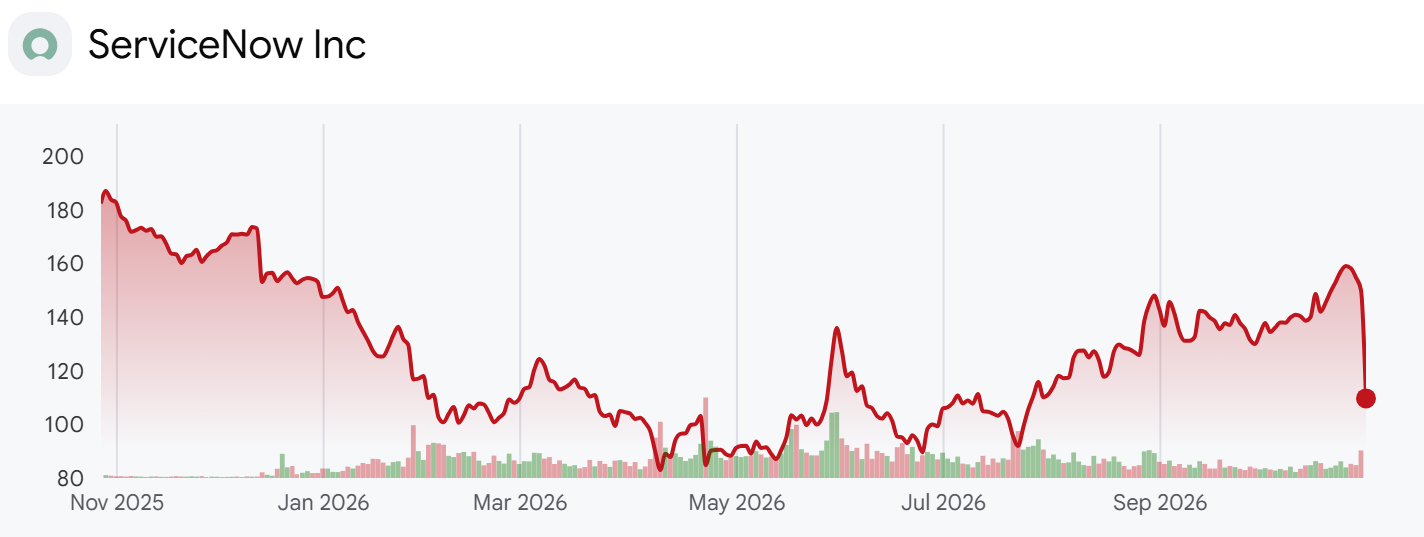
- ServiceNow (NYSE: NOW) grew third-quarter 2026 subscription revenue +20.9% to $3.99 billion and posted a 32.5% non-GAAP operating margin. The stock still fell -26.95% the next trading day, from $150.13 to $109.67. The number the market fixed on was fourth-quarter cRPO guidance of 18.5%, and the company's own investor deck attributes about 1.75 percentage points of that figure to Armis, the security company it bought in April. Take Armis out and the guide is about 16.75%.
- ServiceNow sells subscriptions to a cloud platform that started by automating IT help desks and now runs customer service, HR and security workflows inside large companies. At $109.67 and 1.038 billion shares outstanding, its market value is about $113.8 billion, and Q3 revenue was $4.11 billion.
- The question is what ServiceNow grows at once acquisitions are stripped out. cRPO, current remaining performance obligations, is contracted revenue the company expects to recognize over the next 12 months, and for a subscription business it is the earliest read on next year's sales. The analysis lines up the Q3 earnings release, the Q3 10-Q, the Q1 earnings release, the 27-page Q3 investor deck and 32 quarterly releases back to the December 2018 quarter.
- Three caveats apply. The Q3 call transcript was not available, so management commentary comes from the release and the July call and is paraphrased. The Armis contribution is the company's own figure rounded to the nearest 0.25 point, and the Armis share of Q2 actuals uses the roughly 1.25 points the Q1 release assumed in guidance. The 10-Q does not present pro forma results for the 2026 deals.
What the Q3 Investor Deck Says About Armis
- Bill McDermott opened the release by calling the quarter "more than another beat-and-raise quarter" and an inflection point. Slide 7 puts the scorecard on one page: subscription revenue of $3.988 billion, up 20.5% in constant currency, cRPO of $13.65 billion, up 21% in constant currency, a 32.5% non-GAAP operating margin and a 20% free cash flow margin.
- Slide 11 breaks the beat into pieces. Q3 subscription revenue equals the July guidance midpoint of $3.978 billion plus $2 million of currency and $8 million of performance. The full-year midpoint moved from $15.770 billion to $15.785 billion, and $12 million of that $15 million increase came from currency, leaving $3 million of actual guidance change.
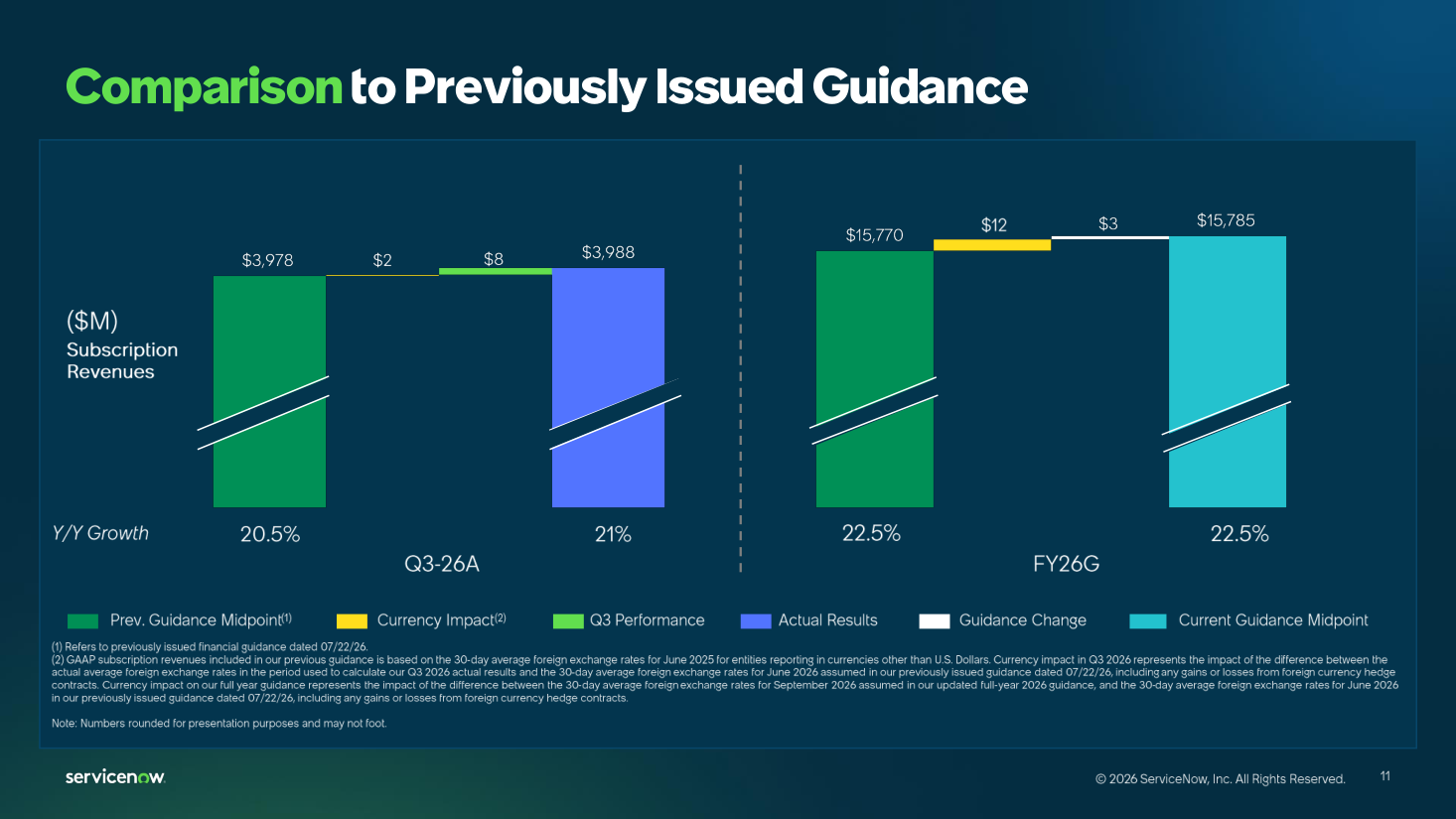
- The $8 million of performance is 0.2% of the guidance midpoint. For a company that has beaten its cRPO guide by more than a point in most quarters since 2022, the beat label was carrying more weight than the number behind it, and the full-year raise was $3 million once currency is set aside.
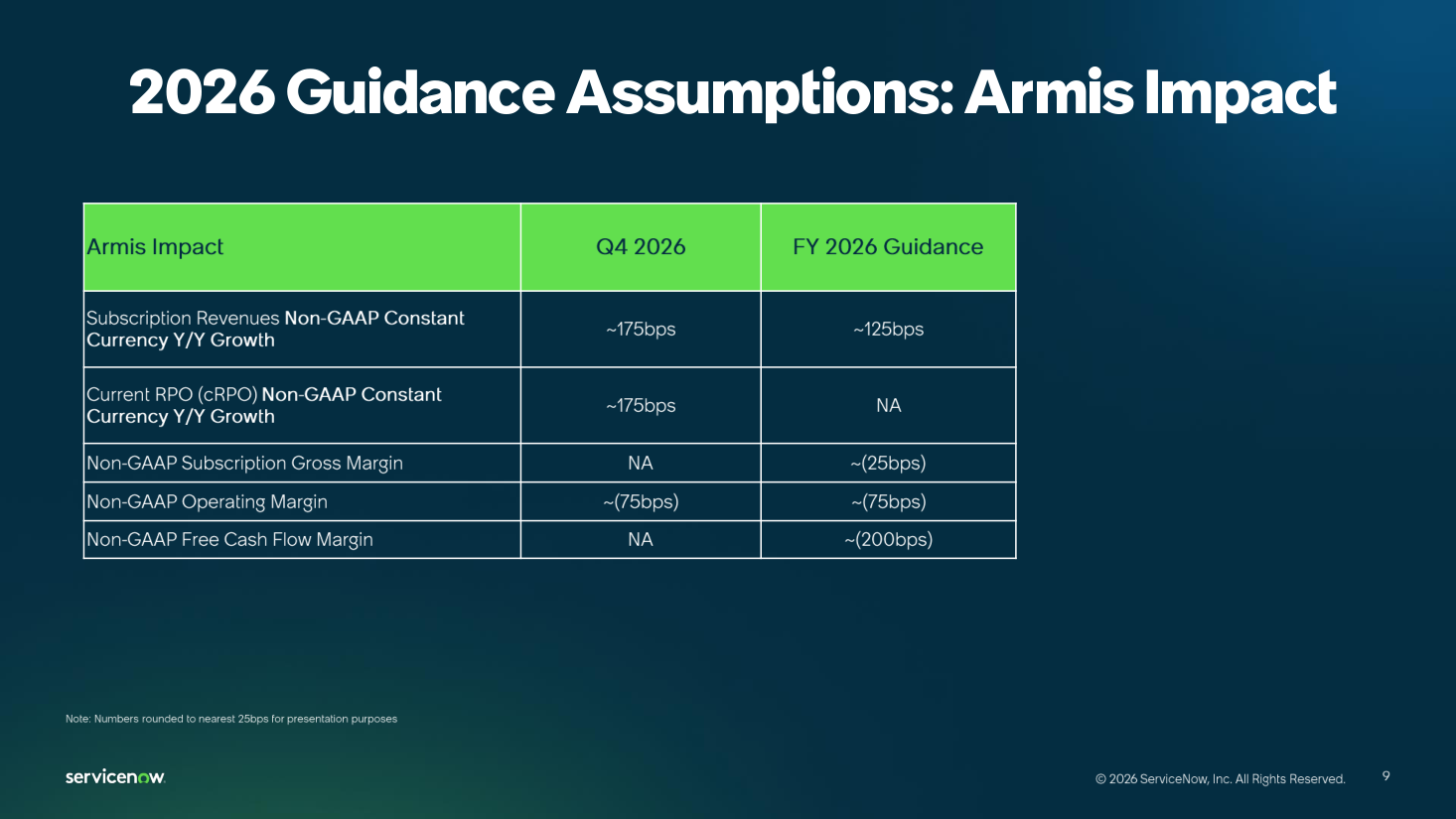
- Slide 9 gives Armis a table of its own. In constant currency, Armis adds about 1.75 points to fourth-quarter growth in both subscription revenue and cRPO, and about 1.25 points to full-year subscription growth. It costs about 0.75 point of non-GAAP operating margin in Q4 and for the year, about 0.25 point of subscription gross margin and about 2 points of full-year free cash flow margin.
- Slide 10 lays out guidance. Q4 subscription revenue is $4.245 billion to $4.255 billion, 21.5% in constant currency, with cRPO growth of 18.5% and a 32% non-GAAP operating margin. The currency column shows about 1 point of tailwind in Q4 subscription growth, about 1.5 points for the year and almost none for cRPO. Full-year non-GAAP subscription gross margin is guided at 81%, about 2.5 points lower than a year ago, of which Armis explains only about 0.25 point.
- Own calculation (deck slides 9 and 10): Removing the Armis contribution leaves fourth-quarter constant-currency growth of about 19.75% for subscription revenue and about 16.75% for cRPO. Q3 actuals were 20.5% and 21%.
- Slide 22 shows profitability holding up. The 32.5% non-GAAP operating margin in Q3 is one point below last year's 33.5%, and adding back the roughly 0.75 point Armis costs puts it close to last year's level. Free cash flow margin was 31.5% in 2024 and 35.0% in 2025, and this year's 36% target already absorbs the Armis drag.
What the Deck Says Is Left Out of cRPO
- Slide 8 is the company's own explanation of why cRPO looks lighter. ServiceNow now bundles AI deployment specialists into select large deals, and under ASC 606 the value of that help is carved out of the subscription contract, booked as professional services and in some cases left out of cRPO. Customers who get the help adopted AI twice as fast in their first five weeks, the slide says. The shift moved about 0.25 point of subscription growth into services in Q3 and should move about 0.5 point in Q4, and the company says it returns to subscription revenue at renewal.
- The same slide says cRPO excludes contracts with termination-for-convenience clauses inherited through acquisitions, which will leave about 0.5 point of backlog growth out of cRPO at the end of Q4, and may exclude direct public-sector deals in the future. The Q1 release had already warned that some Armis customer contracts carry those clauses.
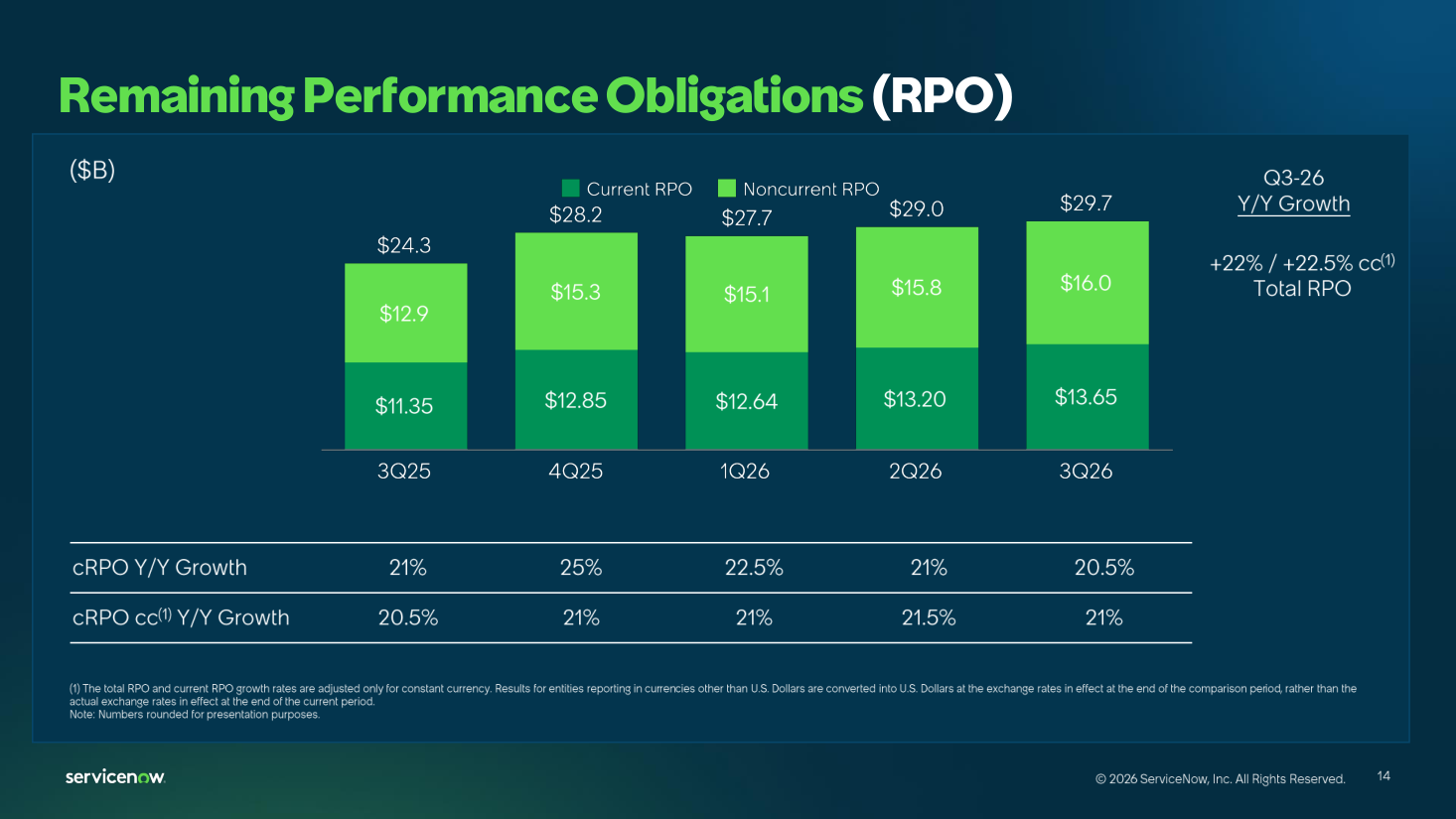
- Slide 14 shows total remaining performance obligations of $29.7 billion, up 22%, and cRPO of $13.65 billion, with constant-currency growth between 20.5% and 21.5% for five straight quarters. Even if the deployment carve-out and the termination clauses are worth a full point combined, the Q4 guide excluding Armis would be about 17.75%, still well below Q3's 21%.
- The cost of those specialists already shows in the income statement. Professional services revenue was $118 million in Q3, up from $108 million, but the GAAP professional services gross loss was $39 million, a margin of -32.5%.
- The 10-Q is less forthcoming than the deck. It attributes the $689 million year-over-year rise in Q3 subscription revenue to growth "primarily driven by increased purchases by new and existing customers" and skips pro forma figures because "the effects of these acquisitions were not material to our consolidated results of operations." The deck and the Q1 release are the only places Armis is sized.
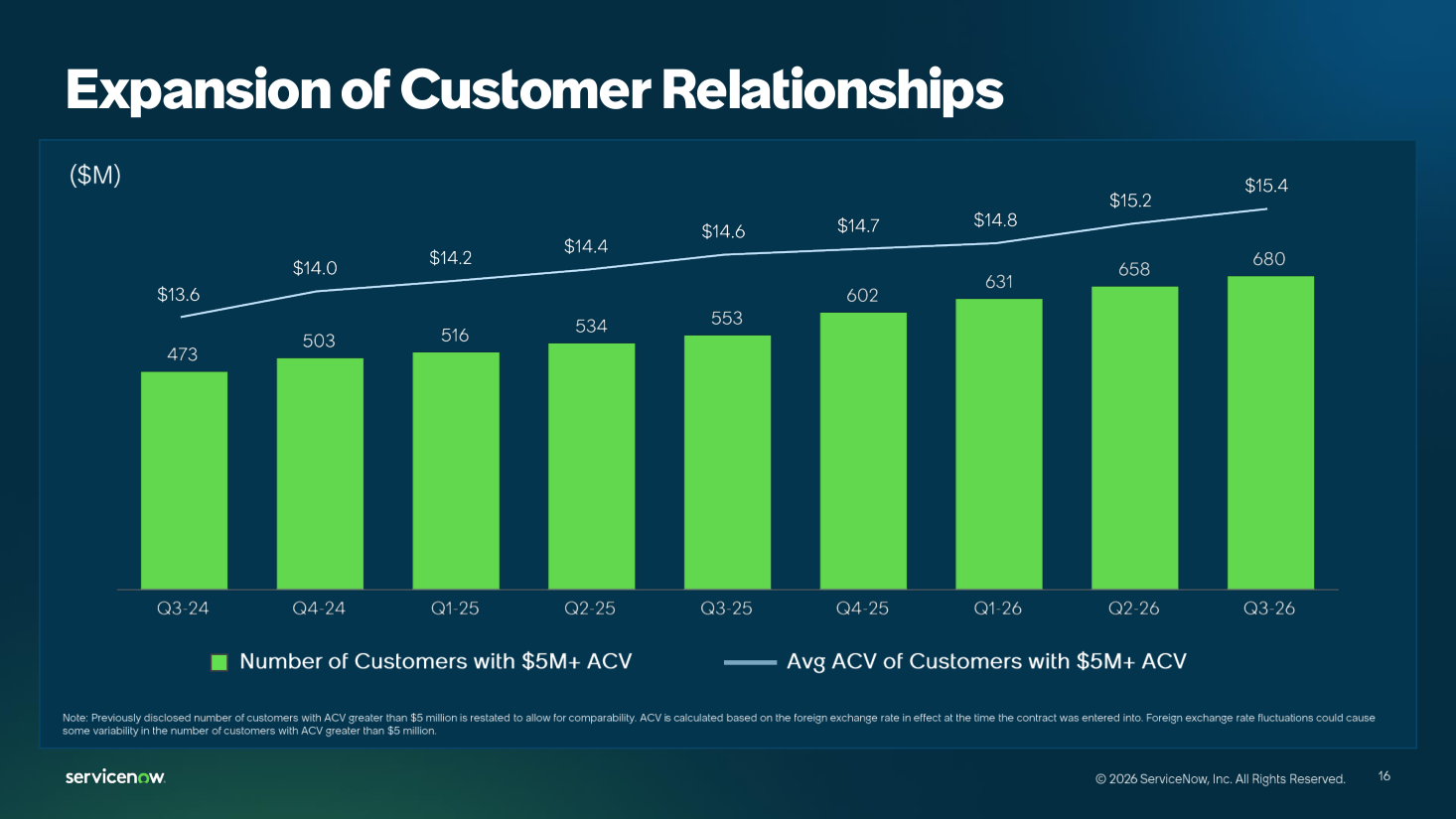
- Slide 16 shows customers above $5 million in annual contract value rising from 553 to 680, +23.0%, with average contract value up from $14.6 million to $15.4 million, or +5.5%. Because the average grew more slowly than the count, most of the gain came from customers crossing the threshold rather than from existing giants getting bigger. Slide 15 notes that the 2011 customer cohort grew from $100 of initial contract value to $3,730, and slide 17 puts the renewal rate at 98%. With almost no churn, a slower cRPO comes down to the pace of new and expansion deals.
The Bull and Bear Case for ServiceNow Shares
- The bull case rests on the guidance habit. Actual cRPO growth beat the prior quarter's constant-currency guide in 17 of 19 quarters since 2022, by an average of 1.56 points over the last eight. The non-GAAP P/E of 28.94 sits in the bottom 6.8% of the 59 months since December 2021.
- The bear case rests on what the acquisitions hide. Excluding Armis, the Q4 cRPO guide of about 16.75% is the lowest of 20 constant-currency guides, GAAP operating income fell -32.7%, and $11.28 billion spent on three deals turned $8.56 billion of net cash into $0.56 billion of net debt.
From McDermott's Arrival to Three Acquisitions
- In October 2019 ServiceNow filed an 8-K saying John Donahoe would leave to run Nike and Bill McDermott, who had led SAP, would take over. Subscription revenue that quarter was $899 million; by the fourth quarter of 2025 it was $3.47 billion, 3.9 times larger. On a split-adjusted basis the stock went from a $49.45 month-end close in October 2019 to a $225.00 weekly close in January 2025, and the company split its shares five for one on December 17, 2025.
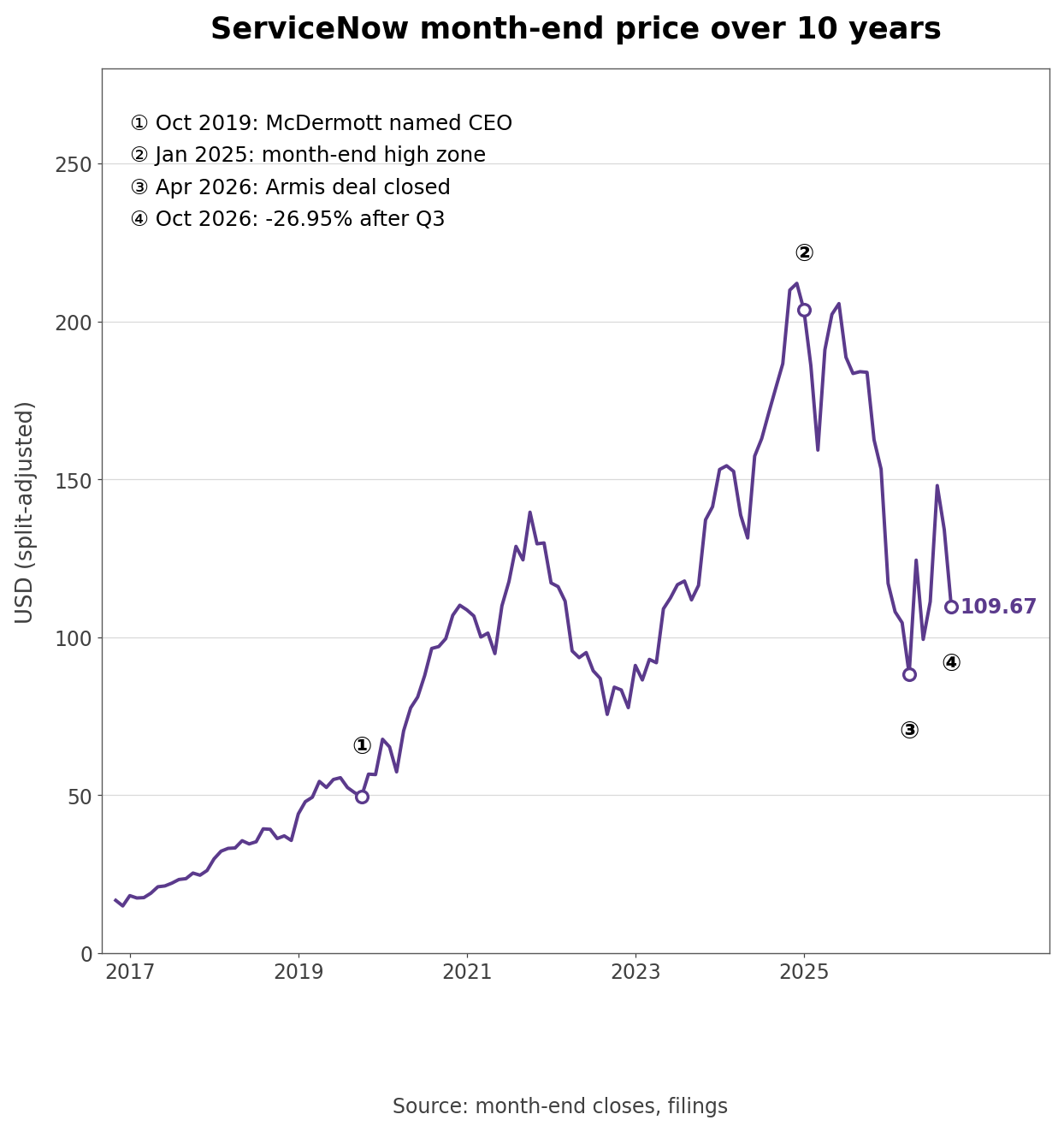
- The later McDermott years are about acquisitions. In December 2025 ServiceNow bought Moveworks, an AI assistant for employee requests, for $2.41 billion in stock and cash. Veza, an identity security company, followed in March 2026 for $1.24 billion, and on April 20 it paid $7.64 billion in cash for Armis, which finds and secures connected devices. The three deals total $11.28 billion. On the July call McDermott said Armis tracks 7 billion devices in real time.
- Shares are down -28.4% this year from $153.19 at the end of 2025. The April month-end close, after Armis closed, was $88.31; the stock reached $147.99 in August before falling again after Q3. It is -51.3% below the January 2025 high.
How Often Has the cRPO Guidance Been Beaten?
- Own calculation (32 earnings releases): ServiceNow has issued constant-currency cRPO guidance since the first quarter of 2022. In 17 of the 19 quarters through Q3 2026, actual growth beat the prior guide. The two misses were Q2 2022 at -1.0 point and Q4 2022 at -0.5 point, the average gap was +1.32 points and the largest beats were +2.5 points in Q3 2023 and Q3 2025.
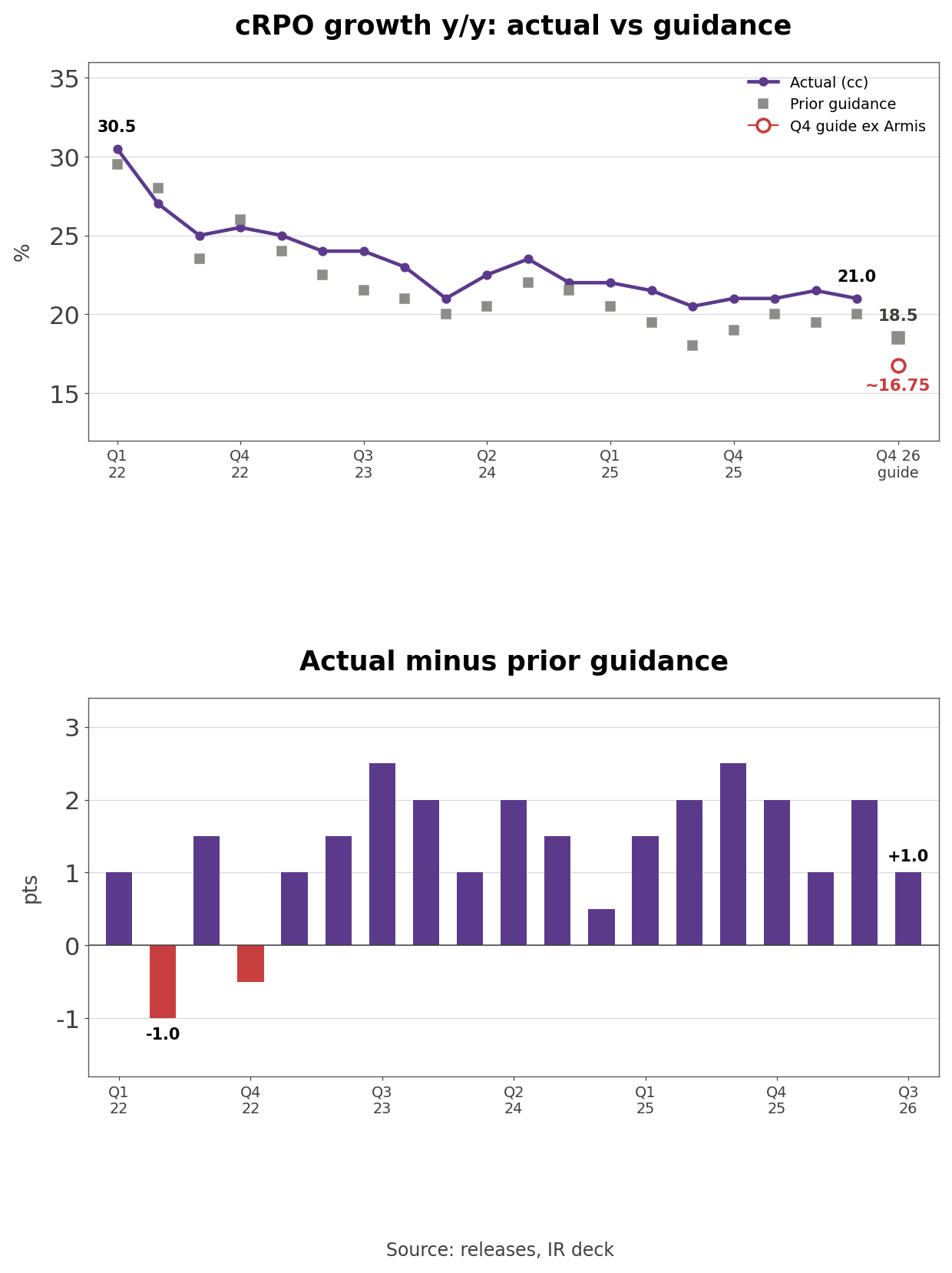
- The guide itself has stepped down from 29.5% for Q1 2022 to 18.0% for Q3 2025. The new 18.5% is the second-lowest on its face, but at about 16.75% excluding Armis it is the lowest of all 20. If ServiceNow beats by its recent eight-quarter average, Q4 would come in near 20.1%, or about 18.3% without Armis, roughly two points below the 20.25% it delivered in Q2 once that quarter's estimated 1.25-point Armis share is removed.
- Subscription revenue tells a similar story. Constant-currency growth eased from 20.0% in Q1 2025 to 19.0% in Q1 2026, then jumped to 23.0% in Q2 and settled at 20.5% in Q3. The company said in July that Q2 pulled some on-premises federal revenue forward from Q3.
- The full-year guide makes the point most simply. Before Armis, the January guide for 2026 subscription growth was 19.5% to 20% in constant currency. It is now 21%, and subtracting about 1.25 points for Armis brings it back to about 19.75%, inside the original range.
Acquisitions Reshaped GAAP Profit and the Balance Sheet
- GAAP operating income was $385 million in Q3, -32.7% from $572 million, while non-GAAP operating income rose +17.4% to $1.34 billion. The $953 million gap is stock-based compensation of $633 million (15.4% of revenue), amortization of acquired intangibles of $198 million, severance of $87 million and acquisition costs of $35 million. Amortization is six times last year's $33 million.
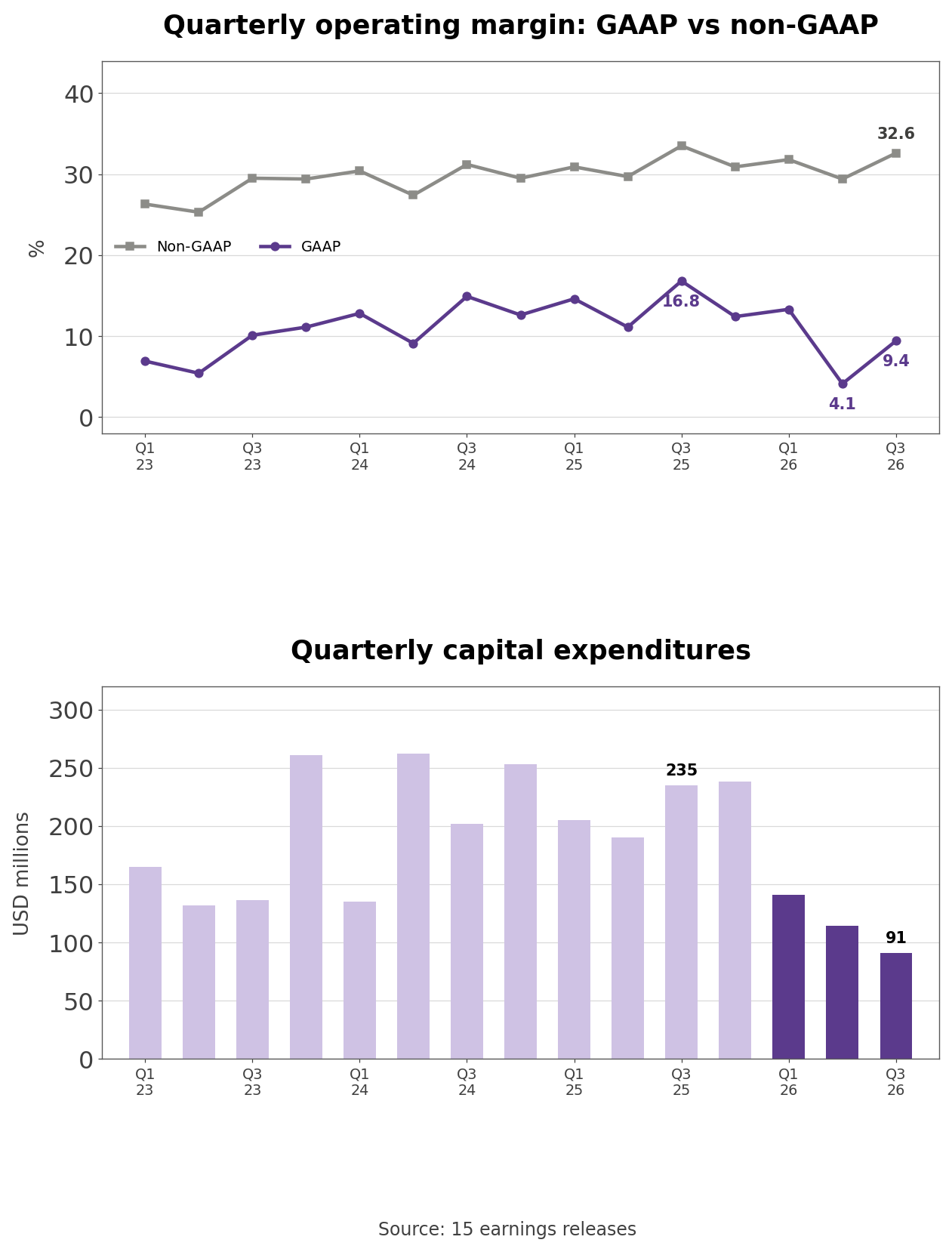
- GAAP operating margin fell from 16.8% to 9.4%, after 4.1% in Q2. GAAP net income was $277 million, down 44.8%, and diluted EPS of $0.27 compares with non-GAAP EPS of $1.00. Subscription gross margin was 73.5% on a GAAP basis and 80% non-GAAP.
- The balance sheet carries the deals. Goodwill rose from $3.58 billion at the end of 2025 to $10.01 billion and intangibles from $1.12 billion to $3.59 billion, together 42.7% of total assets of $31.83 billion. Cash and marketable securities fell from $10.06 billion to $6.96 billion while debt rose from $1.49 billion to $7.52 billion.
- Filing footnote (Q3 10-Q, quarter ended September 30, 2026): ServiceNow paid part of the Armis price with a $4.0 billion term loan in April and refinanced it with $4.0 billion of senior notes in May. Over nine months it issued $4.53 billion of commercial paper and repaid $2.48 billion, and spent $2.23 billion on buybacks, including an accelerated program that retired 18.5 million shares at an average $107.97. It bought no stock in Q3 and has about $4.2 billion of authorization left.
- Capex went the other way. Q3 capital spending was $91 million, -61.3% from $235 million, and nine-month capex was $346 million, -45.1%. Q3 free cash flow was $822 million, and trailing twelve-month free cash flow was $5.15 billion, or 33.4% of revenue.
- Company disclosure (Q3 earnings release): CFO Gina Mastantuono pointed to "reducing capex and raising our full-year free cash flow margin target by 100 basis points to 36 percent." McDermott asked: "What other company at the forefront of the agentic enterprise has no capital or compute constraints?"
How ServiceNow Makes Money From Workflow Subscriptions
- Subscriptions are 97% of revenue. The 10-K says customers are typically invoiced annually in advance, revenue is recognized over the contract term and contracts are generally non-cancellable. That is why cRPO works as a floor under the next year's revenue, and why contracts that can be terminated for convenience, like some of Armis's, are kept out of it. Self-hosted software is recognized upfront on delivery, and that portion was $96 million of Q3 subscription revenue.
- The 10-K frames the company as the layer between AI and the systems that actually run a business. AI models, it says, can surface insights but "they cannot independently execute transactions, route approvals, update systems of record" without a platform that carries the decision through. To investors worried that AI agents will shrink seat-based software, that is ServiceNow's answer: more agents need more governance. The Q3 release also highlighted a Google Cloud integration that lets employees run ServiceNow workflows inside Gemini Enterprise.
- The product set has three groups. Technology workflows cover IT service management, IT operations, asset management, security operations, risk and now Armis. CRM, industry and core business workflows cover customer service, field service, HR, legal and procurement, plus Moveworks. Creator workflows include App Engine, for building custom apps, and data connection tools.
- Slide 18 shows the trailing twelve-month mix of net new contract value shifting. Technology workflows fell from 52% to 48% over the year while CRM, industry and core business rose from 28% to 34%. A company that started in the IT department is spreading into customer service and HR, and Armis and Veza give security its own leg.
- Geographically, 62.7% of Q3 revenue, $2.57 billion, came from North America, 25.0% from Europe, the Middle East and Africa and 12.3% from Asia Pacific and other regions. Customers above $5 million in annual contract value numbered 420 at the end of 2023, 502 at the end of 2024 and 603 at the end of 2025 before reaching 680 in Q3, and 19 deals in the quarter added more than $5 million of net new contract value each.
- AI earns money through price and through usage. On the July call management said customers moving to the AI-native editions were paying 20% to 30% more, and the Q3 release raised the year-end AI annual contract value target from $1 billion at the start of the year to $1.7 billion, with agentic AI consumption in production up more than 13 times. The same day ServiceNow announced a deeper OpenAI partnership that starts with a ServiceNow plugin for ChatGPT.
How ServiceNow Compares With Three Software Peers
- The comparison set is Salesforce, Workday and Adobe. Salesforce overlaps in customer service, Workday in HR, and Adobe shares the enterprise subscription model. Salesforce and Workday figures run through July and Adobe's through August. Trailing four-quarter revenue growth is +21.8% at ServiceNow against +13.3% at Workday, +12.0% at Adobe and +11.2% at Salesforce.
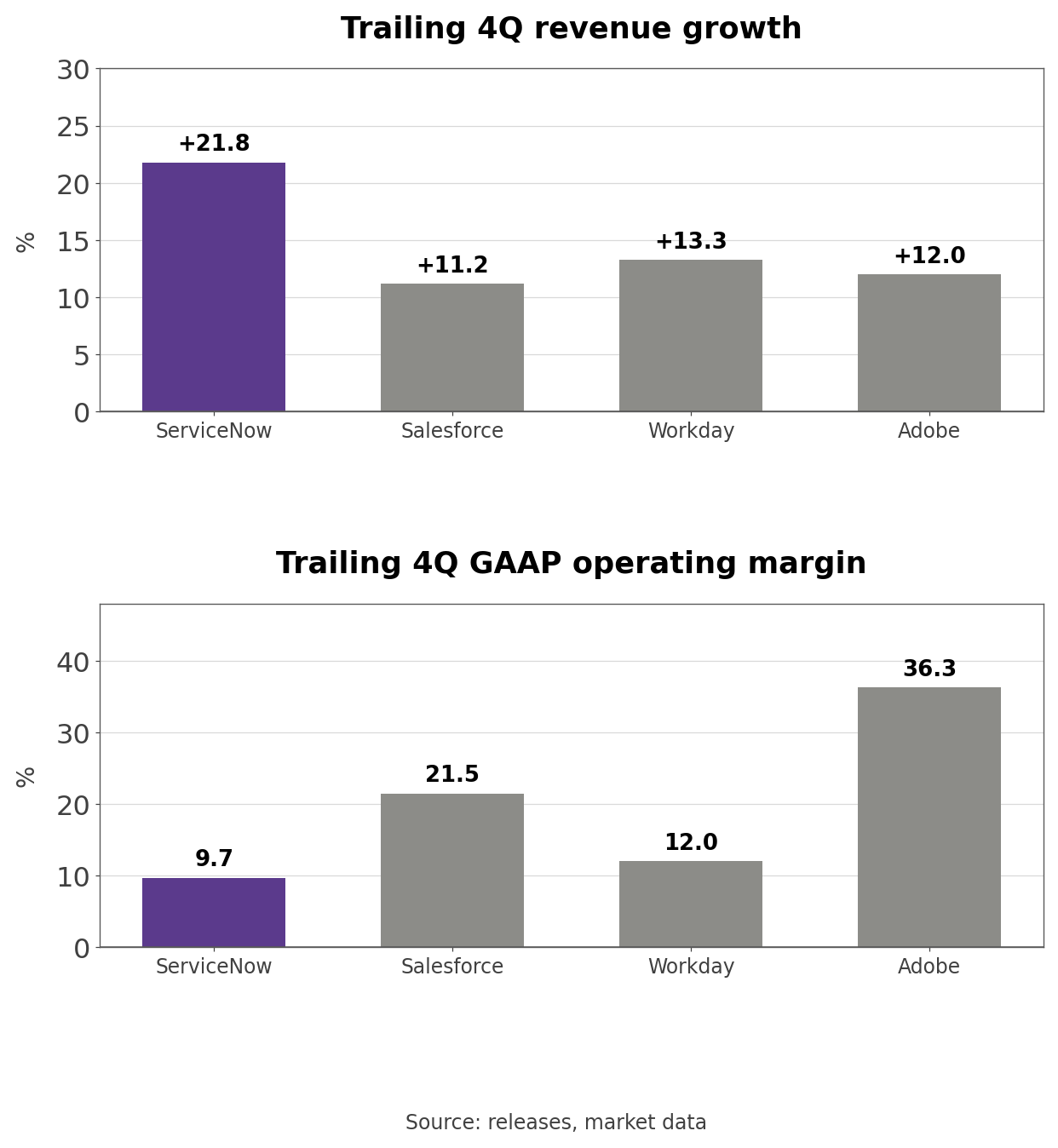
- On GAAP operating margin the order flips: Adobe 36.3%, Salesforce 21.5%, Workday 12.0% and ServiceNow 9.7%, weighed down by deal amortization and stock compensation near 15% of revenue. Market data counts ServiceNow's Q4 2025 operating income as $589 million rather than the $443 million in the release, so the ServiceNow figure here uses the release.
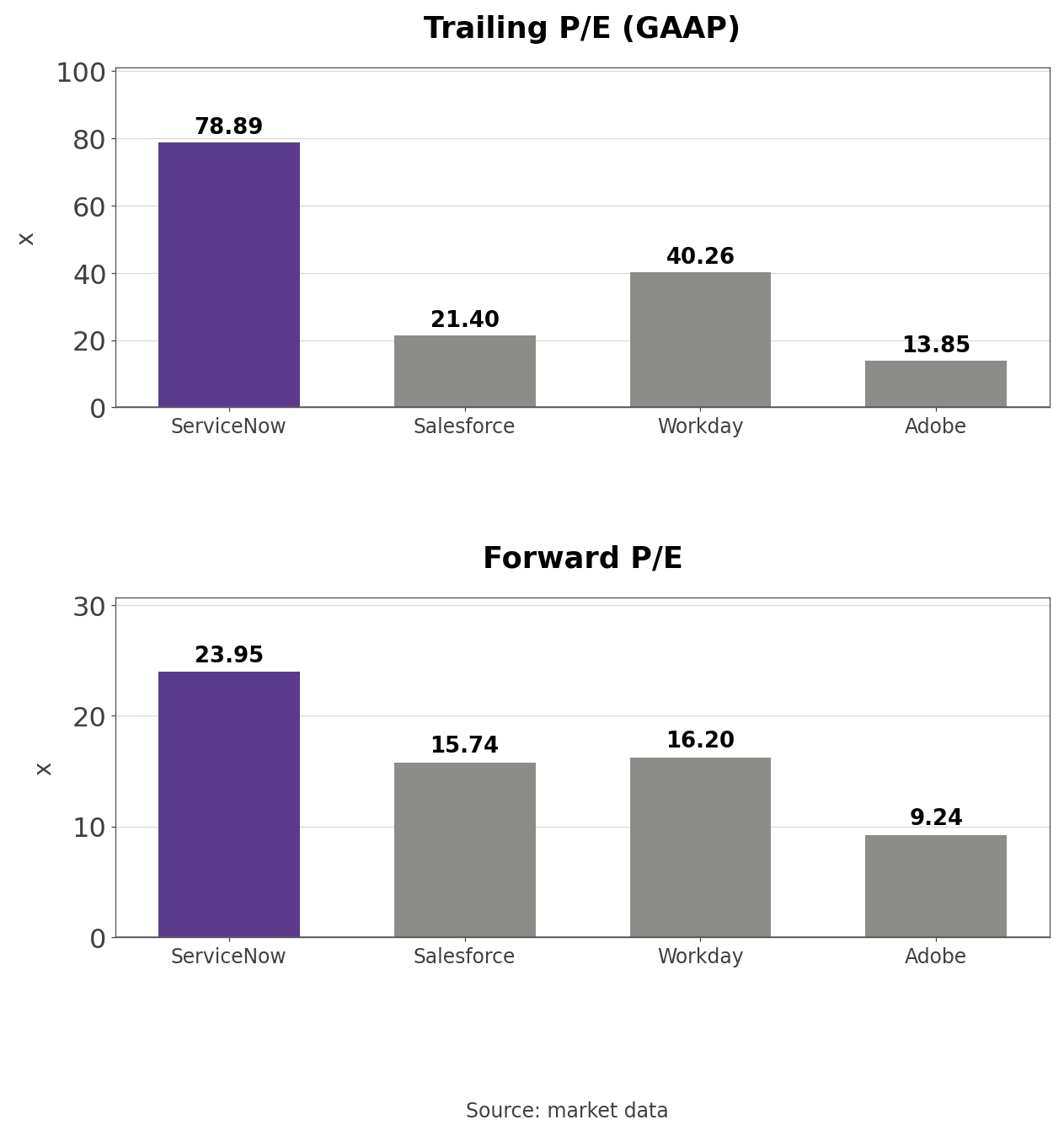
- Trailing GAAP P/E is 78.89 for ServiceNow, 40.26 for Workday, 21.40 for Salesforce and 13.85 for Adobe, and forward P/E is 23.95, 16.20, 15.74 and 9.24. Over the past year market value fell 21.9% at Salesforce, 27.3% at Workday, 35.5% at Adobe and 42.2% at ServiceNow. The worry that AI agents will cut seat counts hangs over the whole group, and the fastest grower has seen its multiple shrink the most.
ServiceNow's Non-GAAP P/E and Price-to-Sales Band
- The share price divided by trailing non-GAAP diluted EPS of $3.79 gives 28.94 times, in the bottom 6.8% of the 59 months since December 2021 and less than half the 62.58 median. The low was 24.05 in April 2026, the month Armis closed. Price to sales is 7.38 times, in the bottom 5.1%, against a median of 14.91.
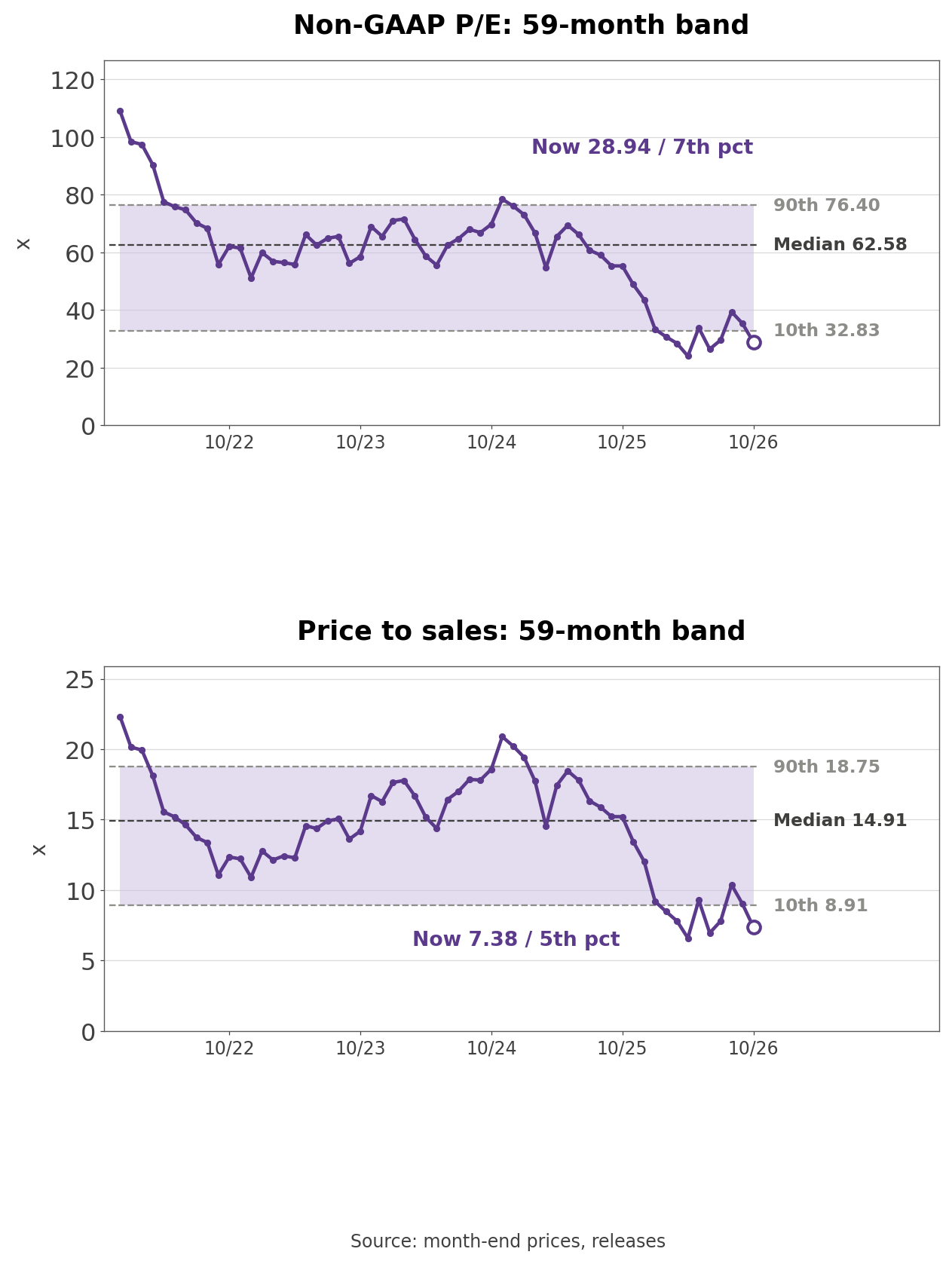
- GAAP P/E is 78.90, 2.7 times the non-GAAP multiple. The same share price reads very differently depending on whether stock compensation and deal amortization count as costs, so the band uses the non-GAAP EPS the company reports every quarter.
- Outside view (market data consensus, right after Q3 results): Of 49 analysts, 35 rate the stock strong buy, 9 buy, 3 hold, 1 sell and 1 strong sell, with an average price target of $155.17. The average 2027 revenue estimate is $19.29 billion and EPS $4.89, some of it not yet updated for the Q3 guide.
Three Conditions That Move the Stock
- cRPO growth excluding Armis is guided at about 16.75% for Q4. A beat in line with history, landing in the high 18s, would mark the guide as conservative. A result near 17% would confirm that the underlying pace has stepped below Q3's 21%. Fourth-quarter results will show which reading the selloff priced.
- GAAP operating margin was 9.4% in Q3. With $3.59 billion of intangibles amortizing mostly over five to six years, the $198 million quarterly charge will persist, and closing the gap to the 32.5% non-GAAP margin requires stock compensation to fall below the mid-teens share of revenue.
- Net debt was $563 million at September 30. Paying down roughly $2 billion of commercial paper from free cash flow would reopen buybacks within the $4.2 billion authorization, while more borrowing would put deal debt ahead of shareholder returns.
What to Watch in the Q4 Report
- Fourth-quarter results, expected in late January, should show how far cRPO beat the 18.5% guide and whether the 2027 outlook sizes Armis separately. From Q2 2027 the year-ago quarter also contains Armis, so most of its contribution drops out of growth rates and organic growth becomes visible on its own.
- One question stays open. How much will the AI deployment carve-out, which the company says returns to subscriptions at renewal, lift cRPO growth in 2027?
Related Analysis
- CrowdStrike (CRWD) Stock Analysis: GAAP vs Non-GAAP Results: another security-heavy software company with a wide GAAP to non-GAAP gap, useful next to ServiceNow's 9.4% GAAP and 32.5% non-GAAP margins.
- Adobe (ADBE) Stock Analysis: Valuation After the CEO Change: a subscription software peer whose multiple has also compressed, a reference for ServiceNow's 28.94 times non-GAAP P/E.
#ServiceNow #NOWStock #SaaS #SoftwareStocks #Cybersecurity #AIAgents #USStocks #StockAnalysis #EquityResearch #GlobalStockBrief
'US Stock Analysis' 카테고리의 다른 글
| Intel (INTC) Stock: A 6.1% Q4 Cut as Servers Pass PCs (0) | 2026.11.02 |
|---|---|
| Verizon (VZ) Stock: Record Adds and Flat Revenue Ex Frontier (0) | 2026.11.02 |
| Amazon (AMZN) Stock: AWS Up 39% and Free Cash Flow Negative (0) | 2026.11.01 |
| Alphabet (GOOGL) Stock: Equity Raise and Cloud Up 103% (0) | 2026.11.01 |
| Microsoft (MSFT) Stock: OpenAI Is 10.8% of Revenue (0) | 2026.11.01 |


