- AstraZeneca (NYSE: AZN) grew third-quarter 2026 revenue +6.7% to $16.21 billion and Core EPS 17% to $2.79, and the stock closed results day at $186.65, +7.02%. Break the quarter down by therapy area, though, and oncology alone added $1.13 billion against a year-earlier quarter, more than the company's entire $1.02 billion increase. Everything outside oncology shrank in aggregate, and at the center of that is Farxiga, the diabetes, heart failure and kidney drug that lost exclusivity in the US and fell -24.8%.
- AstraZeneca is a UK drugmaker that sells cancer medicines, cardiovascular, renal and metabolic (CVRM) drugs, respiratory and immunology (R&I) products, infectious disease medicines and rare disease treatments from its Alexion unit. Its ordinary shares have traded directly on the New York Stock Exchange since February 2026. At $186.65 and 1.554 billion shares, its market value is about $290.1 billion.
- The question here is how long oncology growth can fill the hole Farxiga is leaving. The analysis lines up the Q3 2026 results 6-K, the H1 2026 results 6-K, the FY 2025 results 6-K, the 46-page Q3 results presentation and 28 results filings going back to 2019.
- Two caveats apply. AstraZeneca reports growth at constant exchange rates (CER), while the calculations here use actual dollars, so the two can differ by a point or two. The ex-Farxiga figures subtract the two products' product revenue from total revenue, and the 2030 target is set at Q1 2024 exchange rates, so comparing it with reported dollars is approximate.
What the Q3 Deck Says About Growth Without Farxiga
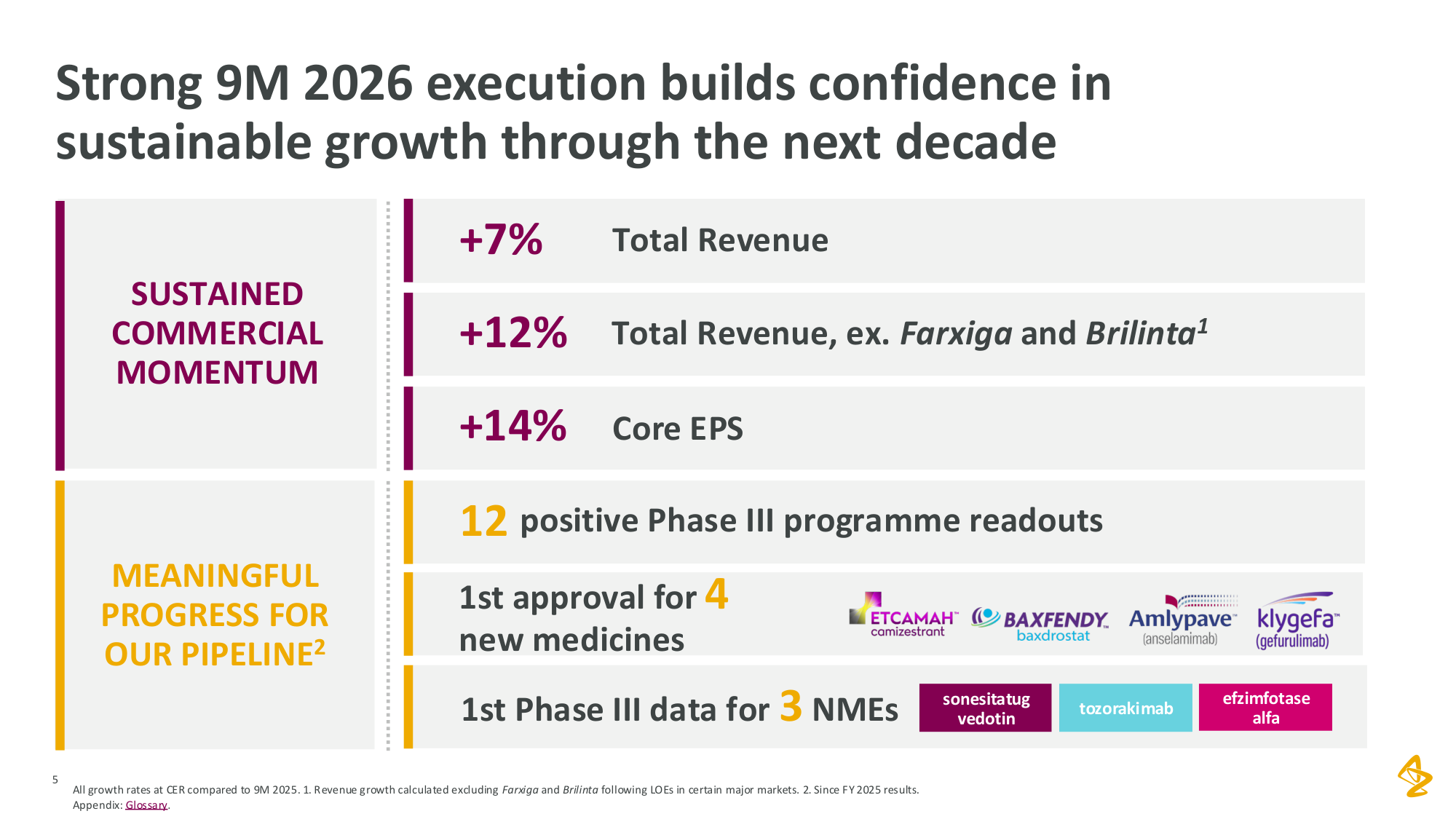
- Slide 5 of the Q3 deck lines up three growth rates for the first nine months: total revenue +7%, total revenue excluding Farxiga and Brilinta +12%, and Core EPS +14%. Underneath it adds 12 positive Phase III readouts and first approvals for four new medicines (Etcamah, Baxfendy, Amlypave and Klygefa). The footnote defines the +12% as growth calculated excluding Farxiga and Brilinta following loss of exclusivity in certain major markets.
- Taking those two products out is not a small adjustment. In 2025 Farxiga sold $8.41 billion and Brilinta $823 million, together 15.7% of $58.74 billion in total revenue, and their combined nine-month sales fell from $7.01 billion to $5.86 billion, -16.3%.
- Company disclosure (Q3 results 6-K, October 30, 2026): AstraZeneca said nine-month revenue rose 7% as double-digit growth in Oncology, R&I and Rare Disease offset headwinds from Farxiga and Brilinta loss of exclusivity and volume-based procurement in China. In its cash flow commentary it named working capital "including the impact of Farxiga loss of exclusivity in the US" as the main reason operating cash flow fell $1.34 billion year over year.
- Own calculation (Q3 results 6-K): In the third quarter alone, total revenue grew 6.7%, but without the two products it went from $12.91 billion to $14.53 billion, +12.5%. Over nine months the ex-Farxiga figure rose 13.2%, from $36.23 billion to $41.02 billion, consistent with the company's +12% at CER.
- The Farxiga table in the filing explains where the decline comes from. US sales over nine months were $795 million, down 36%, with the note "Multiple generics launched in Q2 2026". Emerging Markets fell 21% at CER on generic competition and China's volume-based procurement (VBP) from Q1 2026, and Japan saw a generic diabetes entry in Q4 2025. Only Europe grew, up 6% at CER despite a UK generic.
- Slide 6 shows the mix. Oncology is 47% of nine-month product revenue, CVRM 18%, R&I 16% and Rare Disease 16%. By region the US is 42%, Europe 23%, emerging markets outside China 15% and China 12%. Europe grew 10% at CER and China was the only region in decline, at -3%.
The 2030 Revenue Target and the Growth It Requires
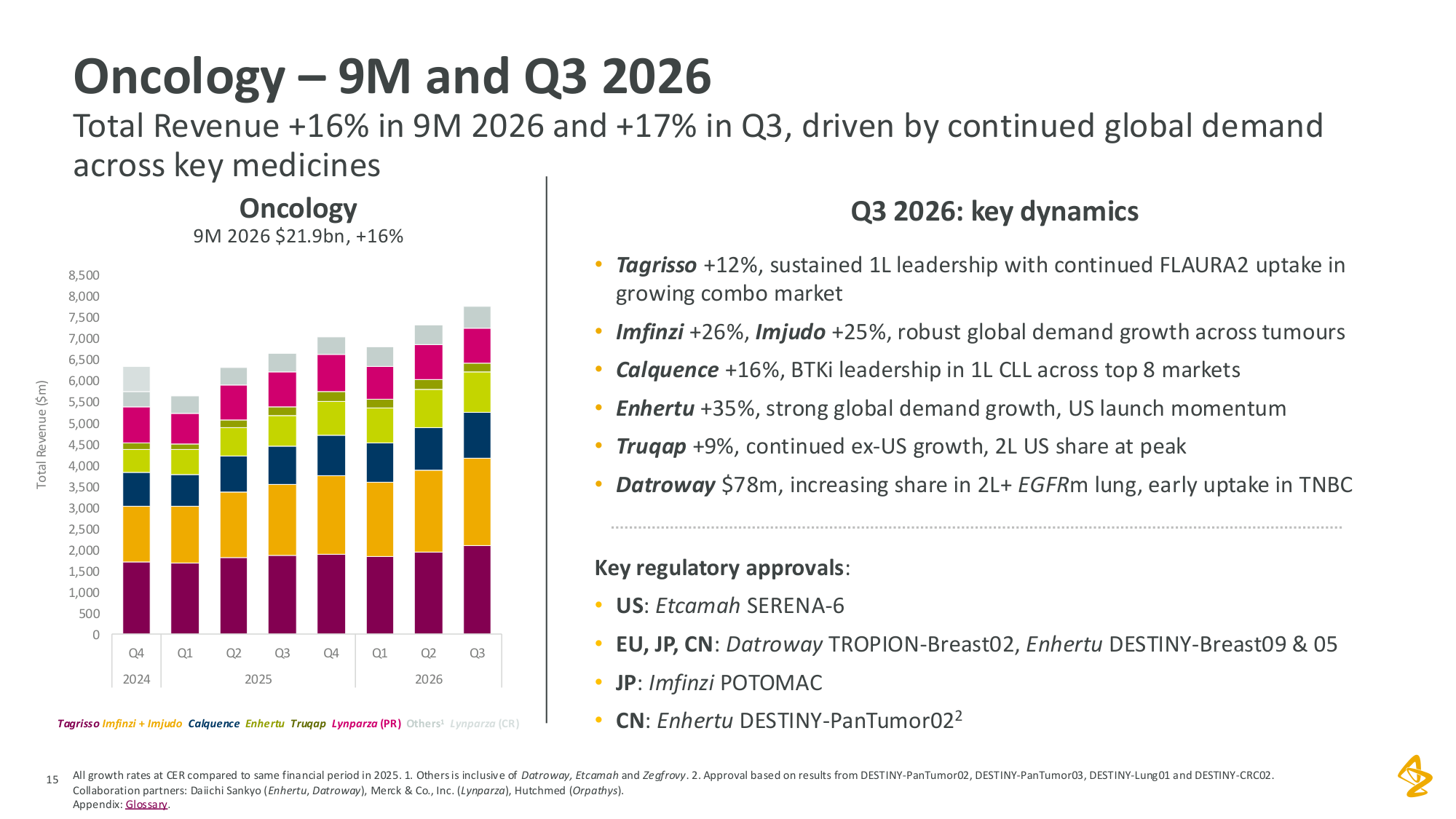
- Slide 15 stacks oncology revenue by product for eight quarters and headlines $21.9 billion in the first nine months (+16%) with +17% in Q3. The right side lists Tagrisso +12% on continued first-line combination uptake, Imfinzi +26%, Calquence +16%, Enhertu +35% on global demand and US launch momentum, Truqap +9%, and Datroway at $78 million. The footnote names Daiichi Sankyo as the partner on Enhertu and Datroway and Merck on Lynparza.
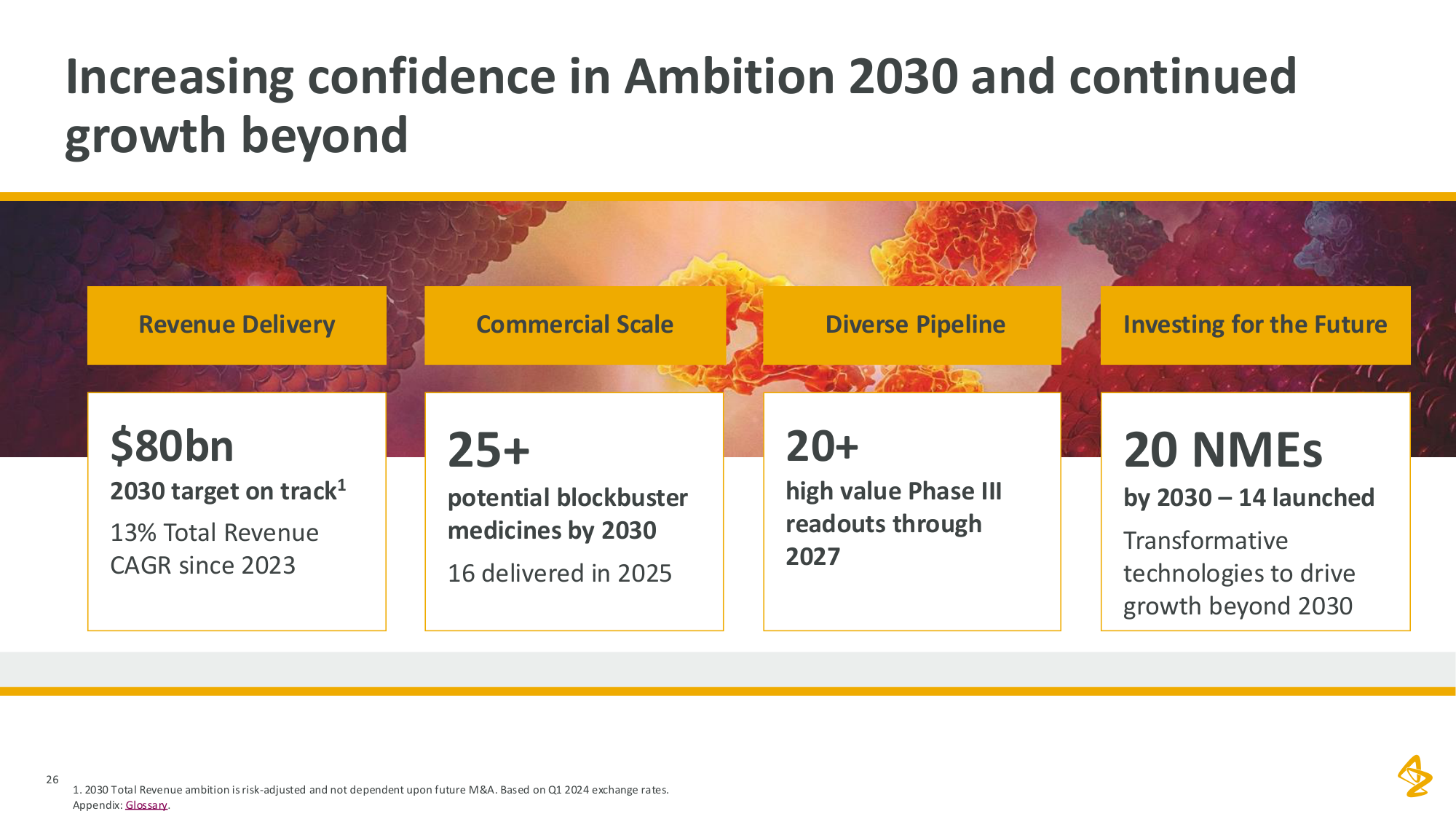
- Slide 26 opens with an $80 billion 2030 target described as on track and a 13% total revenue CAGR since 2023. The footnote says the ambition is risk-adjusted, does not depend on future M&A and uses Q1 2024 exchange rates. The other boxes promise 25-plus potential blockbusters by 2030 (16 already delivered in 2025), 20 new molecular entities by 2030 (14 launched) and more than 20 high-value Phase III readouts through 2027, which leaves at least nine blockbusters and six new medicines to come in four years.
- Own calculation (FY 2023 to FY 2025 results 6-Ks): Total revenue went from $45.81 billion in 2023 to $58.74 billion in 2025, a 13.2% compound rate that matches the slide. By year, though, growth was 18.0% in 2024 and 8.6% in 2025, and the first nine months of 2026 were +8.4%. Reaching $80 billion in 2030 from the 2025 base takes 6.37% a year. If Q4 2026 simply repeats Q3, 2026 revenue is $63.09 billion (+7.4%), and the remaining four years need 6.1% a year.
- Slide 7 adds that this year's 12 positive Phase III programmes represent more than $10 billion of peak-year revenue, a figure the footnote says is not risk-adjusted. Tozorakimab in COPD, efzimfotase alfa in hypophosphatasia and the gastric cancer antibody-drug conjugate sonesitatug vedotin produced their first Phase III data. CEO Pascal Soriot said the company is "on track to deliver our 2030 ambition and to sustain growth through the next decade." The slide does not mention that the Farxiga decline that cuts into that path only began in Q2 2026.
The Bull and Bear Case for AstraZeneca Shares
- The bull case is oncology and margin. Oncology revenue was $7.77 billion in Q3, up 17%, and Core operating profit rose 20% at CER, faster than revenue. Management kept full-year guidance and says the 2030 target is on track.
- The bear case is the speed of the Farxiga decline. Farxiga peaked at $2.19 billion in Q1 2026 and fell to $1.61 billion in Q3, down 26.8% in two quarters. If Q3's pace holds for a year, Farxiga and Brilinta take about $2.5 billion out of revenue, equal to 4.3% of 2025 sales.
From Alexion to a Direct NYSE Listing
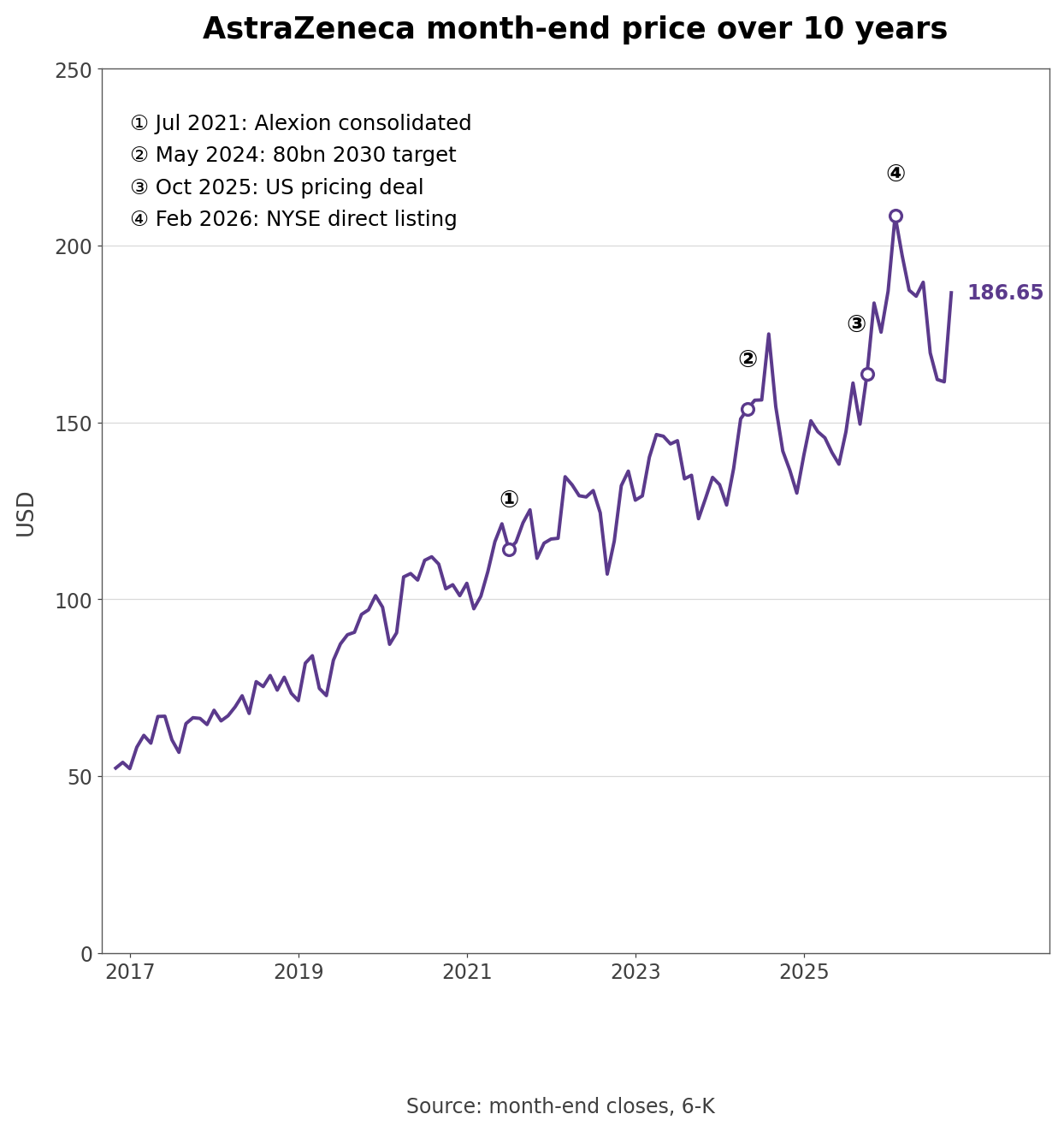
- AstraZeneca began consolidating rare disease specialist Alexion on July 21, 2021, with the stock at a $114.11 month-end close. Alexion's Soliris and Ultomiris became today's Rare Disease unit, 16% of nine-month 2026 revenue. At its May 2024 investor day the company set the $80 billion 2030 revenue target, with the stock at $153.78.
- In July 2025 AstraZeneca announced plans to invest $50 billion in US manufacturing and R&D by 2030. In October 2025 it announced an agreement with the US administration under which American patients get medicines at "prices that are equalised with those available in wealthy countries", select chronic disease drugs are sold direct to consumers, and Section 232 pharmaceutical tariffs are delayed for three years. The same month it broke ground on a $4.5 billion plant in Virginia.
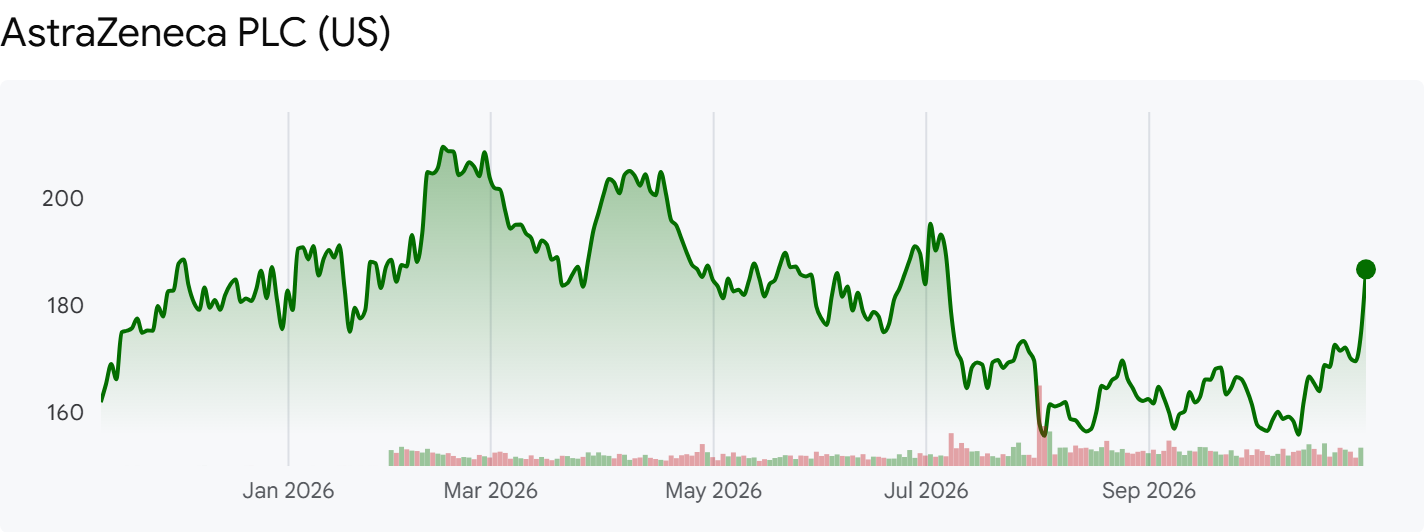
- Ordinary shares started trading on the NYSE on February 2, 2026, and the old American Depositary Share listing on Nasdaq ended on January 30. February's $208.45 month-end close was the 10-year high. The stock fell to $161.47 at the end of September before a +15.6% October brought it back to $186.65, still -10.5% from the peak and +6.4% for 2026.
How Much of the Growth Came From Oncology?
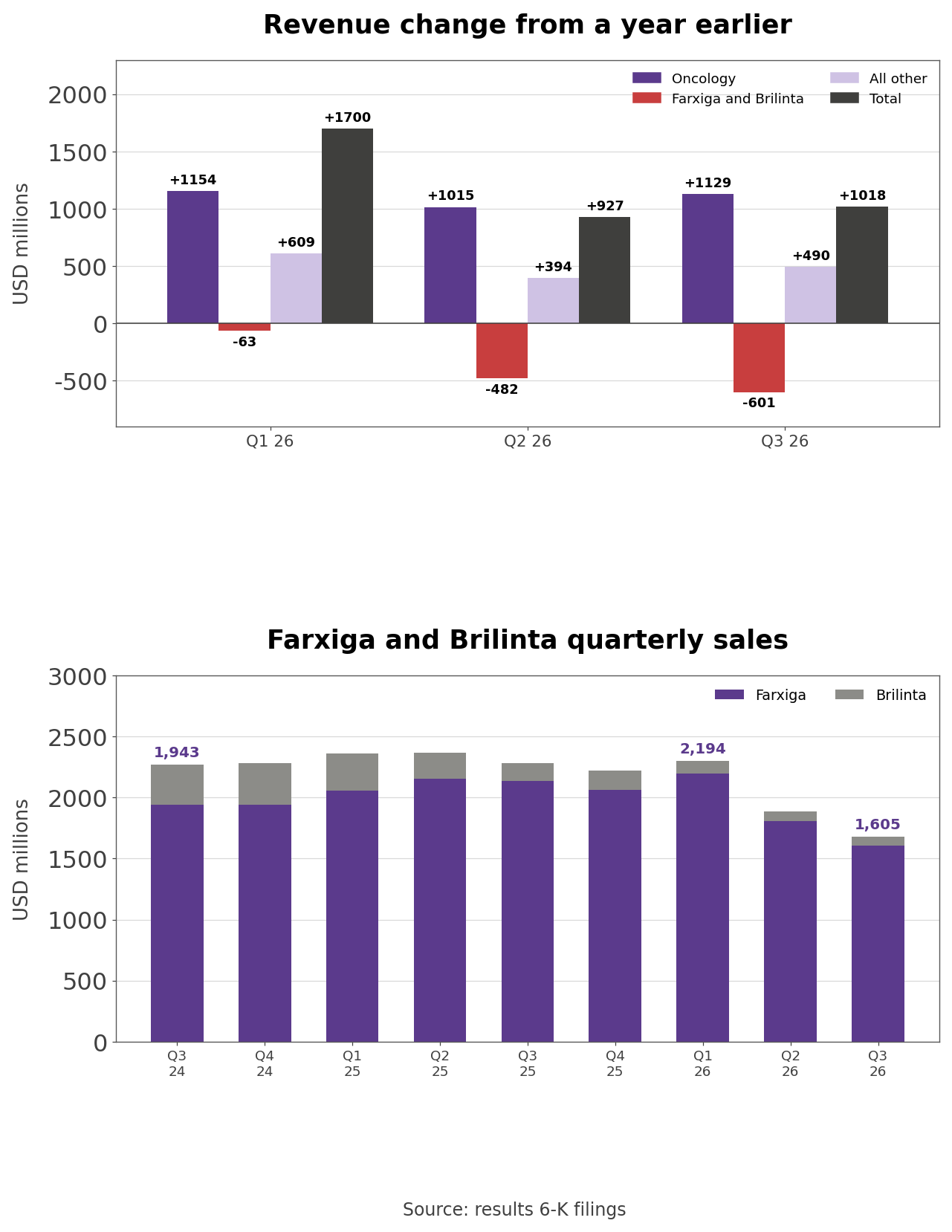
- Own calculation (seven quarters of results 6-Ks): In Q1 2026 total revenue rose $1.70 billion from a year earlier and oncology supplied $1.15 billion, or 68%. In Q2 oncology's $1.02 billion increase exceeded the company's $927 million total, and in Q3 oncology added $1.13 billion against a total of $1.02 billion. Outside oncology, revenue fell $88 million in Q2 and $111 million in Q3.
- The reason is plain. Farxiga's year-over-year change went from +$136 million in Q1 to -$347 million in Q2 and -$530 million in Q3, and with Brilinta the Q3 drag was $601 million. In the same quarter R&I added $259 million and Rare Disease $217 million, so the Farxiga decline alone was larger than both gains combined.
- If Farxiga's $1.61 billion and Brilinta's $75 million Q3 sales simply held for a year, they would total $6.42 billion and $300 million, about $2.51 billion less than in 2025. Because the Farxiga decline has widened every quarter since Q1, assuming it stops at Q3's pace is the optimistic case.
- Oncology's weight has grown accordingly, from 41.5% of total revenue in Q1 2025 to 47.9% in Q3 2026. With one therapy area close to half of sales, the growth of a handful of cancer drugs now sets the company's growth rate.
The Oncology Drugs Doing the Work
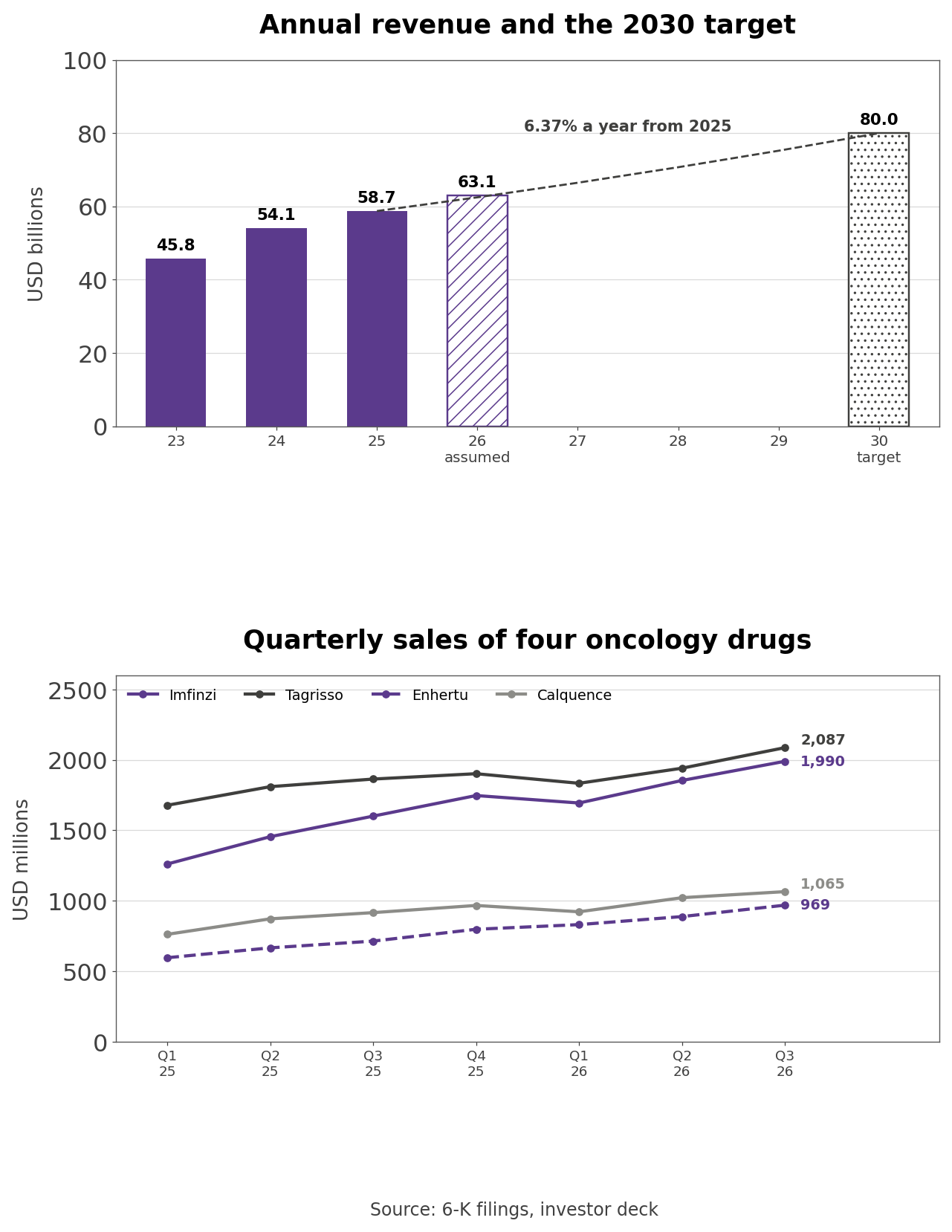
- The oncology gain is concentrated. Against Q3 2025, immunotherapy Imfinzi rose from $1.60 billion to $1.99 billion, +$389 million; Enhertu from $714 million to $969 million, +$255 million; and lung cancer drug Tagrisso from $1.86 billion to $2.09 billion, +$223 million. Blood cancer drug Calquence added $149 million and Datroway went from $24 million to $78 million. Lynparza, sold with Merck, slipped to $811 million, -3.1%.
- Outside oncology, asthma biologic Tezspire grew 49.5%, Strensiq 33.3% and Ultomiris 16.9%, while Soliris fell 35.5% as patients converted to Ultomiris and, in the US, because Soliris is "Affected by biosimilar pressure".
- Part of the growth is shared with partners. Q3 Alliance Revenue was $1.11 billion, up 36%, more than five times the total revenue growth rate. The deck lists Enhertu, Lynparza, Datroway, Beyfortus, Tezspire and Wainua as partnered medicines, and the company's share of partner sales in their territories comes in as Alliance Revenue.
- Profit grew faster than sales. Q3 Core gross margin was 82%, a point higher than a year earlier, and Core operating profit was $5.86 billion, up 20% at CER and 36% of revenue. Trailing four-quarter Core EPS was $10.12, $3.00 more than reported IFRS EPS of $7.12, the gap being items such as amortization of intangibles from Alexion and other deals. Guidance is given on a Core basis.
- Net debt rose $2.46 billion in nine months to $25.83 billion at the end of September, and the deck puts net debt to EBITDA at 1.2 times. In October the company completed a $2 billion equity investment in Summit Therapeutics, giving it "rights equivalent to approximately 12.0% of Summit Therapeutics' outstanding common stock", and agreed to test Summit's PD-1/VEGF bispecific ivonescimab with its own antibody-drug conjugates.
How AstraZeneca Makes Money Across Three Businesses
- Revenue comes in three forms. Product Sales of medicines AstraZeneca sells itself were $43.96 billion over nine months, 94% of the total; Alliance Revenue from partner-sold medicines was $2.81 billion; and Collaboration Revenue from licensing and milestones was $113 million.
- The businesses are Oncology, BioPharmaceuticals and Rare Disease. Oncology covers lung cancer (Tagrisso, Imfinzi), breast cancer (Enhertu, Datroway, Truqap, Etcamah), blood cancer (Calquence) and ovarian and prostate cancer (Lynparza). Enhertu and Datroway are antibody-drug conjugates co-developed with Daiichi Sankyo. The deck's tumour maps for lung, breast, gastric and bladder cancer show the strategy of covering the same patients with several drugs, from first-line treatment to therapy around surgery.
- BioPharmaceuticals spans CVRM, R&I and infectious disease. CVRM includes Farxiga, cholesterol drug Crestor, potassium binder Lokelma and newly approved hypertension drug Baxfendy. R&I includes inhalers Symbicort and Breztri, biologics Fasenra and Tezspire and lupus drug Saphnelo; nine-month R&I revenue was $7.27 billion, up 12%, and COPD candidate tozorakimab was filed in the US and Japan. Infectious disease, renamed from Vaccines and Immune Therapies in 2026, was $735 million, down 11%, about 2% of revenue.
- Rare Disease is Alexion. Complement C5 inhibitors Ultomiris and Soliris are the core, alongside hypophosphatasia drug Strensiq and Koselugo. Nine-month revenue was $7.54 billion, up 12%, with Ultomiris at $4.02 billion (+16%), Strensiq $1.64 billion (+38%) and Soliris $1.08 billion (-25%). Efzimfotase alfa for hypophosphatasia has been filed in the US, EU and China.
- The cost structure is research heavy. Nine-month Core R&D was $10.77 billion, 23% of revenue, and SG&A $11.82 billion, 25%. With an 83% Core gross margin, AstraZeneca can spend nearly half of sales on R&D and selling and still keep a 35% Core operating margin. In Q2 it also paid a $1.10 billion upfront fee to CSPC Pharmaceuticals for a collaboration built on an AI-driven peptide discovery platform and once-monthly dosing technology.
- Manufacturing is moving toward the US. According to the 9M 2025 filing, the Virginia plant will produce drug substance for the weight management and metabolic pipeline, including oral GLP-1 AZD5004, baxdrostat and oral PCSK9 laroprovstat, as well as antibody-drug conjugates. The US is 42% of revenue, and the tariff delay gives the company three years to build more of that supply domestically.
- Shareholder returns run through the dividend. Nine-month operating cash flow of $10.89 billion less $2.28 billion of capital expenditure leaves free cash flow (FCF) of $8.61 billion, and dividends paid of $4.96 billion were a 57.6% payout of that FCF.
How AstraZeneca Compares With Three Pharma Peers
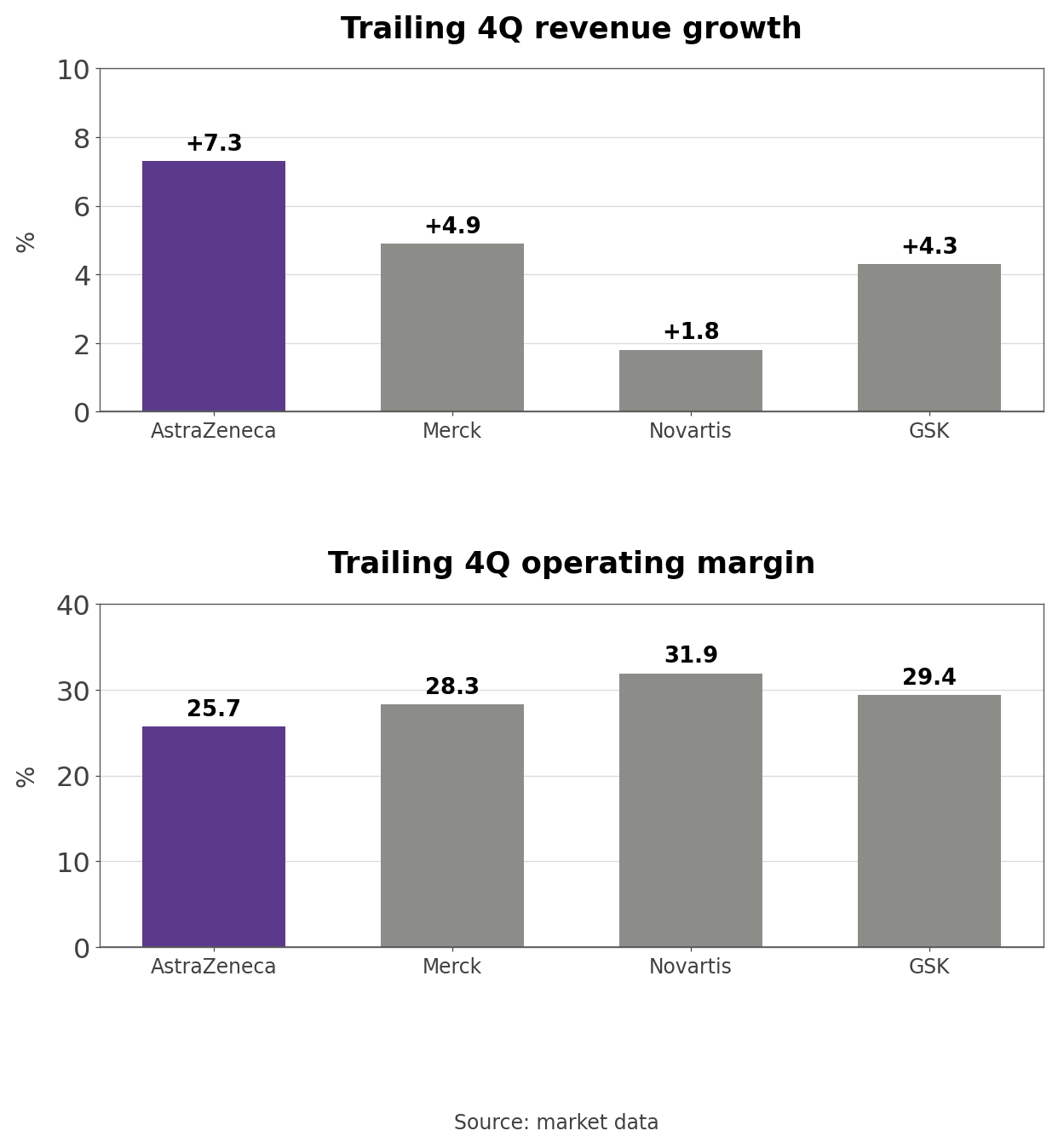
- The comparison set is Merck, whose Keytruda leads immuno-oncology and which also partners with AstraZeneca on Lynparza; Novartis, a European pharma group overlapping in cardiovascular and immunology; and GSK, the other large UK drugmaker, with respiratory and vaccine businesses. On market data, trailing four-quarter revenue growth is +7.3% at AstraZeneca, +4.9% at Merck, +4.3% at GSK and +1.8% at Novartis. Operating margin is 31.9% at Novartis, 29.4% at GSK, 28.3% at Merck and 25.7% at AstraZeneca, whose figure appears to be on a reported basis that includes intangible amortization, below its 36% Q3 Core margin.
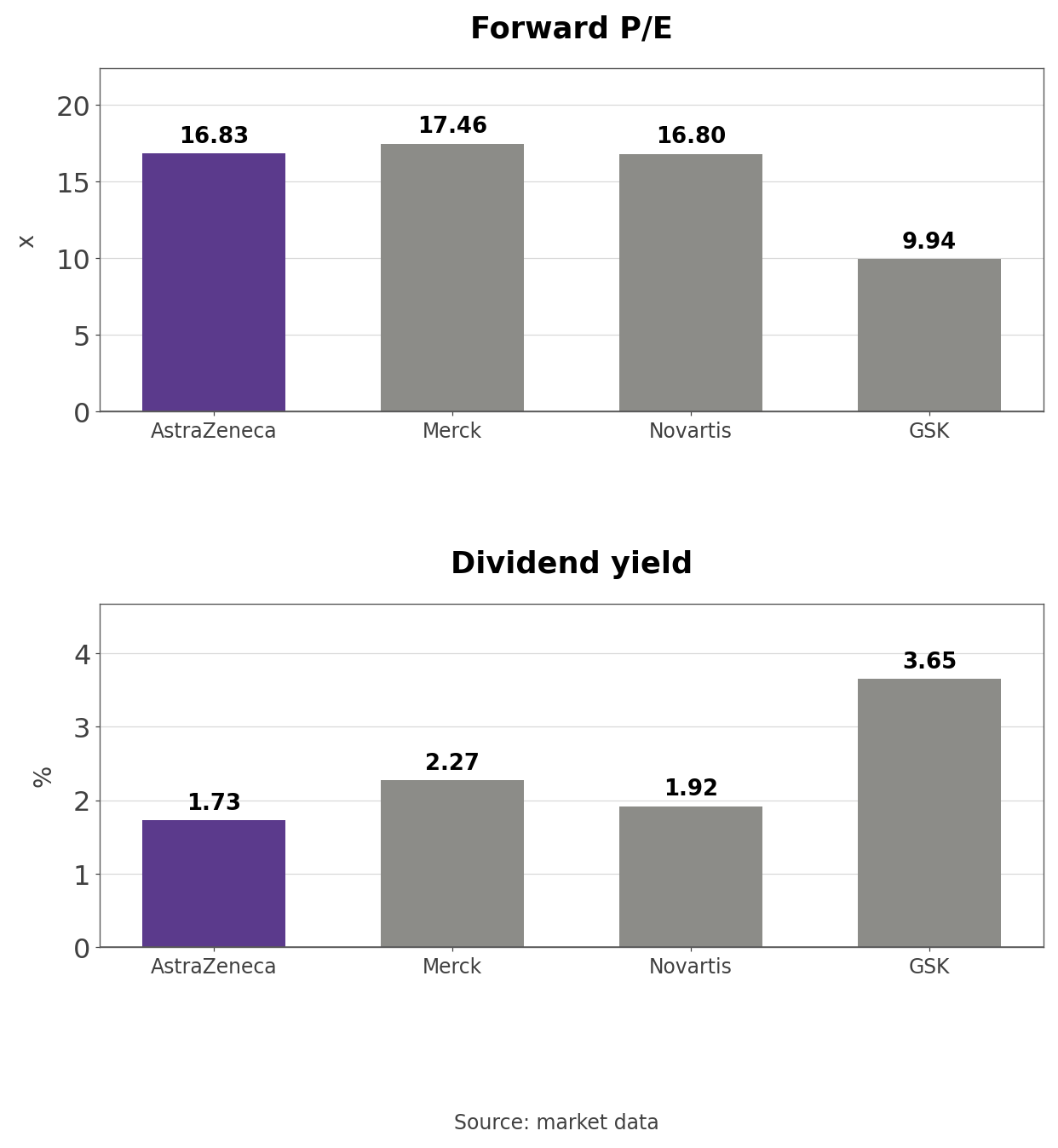
- Forward P/E is 17.46 at Merck, 16.83 at AstraZeneca, 16.80 at Novartis and 9.94 at GSK. Dividend yield is 3.65% at GSK, 2.27% at Merck, 1.92% at Novartis and 1.73% at AstraZeneca. Over the past year market value rose 70.6% at Merck, 30.7% at Novartis, 13.8% at AstraZeneca and 7.5% at GSK.
AstraZeneca's Core P/E and Dividend Yield Band
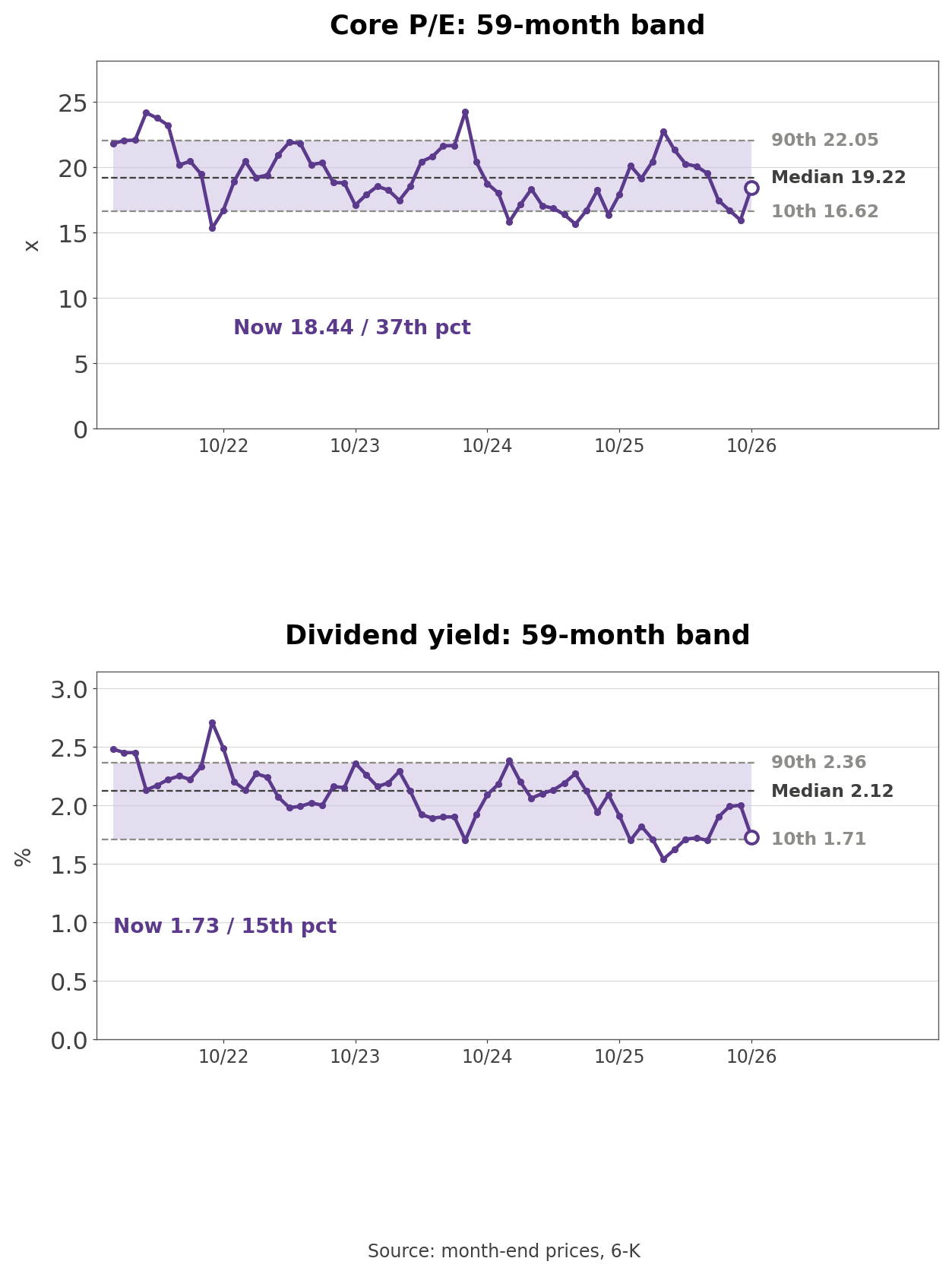
- Reported P/E is 26.20, but the same measure spiked to 1,625 times in 2021 when Alexion amortization hit earnings, so the band uses Core EPS, the basis on which the company guides.
- Using month-end prices and trailing Core EPS of $10.12, the Core P/E is 18.44, a little below the 19.22 median of the 59 months since December 2021 and in the 37th percentile. The low was 15.34 in September 2022 and the high 24.24 in August 2024. Dividend yield on trailing dividends of $3.23 is 1.73%, below the 2.12% median; the low of 1.54% came in February 2026, the month of the NYSE listing.
- Core EPS grew from $2.38 in Q3 2025 to $2.79 in Q3 2026, and the Core P/E went from 15.96 at the end of September back to 18.44 a month later. The 2025 dividend was $3.20, and the 2026 interim dividend of $1.06 compares with $1.03 a year earlier.
- Outside view (market data consensus, right after Q3 results): Of 12 analysts, 7 rate the stock strong buy, 2 buy, 2 hold and 1 strong sell, with an average price target of $206.66. Average revenue estimates are $63.3 billion for 2026 and $67.38 billion for 2027.
Three Conditions That Move the Stock
- Farxiga quarterly sales were $1.61 billion in Q3. A Q4 number below $1.5 billion would make the $2.5 billion annual drag estimated at Q3's pace larger; holding in the $1.5 billion range would suggest European demand and emerging-market pricing are slowing the decline.
- Oncology's quarterly increase has run at $1.0 billion to $1.1 billion a year earlier throughout 2026. As long as it stays larger than the Farxiga and Brilinta decline, total revenue keeps growing; if Imfinzi and Enhertu slow, the shrinkage outside oncology shows straight through to the total.
- Core EPS guidance for 2026 is a low double-digit increase. Nine-month Core EPS growth of 14% leaves room in Q4, but a 2027 guide below mid-single-digit growth for revenue and Core EPS would make the roughly 6% a year needed for $80 billion in 2030 harder to reach.
What to Watch in the Full-Year Report
- Full-year results in early February should show Q4 Farxiga sales, the rate of US decline and AstraZeneca's first 2027 guidance. Because 2027 is the first full year of US generic Farxiga, how much decline that guide assumes will show how much room oncology really has.
- One question stays open. Between the point where Farxiga sales bottom out and the point where the 2027 Phase III readouts turn into revenue, can oncology alone keep the company growing at about 6% a year?
Related Analysis
- Medtronic (MDT) Stock Analysis: Why EPS Stayed Flat Despite 10-Year-High Revenue Growth: another large healthcare company, useful for comparing how revenue growth does or does not reach EPS against AstraZeneca's Core EPS growing faster than sales.
- Qualcomm (QCOM) Stock Analysis: Non-Handset Mix and Margin: a company working to grow beyond one dominant product line, a parallel to AstraZeneca replacing Farxiga revenue with oncology.
#AstraZeneca #AZNStock #PharmaStocks #Oncology #Biotech #HealthcareStocks #USStocks #StockAnalysis #EquityResearch #GlobalStockBrief
'US Stock Analysis' 카테고리의 다른 글
| MakeMyTrip (MMYT) Stock: Discounts Ate the Booking Growth (0) | 2026.11.04 |
|---|---|
| Chevron (CVX) Stock: Refining Carried Q3 as Brent Fell (0) | 2026.11.03 |
| Intel (INTC) Stock: A 6.1% Q4 Cut as Servers Pass PCs (0) | 2026.11.02 |
| Verizon (VZ) Stock: Record Adds and Flat Revenue Ex Frontier (0) | 2026.11.02 |
| ServiceNow (NOW) Stock: Armis Inside an 18.5% cRPO Guide (0) | 2026.11.02 |


