Roblox Corporation (NYSE: RBLX) grew third-quarter 2026 revenue +16% to $1.572 billion, but bookings, the money players actually spent in the quarter, fell -12% to $1.697 billion. Management guided fourth-quarter bookings down another 10% to 15%. Revenue is still rising because most of what players spend is recognized over 27 months, and the 2025 surge in spending is now flowing through the income statement. Rebuilt on a bookings basis, EBITDA fell 45.6% from a year earlier.
Roblox runs a platform where users play millions of games built by other users. Players buy a virtual currency called Robux to spend on in-game items, and creators cash out the Robux they earn. At $49.31 a share the company is worth about $35.29 billion, and the third-quarter GAAP net loss was $230 million, or $0.32 a share.
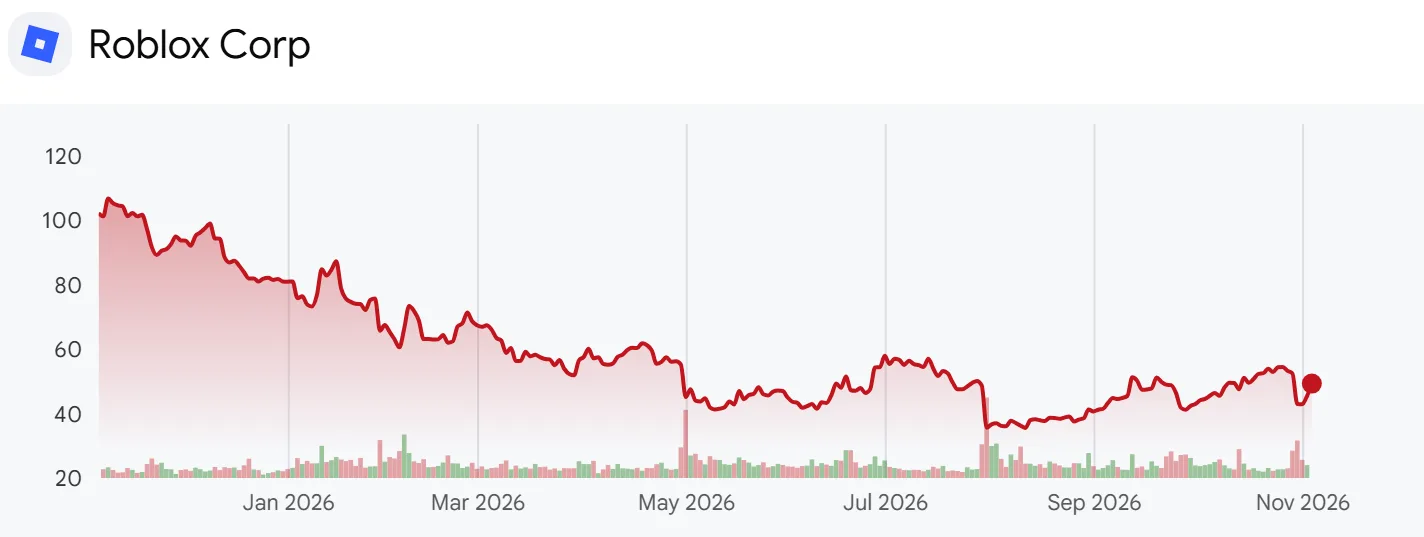
Roblox one-year share price chart
I lined up the Q3 2026 shareholder letter, the Q3 2026 10-Q, the 41-page Q3 supplemental materials, the investor data sheet, the October 29 earnings call and 26 earnings 8-Ks going back to 2021 to see which number better describes the business today. Two limits apply. Bookings is a company-defined non-GAAP measure, and fourth-quarter net loss guidance excludes loss contingency accruals for youth safety settlements, whose final size is not yet known.
Bookings and Daily Users in the Q3 Supplemental Deck
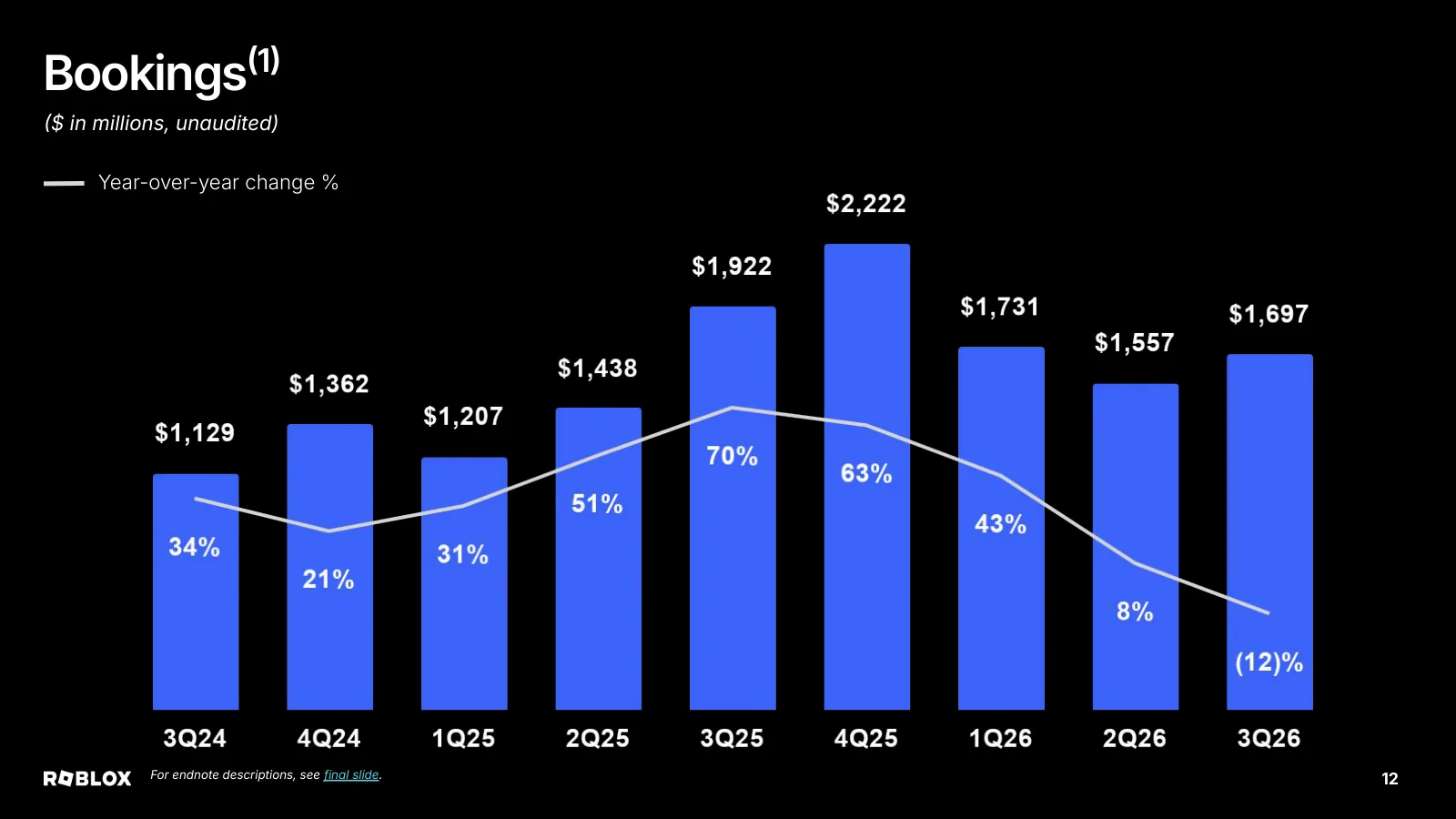
Page 12 of the supplemental materials charts nine quarters of bookings. The peak came in the third quarter of 2025 at $1.922 billion (+70%) and the fourth quarter at $2.222 billion (+63%). Then came $1.731 billion (+43%), $1.557 billion (+8%) and $1.697 billion (-12%), so growth went from +70% to negative in five quarters. Management pointed out that third-quarter bookings beat the top of guidance and were more than 50% above two years earlier.
Q3 supplemental materials page 12 with quarterly bookings and year-over-year change
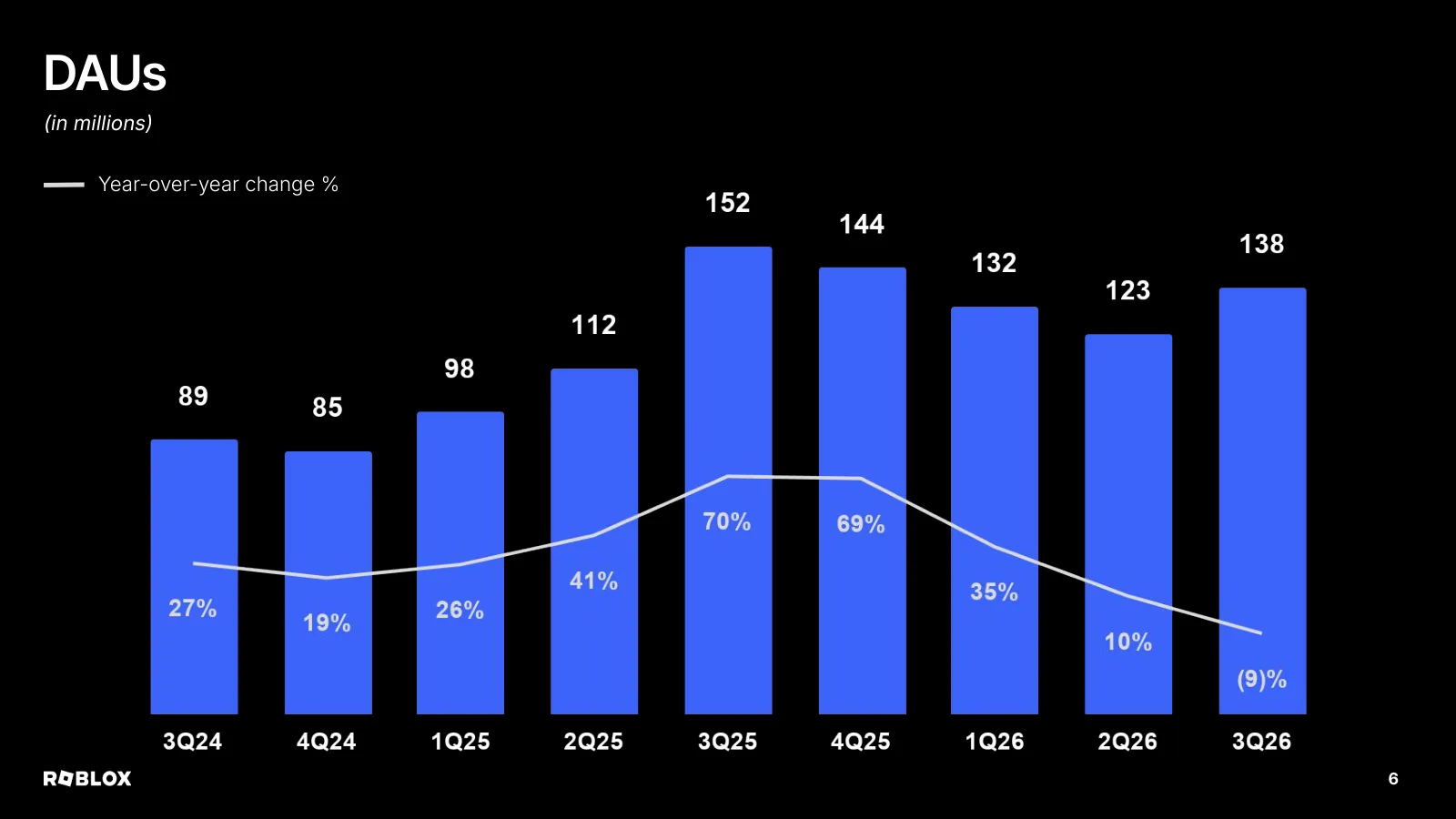
Page 6 shows daily active users (DAUs) following the same arc. DAUs peaked at 152 million in the third quarter of 2025, fell to 123 million in the second quarter of 2026 and rebounded to 138 million in the third quarter, up 12% sequentially but down 9% from a year earlier. Hours engaged fell 15% to 33.8 billion. The investor data sheet shows no region growing: US and Canada had 24 million DAUs (-10%), Europe 32 million (-5%), Asia-Pacific 42 million (-9%) and the rest of the world 40 million (-11%). The letter singled out India (+37%) and Japan (+33%) as countries that did grow.
Q3 supplemental materials page 6 with daily active users
Own calculation (supplemental materials and data sheet): Bookings per hour came to 5.02 cents against 4.85 cents a year earlier, up 3.5% (the company says about 4%). Average bookings per DAU fell 3% to $12.29. Monthly unique payers fell 16% to 30 million, while bookings per payer rose 5%. On the call, the CFO said seasonally adjusted retention reached its highest level since 2021.
How Roblox Turns Bookings Into Revenue Over 27 Months
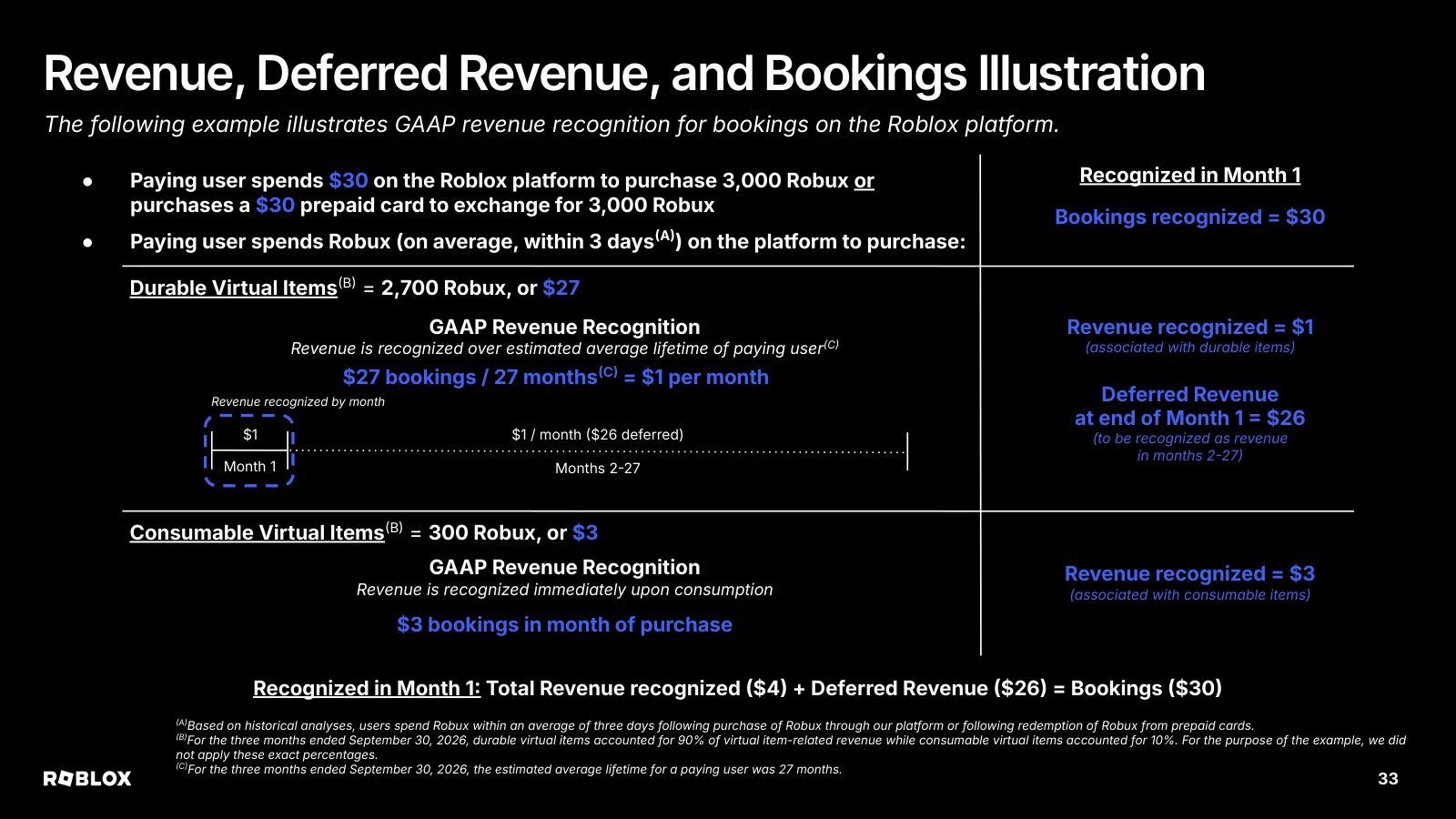
Page 33 walks through an example. A player spends $30 on 3,000 Robux, and that month’s bookings are $30. If $27 goes to durable items such as avatar clothing, Roblox spreads it over the 27-month estimated life of a paying user and books $1 of revenue a month. The $3 spent on consumable items becomes revenue right away. Month one shows $4 of revenue and $26 of deferred revenue. Plugging in third-quarter numbers, revenue of $1.572 billion plus a $136 million increase in deferred revenue less $11 million of other items equals bookings of $1.697 billion.
Q3 supplemental materials page 33 showing how bookings split into revenue and deferred revenue
Durable items made up 90% of virtual item revenue in the third quarter, which is why falling bookings do not show up in revenue right away. The company spells it out in its guidance footnote: “Revenue is expected to grow year-over-year despite an expected decline in bookings reflecting our GAAP revenue recognition policy.” Deferred revenue on the 10-Q balance sheet was $4.781 billion current plus $2.259 billion non-current, or $7.040 billion, up from $6.506 billion at the end of 2025.
Own calculation (10-Q and earnings 8-Ks): The $7.040 billion deferred revenue balance is 1.19 times trailing four-quarter revenue of $5.8976 billion. The fourth-quarter revenue guide assumes no change in the durable and consumable mix or the 27-month estimate, which has been in place since it moved from 28 months in the second quarter of 2024. On that schedule, the durable share of the $2.222 billion booked in the fourth quarter of 2025 keeps turning into revenue until early 2028.
Developer Exchange Fees and the Fourth-Quarter Guide
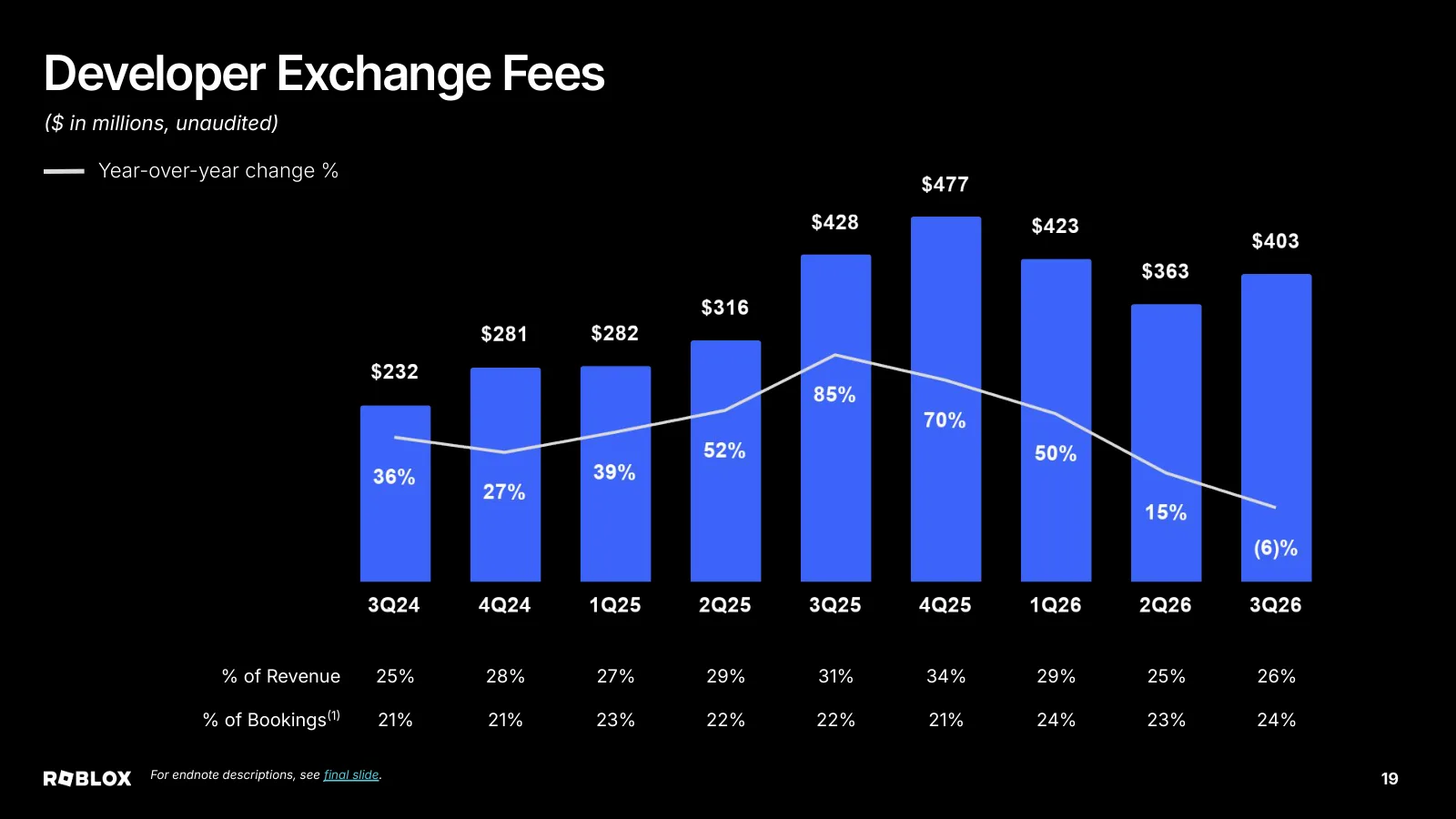
Page 19 tracks Developer Exchange (DevEx) fees, the cash Roblox pays creators who convert earned Robux. Third-quarter fees fell 6% to $403 million, but they rose to 24% of bookings from 22% a year earlier. Against revenue they dropped from 31% to 26%, only because revenue is inflated by past bookings. Page 20 shows the separately tracked infrastructure and trust and safety expense rising to 15% of bookings from 11%. The 10-Q explains the DevEx move: on September 5, 2025 Roblox raised the cash creators receive by 8.5%, and from June 8, 2026 “we increased our Developer Exchange rate by 42% for eligible in-game spend generated by age-checked U.S. users 18 or older.”
Q3 supplemental materials page 19 with Developer Exchange fees as a share of bookings
Company disclosure (supplemental materials pages 28 to 31 and shareholder letter, October 29, 2026): Fourth-quarter bookings are guided to $1.89 billion to $2.00 billion, down 10% to 15% from $2.222 billion, and revenue to $1.47 billion to $1.58 billion, up 4% to 12%. Adjusted EBITDA is guided to a loss of $70 million to $10 million and free cash flow to negative $190 million to negative $105 million, partly because $140 million of capital spending slipped from the third quarter into the fourth, lifting fourth-quarter capex to $380 million. Operating cash flow guidance of $190 million to $275 million compares with $607 million a year earlier. The CFO said the bookings guide includes a modest headwind from this quarter’s GTA launch and that spending on AI infrastructure and on marketing to users 18 and older will keep rising.
The Bull and Bear Case for Roblox Stock
The bull case rests on two-year growth and the balance sheet. Third-quarter bookings were more than 50% above two years earlier and DAUs 55% higher, and spending per payer is rising. Net cash of $5.229 billion is 14.8% of the market value, and price to bookings of 4.90 sits in the bottom 10% of its 60-month range. Management’s claim that AI tools are multiplying new games also belongs here.
The bear case is that costs are climbing while spending shrinks. Bookings fell 12% and are guided down another 10% to 15%, while total costs rose 12%. Bookings-basis EBITDA, adjusted EBITDA plus the net increase in deferrals, fell -45.6%. Settlement charges with several states over youth safety reached $140 million in nine months, and $855 million of stock-based compensation never touches free cash flow.
From the Direct Listing to Two Bookings Declines
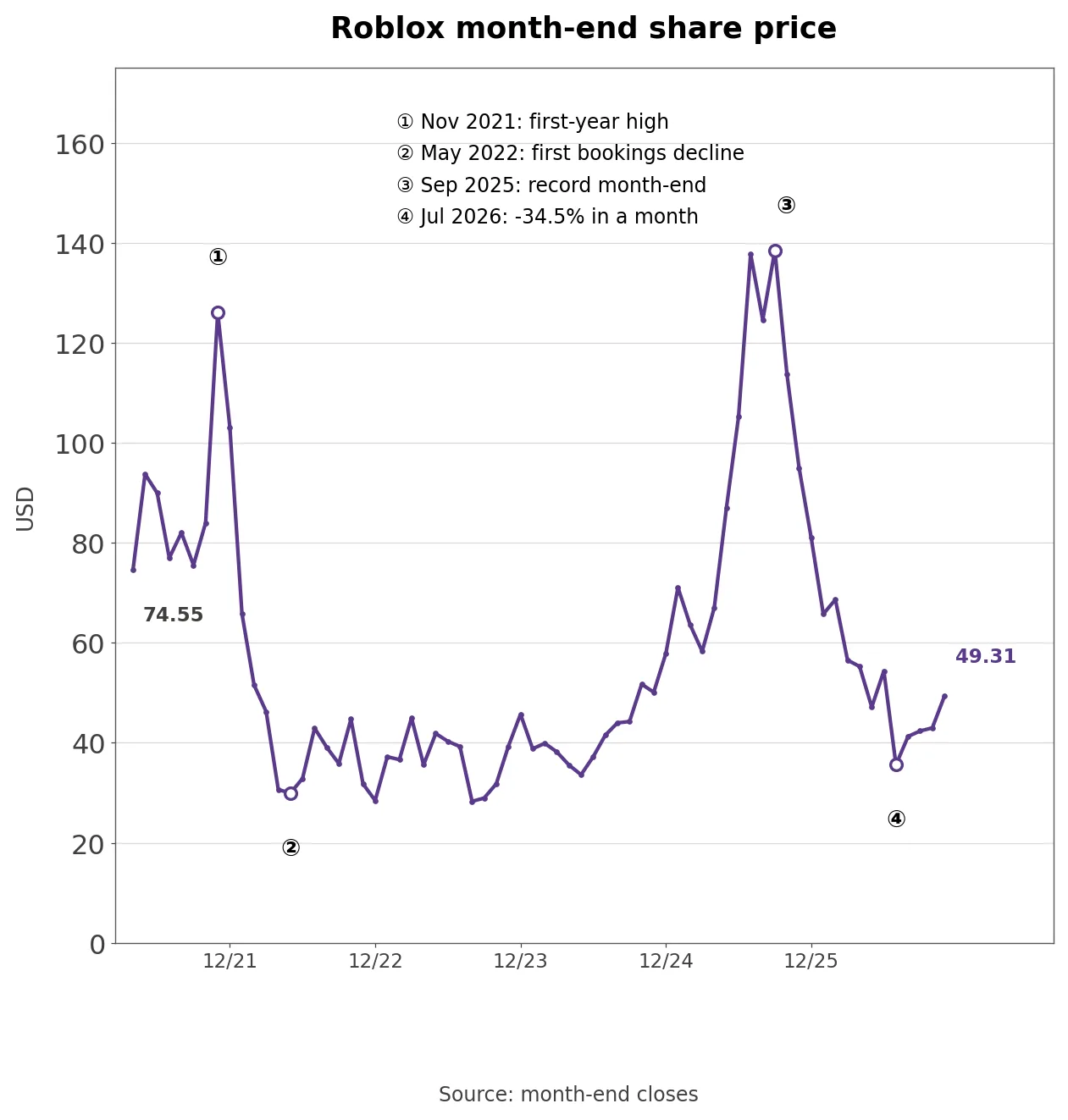
Roblox listed directly on the New York Stock Exchange in March 2021. Its first month-end close was $74.55 in April 2021, and the first peak came at $126.10 in November 2021. In 2022, bookings fell year over year in the first and second quarters, and the stock dropped -72.4% that year from $103.16 to $28.46. The lowest month-end close was $28.29 in August 2023. As bookings growth settled back near 20%, the stock gained 60.6% in 2023 to $45.72 and 26.6% in 2024 to $57.86.
Roblox month-end share price over 68 months with four dates
The second phase came in 2025. Bookings growth hit +50.5% in the second quarter and +70.3% in the third, and the stock climbed from $57.86 at the end of 2024 to a record month-end close of $138.52 in September 2025. As growth faded, the stock fell to $35.60 by July 2026, a 34.5% drop in that month alone, when second-quarter results showed bookings growth of just 8.3%. At $49.31 the stock is 64.4% below its peak, 38.5% above the July close and down 39.1% in 2026. Annual bookings grew from $1.883 billion in 2020 to $6.788 billion in 2025, 3.6 times as much.
Why Is Revenue Growing While Bookings Fall?
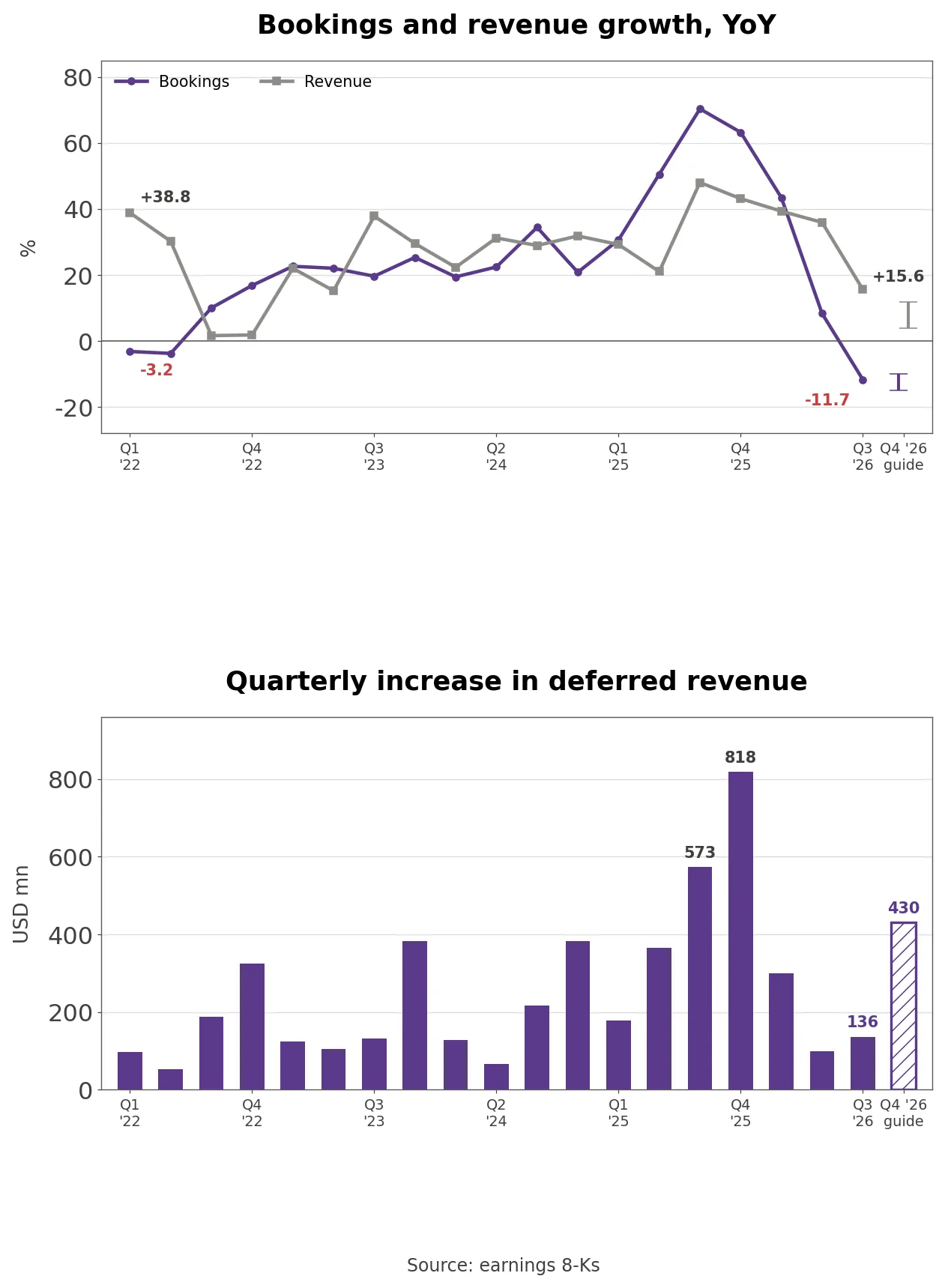
I pulled 27 quarters of bookings from the revenue-to-bookings reconciliations in 26 earnings 8-Ks and checked each prior-year column against the earlier release (17 matches). Bookings growth went from +70.3% in the third quarter of 2025 to +63.2%, +43.4% and +8.3%, and then to bookings -11.7% this quarter. Revenue grew 15.6% in the same quarter, a gap of 27.3 percentage points.
Bookings and revenue growth over 19 quarters and quarterly increase in deferred revenue
This is the third quarter of year-over-year bookings decline, after the first two quarters of 2022, and in the first quarter of 2022 bookings fell 3.2% while revenue rose 38.8%, a wider gap than today. Revenue growth then dropped to 1.6% two quarters later, but that quarter also included a change in the estimated paying-user life from 25 to 28 months that cut revenue by $111.0 million. Revenue can move by more than $100 million on one estimate, while bookings do not depend on it.
Deferred revenue grows by the amount bookings exceed revenue. The third-quarter increase was $136 million, less than a quarter of the $573 million a year earlier, and the $430 million built into fourth-quarter guidance is about half of last year’s $818 million. Bookings divided by revenue fell from 1.41 in the third quarter of 2025 and 1.57 in the fourth to 1.08 now. Below 1.0, the deferred balance starts to shrink and revenue growth follows bookings down. US and Canada is furthest along: bookings there fell 13.5% while revenue rose 9.5%.
Own calculation (earnings 8-Ks and Q4 guidance): Adding the fourth-quarter guide to $4.985 billion of nine-month bookings gives full-year 2026 bookings of $6.875 billion to $6.985 billion, up just 1.3% to 2.9% from $6.788 billion in 2025. The same math puts 2026 revenue growth at 21.7% to 24.0%, a gap of more than 20 points for the full year.
Adjusted EBITDA Versus Bookings-Basis EBITDA
Adjusted EBITDA, the profit measure Roblox leads with, was $138 million in the third quarter, 3.0 times the $46 million of a year earlier. It is built on revenue, excludes the change in deferred revenue and adds back $298 million of stock-based compensation and $49 million of legal settlement expense. Most costs hit the quarter they occur while revenue arrives over 27 months, so adjusted EBITDA reacts late when bookings turn down.
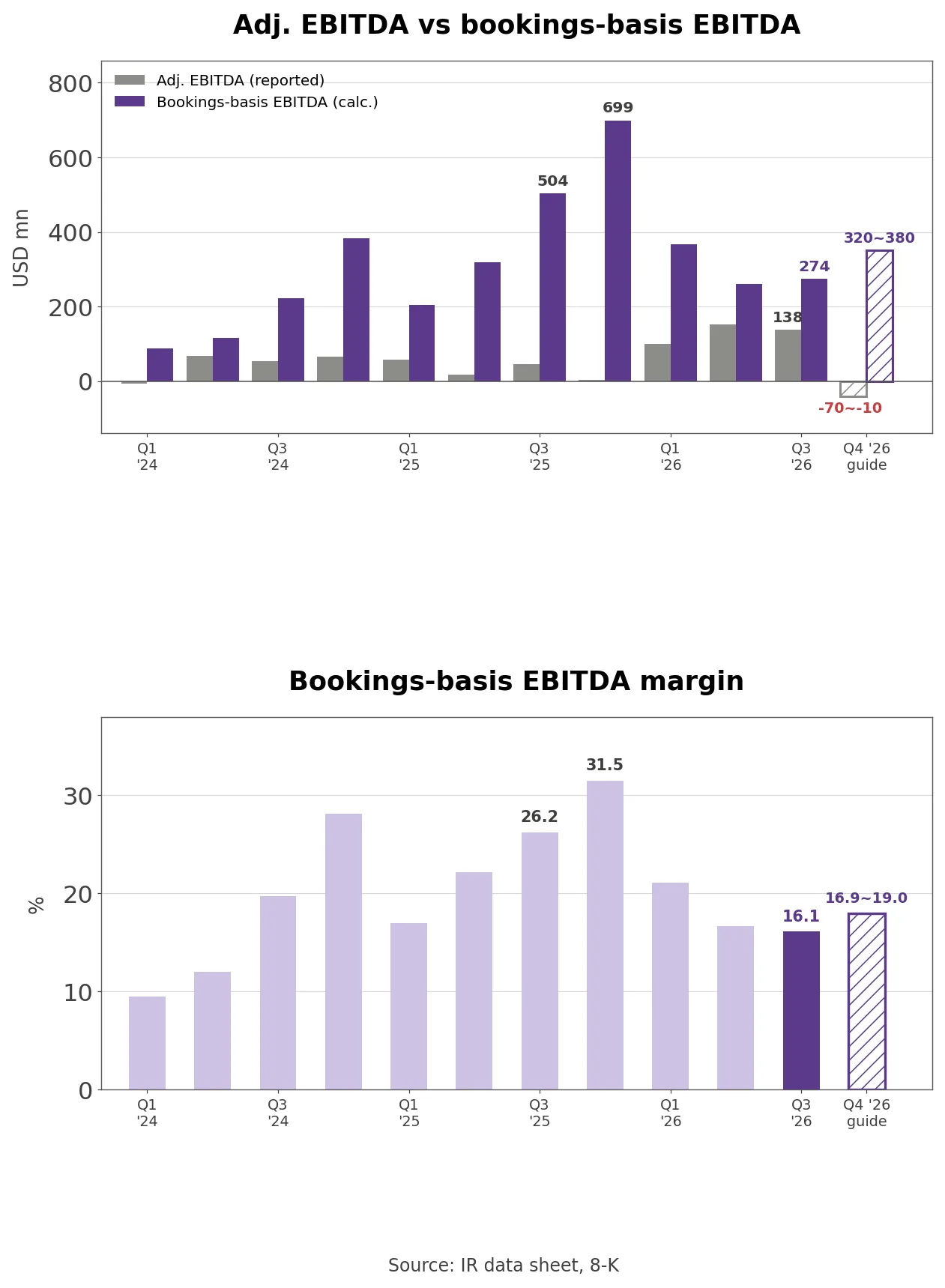
Adjusted EBITDA and bookings-basis EBITDA over 11 quarters with margin on bookings
Own calculation (investor data sheet): I added the net increase in deferred revenue and deferred cost of revenue back to adjusted EBITDA for 11 quarters starting in early 2024. Third-quarter bookings-basis EBITDA was $274 million against $504 million a year earlier, down 45.6%. As a share of bookings it fell from 26.2% to 16.1%. The fourth-quarter guide implies $320 million to $380 million (16.9% to 19.0% of bookings), roughly half of last year’s $699 million (31.5%).
Costs made the difference. Total costs and expenses rose 12.0% to $1.855 billion. The separately tracked infrastructure and trust and safety expense rose 24% on AI training and inference, marketing rose 66% on campaigns aimed at users 18 and older, and general and administrative expense rose 40%, mostly because of “$49 million in legal settlement accruals related to settlements and settlement negotiations with various states and territories regarding youth-related consumer protection and digital safety matters.” Operating cash flow fell 28% to $395 million, and free cash flow of $364 million (-18%) was helped by the capex delay. Subtracting stock-based compensation leaves $66 million for the quarter and $399 million for nine months, and full-year 2026 free cash flow implied by guidance is $1.064 billion to $1.149 billion, 15% to 21% below the $1.353 billion of 2025.
How Roblox Makes Money From Robux
Nearly all bookings come from selling Robux, bought once through app stores or prepaid cards or received through monthly subscriptions. Advertising and licensing are still described as insignificant. Part of every Robux spent goes to the creator of the game, and the cash Roblox pays when creators convert those Robux is the DevEx fee. Roblox does not make the games, so creator payouts are its content cost.
Costs fall into four groups. Measured against third-quarter bookings, DevEx took 24%, infrastructure and trust and safety 15% (11% a year earlier) and personnel excluding stock compensation 17% (13%). Cost of revenue, mostly payment processing, rose 7% to $318 million, but a growing share of bookings through lower-cost payment channels kept its burden down. Headcount is about 3,400, up from about 3,100. In a quarter of falling bookings, creator payouts, infrastructure and payroll all took a bigger slice.
The money comes from North America. US and Canada had 24 million DAUs, 17.4% of the total, but $907 million of bookings, 53.4%. Bookings per DAU there were $38.52, 7.2 times the $5.37 in Asia-Pacific. US and Canada bookings fell 13.5%, more than the company total, and Europe fell 12% to $360 million. Fast-growing markets such as India and Japan spend too little per user to fill the gap.
The user base is changing too. By the end of the third quarter, 64% of global DAUs had completed an age check, and of those, 34% were under 13, 37% were 13 to 17 and 29% were 18 or older. In the US, users 18 and older spend more than 50% more than younger users, which is why Roblox is raising DevEx rates and ad spending for that group. On the call, the CEO said about 30% of US 13 to 17 year olds use Roblox every day.
Supply is changing faster. The letter says more than 80% of the top 100 games used AI tools over the past month and two games built almost entirely with AI broke into the top 20. Build, the prompt-to-game tool, drew more than 500,000 users and over 70,000 games in a limited test, and more than 75% of its users had never opened Roblox Studio. Roblox Plus, launched in April, has millions of subscribers who play twice as long and spend seven times as much Robux. More than 70% of the top 100 games ran sponsored ads, Roblox Everywhere will put select games in other app stores in the first half of 2027, and Build rolls out more broadly in the US in December.
Roblox vs Take-Two Unity and NetEase
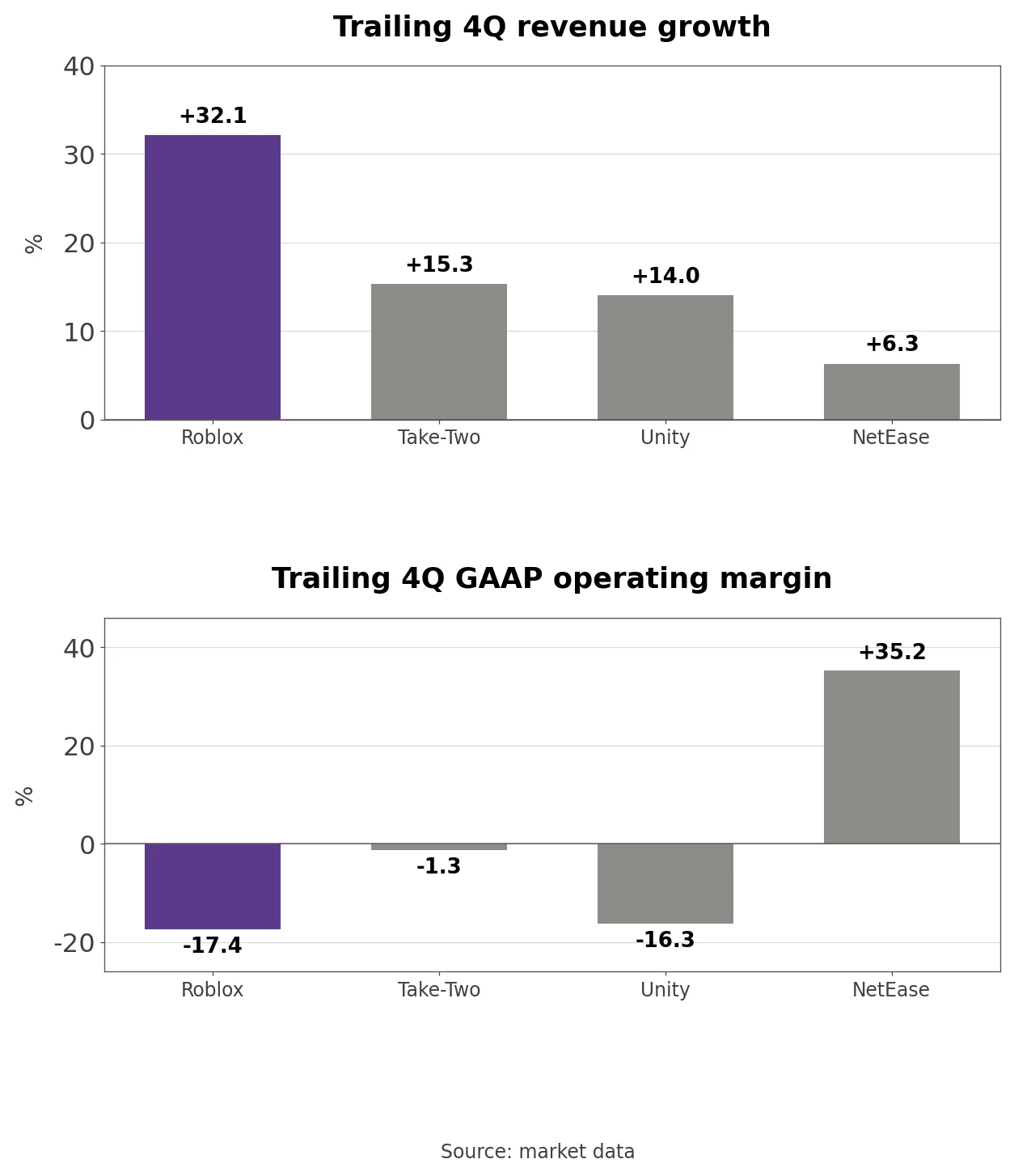
The peers are Take-Two, a console and PC publisher competing for the same playtime, Unity, which sells the game engine and tools many studios build with, and NetEase, a large online game company that reports in yuan, so only ratios are compared. Peer data runs through the June quarter. Roblox is worth about $35.3 billion, close to Take-Two at about $39.1 billion, 1.9 times Unity at about $18.7 billion and about half of NetEase at about $74.7 billion.
Trailing revenue growth and GAAP operating margin at Roblox Take-Two Unity and NetEase
Trailing four-quarter revenue growth of 32.1% at Roblox beats Take-Two (+15.3%), Unity (+14.0%) and NetEase (+6.3%), but Roblox revenue carries deferred bookings, and trailing bookings of $7.2073 billion grew only 21.6%. In the latest quarter Unity grew 23.9%, faster than Roblox at 15.6%, while Take-Two grew 2.0% and NetEase 7.9%. GAAP operating margin is lowest at Roblox (-17.4%), against Take-Two (-1.3%), Unity (-16.3%) and NetEase (+35.2%).
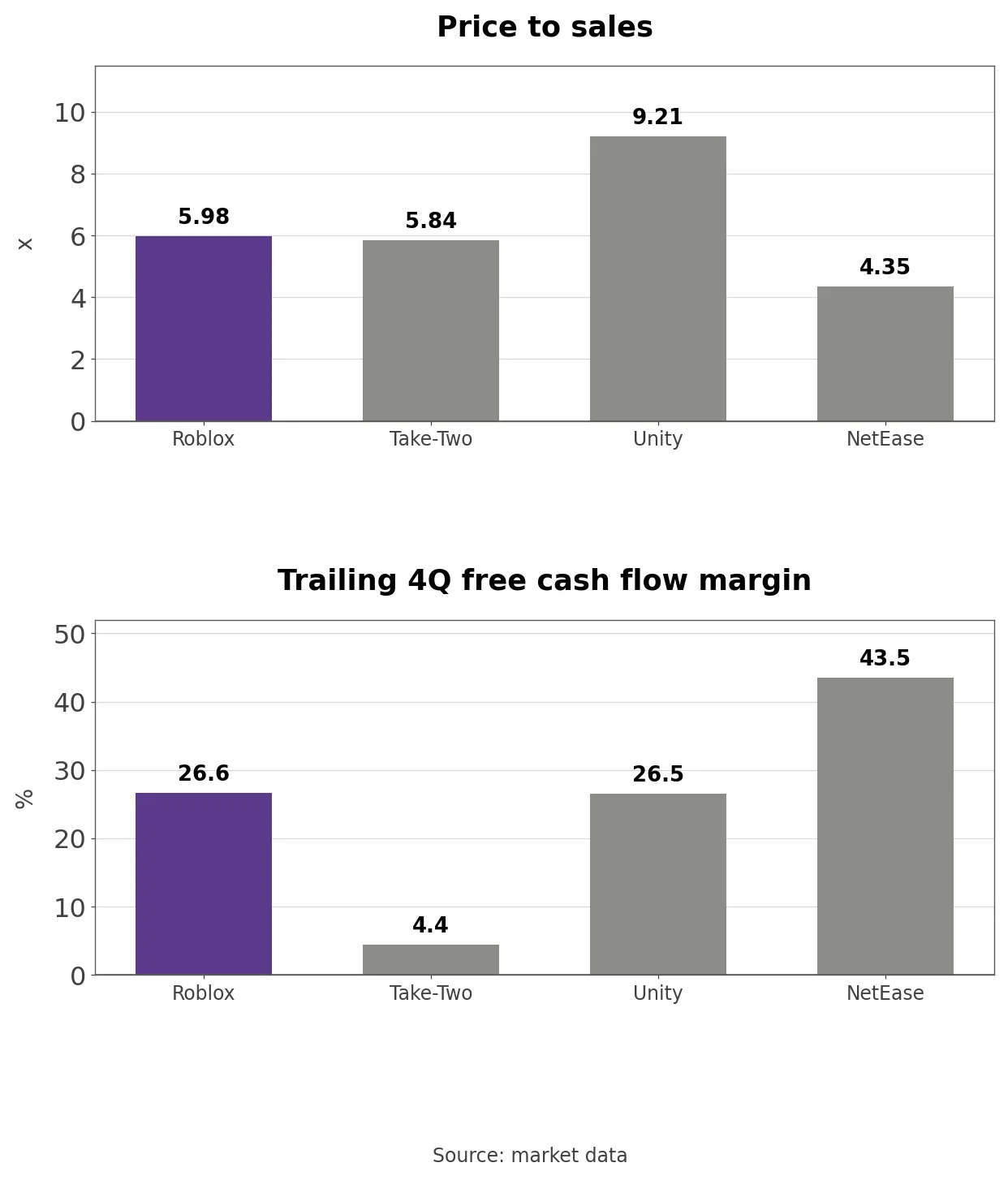
Price to sales and free cash flow margin at Roblox Take-Two Unity and NetEase
Price to sales of 5.98 at Roblox is close to Take-Two at 5.84, below Unity at 9.21 and above NetEase at 4.35. Free cash flow margins are 26.6% at Roblox, 4.4% at Take-Two, 26.5% at Unity and 43.5% at NetEase. Roblox defines free cash flow before stock compensation, so $855 million of stock awards over nine months, 17.2% of bookings, sits outside that margin. On free cash flow after stock compensation, annualized from nine months, the market value is 66.3 times. Take-Two is also the company launching the GTA title that Roblox built into its guidance as a headwind, though the CEO said cultural moments like that often pull players toward similar genres on Roblox too.
The Price-to-Sales and Price-to-Bookings Band
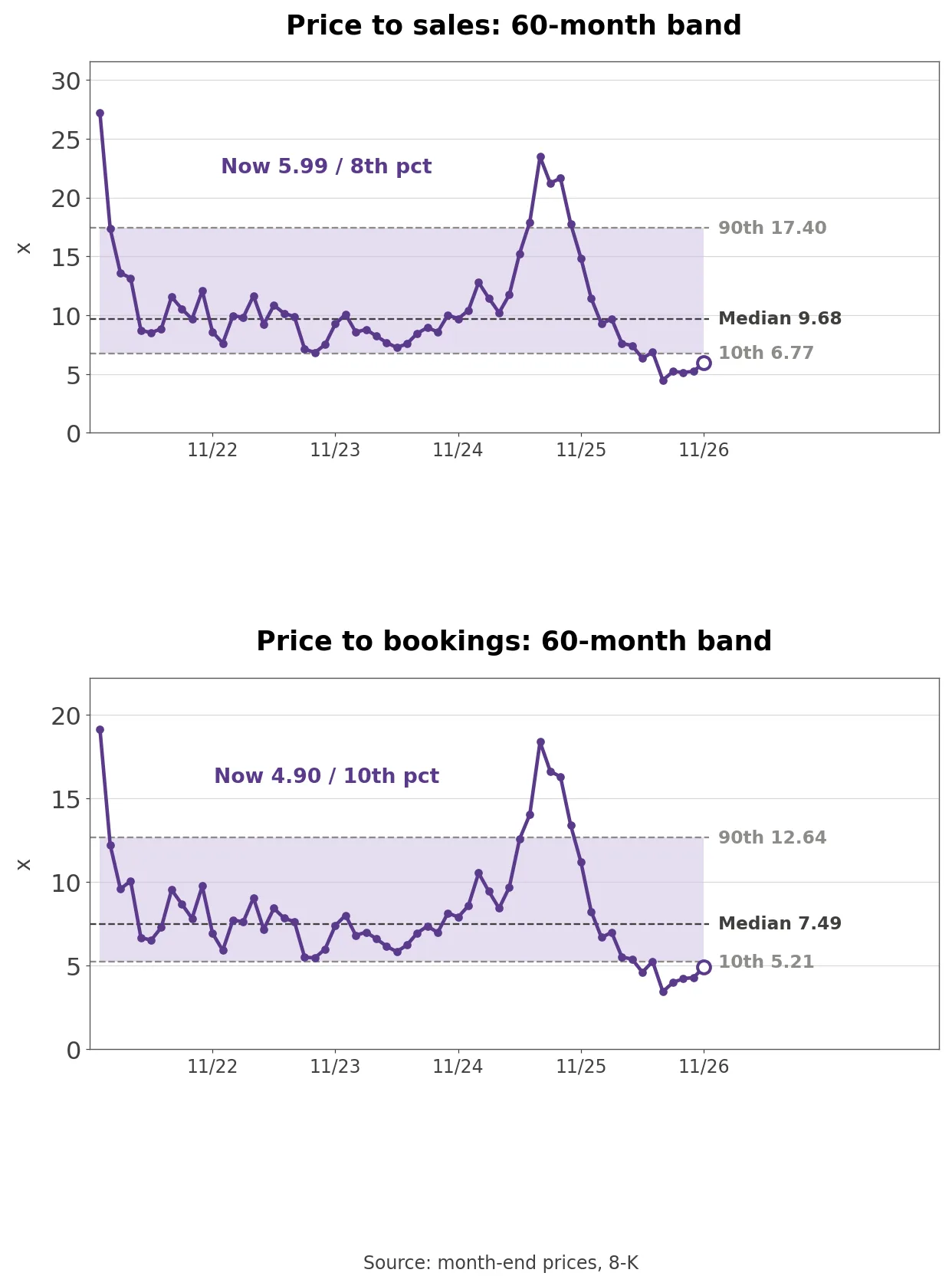
Roblox has never posted a GAAP profit, so there is no P/E, and shareholders’ equity was negative $27 million at the end of September, so there is no price-to-book band either. Instead I divided month-end market value by trailing revenue and trailing bookings for 60 months starting in December 2021.
Roblox price to sales and price to bookings over 60 months
Price to sales of 5.99 is below the 60-month median of 9.68 and lower than in all but 8.3% of months, matching 5.98 on market data. Price to bookings of 4.90 is below both its median of 7.49 and its 10th percentile of 5.21. Both hit their lows in July 2026 (4.49 and 3.43) and their highs in December 2021 (27.19 and 19.15). Net of $5.229 billion in net cash, enterprise value is 4.17 times trailing bookings. Roblox bought back 4.4 million shares for about $200 million in the third quarter and has about $2.4 billion of authorization left.
Three Conditions That Move the Stock
Bookings growth is the first, measured against the -10% to -15% fourth-quarter guide. Fourth-quarter bookings above $2.00 billion would support the stock, and a return to growth in the first quarter of 2027 against last year’s $1.731 billion would show the decline lasted only two quarters. Bookings below $1.89 billion would weigh on it.
Bookings-basis EBITDA margin is the second, starting from 16.1%. A recovery above the guide-implied 16.9% to 19.0% and back into the 20s would show AI and marketing spending paying off in bookings. A drop below 15% would mean costs are outrunning spending.
DAUs are the third, starting from 138 million. The guide assumes the usual seasonal dip in the fourth quarter. A smaller year-over-year decline than the third quarter’s -9% against last year’s 144 million would support the stock, while a deeper decline as age checks spread and the GTA title launches would weigh on it.
What the Fourth-Quarter Report Needs to Show
Fourth-quarter results usually arrive in early February, and Roblox guides one quarter at a time. The numbers to watch are where bookings land in the $1.89 billion to $2.00 billion range, the seasonal dip in DAUs and hours, whether the deferred revenue increase reaches the guided $430 million, the size of state settlement charges and first-quarter 2027 bookings guidance. How many new creators Build brings in after its December US rollout should also show up in the next letter. Fourth-quarter net loss guidance of $363 million to $423 million excludes loss contingencies, so the actual loss will move by whatever settlements cost.
The open question is whether bookings, once 2025’s tough comparisons pass in 2027, can grow faster than costs.