Lumentum Holdings (NASDAQ: LITE) trades at $626.75, which is -12.8% below the $719.10 value of the 4.5 Marvell Technology shares each Lumentum share is set to receive. Marvell agreed on November 1 to buy Lumentum in an all-stock deal, and on the eve of the leak those 4.5 shares were worth $1,132.42. Marvell stock has since fallen 36.5%, taking the deal value down with it. On the same day Lumentum reported fiscal first-quarter 2027 revenue of $1.2626 billion, up +136.5% from a year earlier.
Lumentum makes lasers, optical transceivers and optical circuit switches that connect AI data center hardware with light. Its fiscal year ends in June, so the September quarter is the first fiscal quarter. At $626.75 a share the company is worth about $56.84 billion on market data, 35.5% below its September month-end close of $971.26.
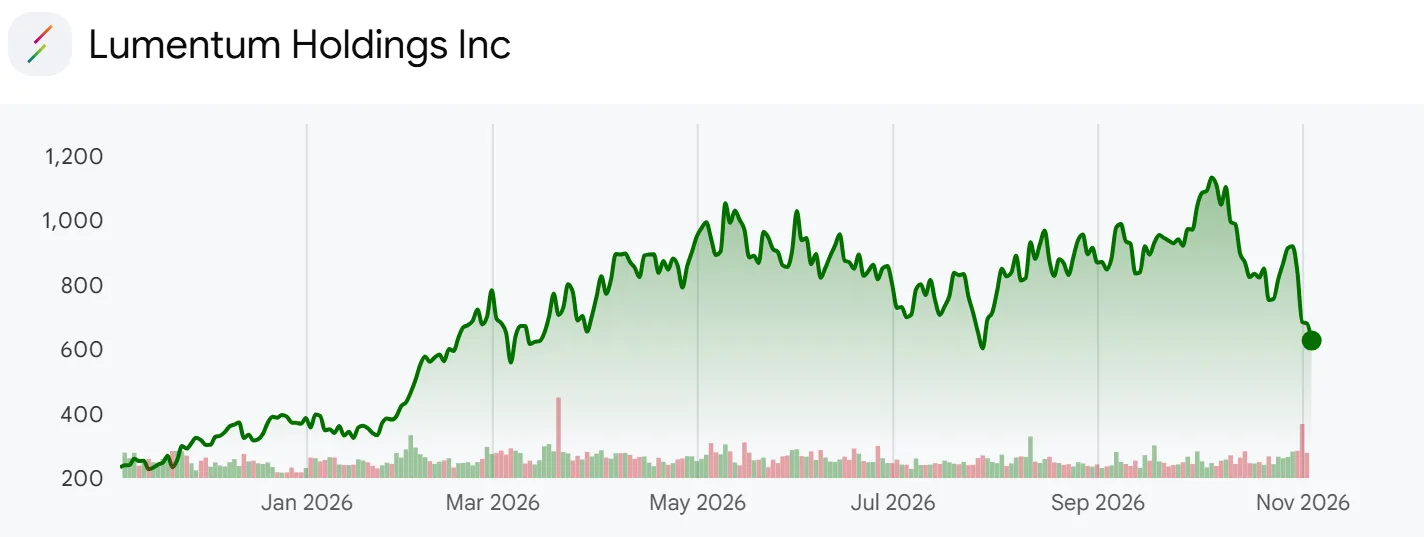
Lumentum one-year share price chart
I lined up the merger 8-K, the fiscal Q1 2027 earnings release, the Q1 10-Q, the 24-page merger investor deck, the transcript of the November 2 joint Marvell and Lumentum call, and 20 quarters of earnings releases since 2022 to ask whether the 12.8% gap is the price of time or the price of a deal that might break. One limit: the joint call covered only the transaction and took no questions on the quarter, so the quarterly figures come from the release and the 10-Q alone.
Deal Terms and Combined Numbers in the Merger Deck
Page 21 of the merger deck sums up the transaction in four lines. It is all stock, with a combined enterprise value of about $275 billion. Lumentum holders receive 4.5 Marvell shares per share and end up with about 33% of the combined company, against about 67% for Marvell holders. Marvell CEO Matt Murphy will run the combined company, and three Lumentum directors, including CEO Michael Hurlston, will join Marvell’s board. The companies expect to close in the first half of calendar 2028, subject to approval by both sets of stockholders and regulators.
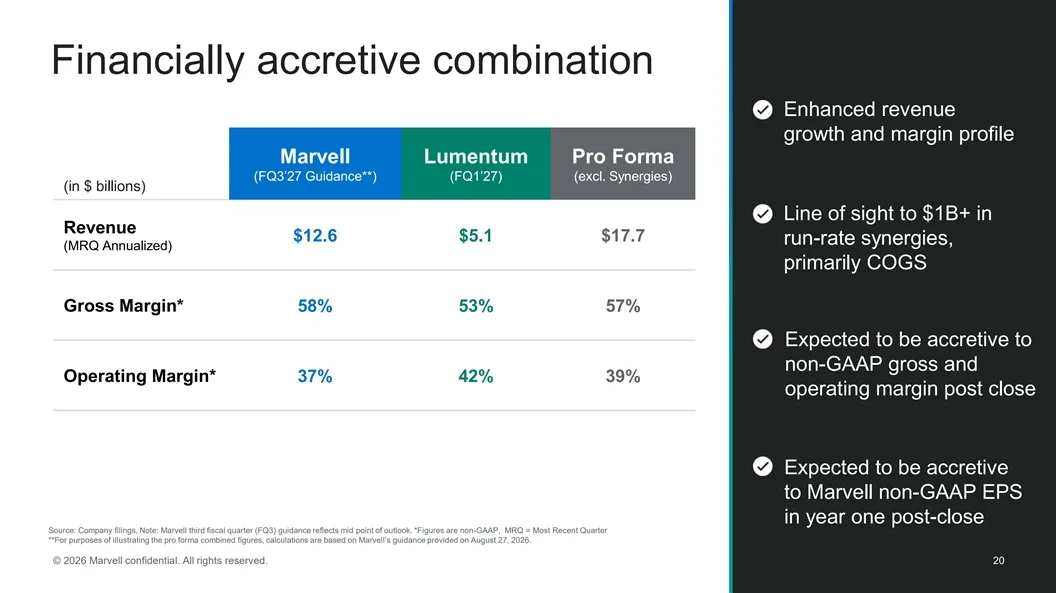
Merger deck page 20 with annualized revenue and margins for Marvell and Lumentum and pro forma
Page 20 sets out the two companies on an annualized most-recent-quarter basis. Revenue is $12.6 billion for Marvell (the midpoint of its fiscal Q3 guide), $5.1 billion for Lumentum and $17.7 billion combined. Non-GAAP gross margin is 58%, 53% and 57%, and non-GAAP operating margin is 37%, 42% and 39%. Multiplying Lumentum’s first-quarter revenue of $1.2626 billion by four gives $5.05 billion, and its 42.3% operating margin matches the 42% on the slide. The company being acquired runs the higher margin. On the call, Murphy said adding Lumentum’s second-quarter guide to Marvell’s next-quarter consensus implies more than $21 billion of annualized revenue with an operating margin in the low 40% range.
Own calculation (deck pages 20 and 21): The 33% ownership Lumentum holders receive is larger than Lumentum’s 28.8% share of combined revenue and its 31.5% share of non-GAAP operating profit. Checking the 33% itself, Marvell’s share count implied by its market value at a $159.80 share price is about 878 million, and the deal adds about 416.2 million new shares (92.5 million times 4.5), which gives Lumentum holders 32.2%.
The 2030 Market and Revenue Ranking Marvell Presented
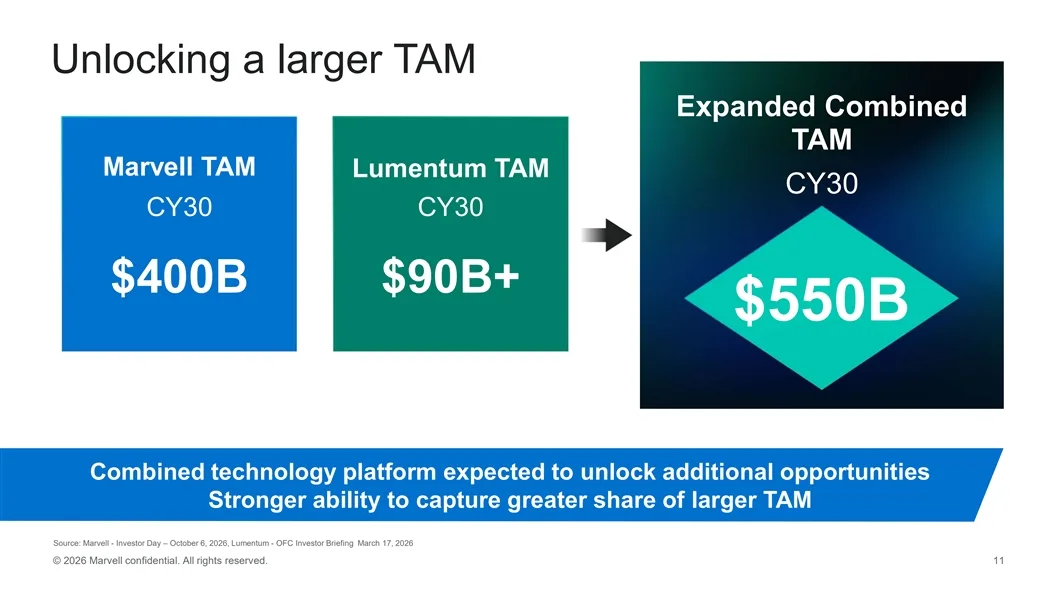
Page 11 puts Marvell’s 2030 addressable market at $400 billion and Lumentum’s at more than $90 billion, and says the combination expands it to $550 billion. That is $60 billion more than the simple sum, which Murphy described on the call as market the combination itself opens up, mostly in near-packaged and co-packaged optics (NPO and CPO). Page 12 splits connections into four distances: between data centers (up to 1,000 km), inside a data center (up to 2 km), between racks (up to 50 m) and inside a package (up to 1 m), with bandwidth needs growing tenfold at each step. Today’s optical module market sits mostly in the first two.
Merger deck page 11 with Marvell and Lumentum 2030 addressable markets and the combined total
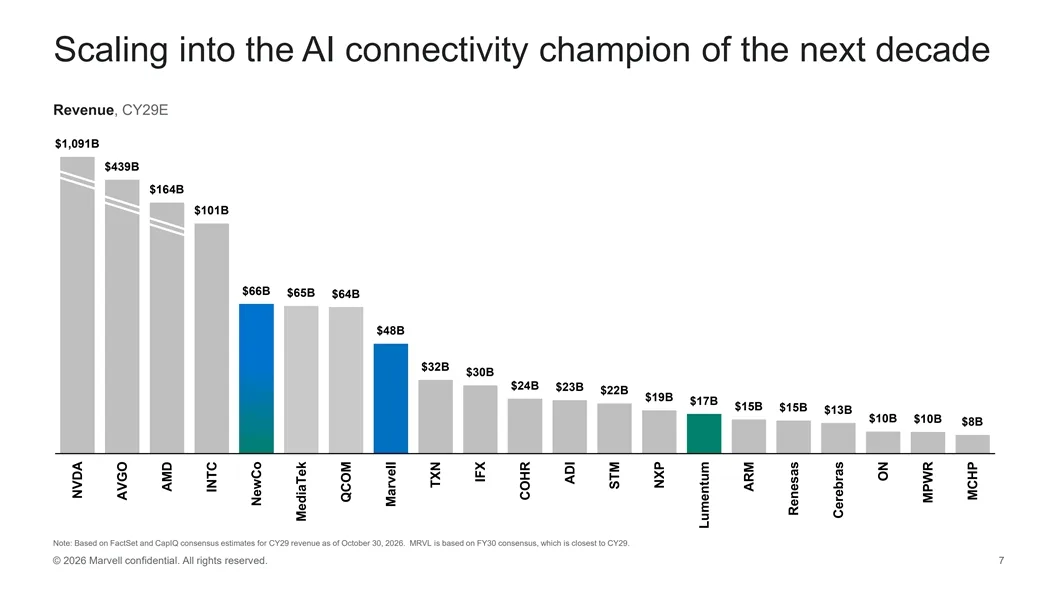
Page 7 ranks chip companies by consensus 2029 revenue. The combined company sits fifth at $66 billion behind NVIDIA, Broadcom, AMD and Intel, with Marvell alone at $48 billion and Lumentum alone at $17 billion. Lumentum’s $17 billion is 3.4 times its current $5.05 billion annualized run rate. Page 18 leads with capacity: for Lumentum it claims the world’s largest indium phosphide wafer fab capacity, a 20x unit volume expansion in two years, billions of VCSELs shipped and a hybrid in-house and contract assembly model.
Merger deck page 7 ranking 2029 consensus revenue with the combined company fifth
In the Q&A, a Bank of America analyst said Marvell was paying about one times Lumentum’s 2030 addressable market while trading at less than half of its own, and asked whether Marvell was buying at the peak of a shortage. Murphy answered that “the tight supply is not the reason we’re wanting to enter this transaction now” and said the design wins are real.
Marvell’s Acquisition Record and Cost Synergies
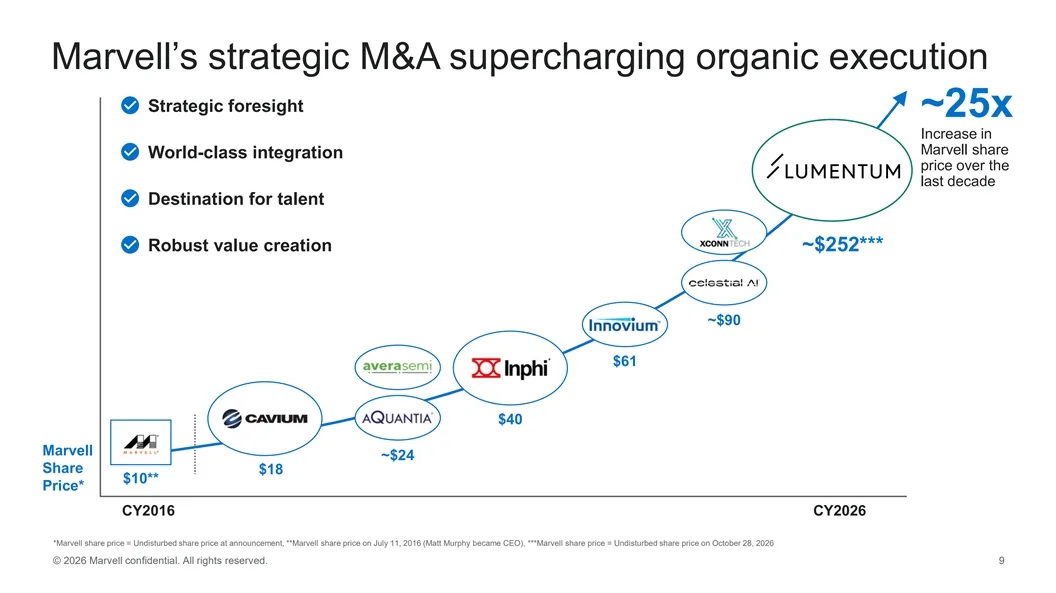
Page 9 plots Marvell’s share price at each acquisition since Murphy became CEO: $10 in July 2016, $18 at Cavium, about $24 at Aquantia, $40 at Inphi, $61 at Innovium, about $90 at Celestial AI and about $252 before the Lumentum leak, roughly 25 times in a decade. On the call, Murphy said the Inphi business is on track to grow more than tenfold from the time the deal was announced, and that the $1 billion-plus of synergies comes mainly from cost of goods, by pulling each company’s components into the other’s products.
Merger deck page 9 with Marvell share price at each acquisition
Hurlston said Lumentum also weighed staying independent and buying semiconductor companies of its own, but concluded that combining with a leader beat assembling several smaller players. The last point on page 9, $252, is the October 28 close of $251.65. Marvell now trades at $159.80, 36.6% below it, so the chart’s endpoint slipped within three days of the announcement.
The Bull and Bear Case for Lumentum Stock
The bull case rests on the gap and the fee. Lumentum trades $92.35 below the value of 4.5 Marvell shares, so a close at today’s Marvell price returns 14.7%. If Marvell walks away in the covered circumstances, it owes a $5.8 billion fee, about $62.7 per Lumentum share. On its own, Lumentum guided second-quarter revenue 24.7% to 28.7% above the first quarter.
The bear case is that Lumentum is now a Marvell proxy. Every $1 move in Marvell moves the deal value by $4.50, closing is expected in the first half of 2028, more than a year and a half away, and Marvell stockholders still have to vote. Two customers made up 48% of first-quarter revenue, and the NVIDIA preferred stock will also turn into Marvell stock.
From the 2023 Low to the NVIDIA Preferred Stock
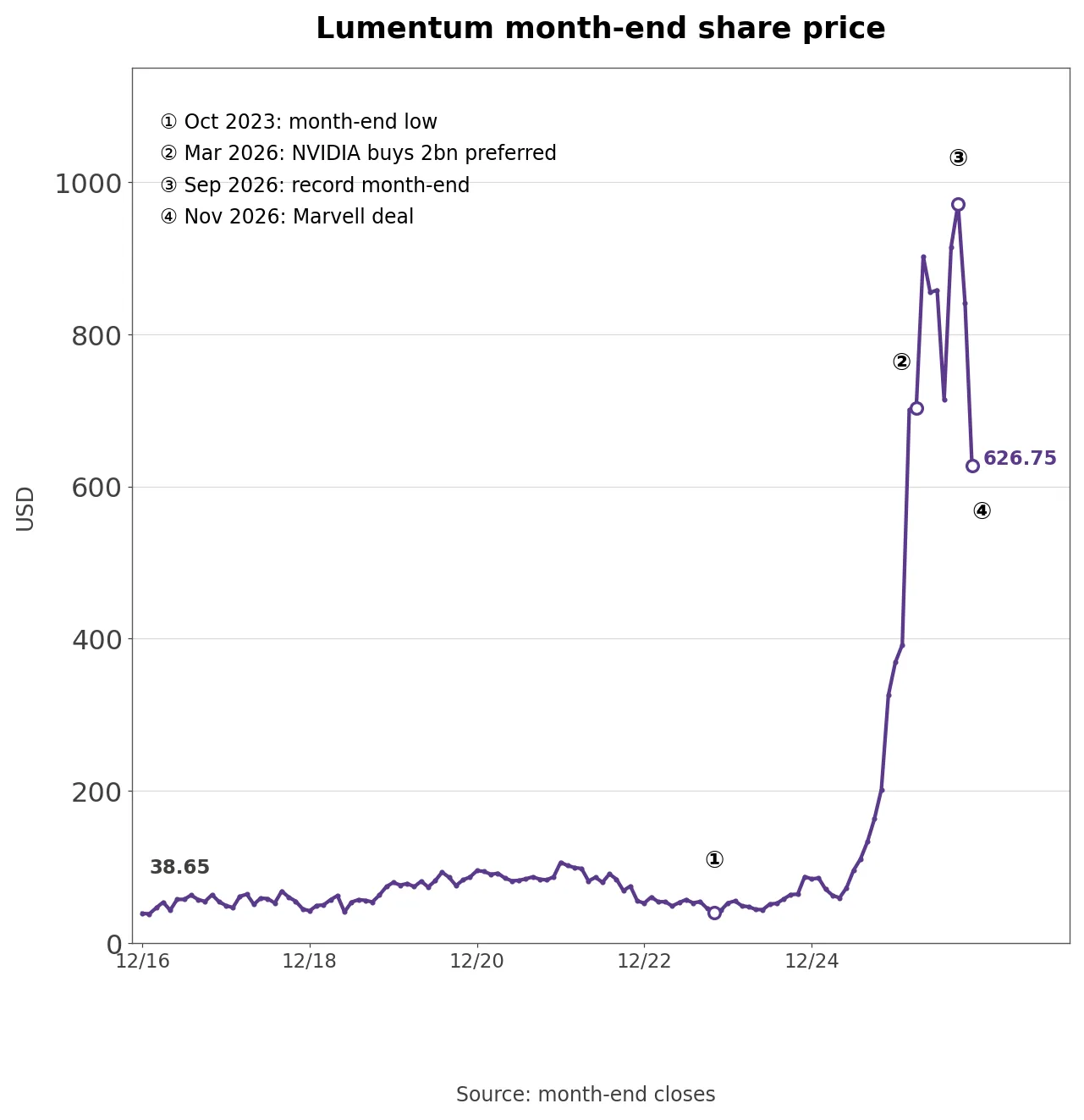
Lumentum’s month-end close went from $38.65 in December 2016 to $105.77 in December 2021 and back down to $39.21 in October 2023. From that low it rose 24.8 times to a record $971.26 in September 2026. The stock gained 339.1% in 2025 and is up 70.0% in 2026, while annual revenue grew from $1.645 billion in fiscal 2025 to $3.014 billion in fiscal 2026, up 83.2%.
Lumentum month-end share price over 120 months with four dates
On March 2, 2026, NVIDIA bought about 2.9 million shares of Lumentum Series A convertible preferred stock at $695.31 a share, $2.0 billion in total, convertible one for one into common stock. At $626.75 Lumentum sits 9.9% below NVIDIA’s price, but a close at a $159.80 Marvell price would leave NVIDIA 3.4% above it. In the fiscal fourth quarter of 2026, equitizing part of its convertible notes produced a one-time, non-cash loss on debt extinguishment of $7.8 billion and a GAAP net loss of $7.2 billion, or $84.65 a share. Long-term debt fell from $2.5626 billion to $40.5 million.
Why Does Lumentum Trade Below 4.5 Marvell Shares?
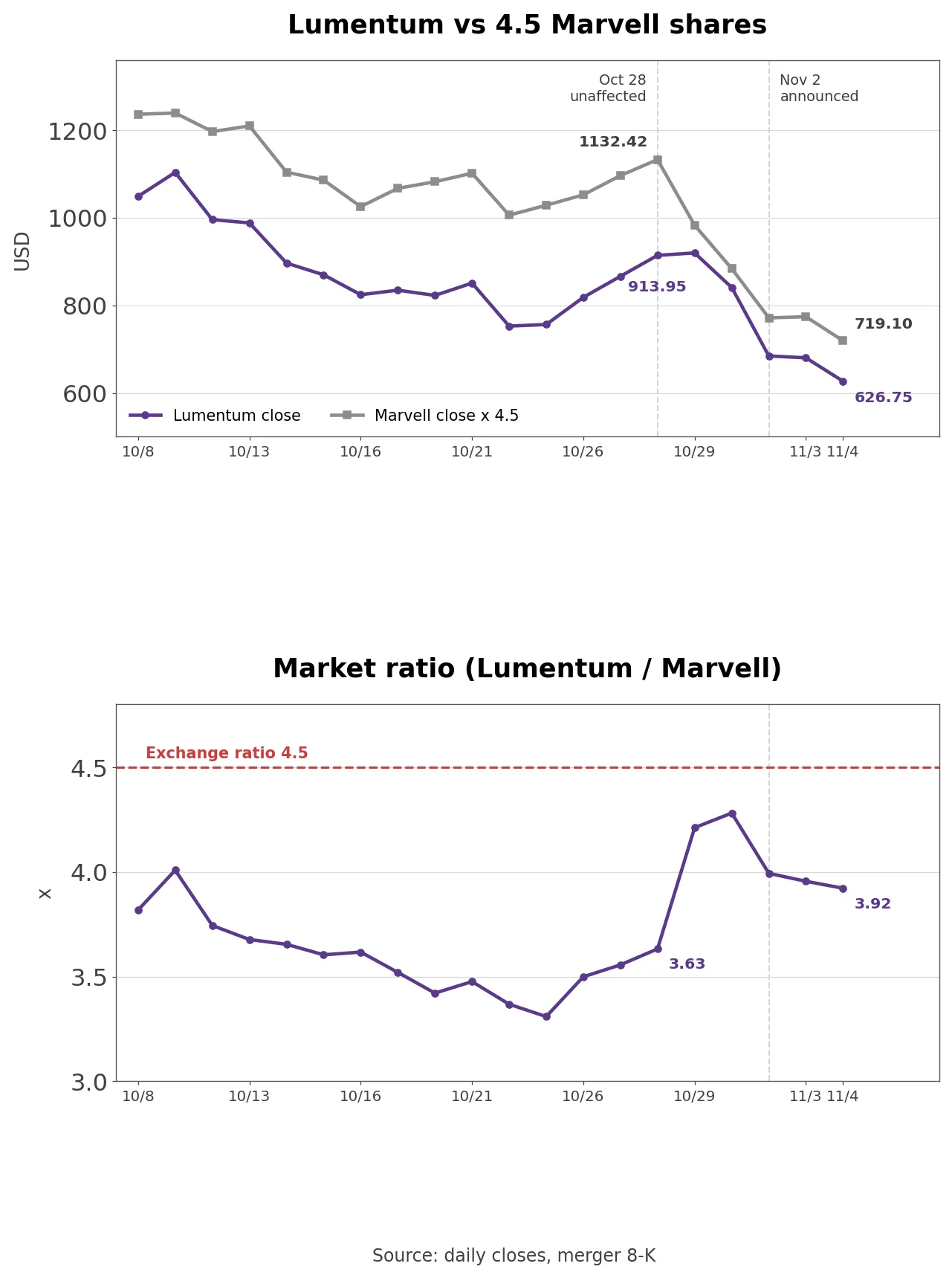
The merger agreement priced the deal off October 28, the last session before the leak. That day Lumentum closed at $913.95 and Marvell at $251.65, so 4.5 Marvell shares were worth $1,132.42, 23.9% above Lumentum. The press release describes “a premium of approximately 23.9% based on each company’s unaffected closing share price as of October 28, 2026.” Since then Lumentum has fallen 31.4% and Marvell 36.5%.
Lumentum close versus 4.5 Marvell shares over 20 sessions and the market exchange ratio
Own calculation (merger 8-K and daily closes): Lumentum at $626.75 is 12.8% below the $719.10 value of 4.5 Marvell shares at $159.80. The market ratio of Lumentum to Marvell moved from 3.63 the day before the leak to 4.21 and 4.28 on October 29 and 30, as Marvell fell 13.2% and then 10.0%, before widening again to 3.99, 3.96 and 3.92 after the announcement. Scaling the $115 billion announced enterprise value by the per-share value gives about $73.1 billion.
I checked the agreement first. It has no special pre-closing dividend, no cash component and no collar that adjusts the ratio to share prices, only an exception allowing Marvell to keep paying its regular quarterly dividend. With the terms ruled out, what remains is time and probability. The outside date is November 1, 2027, extendable to February 1, May 1 and August 1, 2028 if regulatory approvals are pending.
Own calculation (deck page 21 and daily closes): Taking the midpoint of the first half of 2028, April 1, leaves about 1.41 years. Holding Marvell’s price flat, a 14.7% gain over 1.41 years is 10.3% a year. If the market priced only time, that return would sit near the risk-free rate, so the excess is the price of deal risk and Marvell risk. Marvell’s $5.8 billion termination fee is about $62.7 per Lumentum share, or 10.0% of the share price, and Lumentum would owe $2.9 billion, about $31.4 a share, in matching cases. That fee covers board recommendation changes and superior proposals; if the deal misses the outside date or is blocked by antitrust or foreign investment rulings, Marvell instead owes a separate $3.2 billion regulatory termination fee, about $34.6 a share.
Revenue and Margin Above Guidance
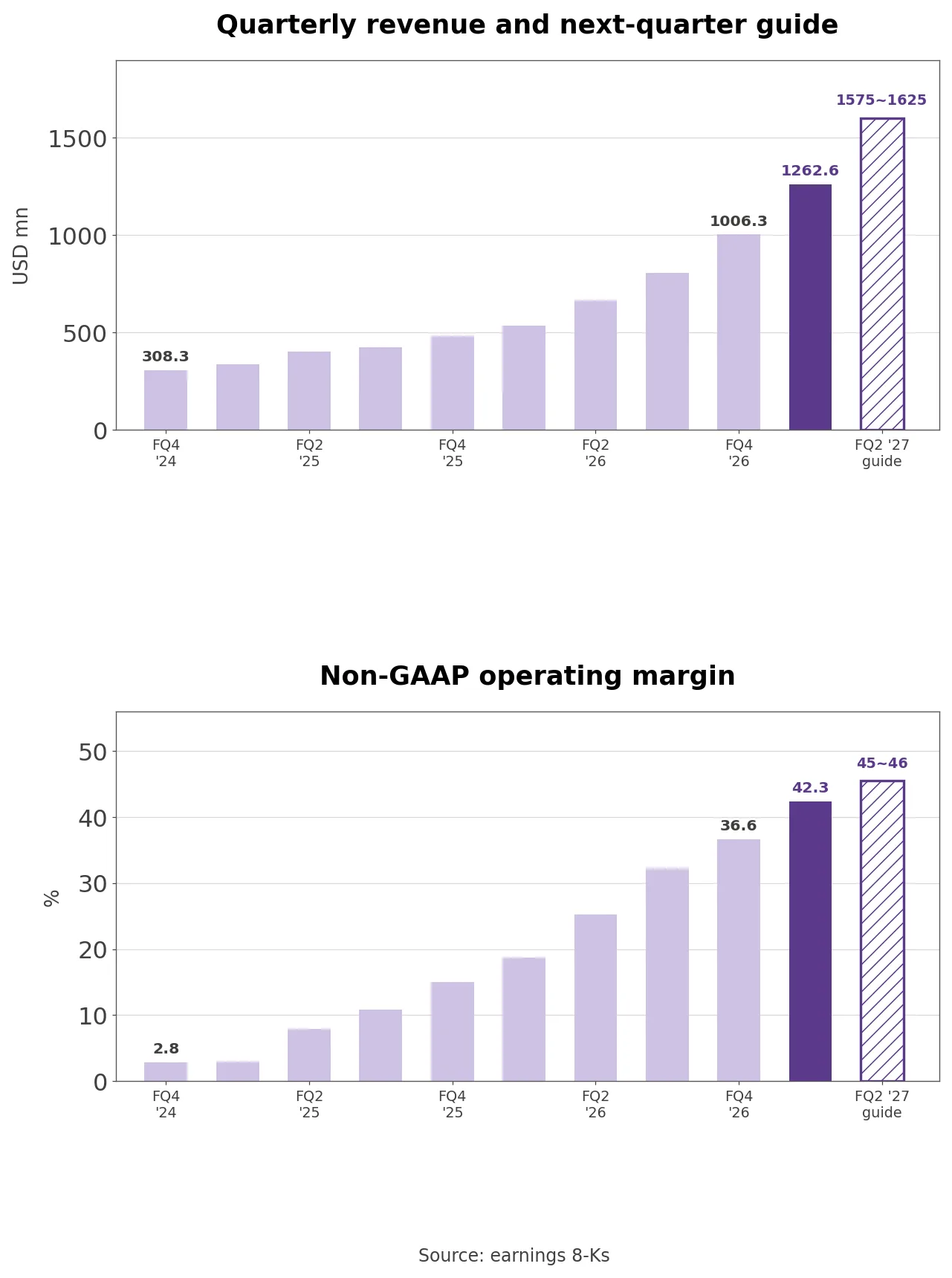
I pulled revenue, non-GAAP operating margin and next-quarter guidance from 20 quarters of earnings releases. Revenue bottomed at $308.3 million in fiscal Q4 2024 with an operating margin of 2.8%. First-quarter revenue of $1.2626 billion is 4.1 times that, with a 42.3% margin.
Lumentum quarterly revenue and non-GAAP operating margin over 10 quarters with the next-quarter guide
Revenue has beaten the midpoint of the prior quarter’s guide for 14 straight quarters, from fiscal Q4 2023 through fiscal Q1 2027, by 0.4% to 5.6%. The last miss was fiscal Q3 2023, at -13.8%. Operating margin also beat the top of each guide: 25.2% against 20% to 22% in fiscal Q2 2026, 32.2% against 30% to 31%, 36.6% against 35% to 36%, and 42.3% against 39.5% to 40.5% in fiscal Q1 2027.
Company disclosure (Q1 earnings release, November 2, 2026): Lumentum guided second-quarter revenue to $1.575 billion to $1.625 billion, non-GAAP operating margin to 45.0% to 46.0% and non-GAAP diluted EPS to $5.90 to $6.20. Hurlston said the roughly $350 million of sequential growth is more than the whole company’s quarterly revenue two years ago. First-quarter non-GAAP gross margin was 53.2%, up from 39.4% a year earlier, GAAP net income was $360.3 million ($3.54 a share) and non-GAAP net income was $461.1 million ($4.57 a share).
Own calculation (earnings release guidance): Four times the $6.05 EPS midpoint is $24.20, which puts the stock at 25.9 times and the $719.10 deal value at 29.7 times. The $1.6 billion revenue midpoint is 28.0% above the first-quarter guide’s $1.25 billion midpoint. Cash and short-term investments fell $758.8 million to $2.0 billion, with $306.9 million spent on withholding taxes for vested stock awards.
How Lumentum Makes Money From Lasers and Optical Switches
Lumentum reports two product types. Components are lasers, optical chips and subsystems sold to cloud data center operators, AI infrastructure providers and network equipment makers. Systems are finished products, including optical modules, optical circuit switches and industrial lasers. First-quarter components revenue was $754.2 million (59.7% of the total, up 98.9%), and systems revenue was $508.4 million (40.3%, up 228.8%). Systems rose 42.4% from the prior quarter against 16.1% for components, lifting its share from 29.0% a year earlier to 40.3%.
Hurlston said pump lasers and optical circuit switches led the quarter. Pump lasers power the optical amplifiers that boost long-haul signals between data centers, while optical circuit switches redirect light without converting it to electrical signals. The company says it has “secured our second major NPO/CPO win, backed by purchase commitments exceeding $5 billion.” That is 1.7 times fiscal 2026 revenue of $3.014 billion, and the release does not say when it turns into revenue.
Revenue is concentrated. Per the 10-Q, two end customers accounted for 37% and 11% of first-quarter revenue, compared with 22% and 21% a year earlier, and the company does not name them. By shipping location, the United States was 23.6% of revenue, Mexico 18.3%, Thailand 18.0%, Hong Kong 14.8% and China 12.8%, or $162.0 million, 3.3 times the $49.3 million of a year earlier. Shipments often go to contract manufacturers, so those shares do not show the end customer’s country.
Lumentum makes its own compound semiconductors, including indium phosphide, and high-power lasers. On the call, Hurlston said Lumentum supplies lasers to almost all of its competitors and buys from some of them, and that it will keep supplying module makers after the merger. The question came from a J.P. Morgan analyst who estimated Marvell’s share of optical module DSP chips at more than 70% and asked whether owning Lumentum’s modules would put Marvell in competition with its own customers.
Lumentum vs Marvell Coherent and Ciena
The peers are Marvell, the acquirer and the stock Lumentum holders will receive, Coherent, the most direct competitor in lasers and optical modules, and Ciena, which sells long-distance optical networking equipment and modules. Marvell and Ciena data run through the July quarter and Coherent through September. Market values are about $140.3 billion for Marvell, $38.6 billion for Ciena and $38.4 billion for Coherent, and the combined company would be worth about $206.8 billion at Marvell’s $159.80 price.
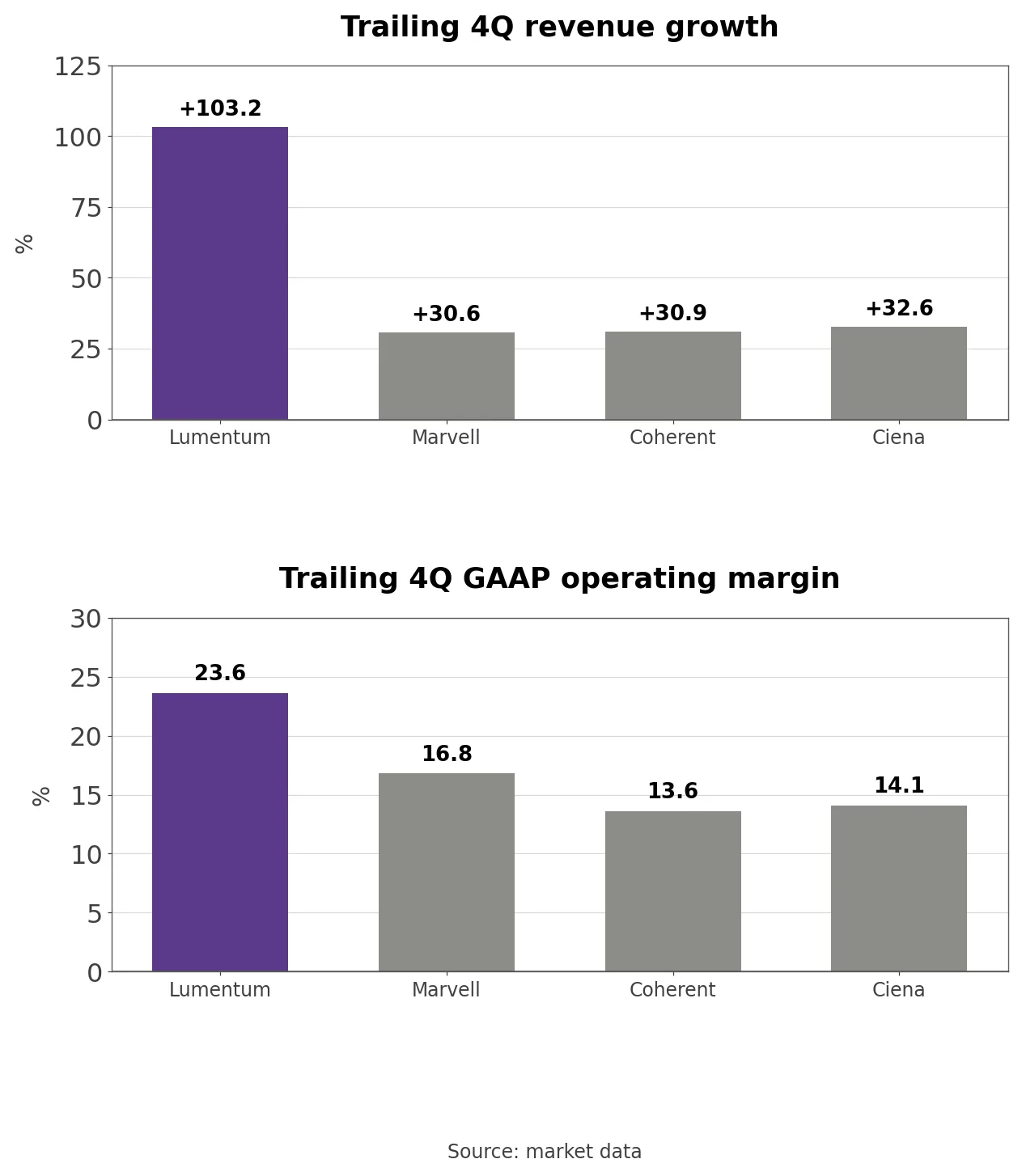
Trailing revenue growth and GAAP operating margin at Lumentum Marvell Coherent and Ciena
Trailing four-quarter revenue grew 103.2% at Lumentum against 30.6% at Marvell, 30.9% at Coherent and 32.6% at Ciena. In the latest quarter the order was Lumentum (+136.6%), Coherent (+49.9%), Ciena (+37.1%) and Marvell (+36.5%). GAAP operating margin is highest at Lumentum at 23.6%, against 16.8% at Marvell, 14.1% at Ciena and 13.6% at Coherent. Trailing free cash flow margin is 9.5% at Lumentum, 18.3% at Marvell, 13.5% at Ciena and -23.2% at Coherent.
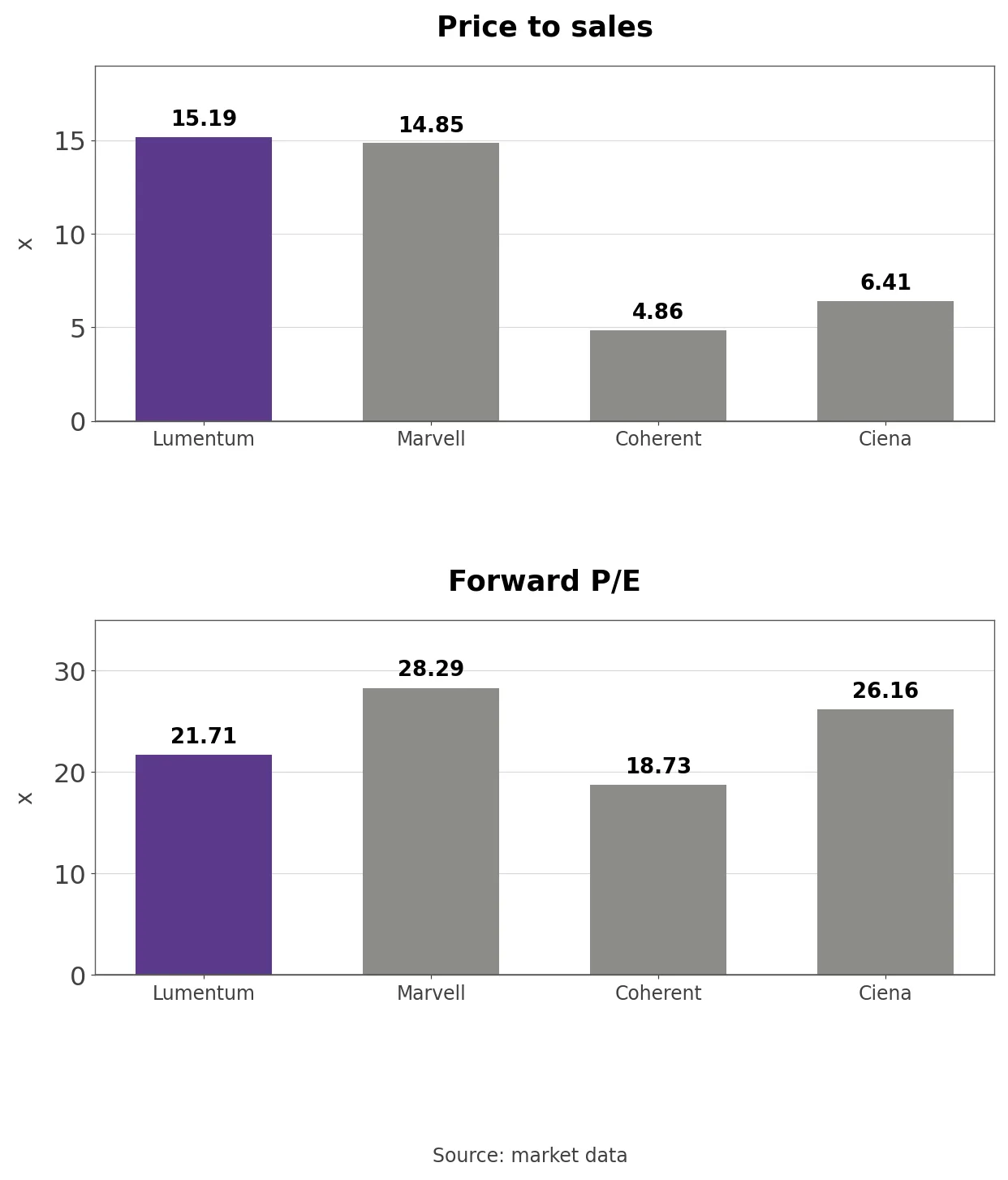
Price to sales and forward P/E at Lumentum Marvell Coherent and Ciena
Price to sales is almost the same for Lumentum (15.19) and Marvell (14.85), far above Coherent (4.86) and Ciena (6.41). On forward P/E, Lumentum at 21.71 is cheaper than Marvell at 28.29, so Lumentum holders are trading a lower forward multiple for a higher one. Dividing the share price by the forward P/E implies next-year EPS of about $28.87, above the $24.20 annualized guide. At the $719.10 deal value, Lumentum’s price to sales would be 17.77.
The Price-to-Sales and Price-to-Book Band
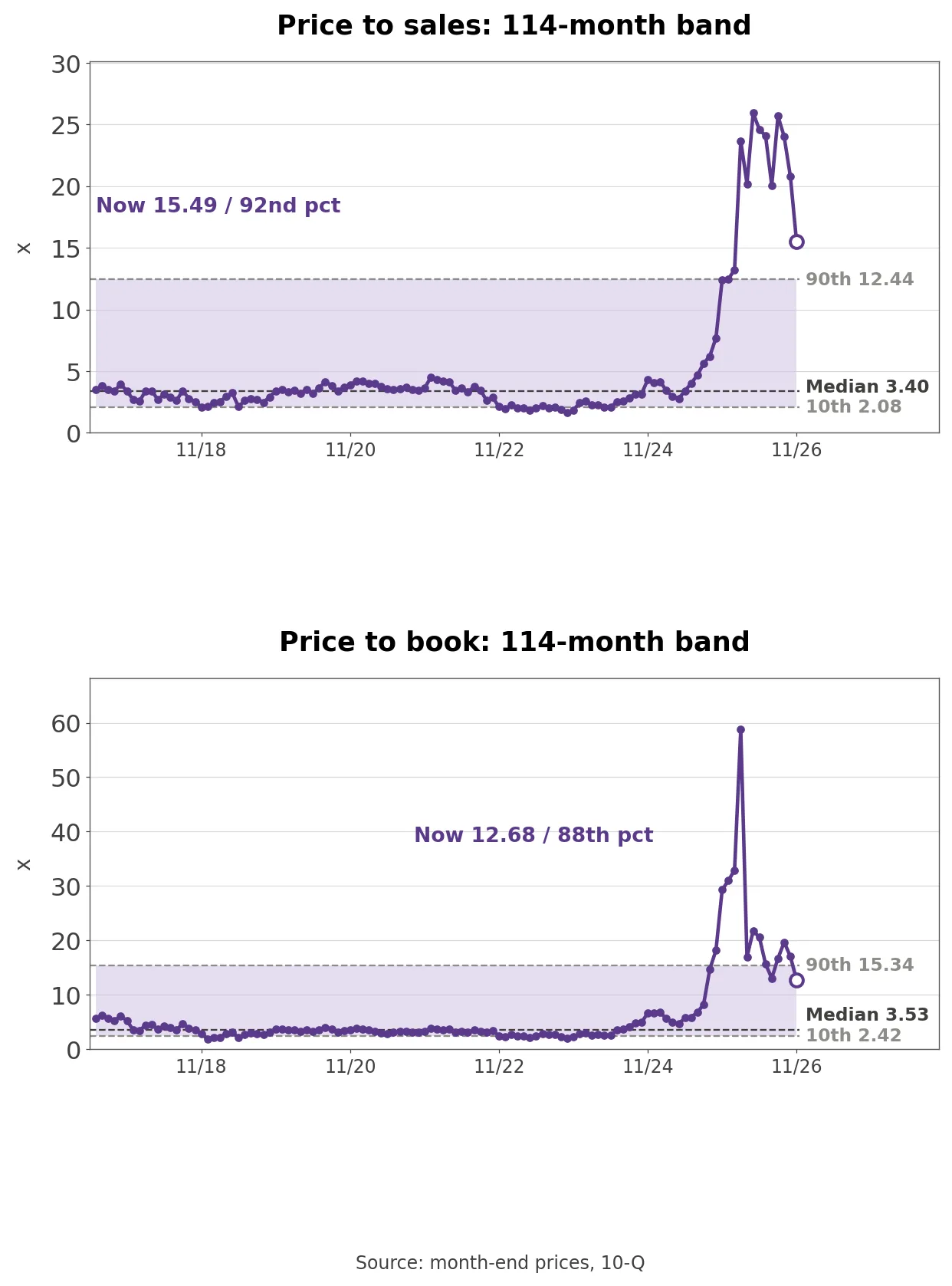
The $7.8 billion extinguishment loss leaves trailing GAAP EPS negative, so there is no P/E band. I divided month-end market value, using basic weighted shares that include the preferred stock, by trailing revenue and quarter-end equity for 114 months starting in June 2017.
Lumentum price to sales and price to book over 114 months
Price to sales of 15.49 is 4.6 times the 114-month median of 3.40 and above the 90th percentile of 12.44. The peak was 25.93 in April 2026 and the low 1.66 in October 2023. Market data shows 15.19 because it counts common shares only. Price to book of 12.68 needs care: equity jumped from $846.6 million in December 2025 to $2.9734 billion after the preferred issue and $4.6439 billion after the note equitization, producing spikes such as 58.86 in February 2026.
Three Conditions That Move the Stock
Marvell’s share price is the first. Each $1 in Marvell adds $4.50 to the deal value, and a 10% move shifts it by about $72. A return to the $251.65 pre-leak price would restore $1,132 and support Lumentum, while further Marvell declines would weigh on it.
The deal gap is the second. A narrowing of the 12.8% gap through stockholder votes and regulatory clearances would support the stock, and a wider gap regardless of Marvell’s price would mean the market sees more risk of the deal breaking and would weigh on it.
Second-quarter standalone results are the third. Revenue above the $1.625 billion top of guidance with a margin above 46% would raise Lumentum’s value if the deal failed, while a first miss in 14 quarters below $1.575 billion would weigh on it.
Approvals Left Before the Merger Closes
The two companies will file a joint Form S-4 and hold separate stockholder meetings. Closing also requires expiration of the Hart-Scott-Rodino waiting period, other regulatory approvals and an amendment to Marvell’s charter. The companies expect to close in the first half of 2028, with an outside date of November 1, 2027 that can run to August 1, 2028. NVIDIA’s preferred shares will convert into Marvell common stock or matching Marvell Series B preferred. The merger 8-K also discloses a tax reimbursement agreement with Hurlston to mitigate Section 280G excise taxes tied to the deal.
The open question is whether Marvell’s share price or Lumentum’s own results will do more to move what Lumentum holders receive over the year and a half before closing.