
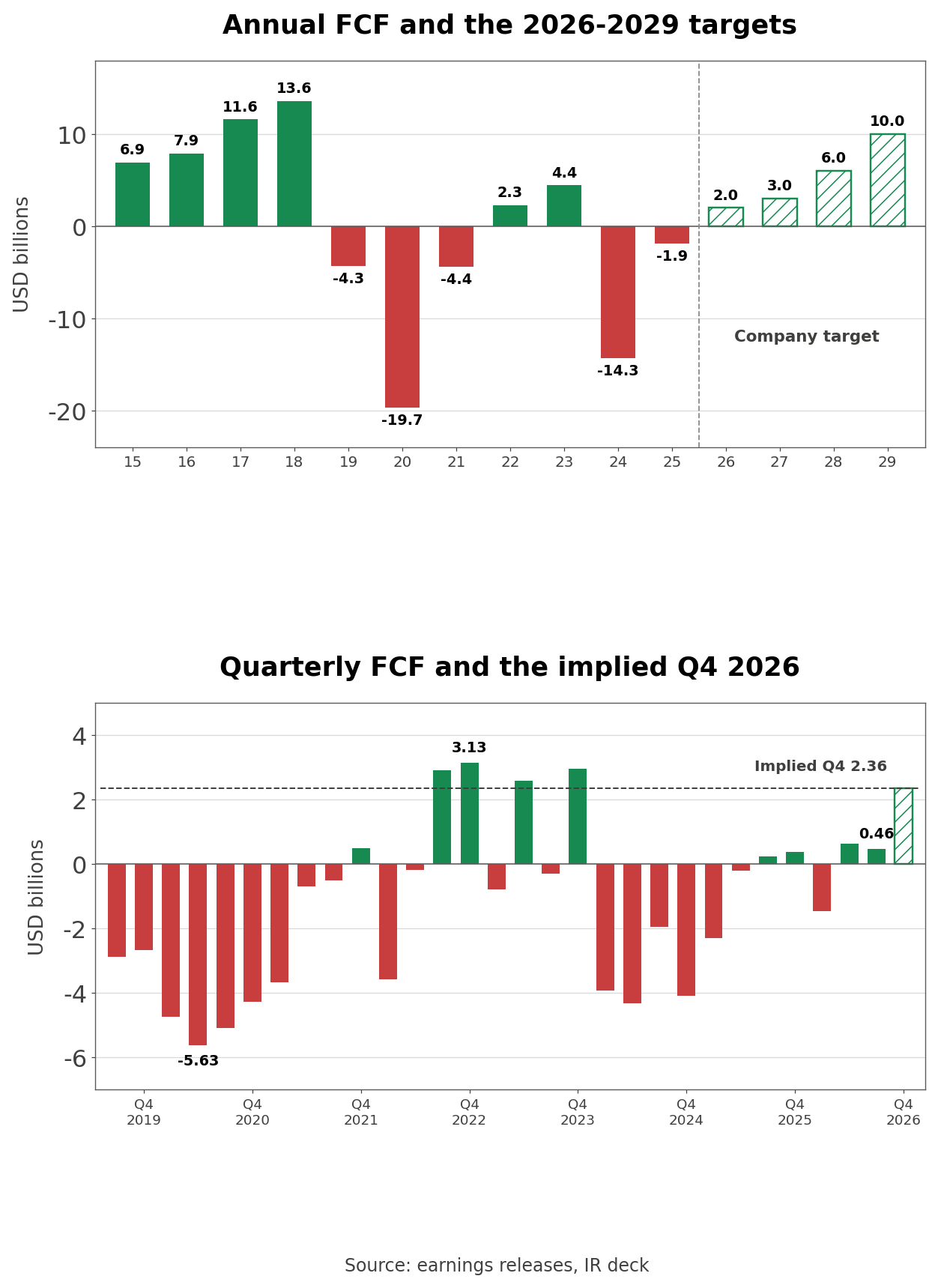
- Boeing (NYSE: BA) used its third-quarter results to put a number on every year between now and 2029: free cash flow of about $2 billion in 2026, $3 billion in 2027, $6 billion in 2028 and $10 billion in 2029. The first step is already tight. Free cash flow for the first nine months of 2026 was negative $359 million, so the 2026 target needs about $2.36 billion in the fourth quarter alone. Only four of the 29 quarters since mid-2019 produced more.
- Boeing builds commercial jetliners, military aircraft and satellites, and sells parts, maintenance and training services through three segments: Commercial Airplanes (BCA), Defense, Space & Security (BDS) and Global Services (BGS). At a $171.55 close the stock is worth about $135.9 billion on market data.
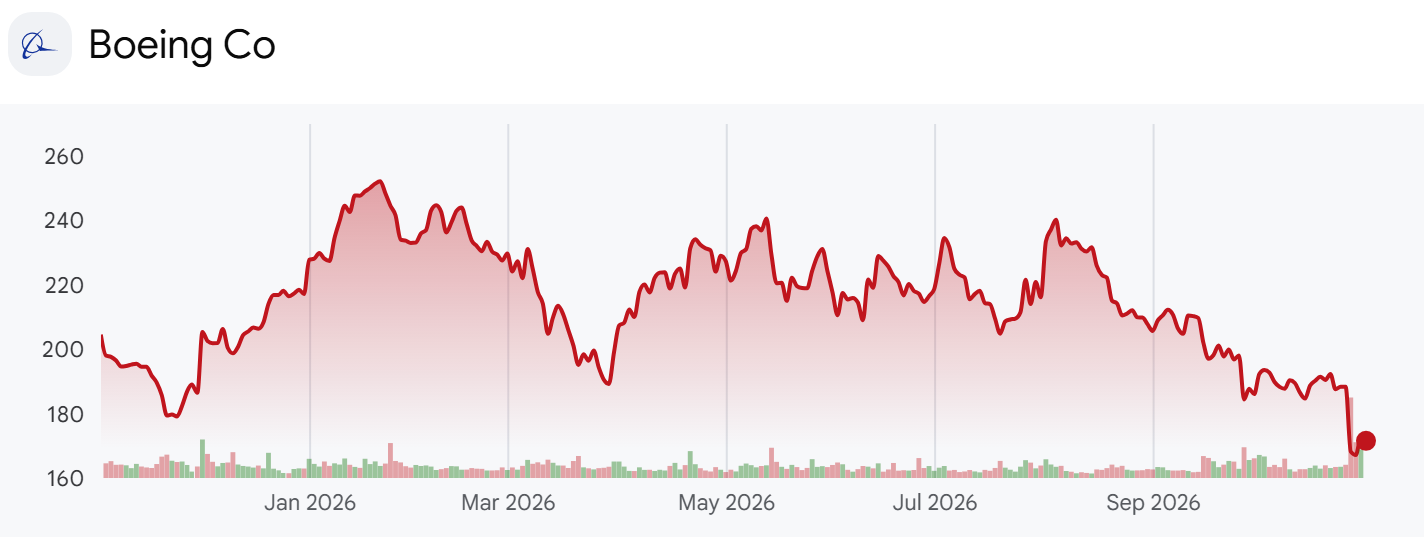
- The question here is what the $10 billion target actually rests on. The analysis lines up the Q3 2026 earnings release, the Q3 investor presentation and call transcript on the IR site, the Q3 2026 10-Q and the cash flow tables in 29 quarterly earnings releases since 2019.
- Two caveats apply. Free cash flow and core EPS are company-defined non-GAAP measures, and the 2027 to 2029 figures are management targets, not results. Share counts use the 792.4 million common shares on the 10-Q cover and leave out the mandatory convertible preferred stock that turns into common shares in October 2027.
Boeing's Q3 Deck and the 2026-2029 Cash Flow Targets
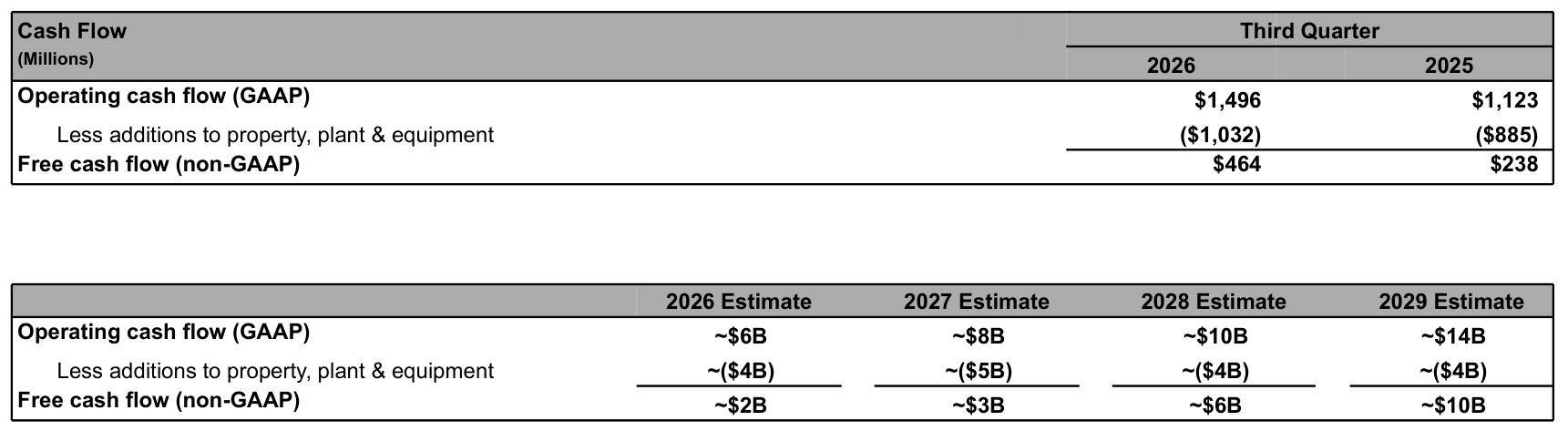
- The Q3 deck runs 12 pages. Page 3 leads with the U.S. Navy's F/A-XX selection, an Apache maintenance award and certification of the 737-7 and 737-10. Page 4 shows revenue of $24.2 billion, a GAAP operating margin of 1.5%, core EPS of negative $0.34 and free cash flow of $0.5 billion next to the year-earlier figures. The yearly targets sit in a reconciliation table on page 11: operating cash flow of roughly $6 billion, $8 billion, $10 billion and $14 billion, less capital spending of roughly $4 billion, $5 billion, $4 billion and $4 billion, for free cash flow of $2 billion, $3 billion, $6 billion and $10 billion from 2026 through 2029.
- Company disclosure (Q3 2026 earnings call, October 27, 2026): CEO Kelly Ortberg said Boeing now expects "to generate approximately $2 billion of free cash flow in 2026", narrowing the $1 billion to $3 billion range on page 11 of the Q2 deck. CFO Jay Malave added that "these targets assume that 777X will be certified by mid-year 2027". Capital spending peaks at about $5 billion in 2027, which Ortberg said includes added investment for F/A-XX development.
- Checked against the filings, the 2026 number already asks a lot. Quarterly free cash flow was negative $1.454 billion in Q1, $631 million in Q2 and $464 million in Q3, and the Q3 figure absorbed roughly $700 million of Department of Justice settlement payments. That leaves about $2.36 billion to find in the fourth quarter. How large is that by Boeing's own record?
- Own calculation (29 quarterly earnings releases): Only four quarters since Q3 2019 topped $2.36 billion of free cash flow: Q3 and Q4 2022 and Q2 and Q4 2023. Three of the seven fourth quarters in that span were negative, and the best was $3.131 billion in Q4 2022.
- Operating cash flow makes the point sharper. Subtracting nine-month operating cash flow of $2.681 billion from the roughly $6 billion target leaves $3.319 billion for Q4, and only two quarters in the series were bigger: Q4 2022 at $3.457 billion and Q4 2023 at $3.381 billion. Malave said the 2026 figure includes the KC-46A Tanker Lot 13 order and its advance payment, plus seasonal working capital inflows.
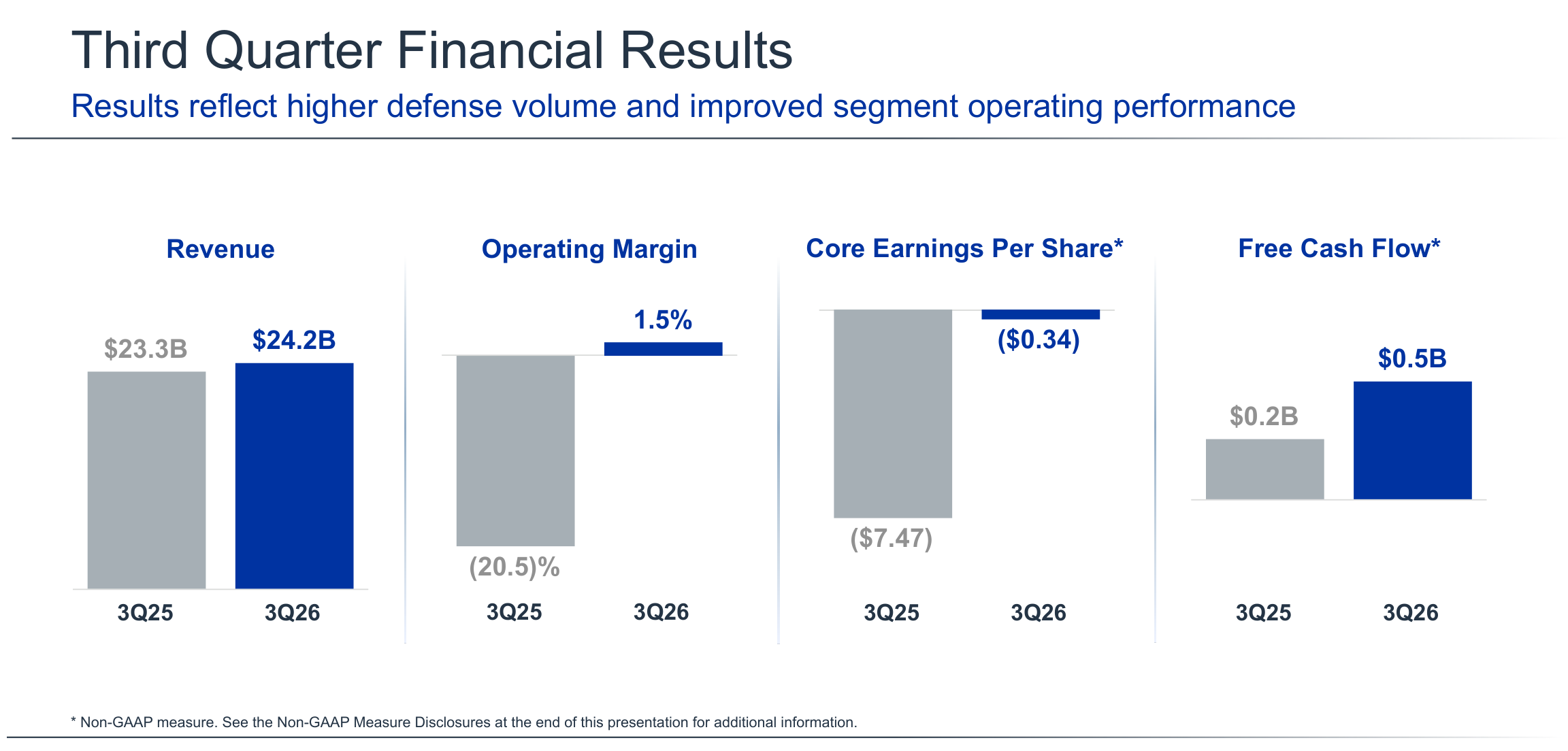
- The improvement on page 4 owes much to the comparison base. The year-earlier operating margin of negative 20.5% and core EPS of negative $7.47 included the 777X charge. Revenue grew +3.9% because defense (+15.0%) and services (+3.8%) offset a -3.4% decline in commercial airplanes.
Commercial Airplanes Defense and Cash in the Q3 Deck
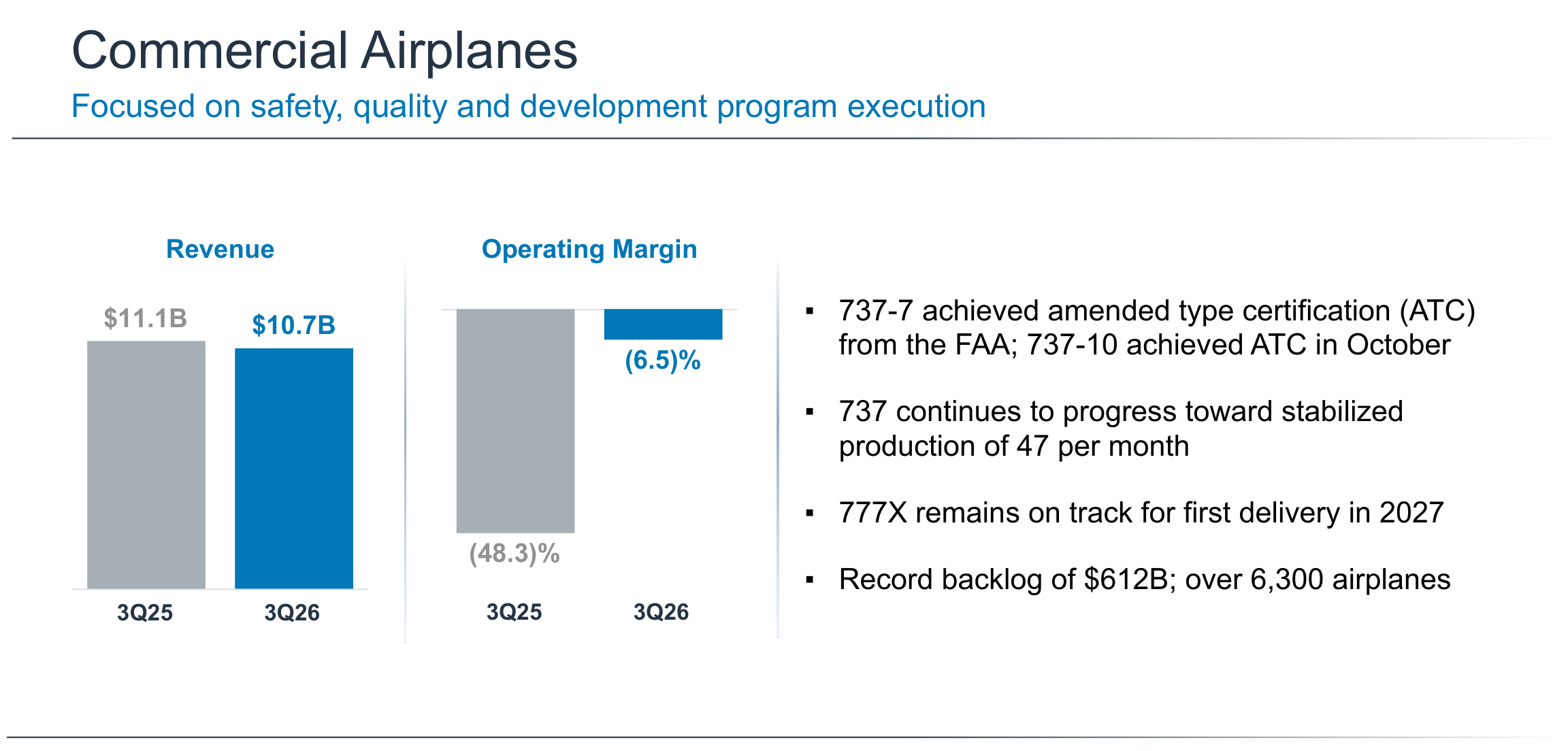
- Page 5 puts BCA revenue of $10.7 billion and an operating margin of negative 6.5% beside $11.1 billion and negative 48.3% a year earlier, and lists the 737-7 and 737-10 certifications, progress toward 47 737s a month, a 777X first delivery in 2027 and a record $612 billion backlog covering more than 6,300 airplanes.
- The quarterly trend is less flattering. BCA's operating loss widened to $697 million from $322 million in Q2, bringing the nine-month loss to $1.582 billion. Malave pointed to lower booking rates tied to production rate adjustments and higher supply chain cost estimates, and he put BCA on a path to about breakeven in early 2028. Since Q3 2019 the segment has posted an operating profit in one quarter out of 29, a $41 million gain in Q4 2023.
- Page 6 shows BDS revenue of $7.9 billion and a 6.2% margin, and the slide itself notes that the margin includes a $252 million gain on the sale of HRL Laboratories. It adds $23 billion of orders and a record $101 billion backlog. Page 7 shows Global Services at an 18.3% margin with $5 billion of orders and a $33 billion backlog. The nine-month BDS margin is 3.1%, or 2.0% without the HRL gain, so 6.2% is a single quarter.
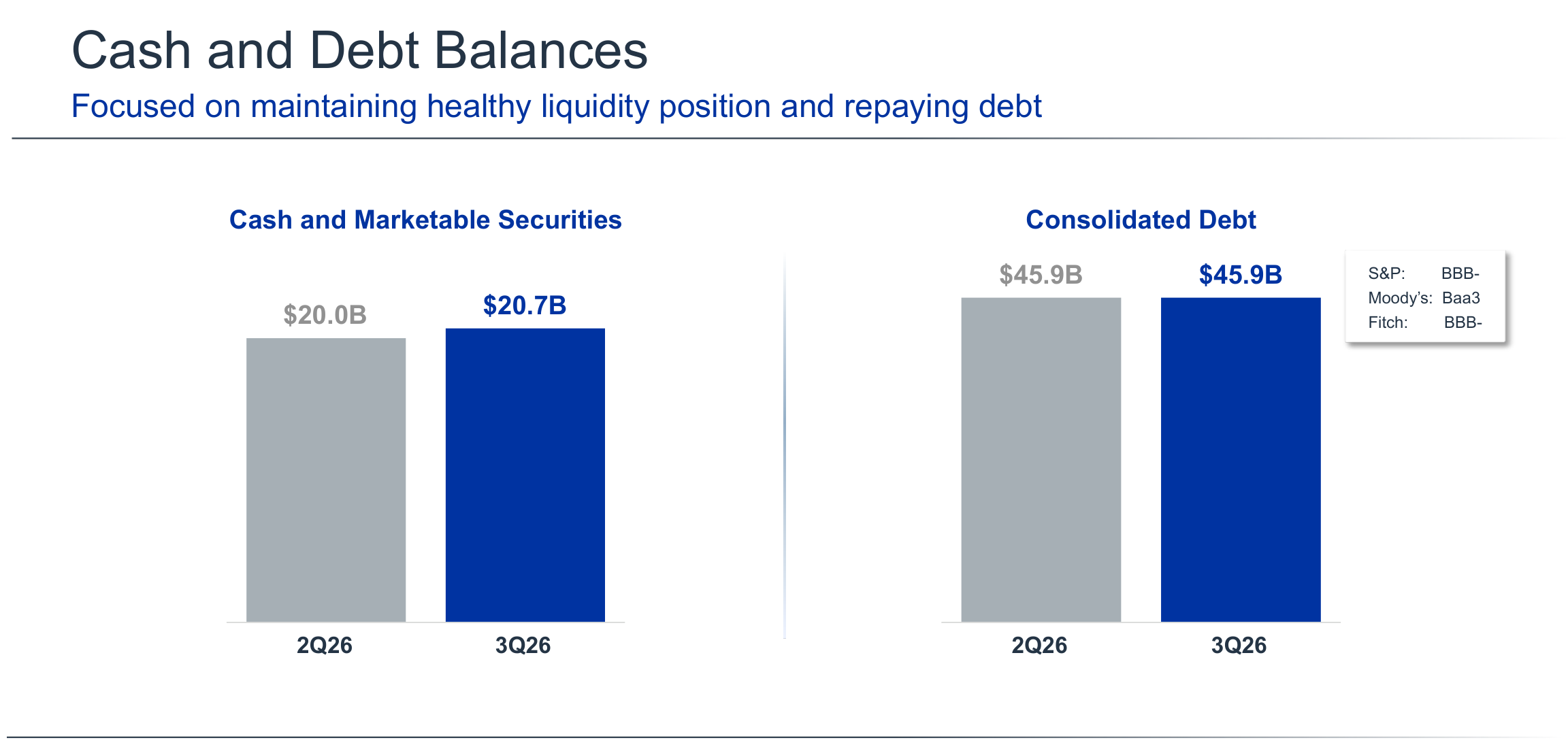
- Page 8 shows $20.7 billion of cash and marketable securities against $45.9 billion of debt, with ratings of BBB- at S&P, Baa3 at Moody's and BBB- at Fitch, the lowest investment-grade rung at all three. The $10 billion revolving credit facilities are undrawn. Debt has fallen $8.2 billion this year, but that came from $8.415 billion of repayments funded out of cash, which was $29.4 billion at the end of 2025. Cash and debt shrank together, leaving net debt of $25.2 billion.
- Own calculation (Q3 2026 10-Q): The four yearly targets add up to $21 billion, less than the $25.2 billion of net debt and 55.5% of the $37.9 billion of cumulative negative free cash flow from 2019 through 2025.
The Bull and Bear Case for Boeing Shares
- The bull case is backlog and pricing. Total backlog is a record $745.4 billion, 7.85 times trailing twelve-month (TTM) revenue, and Malave said the targets are "underwritten by the robustness in pricing" in that backlog. The 737-10 certification frees about 30 prebuilt 737-7 and 737-10 jets for delivery in 2027, and BDS won F/A-XX on top of a $100.5 billion backlog.
- The bear case is where the cash comes from. Nine-month operating cash flow came from customer advances, more than half of this year's inventory build sits in the not-yet-certified 777X, and management has already said 2027 brings lower commercial deposits and $1 billion more capital spending.
From the 737 MAX Grounding to a 2029 Target

- Boeing's free cash flow peaked at $13.6 billion in 2018. After the Lion Air crash in October 2018 and the Ethiopian Airlines crash in March 2019, the FAA suspended 737 MAX operations on March 13, 2019, and deliveries did not resume until the fourth quarter of 2020. COVID-19 hit in between, and 2020 free cash flow was negative $19.7 billion. The month-end share price peaked at $439.96 in February 2019; the $171.55 close is -61.0% below that.
- Free cash flow turned positive in 2022 and 2023 at $2.3 billion and $4.4 billion. Then a 737-9 door plug blew out in January 2024, the FAA stepped up its oversight of production, and a 53-day strike by more than 30,000 machinists in Washington state followed in September. Free cash flow for 2024 was negative $14.3 billion. In October 2024 Boeing raised $23.9 billion in net proceeds from common and mandatory convertible preferred stock, and the common share count on the 10-Q cover rose from 616.2 million in July 2024 to 792.4 million.
- Under Kelly Ortberg, elected CEO in July 2024, Boeing sold parts of its Digital Aviation Solutions business, including Jeppesen and ForeFlight, to Thoma Bravo for $10.55 billion in October 2025, booking a $9.57 billion gain, and in December 2025 it bought fuselage supplier Spirit AeroSystems for about $4.7 billion of Boeing stock. The 737 line climbed from below 38 jets a month in early 2025 to 42 by the fourth quarter. The 2021 deferred prosecution agreement with the Justice Department became a non-prosecution agreement in May 2025, and $689 million held in escrow was released for payment in Q3 2026. The stock is -21.0% from its $217.12 close at the end of 2025 and fell -8.9% in the week of the Q3 report.
How Much of Boeing's Cash Came From Customer Advances?
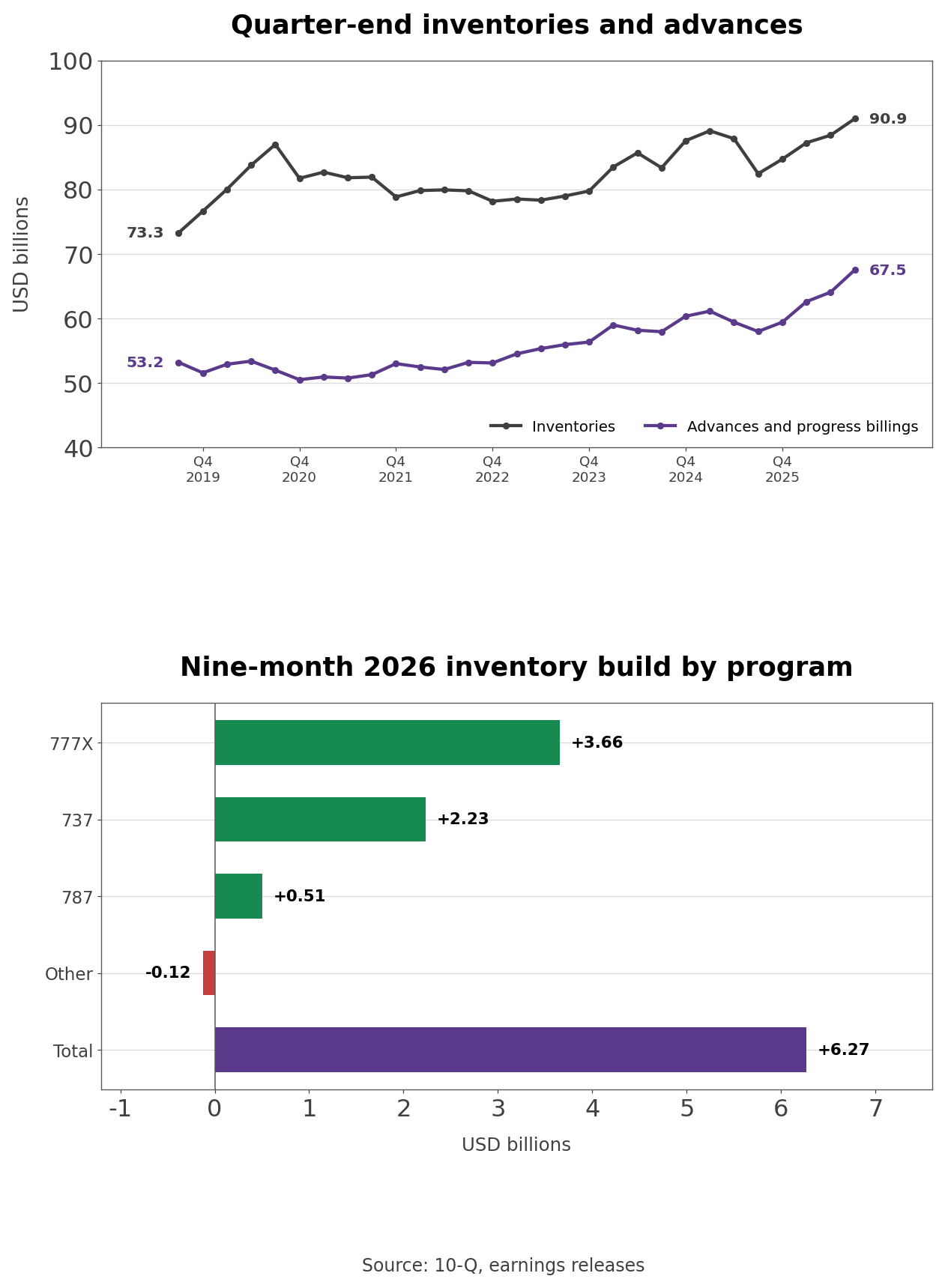
- Own calculation (Q3 2026 10-Q): Without the $8.113 billion increase in advances and progress billings, nine-month operating cash flow of $2.681 billion would have been negative $5.432 billion. Inventories absorbed $6.733 billion over the same period.
- Advances are the progress payments airlines and government customers make before delivery. The balance rose from $59.4 billion at the end of 2025 to $67.5 billion in September, equal to 71.1% of TTM revenue. The gap between inventories and advances has ranged from $20 billion to $35 billion since 2019 and stood at $23.4 billion in September, the narrowest since the start of 2024. Customers are financing the inventory build.
- Will those deposits keep coming at this pace? Backlog rose from $682.2 billion to $745.4 billion this year, $611.8 billion of it commercial. Malave said of BCA deposits that "It's trending to be a record year", and that 2027 will be lower, sizing it at "a few billion dollars of impact". The 2027 target is $1 billion above 2026, but stripping out the roughly $700 million DOJ payment that will not recur leaves growth of about $300 million.
- External view (Wolfe Research analyst Myles Walton, Q3 2026 earnings call): Walton noted that excluding the DOJ payment, the walk to 2027 adds only "a few hundred million dollars of growth" and asked how large the 2027 advance shortfall would be.
The 777X Inventory and the Certification Timeline
- The 10-Q breaks the $6.269 billion balance sheet inventory increase down by program: $3.656 billion for 777X, $2.233 billion for the 737 and $505 million for the 787. The 777X accounts for 58.3%. Its inventory rose from $6.129 billion to $9.785 billion, and deferred production costs inside it more than quadrupled from $651 million to $2.731 billion. The 777X inventory alone equals 38.8% of net debt.
- Deferred production costs build up when units cost more to make than the program's average, on the accounting assumption that later units will recover the difference. The 737 balance rose too, from $11.777 billion to $14.036 billion.
- No 777X has been delivered yet. Boeing builds about one a month and expects to hold that rate for most of 2027. The 10-Q says it expects approval for the final phases of flight testing by the end of 2026 and is still certifying a fix for an engine durability issue found in 2025. On program cash, Malave said "we continue to expect 2027 to be a significant use of cash", with 2028 improving before the program turns cash positive in 2029. The $10 billion target assumes that sequence does not slip a year.
- Company disclosure (Q3 2026 10-Q): The 777 and 777X programs had "near break-even gross margins" at the end of September, and Boeing lists supply chain shortages, delivery timing, customer considerations and certification requirements as risks that could lead to further losses.
How Boeing Makes Money
- Q3 revenue of $24.19 billion split into $10.72 billion from Commercial Airplanes, $7.94 billion from Defense, Space & Security and $5.57 billion from Global Services. Over nine months the mix was 44.6%, 32.4% and 23.0%. BCA books revenue when it delivers jets. It handed over 161 airplanes in Q3, one more than a year earlier, but fewer 777s (5 versus 9) and 787s (22 versus 24), the higher-priced widebodies, cut revenue.
- The customers are airlines and lessors worldwide; Turkish Airlines, Ethiopian Airlines and Lufthansa all ordered in the quarter. The 737 is built in Renton, Washington, and the 787 in Charleston, South Carolina, where the 787 has stabilized at eight a month and a second final assembly building will add a third line, with most of the new capacity due online late next year. Spirit AeroSystems, now part of Boeing, builds 737 fuselages in Wichita, Kansas, and Ortberg named fuselages as the next focus once the wing problems are fixed.
- The widebody lineup is in transition. The commercial 767 ends production by 2027 and continues only as the KC-46A tanker airframe, and FAA approval to build the current 777 Freighter beyond 2027 let Boeing add 21 units to its accounting quantity. A wing component supplier disrupted the 777 Freighter and 767 tanker lines in Q3, and the resulting abnormal production costs will be expensed as incurred through the first half of 2027.
- Profit comes from services. Global Services sells parts, maintenance, modifications and training to airlines and governments, and earned $1.019 billion at an 18.3% margin in Q3, 2.88 times Boeing's total operating income of $354 million. Over nine months it earned $2.958 billion, 3.09 times the company total. Excluding the Digital Aviation Solutions business sold in 2025, BGS revenue grew +11%, and both the commercial and government sides earned double-digit margins.
- Defense builds F-15 and F/A-18 fighters, Apache and Chinook helicopters, the KC-46A tanker, satellites and missile seekers for the Pentagon and allied governments, and recognizes most revenue as costs are incurred. It delivered 30 aircraft and three satellites in Q3, including 12 remanufactured Apaches and seven KC-46s, and Spirit added about $160 million of revenue. Fixed-price development contracts such as KC-46A and MQ-25 have produced repeated charges, and management targets high single-digit margins by the end of the decade.
- Commercial output is set by the production rate. The 737 delivered 367 jets in nine months, so the 500-jet goal would need 133 in Q4; the best quarter in the series was 129 in Q2 2026, and Boeing now says it will fall short. The 787 delivered 62, so even the low end of the 90 to 100 range needs 28 in Q4, against a best of 27 since 2022. The plan targets 52 737s a month in the second half of 2027, and Ortberg said "right now wings are what have caused us the instability".
How Boeing Compares With Airbus GE RTX and Lockheed Martin
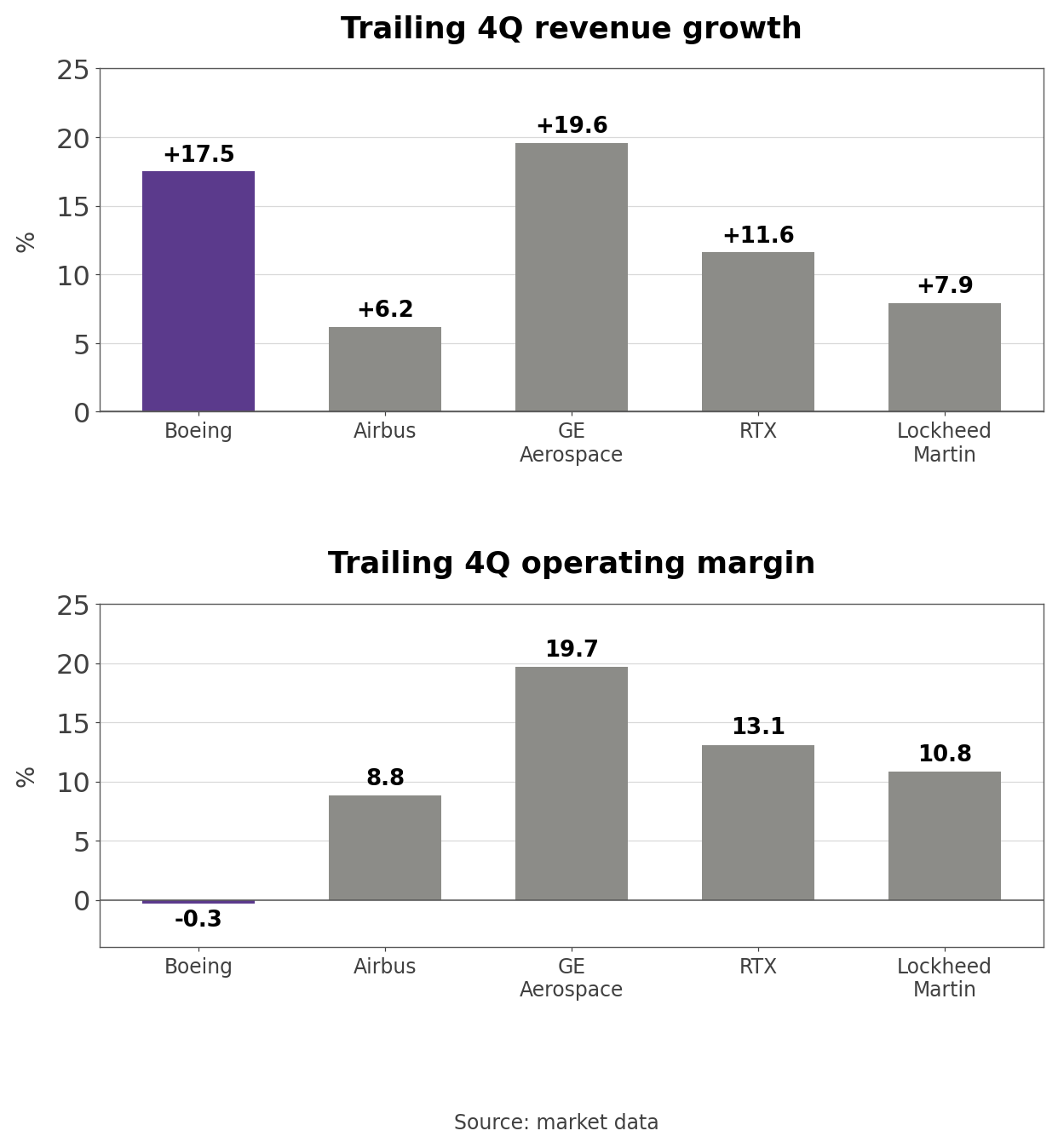
- On market data, Boeing's TTM revenue growth of +17.5% trails only engine maker GE Aerospace (+19.6%), but its operating margin of -0.3% is the only negative one of the five. Airbus posted +6.2% growth and an 8.8% margin, RTX +11.6% and 13.1%, and Lockheed Martin +7.9% and 10.8%. Boeing's comparison period includes the strike-hit fourth quarter of 2024.
- The five are rivals, suppliers and customers at once. The 737 MAX flies on CFM's LEAP-1B, an engine from GE Aerospace's joint venture with Safran, so higher Boeing output lifts GE's engine sales, and RTX's Collins Aerospace supplies Boeing with components. Boeing's $135.9 billion market value is below Airbus at $169.5 billion; over a year market value changed -16.3% at Boeing, -11.6% at Airbus, -5.9% at GE Aerospace, +14.0% at RTX and +31.0% at Lockheed Martin.
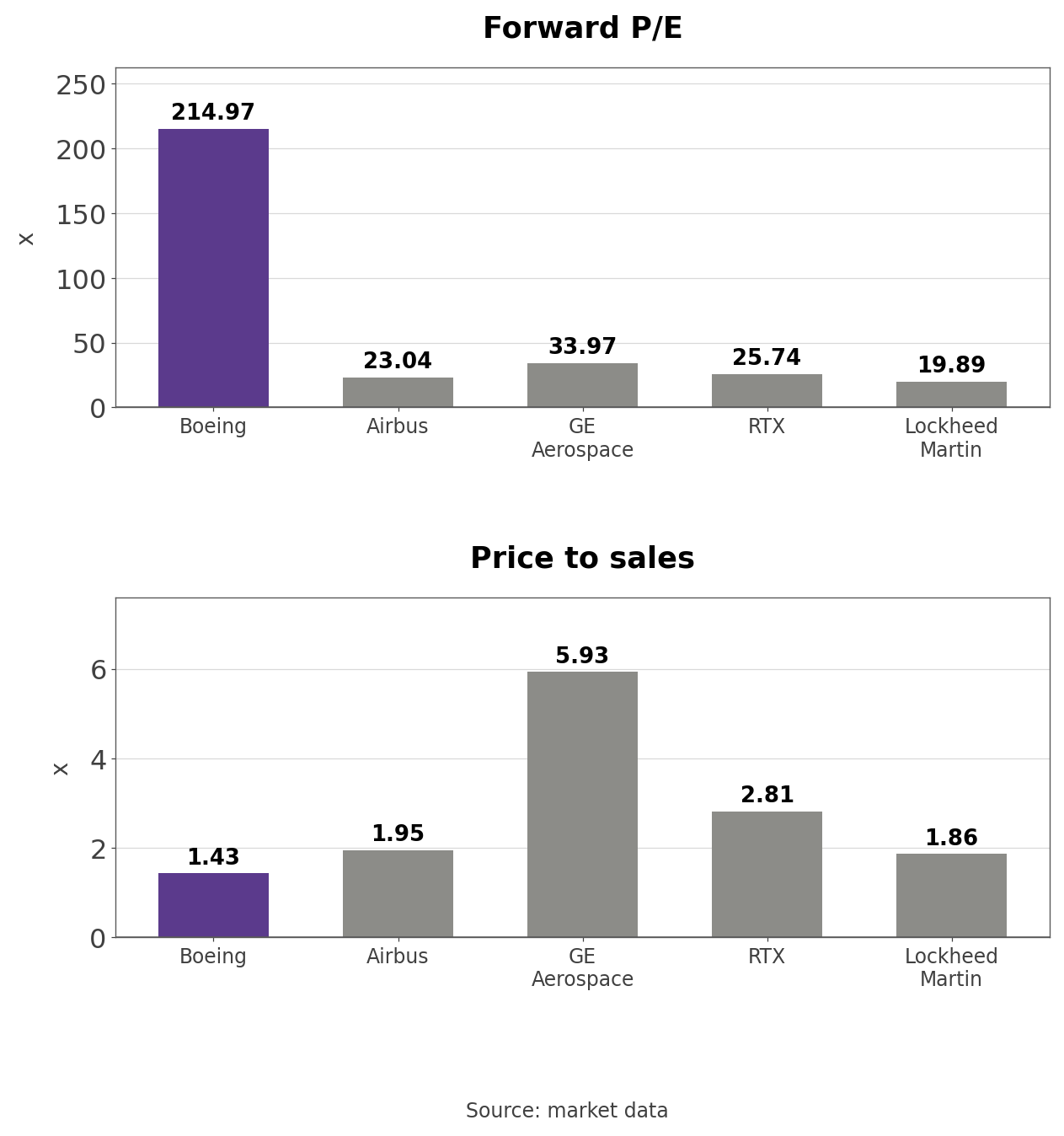
- Boeing's forward P/E of 214.97 is not comparable with the others at 19.89 to 33.97, because next year's earnings estimate is close to zero. Its price-to-sales ratio of 1.43 is the lowest of the five, below Airbus at 1.95 and Lockheed Martin at 1.86, and the gap reflects margins. At Airbus's 8.8% margin, Boeing's TTM revenue of $94.9 billion would produce about $8.35 billion of operating income; the $10 billion cash target needs profit of roughly that order.
Boeing's Price-to-Sales and EV-to-Sales Band
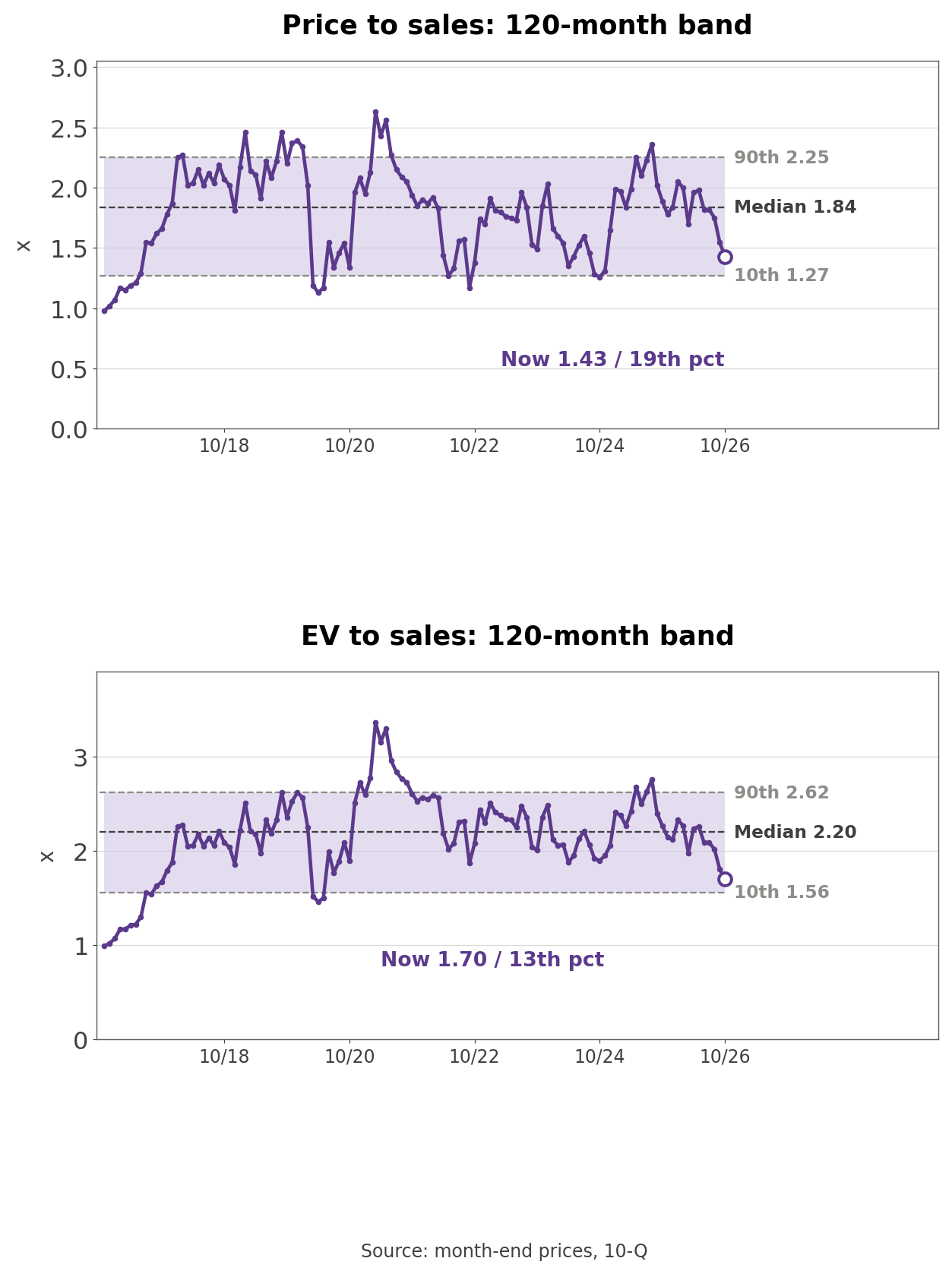
- Earnings and book value cannot anchor a band here. Shareholders' equity was negative in 25 of the 29 quarters since Q3 2019 and turned positive only after the 2025 divestiture gain, which also inflates TTM GAAP earnings. Two sales multiples stand in.
- Price to sales is 1.43, in the bottom 19.2% of the 120 months since November 2016 against a median of 1.84. Enterprise value to sales, which adds net debt, is 1.70, in the bottom 13.3% against a median of 2.20. Before the 737 MAX grounding the medians were 1.84 and 1.87.
- The low sales multiples already price in margins that have not come back. Market value is 13.6 times the 2029 cash target and 45.3 times the 2027 target. On October 15, 2027 the 5.75 million mandatory convertible preferred shares become 33.5 million to 40.2 million common shares, equal to 4.2% to 5.1% of the current count.
Three Conditions That Move the Stock
- 777X certification timing is the premise of the 2029 target. If the final flight test approval arrives by the end of 2026 as the 10-Q expects, and certification and a first delivery date hold for mid-2027, the largest swing factor in the cash path narrows. A slip into 2028 would add to the $9.785 billion of 777X inventory and push the program's cash turn back a year.
- Quarterly 737 deliveries show whether the production rate is real. Q4 deliveries near 133 would confirm stability at 47 a month and support the plan for 52 in late 2027. Deliveries below Q3's 124 would mean the wing problems persist.
- Advances and Q4 free cash flow show the quality of the cash. If inventory growth stalls and Q4 delivers about $2.36 billion to meet the 2026 target, the multi-year plan gains credibility. A large miss, or a target met only with the KC-46A advance, would leave the $3 billion 2027 target exposed to the drop in deposits.
What to Watch in the December Quarter
- The fourth-quarter report, likely in late January, should give 737 and 787 deliveries, Q4 free cash flow and the advances balance, along with whether the 777X has cleared its final flight test phase. From the first quarter, deliveries of the roughly 30 prebuilt 737-7 and 737-10 jets should start to pull inventory down.
- One question stays open. 737 deferred production costs rose $2.259 billion in nine months to $14.036 billion, and the 10-Q expects the full $14.760 billion including tooling to be recovered from units with firm orders. As the line moves toward 52 a month, will that balance start to shrink, or will start-up costs on a new line push it higher?
Related Analysis
- Oracle (ORCL) Stock Analysis: Cash Flow and Capex Gap: another company where customer prepayments carried operating cash flow, useful for judging how durable Boeing's advance-funded cash is.
- Texas Instruments (TXN) Stock Analysis: Cash Flow and Capex: a multi-year free cash flow path that depends on capital spending coming down, a parallel to Boeing's 2027 capex peak.
#Boeing #BAStock #AerospaceStocks #DefenseStocks #FreeCashFlow #737MAX #USStocks #StockAnalysis #EquityResearch #GlobalStockBrief
'US Stock Analysis' 카테고리의 다른 글
| Reddit (RDDT) Stock: Users Shrink as US ARPU Jumps 53% (0) | 2026.11.05 |
|---|---|
| GE Vernova (GEV) Stock: Deposits Drive the $16B Cash Guide (0) | 2026.11.05 |
| MakeMyTrip (MMYT) Stock: Discounts Ate the Booking Growth (0) | 2026.11.04 |
| Chevron (CVX) Stock: Refining Carried Q3 as Brent Fell (0) | 2026.11.03 |
| AstraZeneca (AZN) Stock: Oncology Fills the Farxiga Gap (0) | 2026.11.03 |


